Duffman Down

kc1

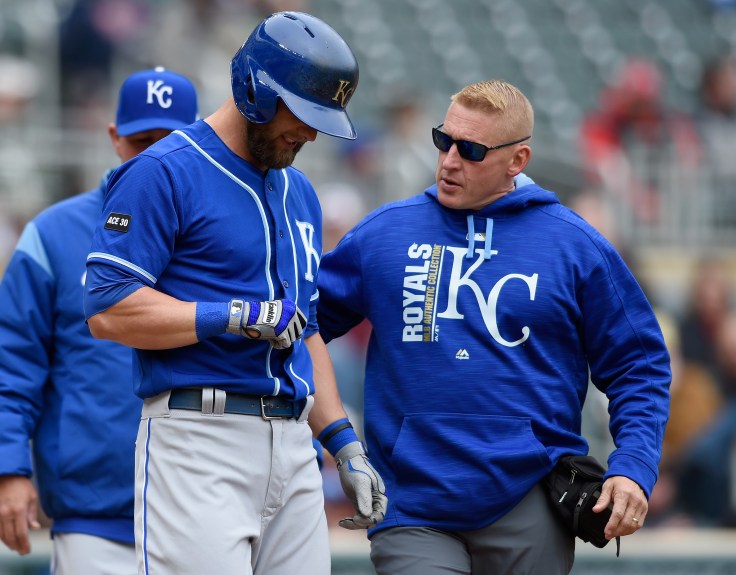
Back in 2015, lady luck was on the Kansas City Royals side. The bounces went the Royals way and in some ways led them all the way to a world championship. So far in 2017, it appears lady luck is “ghosting” Kansas City in a very passive-aggressive manner. The offensive scuffled in April, the relief core, while improving, isn’t a lock anymore and injuries have been a bit more normal. In that vein, the Royals were dealt their biggest blow so far in this short season, as Danny Duffy will miss the next 6-8 weeks with a Grade 1 Oblique Strain suffered in Sunday’s loss to Cleveland:

After getting past the depressing part of this injury (no team wants to lose their top starter for an extended period of time), it is easy to ask the most important question at the moment: where do we go from here?

kc2

First, let’s digest just what the Royals are missing with Duffy out. Duffy has posted a 3.54 ERA over 68 innings (2nd best in Kansas City’s rotation), an FIP of 3.43 and a fWAR of 1.4 (which is already halfway to his 2016 total). Duffy has seen his K rate go down while his walk rate has increased, but that is also factoring in that he was a reliever for the first 5-6 weeks of last year. Also, he had seen his strike outs increase over the last couple of starts. He has also induced less hard contact this year (down to 28.3% from 36.6%) while his WPA is already at 1, almost halfway to last year’s 2.34. To go even further, if you average out his game scores (taking out his three worst starts, including Sunday’s), he has an average game score of 65 over 8 starts. To put it another way, Duffy is the ace of this staff and was showing his 2016 wasn’t a fluke. It’s pretty obvious that moving forward, it will be difficult to replace his production.

kc3

Speaking of, who will get the honor of taking Duffy’s spot in the rotation? There are at least a few options available to the Royals, starting with Jake Junis. Junis is a control pitcher who cleaned up his delivery and improved his arm speed last year and made him self a more deceptive pitcher. Nothing pops out about Junis, as he has an average fastball and curve with a slightly below change and slider, but with the improved control it made all of those pitches a bit sharper. Junis made his first major league start on May 21st (after two relief appearances) and went 4 2/3 innings, giving up 5 hits and 2 runs while striking out 4 and walking 3. The most impressive part of this start against Minnesota was his ability to locate and to move the ball around the plate. To me, Junis should be the Royals first option, but there are a few more for Kansas City to consider if Jake isn’t a good fit. Eric Skoglund will make his major league debut on Tuesday and has an opportunity right now to step up and make an impression. Skoglund is the 4th best prospect in the Royals farm system according to Baseball America and the 6’7″ lefty is similar to Junis: above-average fastball, average curveball, below average slider and change-up but has impeccable control and location. Earlier in the spring I felt like Skoglund could be a nice addition to to the bullpen at some point this year, especially as a lefty specialist. Now he has an opportunity to lock-down a spot in the rotation.

kc4

Unfortunately, when it comes to the bullpen, there really aren’t any relievers that could slide into the starting role and be productive. Chris Young has been given a chance to start this year and failed badly: two starts, only 6 2/3 innings thrown while giving up 9 runs (3 home runs). Travis Wood is a former starter who was thought of as an option to start if an injury happened to someone in the rotation, but with his performance this year I highly doubt the Royals would give him a chance to start at this point. An interesting, out of the box idea would be to slot Matt Strahm as a starter. Strahm was a starter coming up through the Royals minor league system and the team envisions him as a future starter. The one issue with that would be that Kansas City would have to stretch out his arm, which would probably involve a trip to Omaha to spend a few weeks before slotting him in as a starter. Although…if you remember last year, Duffy was moved from the pen to the rotation and the length of his appearances were determined by his pitch count. Conceivably, the Royals could do the same thing with Strahm. I highly doubt this happens, but it is an interesting thought.

kc5

There is one final question being bandied about when it comes to the Duffy injury: Is this the final nail in the Royals contending coffin? You won’t hear me shouting ‘this is the end’, but it’s not looking good, folks. Losing Duffy is a big blow and just having his presence on the mound and in the dugout is a confidence builder to this team. Not having him around hurts and there is no actual ‘replacement’ for him. At this point, it is all about how the Royals perform with Duffy gone. If the team can get some production out of guys who haven’t done much at this point in the season (Read: Gordon, Alex or Escobar, Alcides), that will help. If a guy like Skoglund can step in and perform admirably, then that will help. If none of this happens, we will be discussing trade options in a month’s time. It all comes down to performance and the direction this team takes moving forward is performance-based.

kc6

Losing an elite pitcher the caliber of Duffy is something no team wants to ever deal with, but here we are. All the Royals can do is hope the rest of the rotation (and offense) step up and pull some of the weight Duffy has been carrying. This was supposed to be the last year for this group of players who brought gold back to Kansas City. The band was tuning up for one more tour and Danny Duffy was supposed to be a big part of that. As a fan, I hate that a player who I have grown to adore won’t be able to go out on the mound every fifth day and make hitters look silly. The earliest Duffy will return is after the All-Star break; let’s hope we are talking about how the injury to Duffy woke up the Royals as they made a run to the top of the American League Central. Hopefully…hopefully when he returns he can recognize the players he calls teammates. Kansas City, it’s time to step up. It’s time for someone to get ‘Gnar’.

Rebuilding a Franchise

kc1

Hi, my name is Sean and I am addicted to ‘Out of the Park Baseball’. What is that, you might be asking? Here is the tagline they use on their website:
Out of the Park Baseball is the best baseball management game ever created. Can you guide your favorite baseball team to glory? Win the World Series and build a dynasty?

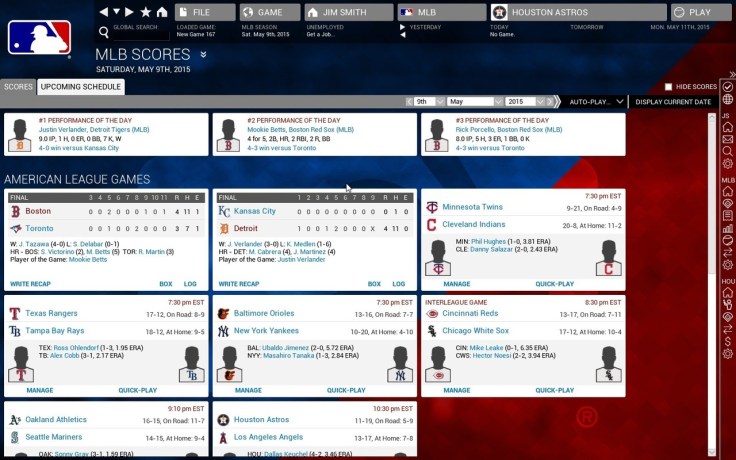
In other words, OOTP Baseball is the “World’s most realistic sports simulation game”. There are a number of different options of how you can you play this game: you can be the manager, the General Manager, you can play a real league, a fictional league, or an international league…and that is just the tip of the iceberg. If you have ever wanted to know how you would do managing and/or running a major league team, this is the game for you. The thing is, once you get into it, it’s hard to stop. Last year I started a Kansas City Royals franchise, beginning with the 2016 season. That wasn’t a banner season for my team, as they struggled with injuries and a bit of regression, finishing the year 76-86. So going into 2017, I had the majority of the same roster with a number of minor tweaks. Much like the real life Royals, I knew after the season I was going to have a hard time re-signing a large chunk of the core group, but was hopeful they could get off to a good start and put myself in a good position after the season. Unfortunately, that did not happen.

kc2

Instead, I got off to a horrible start. My team went 4-14 in April and while the offense was struggling (once again, sound familiar?) the pitching is what was really hurting me. My starters ERA was over 5.00, relievers were close to 5.00. I knew I would be wheeling and dealing, but wasn’t for sure when I would start the fire sale. I had made a few minor trades in May: I dealt Jason Vargas to the A’s and Alcides Escobar to Arizona, picking up Ryan Madson and Mitch Haniger. Nothing ground shaking but slight adjustments. But on May 24th, with my team 12-26 and 12.5 games out of first place in the American League Central, the fire sale begun. Within a matter of days, I had dealt Eric Hosmer, Lorenzo Cain, Kendrys Morales, Kris Medlen, Jason Frasor and Jarrod Dyson.  In return, I went out and made my team younger (and coincidentally, cheaper). For those players I was able to acquire Cody Bellinger, Aaron Sanchez, Randall Grichuk, Blake Snell and Lucas Giolito. In one fell swoop I had improved my rotation while also re-stocking my lineup with enough young talent to keep a low payroll for at least a couple of years. I also recalled a number of young prospects to fill out the team, as Kyle Zimmer, Bubba Starling and Ryan O’Hearn all became regulars on my team. I figured if I was going young, might as well go all the way. I accepted that my team would be bad for at least the remainder of the 2017 season, but I would reap the benefits in the future. My goal was to let these players play and let them get the experience they needed. So how is that working out?

kc3

My team, as expected, is still bad. My record on June 5th (when the final deal went through) sat at 15-33; since then I am 12-16. It’s still under .500, but there has been a slight uptick. The youngsters are struggling at times, but at other times they are excelling. The starting pitchers will have a good outing followed by a bad one, while the hitters will go through a stretch where you see improvement while struggling just a few games later. I understand it is a process and don’t expect a huge improvement instantly. Speaking of, my pitching numbers have slightly picked up since all the trades were made and between that and the defense, there have been less blowouts and more close games, which have been split when it comes to success rate. Instant gratification won’t be found here, but I feel better about my team’s future and feel I did the proper moves to help my team in the future. That is where the connection to the real life Royals comes in.

kc4

This whole article has been building to this one big question: how does this game I play reflect on what is going on in real life this season for the Kansas City Royals? Very simply, the Royals are playing themselves out of contention this year and pushing themselves in the direction of a seller rather than a buyer at the trade deadline. Do I think Kansas City can go out, deal their valuable parts the way I did and get about the same return? Probably not. Mine is a game on a computer that has different values than a real GM and also is missing out on the human element. I was able to acquire top-notch prospects like Bellinger and Giolito; the Royals could only hope to pick up prospects of that ilk. But what they can do is get what they can and decide if what is being offered for the likes of Hosmer, Cain, etc. is better or less than the draft pick they may (or may not) get the following year. It is a tough line to straddle and I don’t envy the position that Dayton Moore is in. I struggled with my game on whether I wanted to throw up the white flag or move on. Eventually, I gave in and decided to start the rebuild now. In my estimation, that was a better route for my team; what is the better direction for the Royals in real life?

kc5

Here is the honest truth: this time next year, the Royals will look completely different from where they currently stand. Royals fans need to brace for the fact that there is a good chance the team isn’t able to keep Cain, or Hosmer, or Moustakas or Escobar…and that’s not a bad thing. While rebuilding is scary, it is also a reality in today’s game, unless you are a team with endless money. In my eyes, if this Royals team is still slumbering around by late June, then they are probably better dealing off what they can and start moving in whatever the next direction is for this team. Avoiding the inevitable only makes for more suffering and bigger heartbreak. It might appear on the surface that it is easier to tear down a team on a computer simulated game; in reality, it is not as hard to do in real life, with focus, determination and a clear, precise direction. The first question Moore needs to ask himself (and he probably already has) should be ‘where do we want to be ‘x’ years down the road?’, which should be followed by ‘how do we get to that point?’. Start there and begin to move forward. We are getting closer and closer to just pulling off the band-aid and dealing with the pain.

What Is Wrong With Alex Gordon, Take Two

kc1

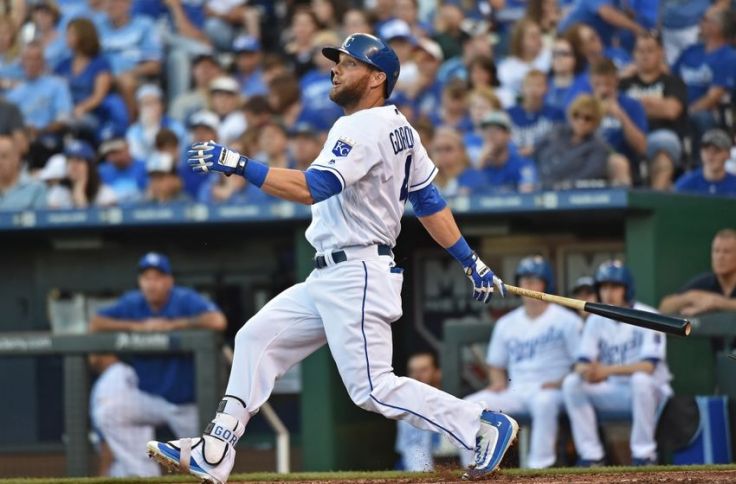
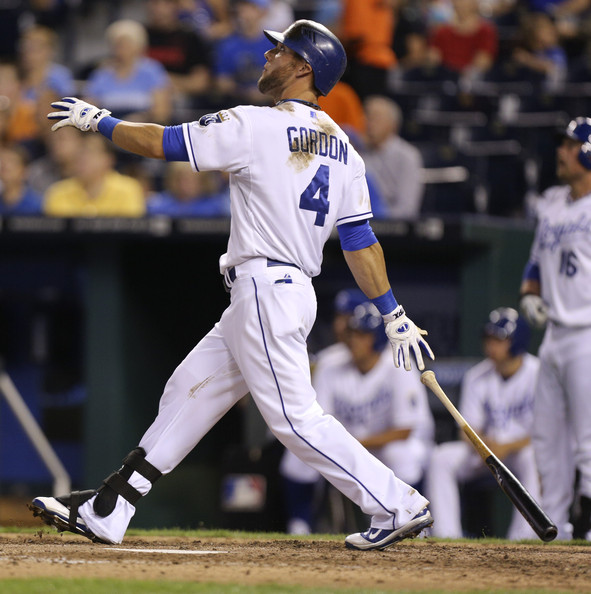
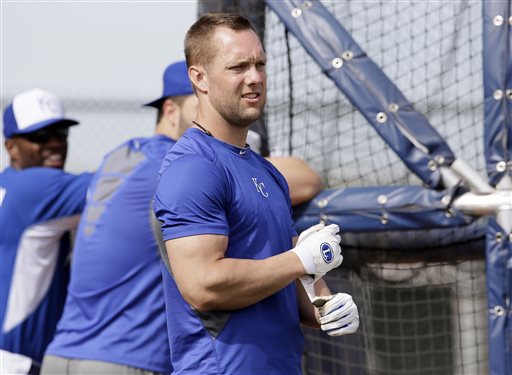
2017 was supposed to be a comeback year for Alex Gordon, a year where he could prove all his skeptics wrong and show that last year was an outlier for him. Gordon struggled throughout 2016 and while some attributed it to the hand injury that occurred last May, others felt like his regression had begun. Players in their early to mid 30’s normally see a drop off in their production and it appeared that might just be the case for Alex. But this offseason, Gordon worked out like a fiend, hoping to be the phoenix rising from the ashes. Instead, this year has been one of the most frustrating seasons of his career, as he is hitting .152/.264/.192 through 35 games has yet to hit a home run and only 5 extra base hits (all doubles) to his credit. Last year I looked at some of his issues: little did I know we would have to do the same thing this year. So lets once again ask the question-what is wrong with Alex Gordon?

Alex Gordon

One of the big issues last year with Gordon was an increase in his strike outs and him swinging at more pitches outside the strike zone. So far in 2017, Gordon’s K rate has slid back down to normal levels (20.8% compared to last year’s 29.2%) while his O-Swing % (which is the percentage of pitches swung at outside the strike zone) has fallen to 24.8%, down from 27. 4%. The interesting part is that Alex is making more contact on pitches both inside and outside the zone (53 O-Contact %, 88.1 Z-Contact %), which also means his contact rate has increased as well (78.3%, up from 71.9% in 2016). With his strike outs down, this makes sense and is actually back on par with the previous five seasons before 2016. So a big part of his problem last year has been addressed and fixed; if that is the case, what has negatively changed since last year?

MLB: Baltimore Orioles at Kansas City Royals

Digging a bit deeper, it doesn’t take long to point at a few problem areas for Alex. One, his soft hit rate is up this year, sitting at 20% (16.1% in 2016) while his hard hit rate is down (28.4%, compared to 36.9% last year). If you have watched the Royals at all this year, it won’t shock you in the least. Line drive and fly ball rates are down (19.1 and 27.7%, respectively), while his ground ball rate is up (53.2%, a big increase from last year’s 37.9%). Once again, not shocking if you have watched him at the dish this year. What did surprise me a bit was that his pull rate was down; I was certain that he had been pulling the ball much more this year in year’s past. Instead, it is down to 41.1% while his opposite field rate is also down to 16.8%. This means he has been hitting the ball more up the middle (up 10% to 42.1%), which is normally a good thing. Unfortunately, quite a bit more shifts have been put on Gordon this year and a number of line drives that he has hit up the middle have been hit directly to a fielder, normally the shortstop who has shifted over to behind the second base bag. It is a bit surprising to see that he has hit the ball to the opposite field less, especially since he is a better hitter when hitting it to left-left center field. One would think if he got a few more hits to the opposite field, it might cause him to get out of this funk and compile a few hits to help his cause.

kc4

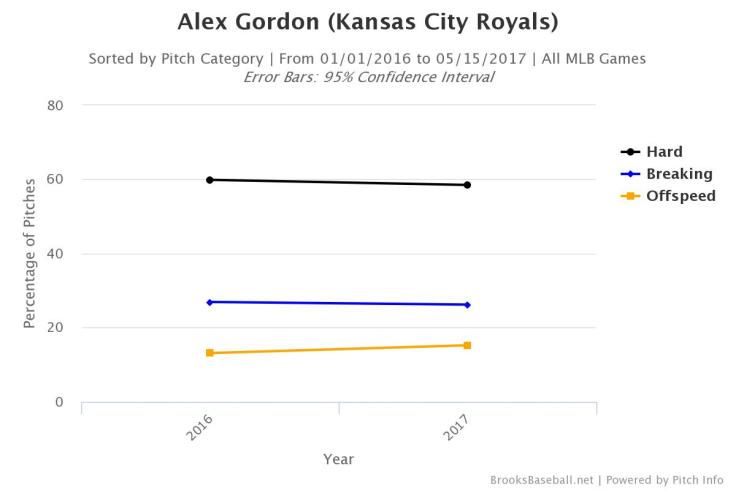
Next, we take a look at the variety of pitches that he has seen since 2016. Now, it is still early in the season, but far enough into it that we can see a pattern forming. First, here is the percentage of pitches seen:

Brooksbaseball-Chart (1)

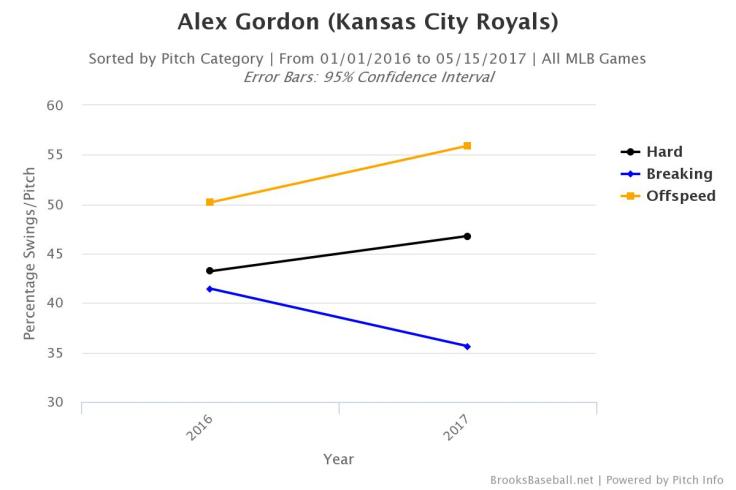
Next, the swing percentage of pitches thrown at him during that span:

Brooksbaseball-Chart

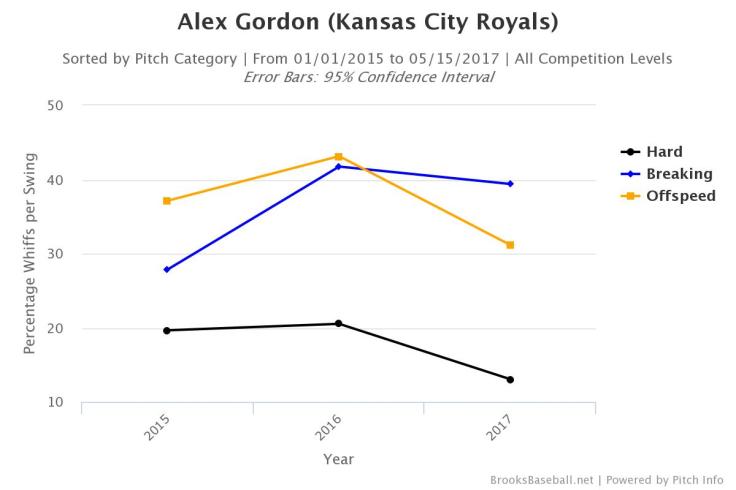
From the numbers, it is evident that Alex is swinging at more hard and off-speed pitches and less at breaking balls. What is different this year, has been that while he has been more patient with breaking balls, he also has a greater chance to swing and miss at those pitches (39% whiff/swing with breaking balls). In fact, his whiffs per swing on breaking balls has picked up tremendously since 2015:

Brooksbaseball-Chart (2)

While these numbers explain part of the story, there is another piece to the puzzle. When Gordon faces left-handed pitchers, he is seeing a breaking ball (most specifically sliders) a vast majority of the time. Against lefties, Gordon sees a slider 21% of the time in all counts, 25% when the batter is ahead and 26% with two strikes. Lefties have been throwing more sliders and curves to Alex and they have been a difficult pitch for him to handle.

kc5

There is also the issue of Gordon and fastballs, which has raised some eyebrows the last two seasons. Rustin Dodd of the Kansas City Star wrote about this issue earlier today:

From 2011 to 2015, Gordon was the sixth-best hitter in the American League against fastballs, compiling 92.4 runs above average, according to data from FanGraphs. To look at the players who were better is to see a list of the best hitters from the era: Miguel Cabrera, Mike Trout, Nelson Cruz, Jose Bautista and David Ortiz.

But then came 2016, and Gordon’s numbers against fastballs plummeted. He compiled just 1.1 runs above average against the pitch. This year, he’s been the 24th-worst hitter in the American League against fastballs, compiling -2.3 runs above average. He entered Tuesday batting .190 against four-seam fastballs and .167 against two-seamers, according to MLB Statcast data. For comparison, the league-average batting average against four-seam and two-seam fastballs was .271, according to Baseball Savant.

So the question has to be asked: is Gordon starting to regress and is having difficulty catching up with the fastball?

Alex Gordon

The numbers seem to attest that very well could be a possibility and has to be concerning for Kansas City management. If this is the case and we are seeing the decline of Gordon, one has to wonder how he will react to it. Alex has always come across as a very competitive player, someone who will put in the time necessary to improve his game. If he is slowing down and his reactionary time is fading as well, he might have to change his game plan up, looking for more off-speed pitches while only focusing on the fastball when necessary. Good hitters over time have dealt with this same issue and have found a way to cheat a little while not seeing their numbers completely dropping off the board. This very well might be the course of action Alex has to take moving forward. Gordon still has the capability of being a productive player, but the days of 20 home runs a season might very well be in the rear-view mirror. Gordon is still a plus defender and is still vital to the Kansas City clubhouse and with his contract is probably not movable. Luckily, it is still only about six weeks into the season, time enough to turn things around and salvage this season. Over the last few weeks we have seen Eric Hosmer and Brandon Moss among others awaken and start hitting. Is it now Alex’s turn? We all hope so. This is not the way most Royals fans envisioned Gordon’s last few years in Kansas City evolving. Hopefully the ‘Prodigal Son’ can bounce back and prove his worth. I don’t know about you, but I still believe.


Forever Royal

Kendrys Morales, Jarrod Dyson, Eric Hosmer

When a team wins a championship, it is only natural for fans to grasp onto the players who elevate the team to that level and cheer them on for years to follow. It is also natural for rosters to change and these same players to eventual leave, whether by a trade or free agency. A number of notable members of the 2015 World Champion Kansas City Royals were sent packing in the offseason and are now setting up residence east to west, north to south and even in Canada. With that in mind, lets see how these former Royals are doing away from Kansas City.

kc1

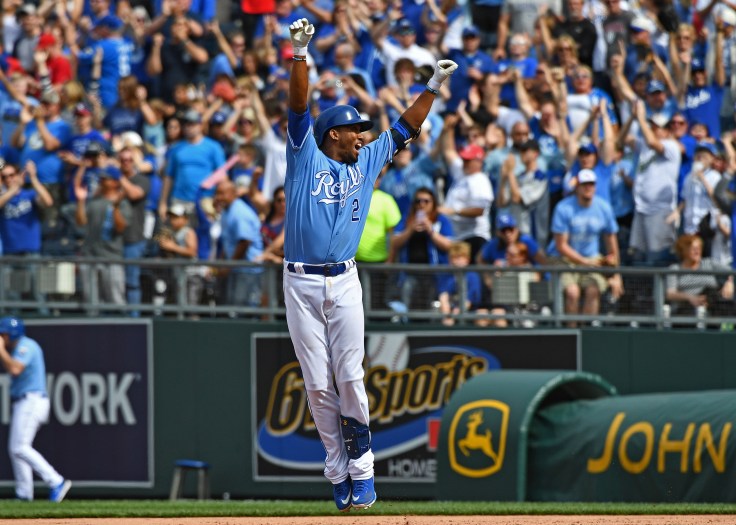
First on the list is former Royals outfielder Jarrod Dyson who has set up residence in Seattle. I’ve been interested to see how Dyson would do elsewhere for a while now, just for the fact that Kansas City always seemed to use him in situations where he could succeed. Seattle has talked about using him as a regular, and knowing how Dyson struggles against lefties, I have wondered how that would play out. So far the numbers haven’t been glowing: .202/.294/.257 with a wRC+ of 59 over 127 plate appearances and a fWAR of 0.3. All of these numbers are heavily down over his career averages but the sign of what really might be ailing Dyson appears to be on where he is hitting the ball. So far this season, Dyson has a 45.5% ground ball rate, where he has averaged 57.2 % over his career. Meanwhile, his fly ball rate is sitting at 38.6%, while his career average sits at 25%. It’s still early, but a player like Dyson (one with little power plus game-changing speed) has to use his positive tools to his advantage. These are all numbers that can be flipped around in a timely manner, but it might just show the difference between an organization that cultivated him and the new one that is still getting acquainted. The Royals always seemed to have a good idea of Dyson’s limitations and used him accordingly. For Jarrod’s sake, I hope he turns things around and can get back on pace to his career numbers.

kc3

Edinson Volquez left Kansas City for Miami in the offseason, signing a 2 year, $22 million deal with the Marlins. In six starts, Volquez has posted an ERA of 4.71 with a FIP of 4.91. What has been noticeable in Eddie’s numbers is the pick up in Strike Out %…and Walk %. Both have seen a healthy increase , with strike outs up from 16% to 24% and walks up from 8.9% to 16.5%. Control has always been an issue with Volquez and those numbers had started rising last year in Kansas City. 2017 has also seen Eddie’s line drive rate, fly ball rate and hard hit rate all see an increase, which can’t be a good sign in the long run. Volquez’s velocity numbers are also on par with 2016, or at least close enough that there shouldn’t be any worries there. One last number I wanted to check was BABIP: the last few years Volquez has had the luxury of having the Royals elite defense behind him. So far in 2017, his BABIP sits at .347, compared to .319 last year and .290 in 2015. The good news for Marlins fans is that all these numbers are just through six starts, so there is lots of room for improvements. But the other side of that coin is that Volquez’s numbers have been skewing this way for a while now, so there isn’t a whole of shock in what we have seen so far in Eddie’s numbers.

kc4

When Kendrys Morales signed with Toronto, I was sure that he would see his power numbers go up. Moving from Kauffman Stadium, where home runs go to die, to the Rogers Centre seemed like a lock he would see his numbers rise. But to this point, it hasn’t happened. So far in 2017, Morales is hitting .244/.294/.433 with 6 home runs and 20 RBI’s. Most of his numbers have seen a dip this year: strike out rate, walk rate, ISO and so on and so on. While he has seen his fly ball rate go down and the ground ball rate go up, there are some positives to his numbers. His line drive rate has seen an increase, as has his HR/FB ratio. But the numbers just don’t tell a good story, as even his hard hit rate has dropped while his soft hit rate has climbed. The one positive for Blue Jays fans is that this feels very similar to Morales’ 2016, where he struggled throughout the first two months of the season…and then June happened. So while it might look questionable right now, just wait Toronto fans. June is just around the corner.

kc5

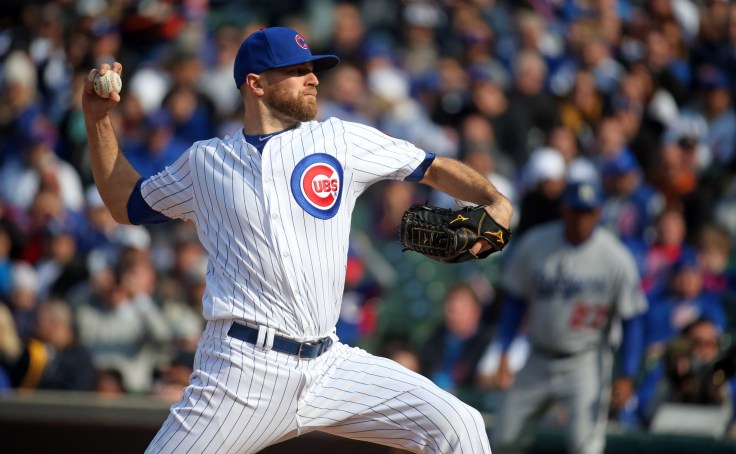
Maybe the hardest goodbye this offseason was Wade Davis headed to Chicago, despite the fact that it felt like the best time to deal him. Wade so far has been as dominant as we remembered him, as he has yet to allow a run in over 14 innings. Davis is coming off of an injury plagued 2016, so it shouldn’t be a surprise to see a jump in his numbers. Strike out rate up, walk rate down. Soft hit rate up, hard hit rate down. Maybe most impressive is his fWAR, which already sits at 0.7; for the entire year last year, he accumulated 1.3 fWAR. There has been a slight decrease in velocity, but that has been going on for a couple of years now and honestly, is expected as he reaches his early 30’s. There is still a part of me that wonders if his forearm issues come back into play this year, but hopefully for Wade and Cubs fans, it is just me thinking the worst right now. So far to date, the Davis/Soler trade swings in the Cubs favor.

MLB: Spring Training-Philadelphia Phillies at Detroit Tigers

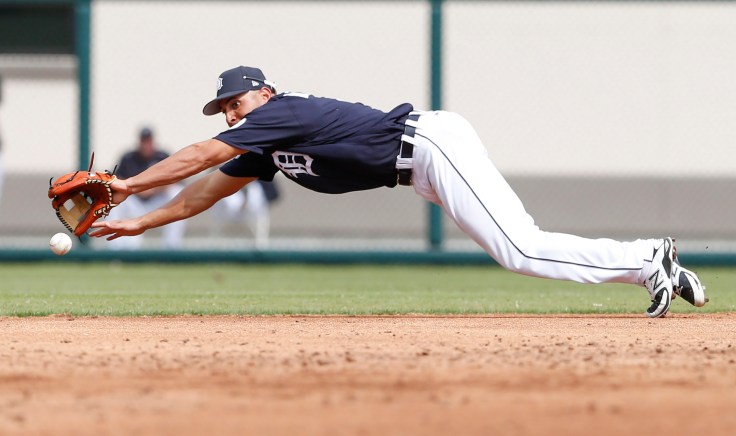
Then there is old friend Omar Infante. Infante is currently down in AAA, playing for the Toledo Mud Hens, the Detroit Tigers minor league affiliate. In 105 plate appearances, Infante is hitting .253/.276/.293 with a wRC+ of 55. If Detroit ever calls him up, it would have to be to fill a roster spot and provide a bit of depth as a backup. It appears as if Infante’s time as a starter is probably in the past, but there is always a place in baseball for a guy with his experience. We just all wish he was doing that without costing the Royals money this year…

kc7

While there will always be an emotional connection to guys like Dyson, Morales and Wade Davis, baseball is a business and at some point everyone moves on. This is another hard reminder that by the end of this season, more members of the 2015 World Championship team will be former Royals rather than current. While these players move on to sometimes greener pastures, it sometimes is the best for both parties as well. Remember, while the present isn’t as glamorous as the past, those memories can never be taken away from us. All these guys are and always will be #ForeverRoyal.


Hammel, Wood & Karns Are No Emerson, Lake & Palmer

kc1

Late this winter, Kansas City Royals General Manager Dayton Moore was on a mission to go out and find starting pitching to fill the void left by the passing of Yordano Ventura. The team had already acquired Nate Karns but they would need more pitching if they were to contend in the American League Central in 2017. Luckily, ownership allowed their wallets to open a smidgen more and the team went out and signed Jason Hammel and Travis Wood to give the rotation more depth than they have had in years. With the first month out of the way (and a frustrating month it was), let’s see how the newbies are performing for Kansas City.

kc2

Let’s start with Hammel, or as I call him ‘Hochevar 2.0’. So far in 5 starts, he has an ERA of 6.65 over 21 innings, which is averaging out to a bit over 4 innings pitched per outing. Comparing his numbers to his 2016 in Chicago, his strikeouts are on par with last year while everything else looks drastically different. Down so far this year is his HR/9 and ground ball rate, as is his FIP. Unfortunately, the batting average on balls in play this year has skyrocketed to .384 and his line drive rate has moved up a bit as well. The good news is that while this is going on, the hard hit rate against him is almost identical to last year (32.4%) while the soft hit rate has jumped up 3% to 21. 6%. This combined with the BABIP tells me that he is dealing with a bit of bad luck and should see some of those numbers even out as the season progresses. I’m not too worried about the higher fly ball rate and lower ground ball rate, since the Royals have a big ballpark at ‘The K’ and their outfield is normally above average defensively. One concern I do have with Hammel so far is his walk rate, which has jumped to 12%, compared to 7.7% in 2016. Hopefully this is just an outlier, since he has never had a walk rate higher than 10.4 % (2007) in his career. A lot of his struggles early on can be traced to the high rate of walks and Sunday was a good example, as he walked 3 in the 3 short innings he threw. If he can lessen the amount of bases on balls and receive a bit of good luck on balls in play, his numbers should be more than acceptable for what the Royals need from him this year.

kc3

Travis Wood on the other hand has been a walking nightmare. There has been nothing statistically that really looks promising for Wood so far in 2017, as he has seen everything rise that shouldn’t: walk rate, hard hit rate, ERA, FIP and BABIP. In 9 games he has only thrown 5 1/3 innings and has allowed more hits (9) and walks (8) than innings thrown. The curious part for me when it comes to Wood is his splits. In 2016, Wood was crazy successful against lefties (.128/.208/.239) compared to righties (.265/.344/.521). This would seem to imply that if manager Ned Yost is using Wood out of the pen, he should primarily face left-handed batters. Instead, he has faced righties 20 times to lefties 13, with righties hitting .400/.550/.733, walking 5 and allowing 6 hits. But Wood hasn’t been much better against lefties so far this year: .300/.462/.400 with 3 hits and 3 walks. Wood has been mentioned before as a possibility later in the season if a starting pitcher goes down, but I’m not for sure he would be a great option at this point. I would still recommend he mainly face those that are left-handed, but Yost also has to figure out a proper way to use him, as he has only pitched in 3 games over the last two weeks. The Royals are committed to Wood through 2018, so hopefully he can turn things around and show some of the magic he had in 2016.

Drew Butera, Ned Yost, Nathan Karns

Nate Karns has been a bit of a mixed bag for Kansas City so far. Over 23 innings, he has improved on his walk rate while inducing more soft contact. Ground ball rate is way up while his fly ball rate is down, which would be good if his home run to fly ball ratio wasn’t 30%. The big thing with Karns has been a decline in his strikeouts and it can more than likely be a cause of his pitch usage. Karns is throwing his fastball just as much as last year (both at 52.7%) but his changeup usage has doubled, bumping up to 20.5%, while he has only been using his curveball 26.9% of the time (compared to 36.4% in 2016). Why is this important? Because Karns has a lethal knuckle-curve that is a game-changer and much of his success the last few years has hindered on it. So it shouldn’t be a surprise to see his struggles considering how little he is using the pitch that everyone gushes about. If Karns start using his knuckle-curve more, I can almost promise his numbers will start improving exponentially.

kc5

So with one month in the book, the 3 big pitching acquisitions haven’t blown anyone away, but 2/3 of them could see some increased success with a slight tweak or two. I would expect Karns and Hammel will get their numbers by the end of the year, while Wood has a long road to prove his worth. The positive is that one month does not make a season and all three have the next 5 months to show Kansas City what they’ve got. By no means should anyone count them out yet, especially since the Royals need them and will give them every opportunity to show their signings were worth it.

Unearthed Solutions For the Royals Offense

MLB: Los Angeles Angels at Kansas City Royals

The Kansas City Royals offensive woes have hit levels that no team should ever have to worry about. You’ve heard all the “answers” to their slump: elevate the ball, be more patient, more barrels, etc. But for a slump of this magnitude, I really feel like the Royals need some major out of the box thinking. That’s where I come in, as I LIVE outside the box. So here are some possible solutions to make the Kansas City Royals a fluid hitting machine once more.

kc2

Royals Ice Cream Social

Who doesn’t love ice cream? Everyone loves the cream of ice (#brokenbrilliance), even those of us who are lactose intolerant (we love ice cream but don’t enjoy what it does to us). Find me a person who doesn’t get excited for ice cream and I’ll show you someone who doesn’t like to have fun. A nice get together where the Royals enjoy some frozen goodness seems like a good way to get their mind off their struggles and onto the bottom of the ice cream cone. I can already picture Salvador Perez and Lorenzo Cain, enjoying their cones, while Salvy takes a few licks of Cain’s ice cream while he isn’t looking. There are some downsides to this. For one, while they will be on the sugar high for a while, at some point they will have to come down. You can only hope that doesn’t happen in the middle of the game. Second, ice cream can pack on the pounds which is bound to slow down even the fastest of Royals on the field. Also, Alex Gordon wouldn’t eat a drop; there is no way he is putting any sugar into his system:

Alex Gordon

Seriously, you don’t look like this by eating sugar. By the way, welcome to the gun show.

kc4

Royals Dance Party

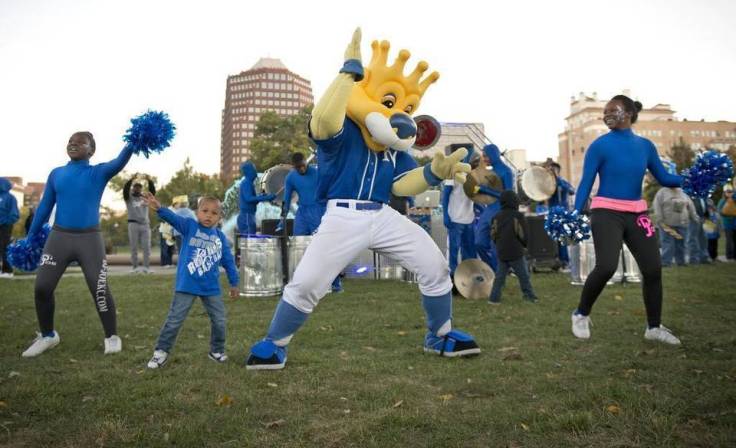
Sometimes you just have to get loose and let the music take over. Some good Royals dancing  could make all their troubles go away as they let their body give in to the smooth stylings of Daryl Hall and John Oates…or whatever the kids are listening to these days. A little electric slide, some Gangnam Style, the funky chicken, even the whip; doesn’t matter what your preference is, as long as you get down and feel the beat. Personally, Brandon Moss seems to be a pop and lock kind of guy. Luckily, Royals fans know how to get down as well:

kc5

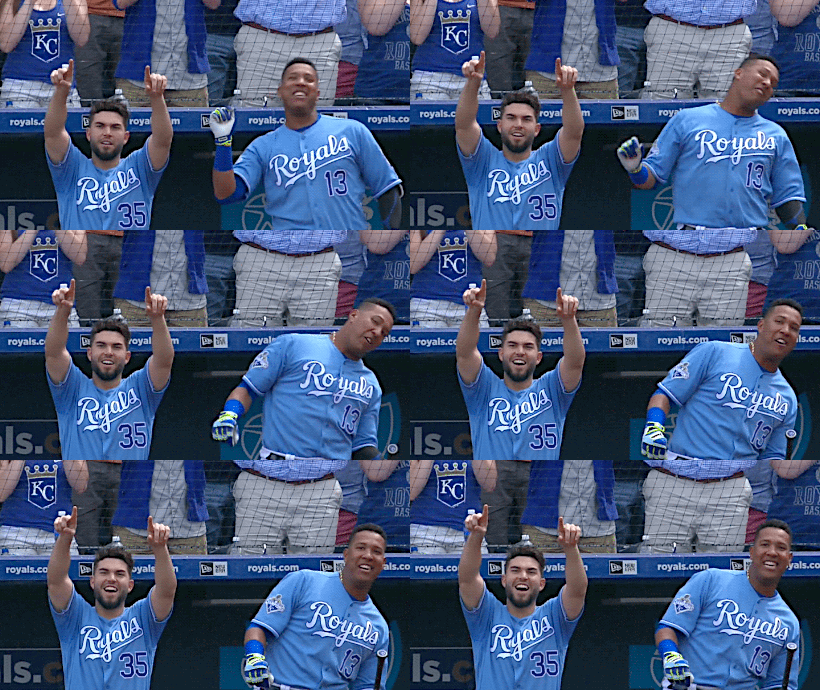
It’s obvious Salvy has some rhythm as well:

kc12

The only issue that could arise with a dance party is someone pulling a hammy or even worse, a stage dive that goes awry. Yes, I’m looking at you Eric Hosmer.

kc6

Tea and Crumpets

While this might feel a tad dull and boring, it also can be a nice, relaxing way to spend an afternoon while not dealing with the doldrums on the field. A nice spot of tea with some tasty crumpets? Indeed and splendid. You just hope no one gets in a big hurry and decides to drink their tea before it cools down a bit; with Alcides Escobar’s patience at the plate, I assume he has the same patience when it comes to his tea. No need to burn the roof of your mouth just to get some refreshing tea.

kc7

A Night of Karaoke

Look, there is a reason that most of us don’t have recording contracts: because we can’t sing. Ball players are no different, but sometimes you just have to belt out your favorite tune while other’s eardrums bleed. There will be classic tunes chosen: ‘Livin’ on a Prayer’, ‘Hungry Like the Wolf’, ‘Ice Ice Baby’ and anything else that can be made worse by people thinking they can sing…and dance.

kc9

Worried about the amount of pitches you are swinging at outside the strike zone? No worries when you know all the words to ‘Bohemian Rhapsody’ but can’t carry a tune to save your life. This would be a good choice for the Royals, although they would probably only sing from the Fetty Wap catalog.

MLB: San Francisco Giants at Kansas City Royals

Hitting the ball hard…in a game

I know this sounds crazy, but hear me out on this. Maybe…just maybe…if the hitters started, I don’t know, hitting the ball hard consistently, they would score more runs and win more games. They could do stuff like this:

kc10

or this:

kc11

I’m a big fan of this:

kc13

and I’m not opposed to this:

kc14

Look, call me crazy but I don’t believe the Royals forgot how to do this. All they need is a bit of a refresher course on ‘Making it Happen 101’.

kc15

Look, we can throw out ideas all day for Kansas City’s offense, but the bottom line is the team needs to decide on a solid game plan and stick to it. There is some stressing and pressing going on right now and a good relaxer would probably help a ton. I would mention a night at a ‘Knocker Locker’ but that turned out badly for the ladies back when Bruce Chen was involved. I’ve even considered voodoo, but considering the “rumor” of Ewing Kauffman selling his soul for a world championship and the Royals proceeding to not win another one for 30 years, I think we’ll pass on that. It’s time to wake up the bats, boys; whatever it takes, do it. Much like ‘slump-busting’, just don’t tell anyone how you did it. There is no need to mention where the bodies were buried.


Kansas City’s Offensive Offense

kc1

It’s highly doubtful that anyone would have predicted that the Kansas City Royals offense would be as pitiful as it has been 18 games into the 2017 campaign. In fact, the stench wafting from the Kansas City offense has become so heavy that it has raised a whole slew of questions moving forward: Who needs to sit? Who should get sent down? Who should be called up? When will Jorge Soler be ready? When will the first player be traded? It feels like they go through these offensive droughts on a yearly basis because…well, because they do. We all remember July 2016. We remember the new batting coaches the team employed in back to back May’s, including hiring George Brett  to help out. This team has been notorious for its offensive struggles, but the timing this year is worse, as it will be the final year of its main core of the lineup; in fact, if things don’t change, guys like Moose, Hos and LoCain could be dealt before we even get to the trading deadline. So just how bad is it?

kc2

Let’s start with a few numbers to break down how comatose the bats are. The big stat that has been thrown out there is the team’s batting average with runners in scoring position: .153, last in all of baseball. It doesn’t get much better with two outs and runners in scoring position: .102, which earns them last in the American League. Last in runs, last in RBI’s, last in slugging percentage, next to last in on-base percentage,  last in wRC+, and next to last in WAR…and this is for all of baseball, not just the American League. The struggle is real and floats all the way down the lineup; here is the regular lineup (or at least what has been the most used lineup) and their individual wRC+, with league average being 100:

Gordon-35

Moustakas-152

Cain-150

Hosmer-41

Perez-118

Moss-56

Orlando- -13

Mondesi- -8

Escobar-30

Three starting players are above league average and the rest are way below that line. In fact, two players sit in the negative column and both of them (Orlando and Mondesi) were sent to AAA last week. Sure, Cain and Moose are hitting good and getting on-base, but does it matter when no one can drive them in? It doesn’t help that the team has hit into 18 double plays, which amazingly is only the 6th most in the AL. But that 18 hurts more when you factor in how little this team is getting on base in the first place, which means they seem to be killing any rally that gets started. So with the numbers glaring us all in the face, one has to ask the question–what is causing this slump?

kc3

There is no bigger factor than looking at what pitches the Royals are swinging at. So far this year, the batters are swinging at 34.3% of pitches outside the strike zone, leading the AL. Fascinating enough, the team is also swinging at 70.2% of pitches within the strike zone (tops in the AL), which means this team is swinging at almost everything being tossed up there. The sad part is that they are only making contact 75% of the time, which earns them 2nd worst in the American League behind only Tampa Bay. The Royals are swinging and missing at pitches 12.5% of the time, the 2nd highest in the AL as well. This shouldn’t be too surprising to long time fans, since this has long been a  ‘put the ball in play’ team who rarely takes a walk. The problem is a lot of the times they just aren’t putting the ball in play and that is killing their offense in the process. In an interesting side-note, the team actually isn’t last in walks so far in 2017, as they have walked 47 times, which sits them in 13th place in the AL. I bring this up for one very big reason: teams that walk more often can power through slumps easier if they are patient and get on base with a free pass rather than get a hit. Because the Royals aren’t a team that walks, their slumps appear worse since they aren’t utilizing their patience the way they probably should. Remember folks, a walk is as good as a hit, and in many cases it also means you are driving the pitcher’s pitch count up. In my mind, that is a win-win situation.

kc4

The other factor that is hurting the offense is how they are hitting the ball. The Royals have the highest soft hit rate in the AL so far this year (23.8%) while racking up the third lowest hard hit rate (26.6%). Kansas City just isn’t hitting the ball hard and it is showing in the offensive output. The team has put a stronger emphasis on hitting for power this year, but it appears to have backfired, or at least it appears that way in the numbers. The Royals have the 4th highest pull percentage in the league (42%) yet their line drive rate sits at only 20.3%, which is 8th best. The team’s HR/FB ratio sits at 10.7% (10th in the AL) while their fly ball rate sits at only 35.1%. This team hits the ball on the ground way too regularly, as their ground ball to fly ball ratio is the 5th worst in the league (1.27, only .41 behind the Angels, who have the worst). The most alarming stat among these numbers is the infield fly ball rate, which is the second worst in the junior circuit (13.4%). The whole name of the game right now in baseball is elevating the ball, yet there is such a thing as bad elevation. The Royals appear to be doing that and there is no Royals batter who is averaging above 90 mph in exit velocity so far in 2017. It’s very obvious what Kansas City would benefit from; more hits off the barrel of the bat and less swinging on a downward plane. It is easy to say, but not as simple to do.

kc5

So can the offense pull out of this? Of course they can. As we sit here on Monday, the Royals have only played 11% of their games, so there is more than enough time for the offense to turn things around. In fact, in year’s past we have seen Kansas City do just that. The issue is that if things are going to turn around, it needs to happen sooner than later. The worst case scenario is for the bats to stay cold and the team decides they aren’t in a hunt for a playoff spot. If that happens, there is a good chance a few of the impending free agents could be available on the trade market. This is worst case, but very real as well. Do I believe this Royals team is this bad at the plate? No. Are there issues that need to be addressed? Obviously. If the team could swing a little less, be a bit more patient and drive the ball more, good things will eventually happen. The only question becomes ‘how long will that take’? Hopefully we have an answer soon, as in this week. The last thing we want to see is Kansas City continuing to struggle offensively into May.


An Angelic Sweep

kc1

We all knew the Kansas City Royals wouldn’t stay down all season long. It was just a matter of time until the team would rattle off a nice little winning streak to bring them up to .500 ball, and the series against the Los Angeles Angels ended up doing the trick. The funny thing is, it’s not like the Royals offense awoke from their slumber and became the 1927 New York Yankees; in fact, Kansas City only scored 5 runs in this series. But what they did get was some outstanding starting pitching.

Angels Royals Baseball

While most of us expected the starting pitching to be better in 2017, so far it has outperformed even the most optimistic of us Royals fans, and the trio of Danny Duffy, Nate Karns and Ian Kennedy were spectacular this weekend. Duffy threw 7 innings of one run ball on Friday night (Game Score of 71), Karns threw 6 innings and gave up just one run (Game Score of 61) and Kennedy threw the real jewel, 8 innings of shutout baseball (Game Score of 86) on Sunday. The Royals starting pitching lead the American League in ERA (2.31), FIP (3.15), Home Runs per 9 (0.49) and tied for the best WAR (1.6 with Baltimore). Now, none of us expect them to be this stellar for the entirety of the season, but even if they keep things above league average, most of us would consider that a win for this ballclub. But as good as the starting pitching has been, the team won’t be allowed to lean on it all year, as at some point the Royals offense is going to have to produce.

Angels Royals Baseball

If you are a Royals fan, you have seen this song and dance before from the offense. For whatever reason, the Royals offense struggles in the early months of each season, or they at least have for a number of years now. Remember when Kansas City had to replace their hitting coaches two May’s in a row a few years back? This Royals offense is fully capable of being above league average (or at least AT league average) but they are also a streaky bunch. So far in 2017, the Royals are last in on-base percentage and next to last in runs, RBI’s, wRC+ and WAR, with only the woeful Blue Jays worst than them. Probably the most surprising is the slugging percentage, which is also next to last in the American League, despite being 8th in the AL in home runs hit. The Royals are hitting home runs, but very little else. In fact, what a perfect time for ‘Fun with Numbers’:

Mike Moustakas-.683 slugging percentage

Lorenzo Cain-.490 on-base percentage, 21.6% walk rate

Brandon Moss- 3 hits (2 home runs) and 6 walks

Eric Hosmer-62.2% ground ball rate

Moustakas seems to have turned a corner, as a hitter who has figured out what pitches he can drive and which ones to go with. Moose is pulling the ball 46.9% of the time and while the preference is a hitter who can use all parts of the field, so far his pull heavy results are turning up positive. On the other side of the spectrum is Hosmer. It feels like I have beaten that horse to death, so the only thing I will mention is that Craig Brown of Baseball Prospectus Kansas City wrote a great piece on Hos and his struggles, which pretty much sums up how I feel about him, just without all the cursing.

kc4

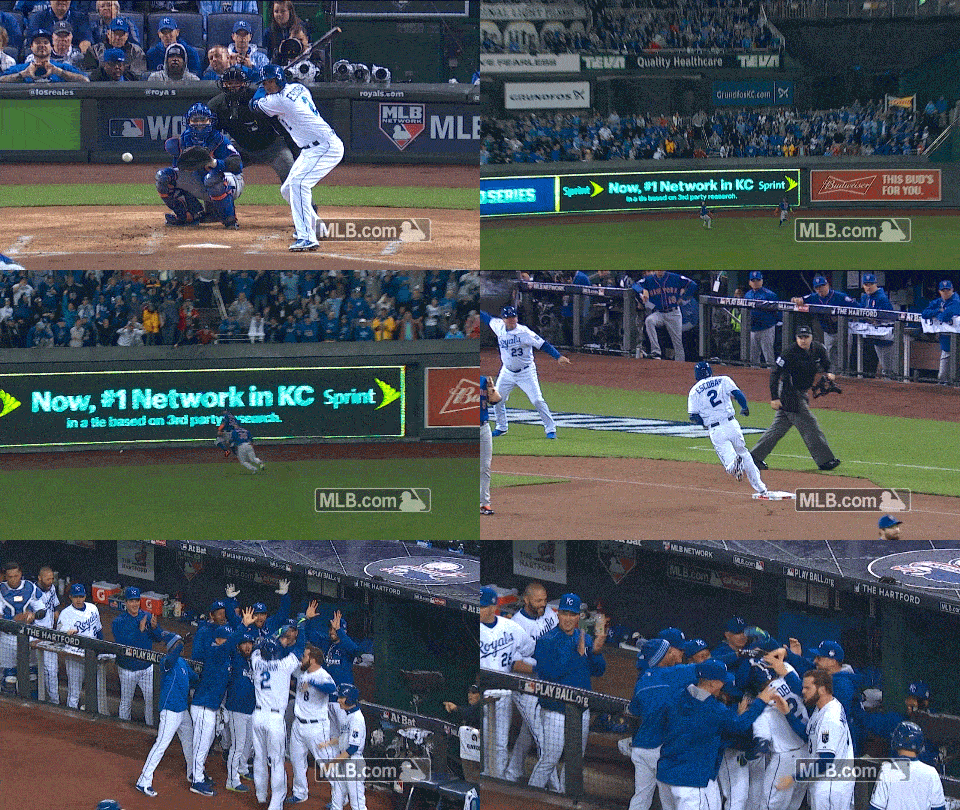
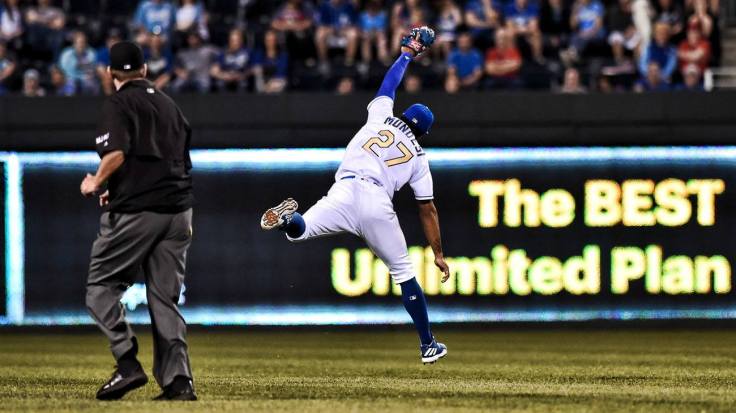
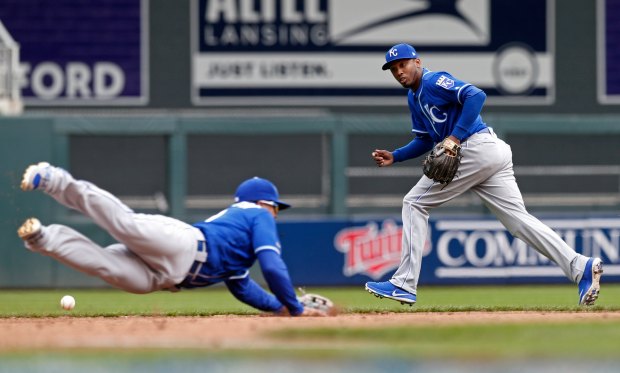
Once again, the defense was front and center this past weekend. Top of the list is this great grab by Raul Mondesi:

Lorenzo Cain made a great grab on Easter Sunday:

and even Eric Hosmer got into the action:

While the starting pitching has been spectacular, this Royals team is built around their defense and they continue to excel. There has been some speculation on how long the Royals will go with Mondesi at second base, but a big part of why he got the job was because of his defense. As long as he makes big plays to help the pitching, he will get the chance to improve on his hitting.

kc5

While the Angels aren’t world-beaters, they can be a dangerous offensive team and the Royals held them in check. A couple of notes to think about this week as the Giants return to Kansas City for the first time since the 2014 World Series (yes, Bumgarner is scheduled to pitch on Wednesday; boo accordingly). One, Joakim Soria has been lights out, not allowing a run in 6 innings of work so far in 2017; look for his role to increase moving forward. Two, Buster Posey was activated today and will be in the lineup for the Giants. Three, let’s see how the Royals do with runners in scoring position. So far this year, they are hitting .158 with RISP and .065 with RISP and 2 outs. Kansas City needs to improve on that if they want to stay above .500. With the temperatures picking up, it’s time for the Royals bats to start heating up as well. If not, the ground they made up this week was all for naught.


Getting Back On Track

kc1

Let’s be honest: Minnesota felt like a mirage. The Kansas City Royals played some of the worst baseball they have played in years during their three game series against the Twins and the general consensus was that the Royals weren’t as bad as they played. They would travel on to Houston to take on a very good Astros team…and would proceed to win 2 of the 3 games at Minute Maid Park. The offense woke up, the starting pitching continued to perform well, the defense was stellar and the bullpen would even improve on ‘The Walk Massacre of Minnesota’. Are we sure that set of games in Minneapolis really happened?

Salvador Perez, Jandel Gustave

Since it is still early in the season, another ‘Fun with Numbers’ is still in order:

Salvador Perez-213 wRC+ through 6 games (4 home runs, all in 4 consecutive games)

Lorenzo Cain-25.9% Walk Rate (7 walks in 6 games)

Danny Duffy-200 ERA+ (In 13 innings over 2 starts)

Matt Strahm-40.50 Walks per 9 (6 walks in 1.1 innings pitched)

Okay, I feel like I am picking on Strahm. I swear I am not; unfortunately the guy is struggling in his limited use this season. The bullpen did improve in this series, although Kansas City still leads the AL in walks allowed (36), 8 more than runner-up Baltimore. The starters have held their own, but the bullpen still lies in the bottom of the league in almost every category, including WAR, FIP and BB/9. There is good news, though; Joakim Soria has been solid in his two outings, Peter Moylan has been a rock and Chris Young has been stellar in his 2.1 innings pitched. Maybe it’s just me, but it has felt like manager Ned Yost is still feeling out his relievers and what role would be best suited for them. I still think Strahm will be one of the main setup guys before the year is out and I could see Soria and Minor also filling that role. The one puzzling move is Yost’s usage of Travis Wood, a lefty who showed major splits in 2016 while with the Cubs. Lefties hit .128/.208/.239 against him last year while righties hit .263/.344/.521. It would appear that Yost should mainly use Wood against lefties, and limit the usage against righties. Instead, he has been using him against righties more and they are clocking him at a .400 pace. Like I said, it appears Yost is trying to feel his new relievers out, but a pattern is already showing when it comes to Mr. Wood.

kc3

Before we move on from the pitchers, I got to say a big kudos to Jason Vargas, who was spectacular in his start on Friday. Vargas threw 6 innings while striking out 6 and allowing a run. Vargas only appeared in 3 major league games last year as he was returning from Tommy John surgery and is entering the final year of his contract. If he can pitch closer to his 2014 performance, the Royals could have a sold rotation spot locked up for this year.

kc4

Maybe the best news was the resurgence of the offense, as the team put up 16 runs in the 3 game series. The most ‘Un-Royal’ stat from the year has been the power surge seen through the first six games:

I love early season numbers and it is always fun to see how big numbers can look HUGE if calculated out to a full 162 game schedule:

Royals GM Dayton Moore said before the season that his objective was to go deep more often in 2017 and so far, so good. In fact, the Royals are slugging:

Mike Moustakas- .739 slugging percentage

Salvador Perez- .792 slugging percentage

Cheslor Cuthbert- .714 slugging percentage

While the Royals power numbers are good this year, they still aren’t great. In fact, they are next to last in slugging (.400) and last in wRC+ (88) and ISO (.139). The offense isn’t totally clicking yet, but this series at least brought some optimism. Also, some things will never change:

Eric Hosmer- 61.9% ground ball rate (already 10th in the American League)

Hey, I’ll quit picking on Eric when he learns to elevate the ball. If he starts doing that, I will be glad to start heaping praise and say I am wrong about him. Until then…

kc5

But if anything stood out this series, it was the defense.  I could describe it to you, but it is easier just to show the proof:

Cain’s was the jewel, but this was pretty great as well:

…and it’s not really a Royals defensive highlight reel without an appearance from Alex Gordon:

That assist was the 75th of Gordon’s career, a great nod to a player who has only been playing the outfield full-time since 2011. One of the biggest head-scratchers for me so far this season is why the Royals pitchers aren’t throwing more strikes when they have this defense behind them. Let the defense shoulder the work; they can handle it.

Raul Mondesi, Alcides Escobar

The Royals are now 2-4 in the ol’ W-L column and are just a winning streak away from a respectable record. The main item that should be preached is ‘improvement’ and as long as they do that, there should be more ‘W’s’ to come. The Royals tend to be a team that is guided by their offense; if the offense is producing, they are normally winning. But if they aren’t…well, if they continue to stay cold, it will be a long summer in Kansas City that could be heated up by a fire sale. This next series against Oakland would be a good time for the bats to wake up and put them back on track. Two series’ are in the book and it has felt like two separate ballclubs. So the question has to be asked–which team is the real Kansas City Royals?

Walking to Houston

kc1

23

That stat looms over the Kansas City Royals as the biggest factor to their 0-3 start to the 2017 campaign. Twenty three is the number of walks they have given up already this season, leading the American League by 5 over Houston’s 18. That’s 8.63 BB/9, which surprisingly isn’t higher than the team’s K/9 rate, which is 9. 38. So the Royals pitchers are walking and striking out batters so far this year, but the numbers are even scarier when you break it down to the team’s starters and relievers. The Royals pen have a BB/9 rate of 12.38; in context the next closest bullpen in the AL is Houston, at 5.06. The pen has the league’s highest FIP, ERA and tied for the worst WAR. Luckily (once again), they have the second highest K/9 rate at 11.25. So the bullpen has been a trouble spot, as Fangraphs predicted. But…I still believe the pen isn’t as bad as believed and unfortunately for me, only time will really prove me right or wrong. What can be proven is that with only 3 games in the books, everything at this point is a small sample size. In fact, these aren’t the only numbers that really stick out this early in the season.

Kansas City Royals v Minnesota Twins

Here are a few more small sample sizes that skew anyone trying to plan out for the entire 162 game schedule:

Mike Moustakas-.769 slugging percentage (2 home runs so far)

Lorenzo Cain-38.5% walk rate (5 walks in 3 games)

Matt Strahm-13.50 HR/9 (1 HR given up over 0.2 innings pitched)

So what is the point of this little exercise? To show that statistics early in the season mean close to nothing. Remember last year about this time when Trevor Story of Colorado went on a home run rampage and was on pace to hit 162 home runs? He ended up with only 27. If you really believed he was going to hit a home run a game, 27 looks like quite the paltry number. The point is that while the numbers can show why the Royals bullpen has been a steaming pile of monkey dung, those numbers won’t hold up over an entire season. Then again, some things never change:

Eric Hosmer-60% Groundball rate (58.9% in 2016, leading all qualified batters)

Stay gold, Ponyboy. We can always count on Hosmer to hit the ball on the ground…

kc3

Now, the bullpen isn’t the only story to take away from the first series up in Minnesota; the offense has done its part to make sure people are talking about them as well. The Royals so far are hitting .174/.255/.283 and those numbers are improved since the offense actually contributed in game 3 of the series, as opposed to the first two games. Last in RBI’s and WAR, next to last in batting average, wRC+ and on-base percentage, and 13th in slugging percentage. The offense we saw in Arizona this spring apparently decided to stay there and hopefully will be catching an adjoining flight to Houston this weekend. This offense has been known to be streaky over the last couple seasons and are continuing that tradition into 2017. While I don’t expect the offense to be in high gear all season, they need to improve. Kansas City’s pitching is just not good enough to maintain an offense that goes silent for super long period’s of time.

Alcides Escobar, Cheslor Cuthbert

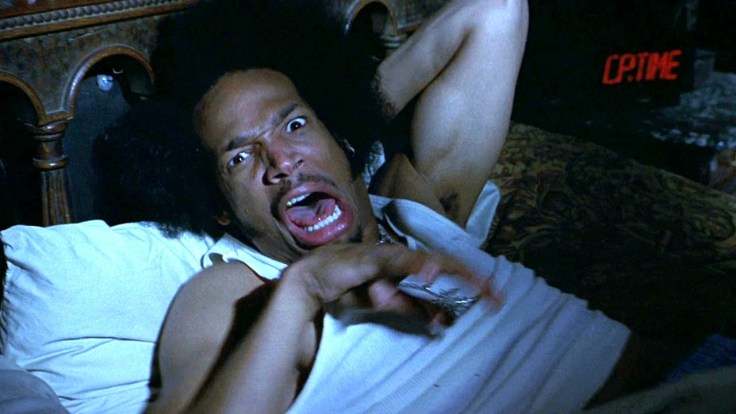
So three games in and we have seen a very lackluster effort from the Royals. In some ways, that first series was a horror show for Kansas City:

kc5

No, not that kind of horror movie; more like this kind of horror show:

kc6

The good news is that it can’t get any worse that what we have seen so far this week. With that being said, a bit of kudos go out to the Twins. While the Royals looked awful, Minnesota did about everything right. The two biggest issues they had in 2016 were defense and the bullpen, and both appeared improved in the first series of the year. For Kansas City, they need to improve sooner rather than later, because if they are out of the pennant race when June rolls around, the fire sale could very well begin. The Royals are better than they have showed early on and I have to believe we will see that soon enough. If not, I have put a lot of faith in a group of guys who have done nothing but proven people wrong over the last 3 years. It’s time to prove more people wrong.

Blog at WordPress.com.

Up ↑