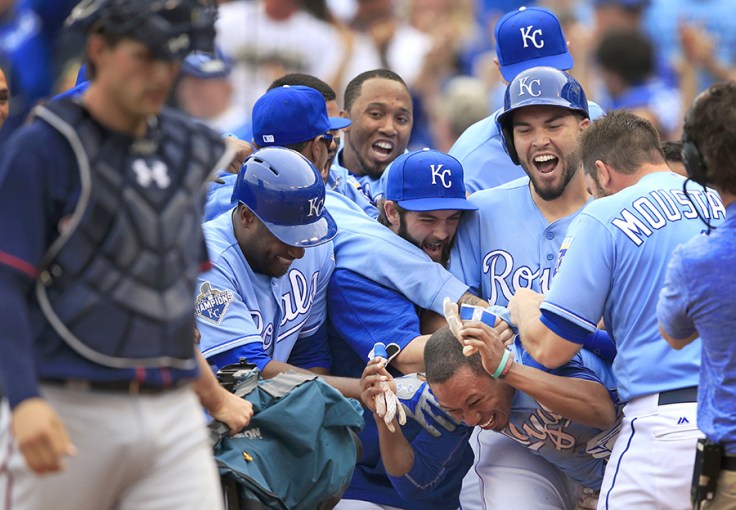
Depth Is King

kc1

(AP Photo/Charlie Riedel)

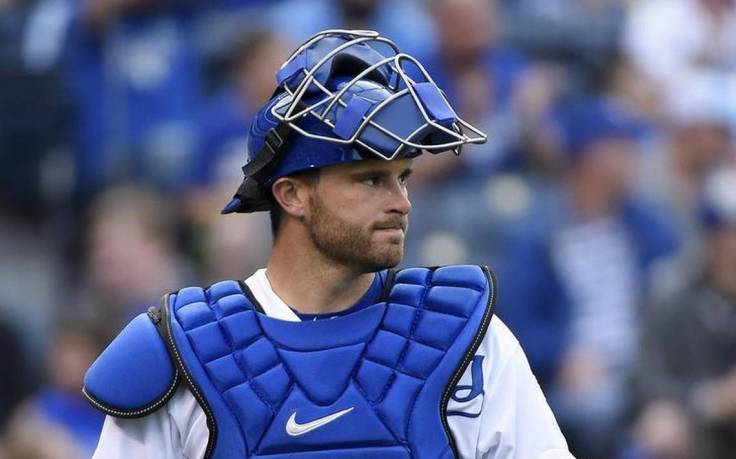
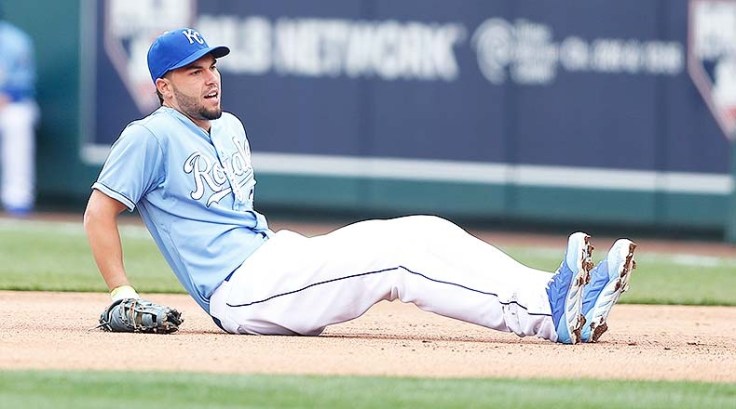
The World Baseball Classic has been a nice distraction through the dog days of Spring Training (I forget every year how long the preseason drags on)but there is an aspect of it that can shake a baseball fan to the core-an injury. I agree with most that an injury, for the most part, is just as likely during a spring game, with the main difference being that at least in a Spring Training game the major league team has control over when and where a player is in the game. With that in mind, most Kansas City Royals fans lost their breath for a short bit a few weeks ago when catcher Salvador Perez was in a collision at home plate with Royals teammate (and his backup catcher) Drew Butera:

https://youtu.be/PwYFbKAxNp0

After my initial thought of “man, that was one awkward slide”, my next thought was Perez’s health and how he needed help being escorted off the field. My mind scurried back to 2012 and the meniscus tear in Salvy’s knee and how he missed the first few months of the season. Then my mind ventured to who could take his place…and I got really worried. There is Butera, who is a great backup but too much playing time would expose his flaws. Brayan Pena is in Royals camp, but like Butera, is better suited to occasional starts, not full-time duty. Cam Gallagher is in the Royals pipeline and is a great defensive catcher…but can’t hit a lick. This meant my mind then started thinking of trades and what catchers might be available. The Royals just don’t have great depth at the catcher position and when I started thinking if there is any other position on the field that Kansas City would have a hard time filling, I was relieved to realize that this 2017 Royals team was not only very deep from position to position, but it also might be the deepest team they have had over the last four years.
kc2

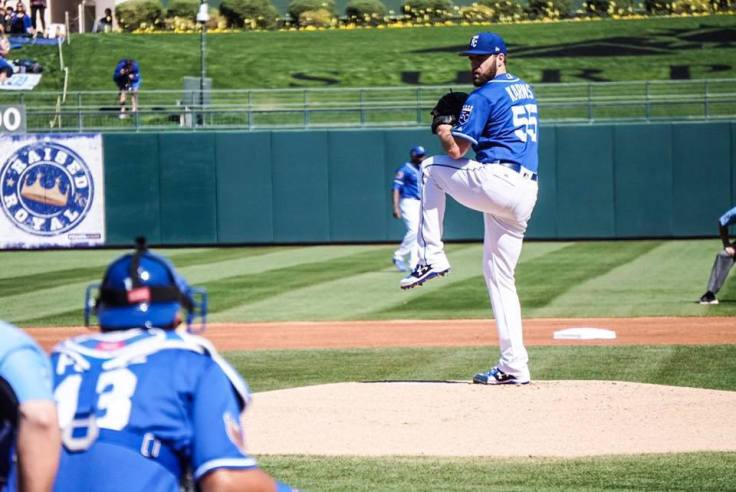
On Monday, manager Ned Yost announced the winner of the 5th spot in the starting rotation:

Karns was part of a deep pool for Yost to dig from, as he was battling with Chris Young and Travis Wood to wrap up the rotation. Any of the three fit into that spot and cases can be made for all three as to why they would be valuable in the bullpen as well. Since the Royals have made their run for postseason contention back in 2013, I can’t remember a time when they had as many quality options in the rotation as they do this season. This isn’t even mentioning prospects like Josh Staumont or Kyle Zimmer, who both could be valuable to Kansas City at some point this season, whether it be in the rotation or the pen. If the Royals are hit with an injury at some point this season, it does appear as if there will be a pitcher that can easily slide into a spot in the rotation.

kc3

The bullpen is just as deep, with Kelvin Herrera taking over the closers role and Matt Strahm and Joakim Soria leading the way as setup guys. Add in Wood and Young from the rotation battle and lefty Mike Minor, and you have the make-up of a solid bullpen crew. But the depth extends; Staumont and Zimmer are possible additions later in the year, along with Eric Skoglund in the minors. Throw in veterans Peter Moylan and Al Albuquerque (who are in camp on minor league deals) and there are arms galore for Yost to choose from. While the relief core might not be Holland-Davis-Herrera deep, it is still an above-average group that is a good ten-men deep.
kc4

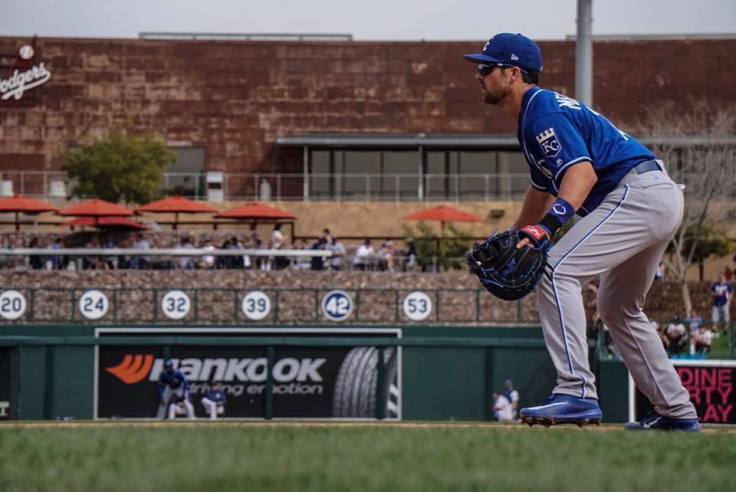
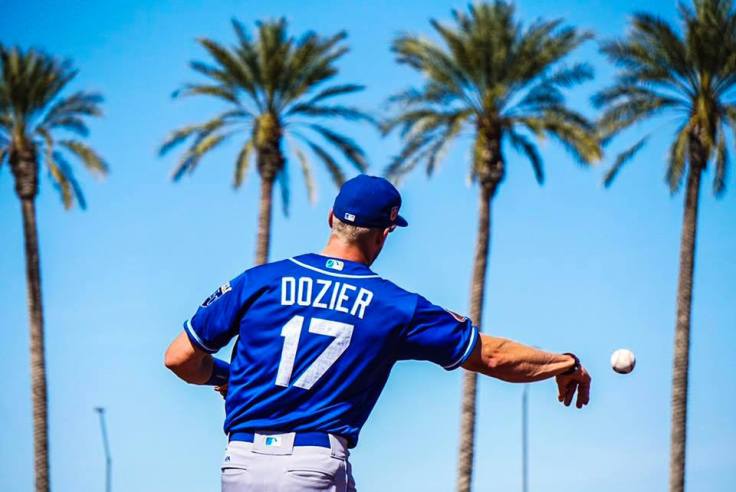
The infield backups, while not a group of all-stars, are still all serviceable and capable of filling in on a semi-regular basis. Kansas City has Cheslor Cuthbert or Hunter Dozier at third base if something happened (again?) to Moustakas, Raul Mondesi can fill the glove of Alcides Escobar in a pinch (although there are questions about his bat, which has been solid this spring) and the group of Mondesi, Christian Colon and Whit Merrifield are all able at second base, a position without a true starter. Initially I thought first base might not be as deep, but it might be even deeper than the other three spots in the infield. If Hosmer went down, Kansas City could plug-in Cuthbert, Dozier, Brandon Moss, or even Peter O’Brien, who has shown some massive power this spring. Even Hosmer’s future replacement (probably), Ryan O’Hearn, has shown marked improvement this spring and might be available late in the season. While not a collection of offensive juggernauts, the infield could survive a few injuries if something happened and in some ways be able to put up fairly comparable numbers.
kc5

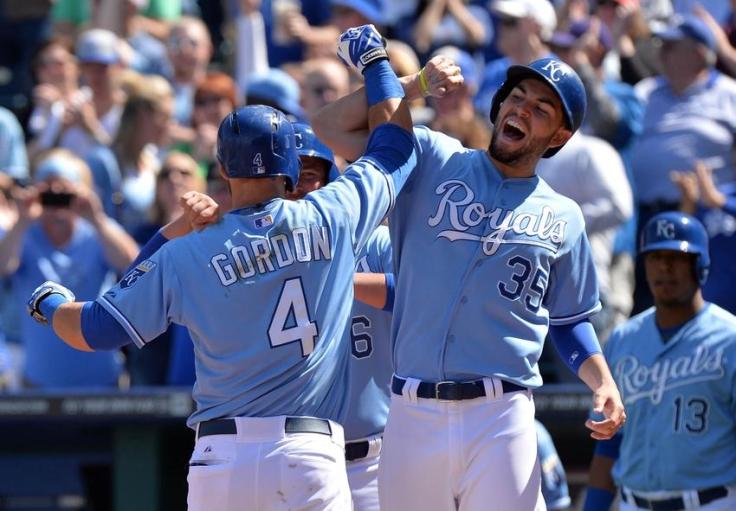
The outfield is more of the same, with Alex Gordon, Lorenzo Cain and Jorge Soler scheduled to be the starters from left to right. If Gordon goes down, Moss, O’Brien, Dozier or Paulo Orlando could fill in. Cain? Orlando’s best defensive position is actually center field and Billy Burns could take over for a few weeks as well. If Soler went down to an injury (or started seeing more time at DH), there are even more options in right field: Moss, O’Brien, Dozier, Orlando and even Jorge Bonifacio could man right if so needed. You can mix and match some of these players, shuffle them all around the outfield but they would spell the same thing-suitable replacements that the Royals have stockpiled within the organization, the most I have seen in years in Kansas City.

kc6

What will be the most interesting aspect of all this depth will be how Ned Yost uses it. It is very well-known that Yost is not a manager who uses his bench a ton and in the past has penciled in the same lineup for weeks on end. Now that he has a surplus of talent all around the diamond, will he use it to maximum effort or get locked in on a set ‘9’ and go with that most of the time? No matter how the lineup shakes out, this amount of depth can only be a positive for the Royals in 2017. If you go back over the years and look at teams who play deep into October and even win championships, the one constant is almost always how deep of a roster they have. If the Royals are serious about playing in the postseason again, their roster is set for an extended run in the playoffs. It has to make management feel a little bit better, knowing there is a replacement for almost every starter on the team in case something happens. Now, if Perez goes down again…

Why the Royals Should Let Hosmer Go

kc1

Everyone who isn’t living underneath a rock knows that 2017 is a make or break year for the Kansas City Royals, as a large chunk of their world championship nucleus will become free agents at the end of the season. As of right now, Alcides Escobar, Eric Hosmer, Lorenzo Cain and Mike Moustakas could all be wearing different uniforms at this point next year. The common thought has been that the Royals won’t be able to keep everyone and more than likely 3/4 of these players won’t be re-signed. The belief has also been that Eric Hosmer would be the hardest to bring back, as he and his agent, Scott Boras, would be asking for the moon and more, which for the Royals would be almost impossible. But it now appears as if Hosmer is numero uno on their list, as the two sides are already discussing an extension  while no discussions have begun for either Cain or Moustakas. It appears that Kansas City wants to keep Hosmer a Royal, but honestly, they shouldn’t.

kc2

Let’s start with the positives when it comes to Hosmer. Hosmer is a 3-time Gold Glove winner, All-Star MVP and has driven in 29 runs in the playoffs, most of them big hits to help the Royals as they ascended to back-to-back World Series appearances. Hosmer has posted a career line of .277/.335/.428 in his six-year career, which is respectable but very average. Hosmer saw an uptick in his home run totals in 2016, but his overall slugging took  a bit of a hit. The biggest thing when it comes to Hosmer is the fact that he is entering his age 27 season, as many believe he has yet to reach his peak and more than likely whomever signs him this winter will end up with his best years, conceivably.

kc3

If you noticed, a lot of the positives associated with him center around what he ‘could’ do. It feels a bit weird to me to think a player entering his 7th big league season is still being waited on to reach his potential, or that the numbers tell a different story than what most people feel about Hosmer off of the ‘eye test’. If you listen to the national media, they have some heavy love for Hosmer and in some ways I see it. Here is a guy who is young and charming, has had success on the national stage in both the playoffs and All-Star Game and is a fun interview. For many, this is the Hosmer they know and for many it is why they believe him to be the focal point of Kansas City’s offense. But the truth lies somewhere else and to many of us who follow this team religiously, it is a big reason why we believe the Royals should not even entertain negotiations.

kc4

2016 is probably the perfect example of what kind of player Eric Hosmer can really be. I wrote in great detail about his struggles last summer and will revisit the two sides of a season that could (should) have been a career year for him. First, lets look at the splits of his year, as it is the best personification of 2016. In the first half, Hosmer looked like the MVP caliber player we’ve all thought he could be, racking up a line of .299/.355/.476 with 13 home runs, 49 RBI’s and an OPS+ of 118. Hosmer, without a doubt, earned that starting first base spot in the All-Star Game and even just an average second half would have put him at career best numbers. But his second half could have taken place in a horror movie, as he put up scary bad numbers: .225/.296/.380 with 12 home runs and 55 RBI’s and an OPS+ of 78. It was very obvious that Hosmer was trying to pull the ball much more in the second half and while his home run and RBI totals are on par with the first half, his other numbers took a giant dip. When trying to figure out why his slugging numbers declined, it is easy to see that while his dinger total was up, his doubles took a bit of a dive, as he hit only 6 doubles the entire second half of the season. To be honest, Hosmer’s season started to decline in June, as his numbers that month were down from the first two months of the season: .257/.350/.366 with 2 home runs, 13 RBI’s and an OPS+ of 91.

kc5

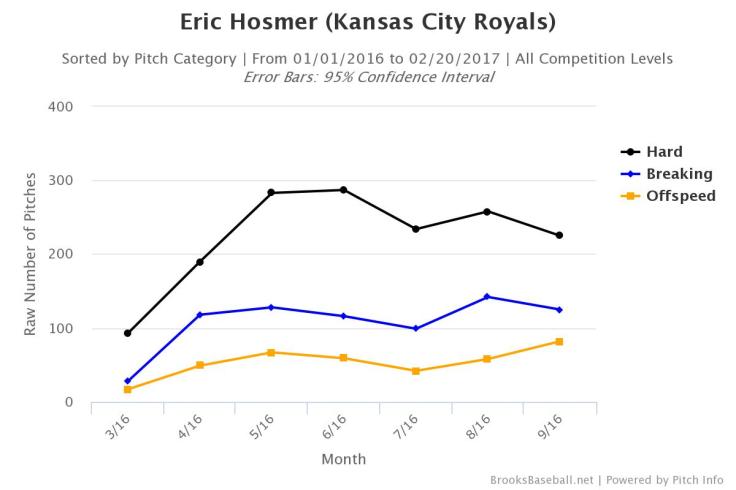
When I looked at his struggles last summer, I noticed a change in his approach at the plate, preparing for the pitch. Hosmer went from a toe tap that seemed to steady his body and cause less movement to a high, exaggerated leg kick that caused much more movement as the pitch was delivered. While the leg kick would sometimes help him deliver more power, it also seemed to throw his body out of balance from time to time. The concern with that was a lack of consistency, which has become a staple of Hosmer’s major league career. In looking back last year at his slumps, it became more and more evident that Hosmer is very inconsistent when it comes to his production. In fact, when looking back through his career, almost every year saw him run into a long cold stretch at some point in each season where he produced very little offense. Now, all players go through slumps and it is rare to find a player who can be consistent throughout an entire season. But Hosmer doesn’t just slump; he looks lost for 4-6 weeks at a time. The biggest concern is his ability to adjust, which he never seemed to do in the second half of 2016. Pitchers started throwing him more breaking balls starting in May:

brooksbaseball-chart

It is very obvious that pitchers adjusted to Hosmer and threw less and less fastballs to him while giving him a steady diet of breaking and off-speed pitches through the rest of the year. If the Royals locked Hosmer up to a long-term deal, I would worry that these struggles would continue and it is hard to justify him being in the middle of the Kansas City order when he stumbles into another lull.

kc6

The other concern with Hosmer is his inability to elevate the ball. In 2016, Hosmer led all qualified batters in baseball with a 58.9% groundball rate. In fact, throughout his 6 year career, his lowest rate has been 49.7% in his rookie season. In comparison, Mike Trout’s highest groundball rate is 44% in his rookie season. Now, no one expects Hosmer to be Trout (seriously, there is only one Mike Trout) but it proves the point I am trying to make: for Hosmer to be considered an elite player, he needs to hit the ball in the air more and less on the ground. Hosmer saw a major decrease in his line drive rate last year (23.6% to 16.5%) and a philosophy of more line drives and less ground balls would be a recipe of success for him. Sadly, I don’t know if that is possible, since he has averaged a 53% groundball rate through the first six years. For him to see a change, it is going to have to be a complete mental change-up to what he has been doing up to this point.

kc7

So how serious is Kansas City about getting Hosmer locked up? It appears to be serious:

“We as an organization have a strong desire to extend Eric,” Moore said. “We’re confident in his desire to be here in Kansas City. As with him and all our players, we’ll work as hard as we can to execute a deal.”

The issue could very well be length of contract, as it appears as if Hosmer is asking for a ten-year deal:

Hosmer isn’t nearly as accomplished offensively as either of those players was, but the Royals anticipate that he will seek a 10-year deal, knowing that a number of high-revenue clubs — including the Red Sox, Mets and Phillies — could seek a first baseman next off-season.

I don’t know about you, but a ten-year deal just feels like the recipe for disaster. I firmly believe no player is worth that long of a deal and definitely not Eric Hosmer.

kc8

Years ago, the Royals locked up another first baseman, Mike Sweeney, to what would eventually be a five-year deal that seemed a positive for the team at the time. Sweeney was a year older than Hosmer (he will be entering his age 28 season in 2018) at the time, and by the end of that deal, injuries had turned Sweeney into a shell of his former self. Go look at the Joe Mauer deal, or Prince Fielder, or any other long-term deal for a first baseman; outside of maybe a Joey Votto, most have not panned out. While Hosmer shows the ability to possibly be a major offensive contributor, there is a feeling that what we have seen these last few years is what we would end up with. When adding up the length of the deal as well as the money that would be involved (and there is no way his deal wouldn’t be a pricey one for Kansas City), it would make more sense for the Royals to spend their money elsewhere. Hosmer reminds me of that shiny novelty item you find while you have some spare coin in your pocket. Sure, it looks nice and shiny and you can already imagine what all you could do with it…but…after awhile you wonder why you wasted your money on something you won’t ever use again. So you end up trying to sell it on ebay and hope you can at least salvage 1/3 of what you initially paid for it. While some Royals fans would love to see Hos locked up long-term, I tend to think the deal would be a regret within just a few short years. Call me crazy, but the Royals could do better than keeping Hosmer in the fold. I’ll go a step further-I feel he is overrated. If Kansas City is serious about locking up anyone who could be gone after this season, all they have to do is look across the diamond. There is a third baseman who feels like a perfect fit for this team and has shown improvement over the years. That would be my choice, but I’m not the GM. By the end of Spring Training we should have our answer, as Hosmer has said he will negotiate until the season starts and if nothing happens by then he will take his chances in free agency. I tend to think no news before Opening Day is good news; Hosmer is not the savior Kansas City needs.

Royalty’s Notebook: February Royals Thoughts

kc1

Spring Training is so close that we can practically smell the freshly cut grass and see the perfectly drawn baselines. It’s that time of year when the phrase ‘Pitchers and catchers report’ is music to any baseball fans ears. Over the last few weeks, I have had a number of thoughts littering my head and figured rather than writing four separate articles, I would shoot out a few short notes on some Kansas City Royals related activities that have been going on. What better way to start than with the pitcher we call ‘Duffman’…
kc2

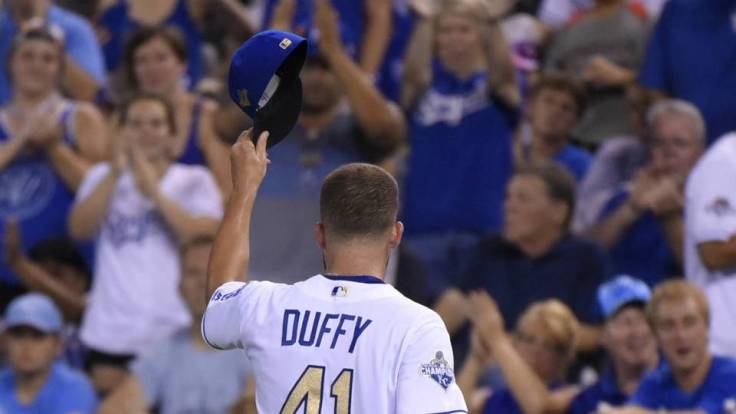
There are so many reasons to love Danny Duffy right now. Duffy showed himself to be a true front of the rotation starter last year and was rewarded with a nice new contract, which means he will be around for at least the next five years. There is his return to twitter where he is trying to do some good. Speaking of Duffy the good samaritan, if you weren’t already ‘Team Duffy’, than him meeting and talking to fans at Kauffman Stadium after Yordano Ventura’s death should have swayed you. But the story that made me really proud to know that Duffy is on ‘my team’ is the one where he bought a Yordano bobblehead. This story must be read, so click here. In short, a Royals fan in the Kansas City area sold his Ventura bobblehead on ebay and right before he mailed it off, he saw it was addressed to Duffy. He canceled the payment and sent Duffy a message, telling him he wasn’t going to charge him for the bobble. Duffy told the guy he was trying to buy up as much Yordano merchandise as possible and then mail it to his mom at the end of the season. When I first read that, a legit huge smile broke out on my face. I have long rooted for Duffy to succeed, if anything because the guy has shown again and again that he is an awesome human being. The fact that he was accumulating as much Yo’ memorabilia as possible because it would help her “remember the good times” was just phenomenal. Talk about being proud that he is in Kansas City; I have never seen an athlete who is so open about his feelings AND in such a positive way, to boot (Yes, that was slightly directed at Zack Greinke). We might love our Salvy, our A1 and our Moose, but dammit if I’m not a Duffy fan for life because of what he represents as a player and a person.

Royals Preview Spring Baseball

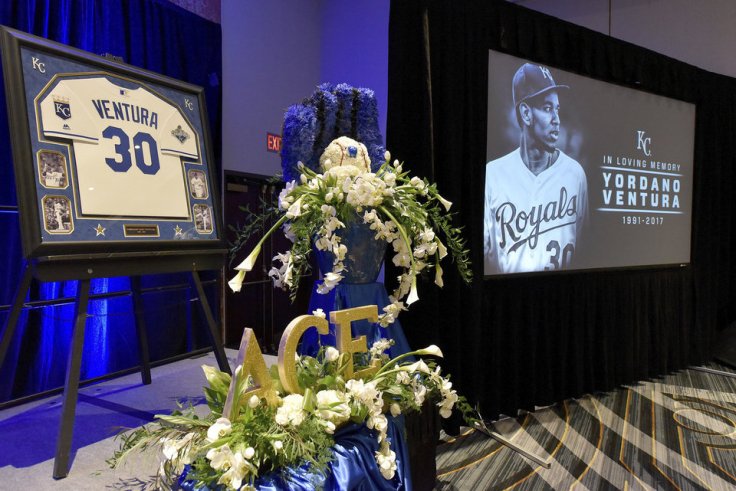
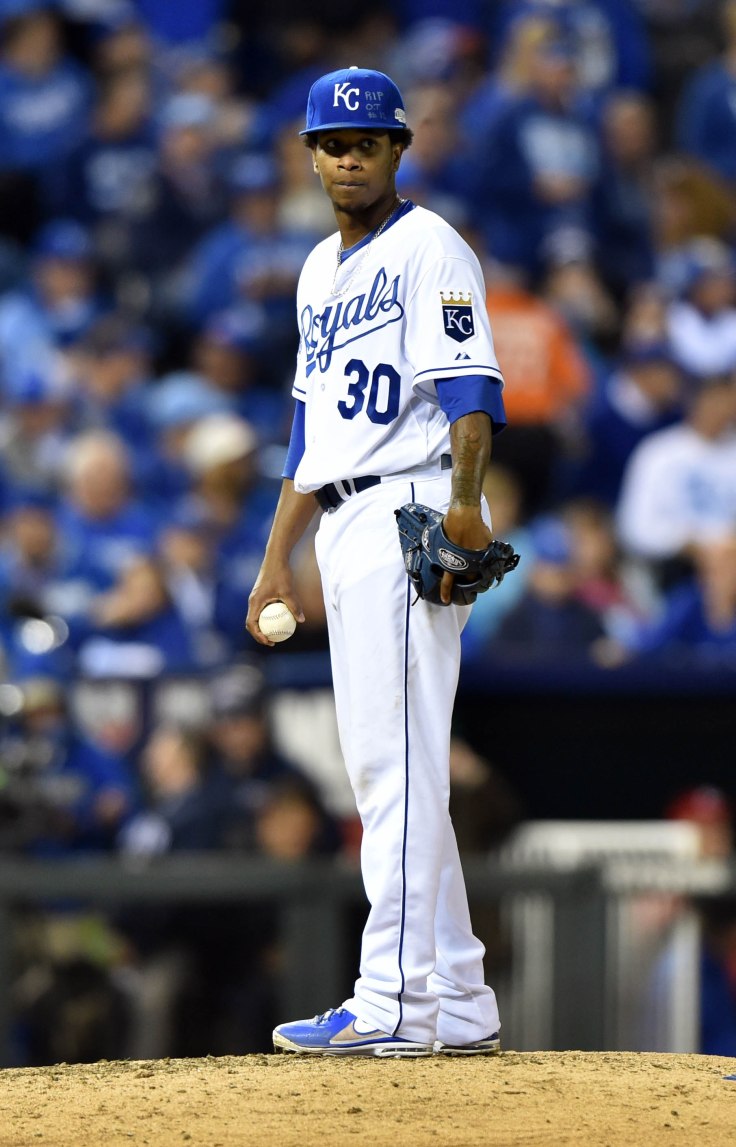
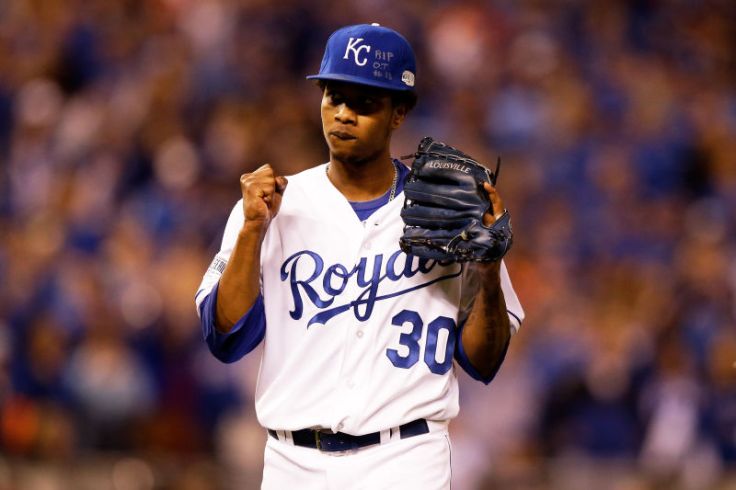
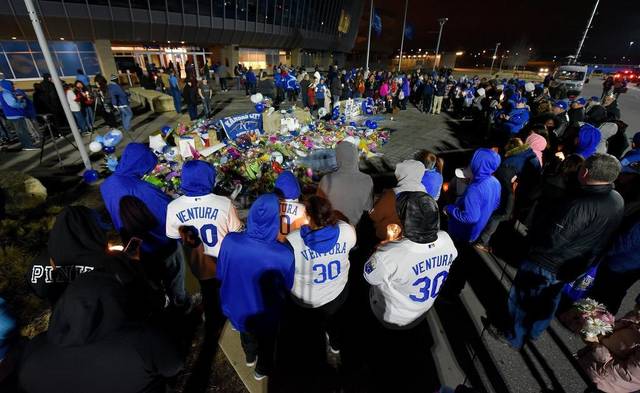
Speaking of Ventura, there has been a call amongst many Royals fans for the team to retire his number 30 this season. I understand that for most of us there is an emotional attachment to the group of players who guided this team to their first championship in 30 years. I was just as broken up about Ventura’s passing as most other Royals fans and I figure the home opener on April 10th will probably cause a few lumps in throats. That being said, it feels like the push to retire his number is an emotional thought and not a logical one. Over the team’s 47 year history, they have retired three former Royals: George Brett (5), Frank White (20) and Dick Howser (10). That’s it. In my eyes there have been a few worthy numbers that could have been retired by Kansas City over the years, but I do like that they aren’t just retiring numbers left and right. To me, if you are going to go that route, it better be a player who really marked their spot in franchise history. While Ventura had a number of big moments in his short career, he did only have three full seasons under his belt, and was just slightly above league average overall during that time. I have heard a number of great ideas in honoring Ventura this year, like leaving the ball on the mound opening day and letting manager Ned Yost make a “pitching change”, or naming a baseball academy down in the Dominican Republic after him. Those are just two great examples of honoring his passing and I wouldn’t even have a big issue with putting him in the Royals Hall of Fame in the future, even if it would feel like it was being done because he passed away while still with the team. But retiring his number feels like an emotional reaction to his death and I just don’t agree with it. I’m sure the Royals will honor his time in Kansas City this year and they should; but lets not overreact. Honoring Ventura is fine, but retiring his number is unnecessary and to be brutally honest, not really earned.

MLB: Minnesota Twins at Kansas City Royals

With the Royals signing of Jason Hammel this week, Kansas City has marked off almost every need that they were searching for this winter…that is, except for another bullpen arm. The thought has been that the Royals would possibly sign one more reliever and with Spring Training looming in just a few days, there could be a last-minute signing, especially if they bring Luke Hochevar back into the fold. Hochevar is coming off of Thoracic Outlet Surgery but it’s been thought all along that as long as he is healthy, the team would look to bring him back to Kansas City. If not Hochevar, there are a few options still available on the market. Guys like Travis Wood, Jonathan Niese and former Royals Joe Blanton and Jorge De La Rosa are still available. The Royals also checked in on Seth Maness last week, the former Cardinals reliever who bypassed Tommy John Surgery and elected an experimental surgery that would have him back on the field in 7 months. While I tend to think Hoch will be back fairly soon, Kansas City has many choices and with a group of young arms also in the running ( Josh Staumont, Kevin McCarthy and Eric Skoglund among them) there will be some definite competition in the bullpen this spring for the Royals.

Boston Red Sox v Kansas City Royals-Game Two

The Hammel signing also meant that room would have to be made for him on the Royals 40 man roster, and Alec Mills was the unfortunate person to be sent packing. Mills was dealt to the Cubs for outfielder Donnie Deewees. Mills was a solid arm for Kansas City’s system but at best was probably someone who would have success out of the bullpen rather than in the rotation. Deewees is an interesting acquisition, as he is a speedy outfielder type that Dayton Moore continually covets. The scouts evaluation of Deewees seems to be on par with current Royals outfielder Billy Burns:

ESPN’s Keith Law recently rated Dewees 15th among Cubs farmhands, noting that he’s a 70-grade runner that can handle center field from a range standpoint but has a 20-grade arm that limits him to left field. Longenhagen ranked him 19th among Cubs prospects offering a similar take (albeit a 30-grade arm instead of 20), writing that without the power to profile as a left field regular, his best scenario is a Ben Revere type. B-Pro’s Steve Givarz was a bit more optimistic about his glovework but still pegs him as more of a fourth outfielder than a potential starter.

Deewees is still only 23 years old and more than likely will start the year in Kansas City’s High A Ball team in Wilmington. This could be a trade to monitor over the next couple years and see how Deewees has (or has not) developed. When all else fails, Moore will always lean towards speed.

kc7

Finally, Kansas City went out and signed Brayan Pena to a minor league deal this past week. Pena is a former Royal who played for Kansas City from 2009-2012 and spent most of his time as a backup catcher. Pena is a serviceable receiver who has a bit of pop in his bat and is well liked in the clubhouse. The honesty is that this is a depth signing and much like Tony Cruz last year, Pena will most likely be spending his time in Omaha this year unless something goes wrong for Salvador Perez or Drew Butera. It’s good to see Brayan back in blue, but I wouldn’t expect to see much of him once the season starts.

kc8

In just a few days pitchers and catcher will be reporting to Spring Training and we can actually start digesting some news on our ‘Boys in Blue’ and start getting a feel for what the major league roster will look like come April. I can say with all honesty that I feel better about the feel of this roster now than I did even a few weeks ago. For all intent and purposes, the Royals are looking to gain back what they lost last year, which would be the top of the Central Division. Next week, step one begins on a long road to their (hopeful) final destination, October baseball.As always, hope springs eternal.

Royals Add Rotation Arm, Sign Hammel

kc1

Ever since the untimely death of Yordano Ventura, the general feeling was that the Kansas City Royals were going to have to go out and acquire another starting pitcher. Names like Doug Fister and Travis Wood, but the name that was mentioned multiple times was Jason Hammel, the best available arm still on the free agent market. Royals GM Dayton Moore can be a sneaky dealer, and while most were zoned in on the Super Bowl, Moore made his move:

The Royals got their man in Hammel, locking him up for two years, $16 million dollars with a mutual option (of course Dayton gave him a mutual option!!) for a third year. As of this writing the breakdown of the financials have not been released (I would tend to think the annual salary will be higher in 2018 than this year) but even without that knowledge the Royals seemed to have locked down a solid mid-rotation starter at a fairly cheap rate.

kc2

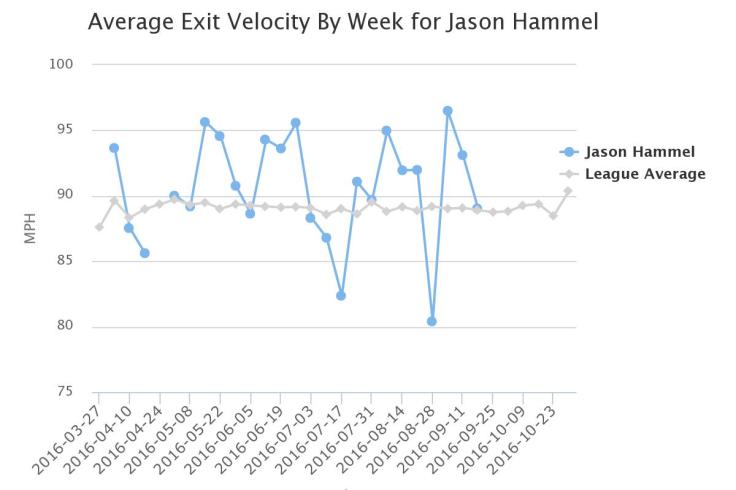
So what kind of production should Kansas City expect from his signing? Hammel pitched for the Cubs in 2016, racking up 166 innings with a 3.83 ERA, 4.48 FIP and an ERA+ of 105. Hammel raised his ground ball rate last year, posting at 42%, his highest percentage since 2012 in Baltimore. He’s not a big strike out guy, but he did put up a 13.2% strike out to walk ratio, and both his strike out and walk rates in 2016 were about league average. He does throw his slider quite a bit, in fact he threw it 35% last year, the 4th highest percentage of sliders for qualified pitchers. Hammel did improve his left on base percentage last year bumping up to 76% while his batting average on balls in play also took a step downward. A very positive sign for Hammel in 2016, especially where it concerns not only Kansas City but pitching at Kauffman Stadium, was how hard the ball was hit off of him. His line drive saw a dip this past year while his ground ball rate saw an increase. Hammel really didn’t see a major shift in hard hit rate or soft hit rate and his exit velocity is interesting:

chart

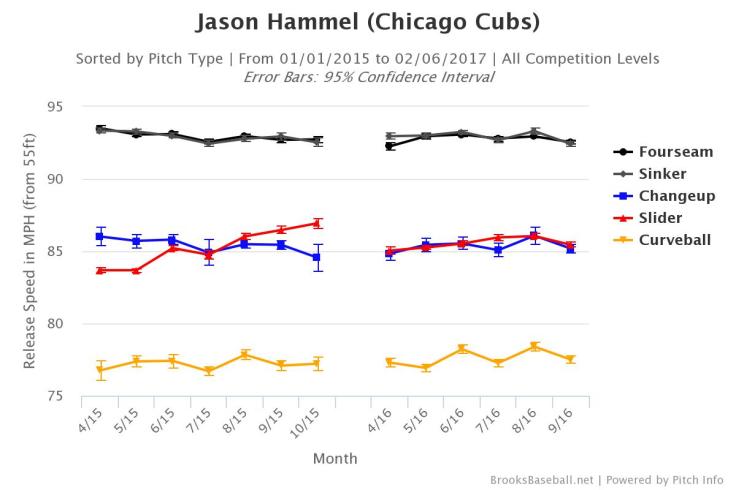
While Hammel was up and down when it comes to exit velocity, this is actually fairly accurate throughout his career. His velocity also didn’t see a big change in 2016:

brooksbaseball-chart

The chart above has Hammel’s velocity for both 2015 and 2016. What was very noticeable, especially with his changeup and slider, was the consistency in 2016 compared to 2015. It really seemed that Hammel was able to not vary much month to month, which is a positive considering some of the rumors that were floated out there this winter.

kc3

One of the reasons Hammel was still available this late in the winter was because of a feeling that he was hurt late in the 2016 season:

If you looked at the exit velocity chart above, Hammel appeared to not pitch after the middle of September and he wasn’t on any of the Cubs postseason rosters. The Cubs also declined his club option for 2017 after the season, which was fairly reasonable at $12 million. All this led to many teams assuming that he was hurt and probably hurt his chances out on the market this winter. Normally, pitchers who are injured show a decrease in velocity, which is normally an indicator that he is injured. If you look at the velocity charts above, they are pretty steady. That shows me that any injury concerns can probably be put to bed, unless a major decrease shows up when games start in Spring Training.

kc4

Financially, Hammel’s signing appears to be a steal for the Royals. Even if his contract calls for a split of $8 million a year (and once again, I’m expecting us to find out it is lower than that for year one of the deal), that puts Kansas City’s payroll just a bit higher than what Owner David Glass was wanting, but not too far off. Considering Hammel has averaged 161 innings a season over the last 8 years, this is a great deal and once again shows what a fantastic job Dayton Moore has done this winter while working under financial restrictions. In fact, Hammel’s deal looks fantastic in comparison with former Royal Edinson Volquez’s contract he got from Miami:

Steamer projections are expecting Hammel to produce 1.3 WAR this year, while 2.0 for Volquez. But if you go more off of last year, Hammel produced 1.4 WAR while Volquez compiled 1.5. The two pitchers are fairly similar with Hammel about a year older in age. If you asked me which pitcher I would want going into 2017, I would take Hammel. Hammel produced a lower walks per 9 and hits per 9 than Volquez, and over their respective careers, Hammel has shown more consistency. In many ways, Hammel is a perfect replacement for Volquez, even if it feels like he is in Kansas City now because of what happened to Yordano Ventura.

USP MLB: CHICAGO CUBS AT MILWAUKEE BREWERS S BBN USA WI

With pitchers and catchers reporting in about a week, it’s good to see that the Royals are now set and ready to go all across the diamond. Hammel is the final piece of the rotation puzzle and should be a steadying veteran force in the middle of what is looking more and more like a good group of starting pitchers. The Royals should expect consistency more than anything else from Hammel this year and that is a strength that some take more lightly than they should. It’s unfortunate the circumstances that brought Hammel to Kansas City (and I do feel the Royals don’t sign him if Ventura is still with the team) but he is now ready to wear Royal blue and represent Kansas City. It’s another good acquisition from the Royals front office and they should be applauded for their work this winter. One thing I ask of Royals fans this year: don’t bring up the Wild Card game to Hammel. I’m sure he will hear enough about it when he shows up to Arizona this spring. I can already hear Salvy joking with him about his game winning hit…trust me, Hammel will take it much better coming from Perez. I mean, who could hate Salvy?

https://youtu.be/UaiUVUAX1Rs

Straddling The Fence

kauffmanfireworks1

Being a longtime Kansas City Royals fan can give someone a different perspective of the team than say, someone who has only been around the last couple years. There is a section of the fanbase that sat around during the “Lean Years” so to speak, an era where many a time we would be accepting of an errorless game, or a quality start from the starting pitcher that day. Trust me folks, years ago the bar was set really low. With that being said, this winter the Royals have been fairly quiet on the acquisition front, as we have essentially seen the Jorge Soler trade and the Nate Karns trade with a few minor signings sprinkled in. I’ve actually felt like both trades made sense and were quality deals on GM Dayton Moore’s part. I even liked the Peter O’Brien signing and don’t hate Jonathan Sanchez being brought in on a minor league contract. But something else has been gnawing at me this winter and these trades have reinforced my worries. It appears on the surface like the Royals are neither “going all in” this off-season nor “rebuilding”. In fact, it appears as if Kansas City management is straddling a fence that often isn’t very successful.

KC Royals VS NY Mets, Game 2, 2015 World Series

I feel like I need to be a bit more clear in my estimation, as it could be taken as if I am saying the Royals won’t be in a position to contend in 2017, which I don’t feel at all. In fact, I feel as if Kansas City has a great chance to be in the playoff hunt this year, as we enter the final year of a contending window with the current nucleus in place. That is a big part of my worries right there; after this season, Eric Hosmer, Mike Moustakas, Alcides Escobar and Lorenzo Cain will be free agents. Danny Duffy was also set to go out on the market, but luckily he was given a long-term extension while Wade Davis and Jarrod Dyson, two more potential free agents after 2017, were dealt in the trades mentioned above. The front office has known for years that this was the final year of winning with this group and while the initial plan was for the farm system to keep spitting out major league ready talent, that hasn’t turned out to be the case. Knowing that there was not really any help on the horizon down in the minors (although someone like Hunter Dozier could contribute as soon as this year), this felt like the season where the team should be “all in” and put the team in the best position to reach the playoffs. That has not happened and not all of that can fall at the feet of Moore. No, you have to look higher up on the food chain to find the biggest issue facing the front office.

kc2

Back in December, it came out that Royals owner David Glass didn’t want the team to increase the payroll for the 2017 campaign, putting Moore and his associates in the front office in a weird position. Moore over the years has always tried to temper expectations and kept his cards close to the vest, but apparently he really meant it this year when he said that the team wouldn’t be able to take on more payroll:

“We’re simply not in a position to add to our current payroll,” Royals general manager Dayton Moore said.

This is why Davis was traded and why Dyson wasn’t far behind; Moore was trying to shuffle the roster by unloading any payroll he can why acquiring players who are younger, cheaper and are under club control for the immediate future. In fact I will go a step further and say Moore has done an admirable job trying to keep the foundation of the team together to make another run while keeping the payroll within Glass’ desired level. Yes, some of this falls at the feet of Moore; he is the one who gave Ian Kennedy his 5 year contract, Omar Infante’s contract that the Royals are still paying for this year and backloaded a number of contracts to make the team’s money situation work in years past. But more than anything this feels like Glass being cheap, which he really hasn’t been these last few years. Why pull back now when more money could be had if the team goes back to the playoffs?

kc3

When I first started understanding the business side of baseball, I learned very quickly that to make money in baseball you have to spend money. There has never been a major league owner that pinched pennies and made a fortune off of it; maybe for one year or some random event but none consistently. Instead, the teams that have made a ton of money did so by spending as well. Now, I am not saying that the only way to make money in baseball is to spend like the Yankees, Red Sox or Dodgers; in fact, many of those teams that were high spenders didn’t even profit from playoff teams to really max out their wealth. So I am not saying Glass should just spend willy-nilly and expect profitable results; no, there is a way to spend wisely while not going over any self-imposed budget. The perfect definition of that could very well be those Royals teams that made the playoffs in both 2014 and 2015. Glass spent more money those two years than any other Royals team and he made more money both of those years than ever before because of the team playing into October. I am not saying Glass should give Dayton an open check and tell him to go get what they need; that should probably never be done, period. But a slight bump in the payroll could give this Royals team a chance to improve a few holes in the team’s roster and improve their chances of winning this year. With the Twins and White Sox rebuilding and the Tigers also straddling a fence (they have hinted at dealing some of their veterans this winter but alas none have been dealt), realistically that would leave the Royals and Indians to battle it out for the American League Central in 2017. That could still happen, but one has to wonder how this team will improve based just off of players being healthy and expecting many to improve on their 2016 output.

MLB: Minnesota Twins at Kansas City Royals

The other issue at hand is tied up in Moore’s trades this winter and what they mean for the future of this team. Like I said, I have liked both trades he has made and feel getting Karns and Soler were excellent acquisitions for what Kansas City is trying to do. But…it does appear on the surface that they are trying to win this year while also building a club controlled roster after the expected departures next winter. The team is neither “all in” or “rebuilding” and this is a problem. In the past, team’s who have tried to leverage a situation like this have eventually decided to take either one path or the other once they figured out that taking neither wasn’t working. We don’t have to look far to see what kind of problem this can cause-just look at the Philadelphia Phillies. In 2012, the Phillies finished .500 while employing a roster of veterans like Ryan Howard, Jimmy Rollins and Roy Halladay. The team attempted to re-stock in 2013, adding Michael Young and Ben Revere while keeping the older nucleus in tact. The team floundered that year, losing 89 games and it appeared a rebuild was in their future. Instead, they acquired A.J. Burnett right before Spring Training that year, and would rack up another 89 loss season. It wasn’t until after that season that the organization put forward a full-scale rebuild on the franchise. The Phillies learned that straddling that line between rebuild and contending normally doesn’t work out and I’m afraid Kansas City will learn the same lesson.

alex1

Since the idea of drifting between contending and rebuilding sounds counterproductive to me, I am in the camp that the Royals should be going for it this year. This is the last year of the window with Moose, Esky, Hos and Cain, so now would be the time to give this team its greatest opportunity to return to the playoffs. The farm system has very little in the way of help next year and this is an organization that didn’t make it to postseason play for 29 years before 2014; now is the time for one last run. The logic I am using is that if Glass agrees to spend even just an extra $10-$15 million to upgrade a few spots, they would at least be giving this squad the best opportunity to reach October baseball. We have zero idea of what will happen after 2017, and the likelihood that the Royals are even able to bring back more than just one of those four free agents is probably slim and none. The thinking is that if the team puts forth another winning season, the stadium will be packed and Glass will make his money back and then some. Instead, it feels like he is saying “we won a World Series, I think we’ll just stop there”. Even if the team doesn’t make it back to the postseason this year, Glass can go cheap in 2018 with a much younger ballclub, make his money that way and no one will think less of it, since they would be “rebuilding”. This group of players deserve one last shot at etching a legacy in Kansas City but the chances of that happening at the moment don’t look as good as it should be.

kc6

So what does this all mean for the 2017 Kansas City Royals? It means that while this club on the surface still looks like a contender, things could go awry very quickly as well. One does have to wonder, after the soul-crushing death of Yordano Ventura, if the team might go out and pick up a replacement starter for the rotation or if they will attempt to fill his spot with a Matt Strahm or a Mike Minor. Even if another acquisition is looming, I’m not sold that this is the best Royals team that could be pieced together. Could they contend with this squad? Of course. But does this feel like a team that could cause damage in October? Not likely. I could be wrong but it feels like ownership is not giving this team the best chance to bring the World Series back to Kansas City, and that saddens me. It’s easy for me to sit here and say “spend more money”, when it isn’t my own. But if I understand the structure of a major league baseball team that wants to contend, you don’t half-ass the project. It should be all about winning the whole damn thing again this year and instead it feels like someone just waiting to turn the lights out. We have no clue how much of a chance the Royals will have to make the playoffs again after 2017; why not go out with a bang and get the band back together for one last gig? Instead it feels like a farewell tour where we keep asking them to play all the big hits one last time before hitting the road. At this point, Royals ownership should do right by the fans, the front office and even the players who have given their blood, sweat and tears these last 4-5 years. It’s time to push the chips all in and go for broke. Now is not the time to stop halfway and assume that will do the trick. It’s time to go for broke…and trust me Mr. Glass, this won’t make you broke. In fact it could increase your wealth for years to come…

Yordano Ventura Remembered

kc2

You often hear that “baseball is a kid’s game”, a phrase that bears a ton of truth. For many fans, they fall in love with the game at a young age and never lose that youthful exuberance when at the ballpark. Players are no different, as many play as if they are still ten years old, kicking dirt on a backfield while playing a pick up game with friends. The realities of life sometimes slip away during the span of a baseball game, as all the daily worries seem to slide into a separate filter, only to be untapped at a later date. Last year, baseball lost a grown up kid in Jose Fernandez, an elite pitcher who’s life was taken all too soon. On Sunday, Kansas City Royals pitcher Yordano Ventura, just 25, fell to the same fate, dying from a traffic crash in the Dominican Republic. Ventura was not wearing a seat belt and was thrown from his vehicle after losing control of it on the highway. Apparently there was some thick fog when the accident happened. For a guy who only pitched three full seasons in the majors, there are a ton of memories for Royals fans to remember him by.

kc3

Ventura first started showing up on most Royals fan’s radar in late 2012, a season where he fanned 130 batters in 109 minor league innings. His ascension in the Royals farm system continued in 2013, where he struck out 155 hitters in just 134 innings and was a September call-up that year, starting three games while throwing just 15 innings and producing an ERA+ of 120. The report back then was pretty simple; lanky righthander with a power arm that would sometimes allow too many baserunners. He was already getting comparisons with Hall of Fame pitcher Pedro Martinez, as there were even questions on whether or not his frame could hold up to a full major league season. That would be put to the test in 2014, as Ventura made the team out of Spring Training, throwing 183 innings, posting an ERA+ of 123, a FIP of 3.60 and a strike out to walk ratio of 2.30. Ventura would end up 6th in the Amiercan League Rookie of the Year voting. He was already cementing his spot in the Kansas City rotation and would further that even more in October.

kc4

It’s funny looking back at it now, but Ventura would make his playoff debut in the 2014 Wild Card game against Oakland, in a very controversial outing at the time. Ventura would be brought in from the bullpen after the 6th inning had started, and would face only three batters; one would single,Brandon Moss would hit a home run, and he would get one batter out.

https://youtu.be/6GEE7VdZmps?t=55s

After the homer, the Royals would be down 6-2 at that point and even to this day, it felt like a weird move to make. Why would you bring in a rookie, who had started all but one game all season, in the middle of the inning with a runner on base rather than bring him in during a clean inning? It seemed like a move that could have cost manager Ned Yost his job. Luckily for Yost, the Royals would come back and win the game in extra innings and moving forward we would only see Ventura start in the postseason.

kc5

In fact, it was during that postseason that he would pitch the greatest game of his career. In Game 6 of the 2014 World Series, with the Royals on the edge of elimination, Ventura would pitch in honor of his friend Oscar Tavares (a Cardinals prospect who had five days earlier passed away from a car accident) and throw a gem against the San Francisco Giants, pitching seven shutout innings, striking out 4 while only allowing 3 hits.

It was hard at that point not imagining Ventura being the future of the Royals starting rotation and putting together a string of memorable outings. Over the years, Kansas City had a number of excellent pitchers to hang their hat on: Saberhagen, Busby, Leonard, Cone and Greinke just to name a few. At this point it felt like we would be able to add Ventura to the list. But that wasn’t how things played out.

MLB: World Series-San Francisco Giants at Kansas City Royals

While the Royals were better in 2015, Ventura seemed to fall down a peg. Ventura would throw 20 less innings in 2015, while his ERA+ was right around league average (103) and his bWAR fell (3.2 to 1.9), his strike out to walk ratio and FIP would slightly improve. 2016 wasn’t any better, as his ERA+ fell below league average (98), while his FIP and WHIP both rose to career highs.His strike out to walk ratio also fell, as his strike out total fell while his walk total increased. It was obvious to some at this point that Ventura’s real battle was going to be harnessing his emotions while on the mound.

kc7

The first bout of his emotions getting the better of him occurred in 2015, as early in the season Ventura would get upset at a Mike Trout single that breezed by his head. It was chalked up to just being a heat of the moment type thing, at least until the incident against Oakland later in the month. After some bad feelings on Friday night (thanks to an aggressive Brett Lawrie slide), Ventura would give up a home run to Josh Reddick in what to that point had been a rocky outing for the young flamethrower. Ventura would follow by plunking Lawrie with a 100 mph fastball and the benches would empty. I was at the ballpark for that game (which I was super excited about since it was the first Yordano game I was getting to see in person) and was disappointed with Ventura’s obvious decision to get himself taken out of the game. Ventura would get ejected again in his next start, as Adam Eaton of Chicago would get under his skin and start a melee. A reputation would be earned at this point for Ventura, that of being a hot-head, and other teams would try to take advantage of this by trying to get him riled up and off his game. That reputation would hit an apex in June of last year as he would tussle with Manny Machado of the Orioles, hitting him and causing everyone to question Ventura’s mental stability on the mound.

https://youtu.be/EKXc9DFp4m0

But was this really who Yordano Ventura was? The answer, like most things, was more complicated than that.

MLB: Cleveland Indians at Kansas City Royals

For all the posturing and cockiness, there was a guy with a big heart inside of Ventura. Many of the Royals players, while frustrated with his shenanigans on the mound, considered him their “younger brother”, disappointed with his actions but supporting him all the same, knowing he was still young and finding his way. They saw the kid who would get upset after a tough loss, feeling like he let the team down with his performance on the field and hoping to work better. For every outburst, there were just as many (if not more) days where you could see a smiling Ventura, loving where he was at considering where he came from. While the Royals had become disappointed with his behavior sometimes, they saw the kid who was watching tape, listening to what his coaches were telling him and who was one of the hardest working guys on the team. Ventura was human, like most of us and with that comes the good and the bad.

kc9

As a fan, most of us were equal parts enthralled and impatient with him. For every outing where he struggled to keep his cool, there was one that gave you hope that the ceiling was starting to be reached. For every emotional outburst there was a perfect setup of a batter, luring the batters in with the heat before finishing them off with the nastiest of curveballs. For a team that has struggled producing quality starting pitching, Ventura was that hope that the Royals had finally found their Marichal, their Martinez, their Fernandez. He was the scrawny kid from the Dominican Republic who was signed at 16 years old, throwing in the mid 80’s, hoping he would grow to be something more. He had grown to be something more…but unfortunately we will never find out just how much more.

kc10

No human being should meet their fate at the age of 25, let alone an athlete who hasn’t reached the peak of their career yet. There was so much more life to live, so much more for Ventura to give and I don’t even mean on the mound. What most people will remember from Yordano Ventura won’t be the fastball, or the fights or the swagger. No, most people will remember that smile, a smile that was infectious and was a little kid’s smile in a grown man’s body. Even at 25, Ventura was just a little kid getting to throw a baseball for a living. That will stay with me much longer than individual accomplishments or frustration I had with him as a player. Ventura was that sign of hope that all of us look for in our baseball team’s, that hope that tomorrow will be a brighter day. While today was a dark one for baseball fans, I promise tomorrow will be brighter. As fans, our days were brighter with the hope that Yordano Ventura’s arm and smile brought us.

Duffman: Signed, Sealed & Delivered

kc1

Most of the focus this winter for the Kansas City Royals has been on how they were going to bounce back in 2017 while trimming payroll, as the team’s cavalcade of free agents after this year looms in every conversation about this team. Throughout all this, there has been a growing sentiment (one of which was from me last summer) that the Royals real focus should have been on getting a new long-term contract worked out for staff ace Danny Duffy. After word leaked out back in November that Duffy and the Royals were negotiating a contract extension, it was hard not to get excited about a deal getting done before Spring Training in February. But as November became December and December became January, worry started to set in. Luckily, all that worry was for not, as Kansas City has locked up Duffy with a 5 year, $65 million dollar deal. Now that Duffman is signed, sealed and delivered, let’s break down the deal and how it will affect the Royals.

MLB: Atlanta Braves at Kansas City Royals

Let’s start with the specifics:

Duffy had asked for $8 million through arbitration last week and the Royals had countered with $7.25 million for 2017. Obviously, GM Dayton Moore has backloaded this deal, which trims some money from Kansas City’s 2017 payroll. Not a big shock, as Moore has shown a tendency to backload contracts to keep the current payroll as low as possible. This will give the Royals some flexibility this year in case the team decides to make any further moves, which it would appear very well could be the case. This is a move that not only is exciting for us fans but for Kansas City management as well:

“We’re very excited to have Danny Duffy with us for the next five years,” Kansas City general manager Dayton Moore told MLB.com. “Danny is someone who fits in with our organization and within our community.”

It was obvious that Duffy’s 2016 season was a deciding factor in working out an extension with him:

“He has begun to separate himself among the top left-handers in the game,” Moore said. “As I said, very excited to know he’ll be a Royal for quite some time.”

Considering how the market has grown the last few years, especially for pitchers, this deal could actually turn out to be a steal for Kansas City, as it is a fair comparison to other elite left-handed starters in baseball. As an example, Chris Sale (who will be the same age as Duffy next year) will be making $12 million this year, $12.5 million in 2018 and $13.5 million in 2019. Duffy’s deal will be just slightly less than Sale’s but within that same ballpark. While Sale has had more success to this point in his career, they are very similar pitchers in many different aspects and it is easy to see Duffy being discussed in the same sentence with Sale if he continues to pitch the way he did in 2016.

kc3

Maybe the biggest advantage to getting Duffy locked in is making sure the rotation is taken care of past this upcoming season. If Duffy had left through free agency after the 2017 season, that would have left Yordano Ventura and Ian Kennedy for the Kansas City rotation followed by a bunch of question marks. Chris Young has a team option and Mike Minor has a mutual option for 2018, but both are question marks in the first place so who knows how valuable they will be in 2017, let alone the year after. Matt Strahm is a possible future fixture in the rotation, but at least in the immediate future he looks to be ticketed for the bullpen. Nate Karns could also be in the back-end of the rotation, but he could also be better suited for the pen. What about any prospects in the farm system? Pitching-wise, there is very little on the immediate horizon, as guys like Miguel Almonte and Christian Binford have taken a step back, Kyle Zimmer can’t stay healthy and Josh Staumont will probably end up as a valued piece of the bullpen. The good news is that the Royals would have had options, but none of the names mentioned would be able to be what Duffy was last year, which was the stopper, ace and leader of the pitching staff. When the Royals scored 0-2 runs in a game, Duffy had an ERA of 1.37 and a strike out to walk ratio of 11.0. Having that guy at the top of the rotation can help a team’s confidence and make a few losses not turn into a long losing streak. Danny Duffy is that guy for the Royals.

MLB: Kansas City Royals at Baltimore Orioles

More than anything, this gives the Royals a homegrown starting pitcher to build the rest of their rotation around, which has been few and far between during Moore’s tenure as General Manager. In fact the only homegrown pitcher to flourish during his time as GM (besides Duffy) was Zack Greinke, who was drafted in 2002, well before Moore was employed by the Royals. If there is one part of the Moore regime that has failed, it is the development of starting pitching. Locking up Duffy gives the Royals a homegrown pitcher that can lead the team into the future and possibly give the younger arms in Kansas City’s system someone to aspire to, an organizational cog. With Duffy signed, the team doesn’t have to go outside the organization and sign a staff leader, or trade a top prospect to get that arm to Kansas City. Instead, they have rewarded a player drafted by the team and can spend the money or prospects on something else over the next five years. Signing Duffy, in some ways, is growth for this franchise.

kc5

Over the last couple months there have been more questions than answers in Kansas City and with this signing there is one less question to be answered for the future of the Royals. The future looks a little bit brighter and (dare I say it) a little more gnar. While some might question the Royals ownership decision to not “push all the chips in” this year (and you can probably count me in that group), it is evident the front office is looking past 2017 and well into the future. Long ago, Danny Duffy said “Bury me a Royal” and while it felt a tad like pandering, you could tell the man meant it and was extremely grateful for this organization and what they had done for him. Now it is his time to return the favor. I honestly can’t think of a better representative to lead the future of this franchise into whatever direction they will be going into. Duffy is a sound investment and hopefully in the future will be discussed the same way the generation before talked about Leonard, Splittorff and Busby.

You Wanted The Royals To Sign Someone…

kc1

It’s been a slow winter for the Kansas City Royals so far. Outside of the acquisition of Jorge Soler, the possible next biggest news for Kansas City might be the team re-signing backup catcher Drew Butera. Yep, that is how slow it has been. In fact, you’ve probably heard many a Royals fan utter the phrase “Just sign someone, anyone…”. Well…you got your wish, as Kansas City signed four players to minor league deals on Christmas Eve. On that list is pitcher Bobby Parnell, infielder Brooks Conrad, outfielder Ruben Sosa and…former Royal Jonathan Sanchez. Yes, the same Sanchez who was acquired for Melky Cabrera at one point. The same Sanchez who was absolutely atrocious during his short stint in Kansas City. We will get back to him in just a moment. But first, lets look at all of these signings and what to expect from them.

kc2

Let’s start with Parnell, who is the biggest name on this list. Parnell used to be a solid contributor out of the bullpen for the Mets, including a four year run from 2010 to 2013 where he produced an average 140 ERA+ during that span. Injuries curtailed Parnell’s run after that, appearing in just one game in 2014 (due to Tommy John surgery) before returning to the Mets for 30 games in the 2015 season. That year was nothing to write home about, as Parnell posted an ERA+ of 61, a FIP of 4.18 and an ERA of 6.38. Parnell signed a minor league deal with Detroit last year but threw most of the year in AAA, putting up very pedestrian numbers. He did appear in six games for the Tigers, throwing 5 innings, striking out 4 while walking 5 in that short span and would eventually be let go by Detroit. The one positive in 2016 for Parnell was that the velocity on his fastball did increase, picking up to 94 mph on average, one mph faster than he racked up in 2015 and closer to the upper 90’s fastball seen by him before the surgery. I actually think Parnell could be a valuable asset in the Royals bullpen, as he could be in the vein of a Ryan Madson, who had been out of baseball for a couple of years before signing with Kansas City before the 2015 season. This is a quality signing by Dayton Moore in my eyes.

MLB: San Diego Padres at Chicago Cubs

Conrad is a veteran journeyman who has floated around baseball for about 15 years now and played in the Independent League in 2016. Conrad last saw action in the minor leagues back in 2015, posting a line of .190/.280/.319 in 83 games. Conrad has basically been used as a utility infielder throughout his career, seeing most of his time at third base. He has played parts of 6 seasons in the major leagues, putting up a line of .200/.271/.389 over 515 plate appearances. It’s pretty obvious that Conrad’s signing was a depth move, as he can fill a number of roles if the Royals end up placing him in either AA or AAA. In fact, I would dare to say there is a chance he was signed for the sole purpose of working with many of the younger players in the farm system and might even be a future coach in the Kansas City system. This might be a signing that was being eyed more for a future role in the organization than anything else, so I wouldn’t really expect to see him in Kansas City at anytime in 2017.

kc4

Sosa is an outfielder who has spent most of his career in the Astros and Angels organizations. Sosa hasn’t had a horrible minor league career, posting a career line of .282./.366/.391 over six seasons. Sosa is a speedy outfielder who seems to take a good amount of walks, but also strikes out quite often (319 strike outs in 419 games). What probably caught the Royals eye is his work in the Mexican League in 2016. Over 70 games, Sosa hit .371/.458/.517 with 22 stolen bases. Sosa probably is a backup outfielder at best if he would reach the big leagues, used mainly as a defensive replacement and pinch runner would be my guess. Sosa would be a long-shot to get to Kansas City and has been assigned to the Kansas City AA affiliate, Northwest Arkansas.

kc5

Finally, we have reached the main event, former Royal Jonathan Sanchez. I’m sure many a Royals fan cringed when they heard Moore had signed Sanchez to a minor league deal, as he is not fondly remembered by Royals fans. Lets not mince words-Sanchez was awful during his short span in Kansas City. In just 12 games (and yes, it feels like he pitched more than that for Kansas City), Sanchez 0.82 Strike out to walk ratio, an ERA+ of 54 (100 is league average) 6.45 FIP and a -1.3 bWAR. Before you ask, yes, Sanchez was as bad as the numbers indicate. The worst part of his run in Kansas City was that it just seemed like he didn’t want to be with the team, so he was dealt to Colorado in July of 2012 for Jeremy Guthrie. Incidentally, my first post on this blog was spent talking about that deal, a deal that was definitely one of Dayton Moore’s best. All this being said…it doesn’t really bother me that the Royals have brought Sanchez back into the fold. The honest truth is that the likelihood that he makes it to the big league club is slim and none. Sanchez hasn’t pitched in the majors since 2013, where he pitched in 5 games for Pittsburgh, throwing only 13 innings, allowing 18 runs and 7 home runs in that short amount of time. He was in the Reds camp last year for Spring Training, but was released at the end of camp. It is very simple math with this signing: if he is awful, the team will release him in Spring Training and that will be that. If he does good, then he can actually contribute to the Royals in 2017, something he didn’t do the first time around. Kansas City doesn’t lose anything by bringing him in, other than a small amount of time.

kc6

The honest truth is that moves like these are necessary for any major league ballclub. Most minor league deals are done for one very big reason: depth. A team never knows how the season will unfold and the more depth you have stored away in the minor leagues, the more likely you will stumble across someone who can contribute to the major league team. It’s a total win/win situation, as most of these signings are done very cheaply and don’t cost the team anything. Over the years the Royals have succeeded on a few of these signings, especially with a few guys who were coming off of injuries and were able to be a part of the big league roster. Ryan Madson is the most prolific, as he pitched good enough in 2015 to earn himself a lot of money from Oakland that following winter. So while these signings aren’t going to blow anyone away, you never know what might actually pan out. So I’m not going to get worked up about Sanchez being in Royals camp this spring; the honest truth is the Royals gave up nothing for him and he either pitches good or he is gone. This time around, Sanchez needs the Royals more than they need him.

The Future of Josh Staumont

kc1

There is no greater currency in baseball than prospects. Prospects can make or break your team, whether you are a team rebuilding or a team making a playoff push. When discussing prospects, every team is in need of a young power arm, the ones who throw anywhere from the upper 90’s to triple digits on the radar gun. It’s also easy for a young flamethrower to get more chances than his softer throwing brethren, making it easier for them to climb up the prospect ladder. No pitcher follows this pattern in the Kansas City Royals system more than Josh Staumont.

kc2

Staumont was drafted in the second round of the 2015 draft by Kansas City and the early buzz on him was that he had a lively arm but also had issues with his control. That was very evident that first season, as in 18 games, Staumont was walking 7.2 batters per 9 innings, an absolutely ridiculous amount. But during that span, he also was striking out 13.0 batters per 9 inning, which is also ridiculous but in the good way. Before the 2016 season, Baseball America rated Staumont as the Royals #15 prospect and had some very glowing praise for him:

He tickles triple-digits regularly with a low-effort delivery. Staumont sits 96-98 and has touched 102 mph with a four-seamer. It grades out as an easy top-of-the-scale 80 on the scouting card.

They also praised his curveball, which had graded out as plus-plus when he stays on top of it. But coming into 2016, the concern was that his inability to harness his windup, which led to inconsistency throwing strikes, would continue to hold him back. Luckily, a slight adjustment would speed up his arrival time.

kc3

What the Royals wanted him to work on was speeding up his delivery. By the second half of the 2016 season, he figured his delivery out:

He was keeping his arm in the glove too long, which caused him to have trouble finding a proper release point. The Royals preached a delivery with more tempo.

“It was causing a lot of erratic behavior, especially when it came to the fastball,” Staumont said. “It was just figuring out how my body worked.”
The numbers definitely showed a different Staumont: over his final 10 starts, Staumont posted a 3.17 ERA while striking out 71 and walking 33 in 45  1/3 innings while in AA Northwest Arkansas. Overall he still had a high walk total (7.6 walks per 9 overall, 6.6 in AA) but his ERA, WHIP, and FIP had all gone down. By the end of the season, there was already rumblings that Staumont could be seen in Kansas City the following season, probably out of the bullpen and probably late in the year. Since then, that timetable might have changed.
kc4
The Royals sent Staumont to the Arizona Fall League this offseason and he has been nothing short of impressive. In 7 games, Staumont threw 24 innings, striking out 30 batters while walking 16. On the surface those aren’t blow away numbers, but they are on par with his second half in AA which is a sign of consistency. It’s also been good enough for Baseball America to bump him from 15th to 1st on the Royals prospect chart. They weren’t the only ones impressed  by Staumont, as former pro scout Bernie Pleskoff was really taken with him during the AFL:
The young man I saw throwing an easy, effortless 98 miles per hour with a recently-incorporated over-the-head, windmill delivery knows how to pitch. He is realizing success with his new mechanics. Of course, more time is needed to perfect the changes, but he is smart and patient.
What I found very interesting was his take on Staumont’s delivery, the one that was adjusted earlier in the year:
Staumont repeats his delivery very well. He uses the identical over-the-head, old-school windmill windup to gain consistency on his delivery. The ball comes from the same location and at the same pace and arm speed every pitch.
This is very good to see and shows that the slight hitch in his delivery is gone and he has taken to the instructions of the coaching staff. Staumont has been pitching as a starter, but Pleskoff did wonder what his role would be once he reaches the majors:
As I observed Staumont, I wondered exactly what role the Royals have in mind for the hard-throwing right-hander. If he remains a starter, he may be able to get a way with two very solid above-average pitches in his four-seam fastball and his curveball. It will help that he mixes in the cutter. However, it would really help him navigate a big league batting order if he includes a two-seam fastball to his arsenal. That would give him an entirely different pitch to show hitters. It could provide earlier sink and induce ground balls.
Overall, Pleskoff was very impressed with Josh:
I project Staumont to be an impact pitcher for the Royals once he is settled in with his new mechanics and a greater sense of confidence in his ability. Yes, there may be some hiccups along the way, but he has the arm, the poise and the pitches to dominate. He just needs time now to refine the entire package.
At this point, it might be okay to get excited about what the Royals have with Staumont.
kc5
So the verdict on Staumont? He will be heading to Spring Training in February and should at the least compete for a role on the Royals 2017 pitching staff. I tend to lean toward Staumont starting the year in the minors but I fully expect to see him before the year is done. But…in what role? I really believe his future is in the bullpen, but I can easily see why the Royals would want to see what he can do as a starting pitcher. I wouldn’t be surprised to see him start in the pen for Kansas City and eventually shift to the rotation, either late in 2017 or even 2018. No matter the role, it appears as if Staumont’s star is on the rise. During Dayton Moore’s tenure, the Royals have had a hard time producing homegrown arms for the rotation that stick. Time will tell, but the thought of Staumont  on the mound at Kauffman Stadium, blowing away hitters, should get Kansas City fans excited. Write Josh’s name down in pencil for now, but it looks like we will be seeing him sooner rather than later.

Euphoria Lingers:What 2016 Meant For the Kansas City Royals

kc1

“I’ve had some wins. And been knocked down with defeats. Glimpsed views from the top of the mountain. And walked through the darkest of valleys. But through this entire ride called ‘a life’ – I’ve refused to give up.”~Robin S. Sharma

Everyone knew from the beginning that it wouldn’t be an easy task. Some would even say it was highly unlikely that the Kansas City Royals would repeat as World Series champions, a title they carried all throughout the 2016 campaign. The last team to repeat? That would be the 1998-2000 New York Yankees, a dynasty of a team that even tried to make it four in a row. So when the Royals came into the season, the hope was that they could make it back to the promise land. Instead, they were forced off their perch at the top of the mountain. There was a litany of factors as to why that was, but it wasn’t as if Kansas City had an awful season. In fact, the team wasn’t officially eliminated from postseason play until the last week of the season with four games to go. There were even some positives that came out of the season that will help the foundation of the 2017 Royals team.

kc2

What Went Right  

First and foremost, Danny Duffy became the team ace that had been hoped of him for years now. Duffy started the year in the bullpen but it wouldn’t be long until he was summoned for starting duty. Duffy would make his first start of the year on May 15 against Atlanta, shutting out the Braves in his three innings of work. Duffy would continue to excel, gradually building up his arm strength while taking the lessons he learned in the pen into his starts. No longer was Duffy a man of inefficiency, racking up high pitch counts in a limited amount of innings. Instead, Duffy would post the lowest walk ratio of his career (2.1) while also increasing his strike out numbers as well (9.4 strikeouts per 9). On August 1st, Duffy would throw the game of his career, holding the Rays hitless through seven before finally giving up a hit, all while striking out 16 batters. Duffy would leave after 8 innings of work, just a mere inning away from throwing the first complete game of his career. He would get that complete game just two starts later, holding the White Sox to 1 run and 7 hits in a 9 inning gem . When it was all said and done, Duffy would post career highs in innings, strike outs, walks, FIP, BB9, SO9, SO/W and will go into the 2017 season as the ace of the Royals rotation.

kc3

Cheslor Cuthbert was a welcome plus for the Royals this year, as he ended up with the third base job after Mike Moustakas went down with a season ending injury in May. Cuthbert’s numbers weren’t at Moustakas’ level, but did put himself into a solid position come Spring Training. Cuthbert hit a respectable .274/.318/.413 with an OPS+ of 93 (slightly below league average) and a bWAR of -0.2 (1.1 oWAR, -0.9 dWAR). Cuthbert could be a man without a position in 2017, but the team has sent him to the instructional league to get some work at second base, a chance to build up some versatility. Considering he is out of options and Moustakas will be back next year, Cuthbert could be dealt in the offseason; the good news is that 2016 really elevated his value in many people’s eyes.

kc4

We also got our first look at Matt Strahm and he was a pleasant addition to the Kansas City bullpen. Strahm appeared in 21 games this year, posting a 1.23 ERA over 22 innings, 12.3 strike outs per 9 with an ERA+ of 362. Strahm became a reliable arm in the pen but manager Ned Yost was reluctant on using him too much, as he threw only 94 innings in 2015 and had already thrown over 100 innings during his time in AA this year. Strahm could return to the bullpen next year, but the Royals have also shown interest in giving him a shot at a rotation job in 2017.

kc5

Paulo Orlando was another surprise this year for Kansas City, as the Brazilian elevated his game in 2016, putting him in a position to compete for a regular spot in 2017. Paulo hit .302/.329/.405 with an OPS+ of 95 and a bWAR of 2.3. Orlando sacrificed some power this year for more of a ‘spray the ball to all fields’ approach and that netted him a solid average but a dip in his slugging numbers. The Royals believe that Orlando is late bloomer and expect him to be in the hunt for the right field job at the ripe age of 31 next year.

kc6

Whit Merrifield showed in 2016 that he could hang with the big boys, hitting .283/.323/.392 with an OPS+ of 90 and a bWAR of 1.6. Merrifield saw a lot of time at second base this year and while he proved adequate both offensively and defensively, he is probably better suited as a super utility guy for Kansas City. Merrifield will probably get at least a shot at the second base job in the spring, but there is a greater chance of Whit holding down a utility spot for the team next year.

kc7

Finally, a slight nod to Drew Butera, the backup catcher for the Royals. It’s hard being the backup to Salvador Perez, as you see very little playing time. Perez did go down with a few injuries in 2016, so Drew saw some extra time behind the dish and performed admirably when asked. Butera got the most plate appearances he has seen since 2014, hitting .285/.328/.480 with an OPS+ of 112 and a bWAR of 0.4. Those are all career highs for Butera, who has long been known as a defense first guy with very little stick value. Drew will be a free agent this offseason and I can only hope he returns for another year in Kansas City. In a lot of ways, Butera is the perfect backup receiver for what this club needs from that spot.

kc8

What Needs Some Work

Let’s start here with the starting rotation. The rotation felt like a talking point for a good chunk of the season, but some of that was positive in a few good stretches. Overall, the Royals starters had the third highest BB/9, the highest HR/9 and FIP, and in the bottom third of the American League in innings pitched, ERA and WAR. Yordano Ventura and Ian Kennedy both had roller coaster years, with equal parts good and bad in 2016. Ventura is still a work in progress and Kennedy gave up the third most home runs in the AL this year. Both will need to work on their consistency, as they will be back next year. There will probably be some change in next year’s rotation, as Edinson Volquez is a free agent while the fifth spot was in constant flux this year. Jason Vargas, Mike Minor and Strahm could all be in-house candidates for next year’s rotation.

kc9

Also needing some work was the Royals bullpen. The bullpen was a key part of the Royals last two World Series’ teams, but this year they struggled. Luke Hochevar was lost for the season back in August, Wade Davis made a few appearances on the disabled list, and Joakim Soria struggled around a couple of strong stretches in his return to Kansas City. While some ranted and raved about the pen (mostly about Soria), I would like to point out here that we as Royals fans have been spoiled these last few years. The bullpen in year’s past were so insanely good that most seemed to just take it for granted. This was still a good bunch of arms for Kansas City, posting a HR/9 of 0.92(third lowest in the league), 77.3% LOB percentage (also third lowest), 3.45 ERA (yep, still third lowest), and 4.9 fWAR, 5th best in the league. The Royals have already talked about the bullpen being their main focus this offseason, so don’t be surprised to see some changes. Davis, Soria and Herrera will be back while Hochevar is a free agent, although it will be interesting to see if the Royals try to re-sign him. I also think there is a decent chance that Kansas City tries to bring Greg Holland, who spent the year recovering from Tommy John surgery, back into the fold. The pen is still a plus for Kansas City, but it will need some work.

kc10

What Went Wrong

Two items of note went horribly wrong for Kansas City in 2016. First, the offense. What was actually a strong point in 2015 (6th in the league in runs scored last year), went sour this year. The Royals offense was last in home runs, ISO, BB% and wRC+, while in the bottom third of the league in runs, RBI’s, OBP%, slugging, and fWAR. Almost the entire lineup could be looked at to blame for this regression; Alex Gordon struggled when he wasn’t hurt, Salvador Perez saw a dip in his offensive numbers while Eric Hosmer had a horrendous second half  of the season, hitting in the low .200’s during that span, producing only six doubles in the second half while leading the American League in ground ball percentage. If it wasn’t for Kendrys Morales’ huge spurts of offense (and even Kendrys saw an early season slump derail his numbers)and Hosmer’s first two months of the season, one has to wonder how worse off this Kansas City team might have been. I believe some of the expectation of the Royals returning players is for them to improve on this year’s numbers in 2017, but there will need to be some changes before Spring Training rolls around.

MLB: ALDS-Kansas City Royals at Houston Astros
(Credit: Thomas B. Shea-USA TODAY)

But the biggest blow to the Royals success this season was injuries. After years of the Royals being fairly healthy, they were dealt a bad hand this season. Alex Gordon, Salvador Perez, Luke Hochevar, Jarrod Dyson, Chris Young, Kris Medlen and Wade Davis all spent some time on the disabled list this year at one point or another. Mike Moustakas collided with Gordon in late May, and while Gordon would miss a month, Moustakas would have a torn ACL and would be gone for the rest of the season. Lorenzo Cain, who was the Royals best player in 2015, had multiple stints on the DL and would end up missing about 1/3 of the season. While backups like Cuthbert, Merrifield and Orlando all performed admirably in their absence, they didn’t produce at the same level and it showed in the numbers. For the Royals to be successful in 2017, they are going to have to stay healthy and not have the level of injuries that hit them this season.

kc12

The Royals finished 81-81 this season, a clean .500 record. To be honest with you, when you consider the performance of the pitching and the offense, then add in the injuries, I feel like Kansas City ended up about where they should have been. A few years back, I made the comment that all I really wanted from the organization was a contending ball club, a team that was in the hunt for a playoff spot on a regular basis. After years of watching them lose and most of the time in an ugly manner, I just wanted a team that could make the playoffs. We’ve gotten that the last couple seasons and even this year, the Royals weren’t officially eliminated until after game 158. You can expect a large chunk of this same team to return in 2017, as that appears to be the last year the window will be open with the core group of players they have now. It will be an interesting off-season, as the team needs to build up a few areas while also taking a look past 2017 when making any signing or deal. The 2016 season will be remembered as the year Kansas City came down from the euphoric high that we have all been on the last few years. Now it’s time to take a breath, rebuild and prepare for what could be another wild ride next season. I don’t now about you, but I’m ready.


Create a free website or blog at WordPress.com.

Up ↑