The other day Matthew LaMar wrote about Hunter Dozier and the unwillingness of the Kansas City Royals to give him an opportunity when a spot has become available on the roster. Matthew wrote up a number of reasons why the team might have passed him over and some of them might carry some weight, especially among those in the Royals front office or even their scouting department.
But Dozier is not the first prospect in the Kansas City farm system to be passed over despite not having anyone of actual value holding them back. In fact, over the years the team has found a way to not see what they have with their younger talent. There for a long time, the Royals were infamous for bypassing younger players for older ones with more big league experience.
Justin Huber was one of the first names to pop in my mind when I thought of players not given a chance to perform. Huber was a highly touted prospect in the New York Mets system when they traded him to the Royals before the 2004 trade deadline for…Jose Bautista. Huber was initially a catcher, but after the trade he tore cartilage in his left knee and underwent surgery that would end his career behind the dish. The Royals would move him to first base and eventually shift him to the outfield later in his career.
Huber consistently was slugging in the .450-.475 range for most of his minor league years in New York and during his first season in the Kansas City organization hit .326/.417/.560 over 527 plate appearances. He would get a slight audition with the major league club that year, playing in 25 games while hitting just .218/.271/.256 over 85 plate appearances.
He would end up back in Omaha to start 2006 but would end up only getting 11 plate appearances that year. I specifically remember the team recalling him in May of that year for a series against Minnesota and he would only get one at bat, a pinch-hitting appearance on May 3rd.
At the time the Royals had Doug Mientkiewicz at first base and while he was a good hitter with a great glove, he also was in his age 32 season and was a one year solution at first. In layman’s terms, no one of major value was blocking Huber from getting playing time. Alas it was not to be, as Huber would play eight more games for the Royals in 2007 before being traded to San Diego in March of 2008.
Credit: Gregory Shamus/Getty Images
Speaking of first baseman, Kila Ka’aihue is another player who the Royals dragged their feet on. Ka’aihue put up a monster year in 2008, hitting .314/.456/.628 with 37 home runs and 100 RBI’s while splitting time in AA and AAA. The Royals gave him 24 plate appearances that September and he looked to at least be an option in 2009.
Instead, Ka’aihue would spend the entire 2009 season in Omaha, hitting .252/.392/.433 with 17 home runs and 57 RBI’s. Meanwhile, the Royals had a 1B/DH combo of Billy Butler and…Mike Jacobs. Jacobs was awful during his only season in Kansas City, hitting .228/.297/.401 with an OPS+ of 84. He would be released by Kansas City in December of that year.
Ka’aihue would get a bit of a chance in May of the following year, as he was recalled to Kansas City but would still see the majority of his playing time in Omaha. He finished the 2010 season on a bit of a hot streak with 8 home runs and 25 RBI’s.
But we knew what would happen next. Eric Hosmer was on the horizon and with Billy Butler firmly entrenched at DH, that left Ka’aihue without a spot. He would end his Kansas City career with only 326 plate appearances in a four-year span, hitting .216/.309/.375.
Finally, there is the tale of Johnny Giavotella. Giavotella moved quickly through the Kansas City farm system and by the end of 2011 had posted wRC+ seasons of 123, 108, 139 and 118 and was easily the best second base prospect in the organization.
Giavotella was recalled in August of 2011 and two days after would hit his first major league home run off of Max Scherzer. Gio would spend the last two months in Kansas City, hitting .247/.273/.376 with a wRC+ of 72. He would spend 2012 bouncing back and forth between AAA and the majors, compiling 189 plate appearances and a wRC+ of 55.
At the time, “Mistake Free” Chris Getz was the Royals second baseman and while he was decent on defense, he was below average with the bat. The Royals liked Getz’s glove and Giavotella’s defense obviously hurt him in the Royals’ eyes. The fact he hadn’t hit during his short trials probably didn’t help matters either.
By the end of 2014 he was designated for assignment and would end his Royals career getting 465 plate appearances (over four years), hitting .238/.277/.334 and an OPS+ of 67. It always felt like Johnny was never given a prolonged look at the position to truly see what he was capable of and the question was always what would happen if he was just told to go out there and play on a day-to-day basis.
That is the issue with all of these players and what appears could happen to Dozier. None of the names I mentioned above were ever really truly given a chance to get comfortable and play on a consistent basis in Kansas City. The chances they were given were sporadic at best and it was frustrating to watch replacement level veterans filling spots on a number of Royals teams that, to be honest, just weren’t going anywhere.
That is the point of this whole thing. I’m not saying that Ka’aihue, Giavotella or Huber (or even someone like Jose Martinez years later) would have been top shelf offensive stars and would plant themselves in the Royals lineups for years and years. For all we know they would have produced exactly like they did in their short time with the team.
Credit: MLB.com
But they should have been given the chance to see what they could do, especially since no one was blocking them. We saw Hosmer and Mike Moustakas struggle for years to reach a level of success in the big leagues and the organization allowed them that time to figure it out on a yearly basis.
The players mentioned weren’t afforded that same chance and because of that we are forever left with questions with what could have been. The Royals have an opportunity over the next couple of years to give a number of players the chance to prove their worth and the time to let them fail and pick themselves back up. Sure, not every prospect is going to succeed and a number of them won’t be keepers. But you never know unless you give them the opportunity.
Not allowing someone like Dozier or even someone like Ryan O’Hearn an opportunity after all the time that has been invested in them feels like a loss of resources. At least find out what these guys can and can’t do; if the Royals want to cut bait after that then they are perfectly within their rights. But don’t leave questions left unanswered.
You don’t think about it during the run. It escapes your mind every October. There is no thought of it during the parades, the raising of the flags or the passing out of rings. It’s after the gold and glory start to fade that you actually begin to think about rebuilding.
The Kansas City Royals have been running with their hair on fire for the past four years and while it sits in the back of our minds, you don’t really begin to think about how to start over until it smacks you in the face. The Royals have dealt with the probability of their next chapter since November, when Eric Hosmer, Lorenzo Cain, Mike Moustakas and Alcides Escobar filed for free agency. They were the last major pieces of the 2015 World Champions to leave the nest and move on from one of the greatest eras in Royals history. Or at least two of them did.
So with Opening Day just a few days away and the Royals looking ahead to their future, it feels like the right time to break down what you should really expect from the ‘Boys in Blue’ as they embark on a new journey. There are some new faces, some old faces and more than anything, a different outlook.
Credit: Scripps Media, Inc.
Let’s begin with what I think will be a positive this season for the Royals and that is the starting rotation. While on the surface this is an underwhelming group of arms, there is potential here that could be reached if circumstances go the right way. Danny Duffy returns to lead the charge, as he looks to bounce back from a season he would overall like to forget. There were the injuries…and then there was the DUI. By the end of the year it just felt like a wash for Duffman, despite the fact he still managed to lead the pitching staff in WAR over the 146 innings he threw. Duffy left his start on Saturday but right now that looks like a precaution more than anything. If the Royals even hope to sniff a winning season, they need Duffy to be healthy and produce the way he did back in 2016.
Duffy will be followed in the rotation by Ian Kennedy and Jason Hammel. Both are coming off disappointing campaigns last year and are looking to bounce back. The honest truth is that neither should be this high up in a rotation, but the one thing they do is eat innings. If Kennedy can give up a few less home runs (and stay healthy) and if Hammel can lessen the amount of base runners allowed, the Royals really only need them to be the reliable veterans they have been over the years. It would be even better if Kennedy can come close to approaching his 2016 season and help people forget that he still has three years left on his contract.
Credit: Frank Jansky/Icon Sportswire
The real potential for the rotation is at the back-end, where Jake Junis and Nate Karns will occupy the final two slots. Junis only posted a 0.9 WAR season in 2017, but it was almost a tale of two seasons for him. In the first half, Junis appeared in eight games (six starts), posting a 5.66 ERA, 1.629 WHIP and a strike out to walk ratio of 1.75. The second half was a different story, as in his 12 appearances he produced a 3.55 ERA, 1.089 WHIP and a strike out to walk ratio of 5.78. Down the stretch, Junis was the Royals most reliable starter and if the team had been able to eek out a playoff appearance, he would have been in the rotation. I’m not a big believer in spring training stats, but Junis did strike out 20 batters in 14 innings while walking only one. His slider has become a very effective out pitch and I wouldn’t be shocked to see him take another big step in 2018.
Karns is one of those pitchers that has always had a stockpile of potential but has always found a way to get hurt. It was not different for him in 2017, as Karns only started eight games before being shelved and having to undergo thoracic outlet syndrome surgery. In fact, over his last four starts he was stellar, posting a 2.01 ERA over 22 innings, striking out 32 while walking only four batters. I discussed Karns a bit more in-depth a few months back and his use of the knuckle-curve has proven to be a game changer for him. If he can stay healthy and on the field, he can be a breath of fresh air for this Royals pitching staff.
So what if any of the starters go down with an injury? The good news is the amount of decent depth built up within the organization this winter makes an injury not feel like a deal-breaker. Jesse Hahn will start the year on the disabled list but he could be an option if he is able to return in the near future (the earliest he will be back is early May). They also have a couple of righties in Andres Machado and Scott Barlow down in the minors and lefty Eric Skoglund could be an option as well, as he would look to improve on his seven appearances in 2017. Clay Buchholz was signed last week and could be an interesting arm to watch as he works to get back to the big leagues. The one name to keep an eye on is Trevor Oaks, who was acquired from the Dodgers this winter and could be a key piece of the rotation by September. Oaks is a sinkerball pitcher who spent most of last year in AAA and is right on the cusp of getting an opportunity in the majors. Oaks won’t miss a lot of bats, but he will keep the ball on the ground and won’t walk many either, as he has only walked 72 batters in 404 minor league innings throughout his career. If a starter goes down, there is a good chance Oaks will get the call.
Credit: Jennifer Stewart/Getty Images
While the rotation could be a major plus for the Royals, the offense has at least a chance to be interesting. The mainstays are still here, as Salvador Perez and Mike Moustakas return and will probably produce about on par with what they have done in the past. I do think Moustakas could be a better overall hitter in 2018, as he could have a chip on his shoulder from how his time on the free agent market went this winter. A Moose with an agenda could be a frightening proposition for American League pitchers.
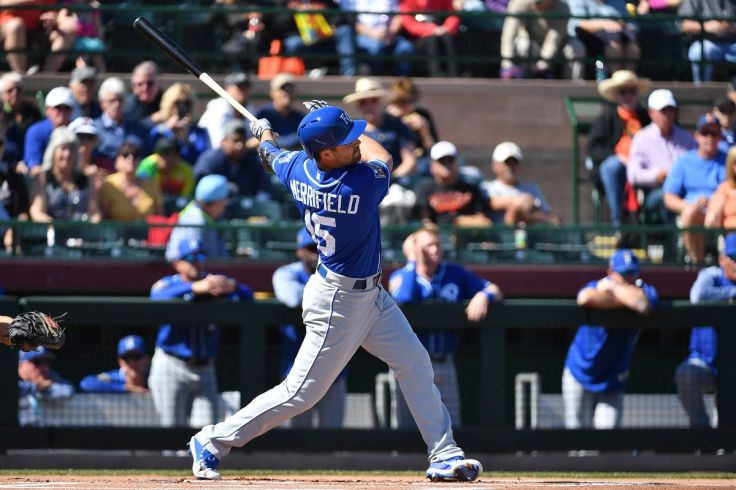
Whit Merrifield will look to improve on his breakout 2017, but the cynic in me thinks he could be in store for a small fall from grace. No one was expecting Whit to hit for power the way he did last year (19 home runs, .460 slugging percentage, .172 ISO) and while I don’t predict a big drop-off for him offensively, there could be a slight adjustment when it comes to the way pitchers approach him this year. The hope is that Whit will be able to adjust as well and negate some of the changes that are sure to pop up.
It should be interesting to see how some of the new bats perform as both Jon Jay and Lucas Duda begin their first season in Kansas City. Jay will probably hit near the top of the order and is a good on-base threat while Duda put together a solid 2017 and is looking to grow on that. While I don’t expect either to duplicate what their predecessors did last year, they are a vital part of the lineup and there is a greater chance they end up being pluses rather than negatives.
Maybe the most intriguing bat in camp this spring is outfielder Jorge Soler. Soler struggled in his first season in Kansas City and is looking to bounce back and live up to some of the potential that he has been tagged with since the Cubs signed him back in 2012. Soler spent the winter working on his swing and management has really been impressed with what they have seen from him in Arizona:
Dayton says Jorge Soler was the best player on the field last Sunday vs. Cubs.
"There are holes (in his swing) that he has to learn to cover. That occurs with experience. … He’s fitting in much better. We’ve seen more fire, more intensity and a greater sense of urgency in him.”
The interesting part of Soler isn’t as much what he is capable of as much as the ridiculous expectations that have been put on him. I talked this winter about what the Royals really need from Soler and it’s very simple: a solid, run producing bat for the middle of the order with league average defense in right field. I think Soler might be a welcome surprise this year and possibly even reach some of those lofty expectations as he enters his age 26 season.
The rest of the lineup is probably questionable at best. Alcides Escobar returns to play shortstop and we all know what we should really expect from Esky offensively at this point. Alex Gordon is looking to prove that the rumors of his demise are overstated, as he has been working on his approach this spring. My belief is that if Gordon works on hitting the ball to the opposite field while focusing more on getting on base than hitting for power, we might just see an improvement in his overall numbers.
The designated hitter spot will be interesting to watch this year, as the Royals won’t be going with just one batter there on a daily basis. Kansas City will attempt to try a floating DH this year, with guys like Cheslor Cuthbert, Soler and Jorge Bonifacio (when he returns from his suspension) probably seeing the majority of at bats there. This will give them flexibility and allow them to try different scenarios throughout the season.
In fact, the lineup we see on Opening Day will more than likely not be the same come September. I fully expect a few bats traded at the deadline, with Moose, Duda and Jay near the top of the list. By September we could be looking at a very young lineup and that could also mean a lot of evaluating by the Royals coaching staff. If these deals go down, they will want to see what they have for 2019 and will give guys like Hunter Dozier and Ryan O’Hearn as many at bats as necessary. While this might not be the best for this year, it will help the team in the future.
Credit: MLB.com
So what does this mean for the Royals offense in 2018? Probably that it will be an inconsistent bunch. There is a decent amount of firepower right now, with Salvy, Moose, Duda and Soler leading the charge. But there are some possible black holes as well like Gordon and Escobar. Also remember, this is a bunch who don’t like to walk much (they were dead last in walks in all of baseball last year) and teams that don’t take as many bases on balls tend to go through wilder peaks and valleys. Add in the younger bats later in the season and this could be a team who offensively really struggles at times. While they weren’t dead last in the American League last year in wRC+ and offensive WAR, they were near the bottom and haven’t done much to improve the lineup.
Credit: MLB.com
This leads to another problem spot, which could be the bullpen. The Royals bullpen outperformed expectations in 2017 (they were ranked by Fangraphs #28 before the season and ended up in the middle of the pack) but that was also helped by the great seasons that Scott Alexander and Mike Minor had. Both are now gone and what is left are a number of relievers that struggled last year, which is why Fangraphs has now ranked them 30th overall, which is dead last in all of baseball.
The good news is that both Kelvin Herrera and Brandon Maurer should be able to perform better than their numbers last year showed. I would also expect new signee Justin Grimm to perform closer to his 2016 season than 2017. But once you get past those three veterans you end up with more questions than answers.
Credit: Adam Glanzman/Getty Images
There are a few veteran arms joining the fray this year, like Blaine Boyer and Wily Peralta. There are also young arms like Brad Keller, Tim Hill, Brian Flynn and Eric Skoglund that will get an opportunity to show what they can do. In fact, I would expect the bullpen to be in constant flux this season, or at least until the team starts figuring out who to keep and who to scrap. Kevin McCarthy, Mike Broadway, Kyle Zimmer, Miguel Almonte, Scott Barlow, Richard Lovelady, Eric Stout, Josh Staumont and even Andres Machado could all see time out in the pen this year and the road between Omaha and Kansas City could get pretty worn out.
But the good news from this is a number of those arms are going to stick. Almonte looked this spring like he had finally turned a corner and his electric stuff could play well out of the pen. Lovelady has turned into a highly touted prospect in just a short amount of time and once he is up he will probably stick. Zimmer has always had the stuff but his health has always held him back. While the idea for some of letting this group work out their struggles in big league games sounds harrowing, it is what needs to happen if the Royals are hoping to be contenders again come 2021 or beyond.
So while it is tough to hear, the bullpen is going to struggle. But the pen you see in April probably won’t be the one you see in July. In fact, by then we could be talking about a completely different story when it comes to the Royals relievers. This will be something to keep an eye on for the next few months, as their will be development with a number of Kansas City arms.
Credit: The Associated Press
The other aspect of this team that will be tough to swallow for some is the defense. Gone is Lorenzo Cain’s ability to cover everything in the outfield. Whether you believe the defensive metrics or not, losing Eric Hosmer at first base will be noticeable. Not only are those two gone, but the elite defenders still in Kansas City are a year older and some of the replacements are league average at best. The Royals teams of 2014-2015 prided themselves on their excellent defense and was a big part of why they had the success they did. Unfortunately, those expectations should be thwarted, as this team defensively will more than likely be a shell of their former selves.
So while the bullpen and defense are no longer the Royals strong points, one aspect of this team that will be fun to follow is the coaching staff. I actually discussed this last week over at Royals Review, but I am really intrigued to see how some of the new coaches are going to shape this team. Cal Eldred, Terry Bradshaw and Vance Wilson have joined the staff and with this will probably come a new way of viewing the pitching and the hitting. In fact, with the likelihood of Ned Yost retiring after this year, we could get a window into the philosophies we could be seeing for years to come. After years of the same coaches scouting and preparing these players, the new bunch will shape a whole new generation of Royals and I for one am excited to see what could come of that.
Credit: John Sleezer/KC Star
So after all that, what does this mean for the 2018 Kansas City Royals? It means that while there will be some highs this year, there will be a few more lows as the team looks to begin their rebuild. For me, I am always interested in seeing what the young talent can do to outperform the expectations that have been thrown onto them and this group has a lot of players in that category. So while it will probably be a bumpy ride, it will at least be one where we learn more about what the Royals have within their farm system.
Overall I am expecting a 74-88 record, placing them in 4th in the American League Central. I wouldn’t be shocked at a few wins or a few losses going either way, but overall this team will fall a bit short of .500 while feasting on some of the lesser teams within the league. The good news is that most of the veterans under contract this year are only signed for one year, so if they aren’t dealt at the trade deadline they probably won’t be back in 2019. This will free up roster spots for any of the prospects who might elevate their game throughout the upcoming season.
Sure, this isn’t going to be the fun ride we got from September 2014 to November of 2015. But it also shouldn’t be as bumpy as most of the early 2000’s were. While most of the remnants of the glory days are gone, they will never be able to take away those memories that us Royals fans have. It’s time now to regroup, rebuild and motivate. It’s time to begin a new chapter to the next era of Royals baseball. That era begins this week, making it closer every day to another classic Kansas City moment…and it all begins this year. Win or lose, we all bleed Royal blue.
Sometimes, when I’m half asleep and veering off into unconsciousness, I remember. I remember a time when we relied on hope. It was a simpler time, when players were “mistake free” and reporters were told to “rewind yourself”. It was a time when the thought of a winning season, never mind a full-blown championship, was enough to put a smile on any Kansas City Royals fan’s face. During this period, a phrase was uttered so many times that it became both a mantra and a sarcastic answer to another blow-out loss. That phrase was “Trust the Process”.
I was reminded of this the other day when reading the latest from a former Kansas City scribe, Joe Posnanski. Joe was around for a number of the lean years and remembers them (I’m sure) somewhat fondly. More than that, he remembers Dayton Moore and his beliefs B.C. (Before Championship):
Moore isn’t naive about it; he dutifully answers those questions. But this idea of baseball being bigger than baseball, this is what he really wants to talk about … and it always has been. He has believed from his first day on the job with the Royals that if he could hire great people, acquire talented players who love the game deeply, create an atmosphere where everyone looks forward to coming to the ballpark and appreciates just how lucky they are, that the team unquestionably would win a championship.
People — again, including me — had their doubts.
But that team absolutely did win a championship exactly as Moore planned.
So here we are again. The rebuild has begun. Once again, Moore wants us to believe in “The Process”. But as fans, did we fully buy in before?
Credit: Jamie Squire/Getty Images
The answer is yes…and no. At first we bought all in. The Royals had become a laughingstock and at that point any sign of an actual plan that might come to fruition seemed promising. What wasn’t promising was the farm system. To truly understand, here are the top ten prospects going into 2006 according to Baseball America:
1. Alex Gordon
2. Billy Butler, of/3b
3. Justin Huber, 1b
4. Chris Lubanski, of
5. Jeff Bianchi, ss
6. Luis Cota, rhp
7. Chris McConnell, ss
8. Mitch Maier, of
9. Donnie Murphy, 2b
10. Shane Costa, of
It started out promising…and then just flat-lines (although I will admit to being a Mitch Maier fan). The system was ranked 23rd in all of baseball to start the year and it was obvious that Moore had his work cut out for him when he took the GM job in June of that year. So at first, we trusted; Moore had an idea where he wanted to go and how to go about it. But as time wore on, our faith wavered.
By 2012 the Royals were almost six years into “The Process” and by the end of May it felt like we had been dealt some cruel, mean joke. Do you remember the slogan for that year? “Our Time”. For those of you not following the team back then, you probably can imagine how that slogan went down as the Royals limped to a 72-90 season. At this point, “The Process” had become a joke.
Credit: Denny Medley-USA TODAY Sports
All it took for me was a quick glance at my blog posts in 2012 and I can see where my faith had diminished. In fact, read just about any article I wrote from 2012 to 2013 (which you can check out at bleedingroyalblue.com) and I was no longer aboard the “Process Express”. It took Moore seven full seasons to grasp a winning record and while the Royals were in the pennant race into the last week of 2013, a number of fans weren’t sold yet that Dayton’s mantra was the end-all, be-all answer.
Then 2014 happened. The wild card game, the sweep through the American League playoffs and a seventh game of the World Series. Then the Royals won it all in 2015. At this point, we had forgotten about our lack of faith (I’m sure Dayton found it disturbing) and bowed to GMDM’s greatness. Whether we wanted to admit it or not, “The Process” had worked and reached its final destination.
So here we are in 2018 and we begin to wrap our heads around putting faith back into Moore’s plan. I won’t lie; the first time I heard him utter those two words again I froze. But when I look at the farm system right now, I feel better than I did in 2006. Here are the top ten current prospects according to Baseball America:
While there will probably be a few misses on this list, there is also a chance for some major upside with guys like Lee, Pratto, Matias and Melendez. In fact, by 2021 the Royals lineup could be way better than say, the 2009 Royals:
I can’t help but point out that nobody is thinking the Royals can win anytime soon, but he says that has always been true — and he’s right, most experts thought that the 2014 team would battle for last place, and they won the American League pennant. Most people thought it was a fluke, and the ’15 team won the World Series.
True, but then I point out that those Royals had some big prospects — Eric Hosmer, Mike Moustakas — that this team lacks. He then says, “Nobody had [five-time All-Star] Salvador Perez on their Top 100 list. Nobody had Lorenzo Cain on their Top 100 list. Nobody had Greg Holland or Kelvin Herrera on their Top 100 list.”
Moore is right about this. While it’s easy to point out the Hosmer’s and Moustakas’ that toiled for “The Best Farm System in Baseball”, it was the off the radar guys that pushed the Royals to the next level. All it takes is for a few players to outperform their expectations and push the team back into contention.
Credit: John Sleezer/KC Star
So is it time to “Trust in the Process” again? The better question might be why you should put your trust back in Moore. The truth is a lot of us doubted him and he proved us wrong. While it might be easy to snicker and roll your eyes when he discusses his ‘grand plan’, it did procure us fans some of the greatest moments in Royals history. For that, I will be forever grateful to Dayton Moore.
It doesn’t mean we have to agree with everything he says, and it doesn’t mean we have to like every move he makes; you can still disagree with decisions while being supportive. But it does mean putting a little dab of faith and a nice chunk of hope into the eventual finished product. We might all be crazy for going down this road again…but if it ends with the same payoff, then I am all in.
It happened quickly and out of nowhere on Thursday night, catching most of us off guard. By the time the evening was done, Mike Moustakas was once again a Kansas City Royal, inking a one-year deal worth $6.5 million, a possible $2.2 million in incentives and a mutual option for 2019 worth $15 million which includes a $1 million buyout:
Mike Moustakas has agreed to a one-year deal with a mutual second-year option with the Kansas City Royals, sources with knowledge of the deal tell Yahoo Sports. It guarantees him $6.5 million and can max out at $22.7 million.
The deal is noticeably smaller than if he had accepted the qualifying offer earlier this winter of $17.4 million and was a big step down from what Moustakas and his agent Scott Boras were looking for out on the market. So what does this mean for all parties moving forward? Let’s start with the effects on Moose himself.
Credit: Rick Osentoski-USA TODAY Sports
For Moustakas, this will be a chance for him to re-set his market and give teams a better look at what they can get if they sign him. The most important aspect for him will be the removal of the pesky compensation pick that will not be attached to him come November:
Upside for Moustakas testing free agency next season is no Qualifying Offer. Downside is Manny Machado and Josh Donaldson also hitting free agency on strong third-base market.
A number of teams (most notably San Francisco) passed on Moustakas this winter because of the compensation draft pick attached to signing him and without it he should be able to find a better deal than the one he finally accepted from Kansas City. It also should help him to have another season under his belt, especially one where he stays healthy. There has been some concern about him being injury prone (he missed a large chunk of 2016 and dealt with leg injuries throughout the latter half of the 2017 season) and a season where he stays healthy should go a long way toward calming some of those concerns.
Credit: Kevin Jairaj-USA TODAY Sports
What should also help him is a much different third base market than what he dealt with this last year. It felt early in the winter that most teams were pretty content with who they had to play the hot corner and the teams that didn’t went out and upgraded in what they probably would have considered a cheaper manner, whether by trade (Giants acquiring Evan Longoria) or free agent signing (Angels signing Zack Cozart to a three-year, $38 million deal). While both Josh Donaldson and Manny Machado will be out on the market this year, that doesn’t always mean a crowded field for third baseman. Both can only sign with one team and Machado has discussed wanting to play shortstop, which could be something he asks for before signing with a team. If Moustakas has a good season in 2018, I can see a team like Atlanta wanting to bring him in. They balked at it this offseason, but the Braves might feel like they are closer to contending before 2019 and adding Moose’s veteran bat to a younger lineup could be an enticing idea for a team who feels like they close (see Hosmer, Eric in San Diego). While the options dried up this winter, it could be a completely different ball game when this season wraps up.
Credit: Sports Illustrated
This should also be a win-win situation for the Royals. They get to bring back a fan favorite, which should appease some of the fans disappointed with the losses of Eric Hosmer and Lorenzo Cain. They also aren’t locked in to anything long-term, as the deal is for two years at the most. It’s also not taking up much space on the payroll, as the most he will be able to make this year is $8.7 million (if he reaches all his incentives). I’m most curious to see how he performs this year, as I tend to believe he will play with a chip on his shoulder. There had been some grumblings at one point that Moose was angry and frustrated with how few offers he was seeing on the free agent market this winter and with him taking a sized down deal to stay in Kansas City (and more than likely just to play baseball before the regular season starts) you could see where he would be motivated to go out and prove all the naysayers wrong. If that happens, the Royals will be benefiting from his experience as a free agent.
Credit: Peter G. Aiken-USA TODAY Sports
It also feels like the Royals weren’t confident in some of the younger players they were looking at to play this season. With the signings of Alcides Escobar, Lucas Duda, and Jon Jay, they got a bit older while pushing guys like Adalberto Mondesi, Hunter Dozier and Bubba Starling to the side. The Moose signing tells me they also aren’t confident in Cheslor Cuthbert, who was the odds on favorite to start the year at third base before the Moustakas move was made. It appears that Dayton Moore likes the idea of guys coming up in the middle of the season rather than beginning the year with the big league club, so it might not be as dire for the younger talent as it appears on the surface.
There is always the chance too that Moustakas could be dealt at the trade deadline to help out a contending team. While this would be upsetting to some, strategy-wise it would be a smart move for a front office that is trying to build back up the farm system and is hoping to get younger over the next couple of seasons. If the Royals would be able to trade Moose for some talent to help out in the future it would show that while some dislike this move from a rebuild standpoint, it would signify part of a deeper game that Moore is playing to place the team in a better spot in the next three to five years.
Credit: Ezra Shaw/Getty Images
Most Royals fans have known over the last couple of seasons that a large part of the core group of Royals would be entering free agency together, and all throughout that time I have stressed that in my opinion, Mike Moustakas was the player to keep. I even went on the record this winter as saying that Kansas City should focus on Moustakas, not Hosmer. In other words, I am on board with this reunion and feel like it is a great match for the upcoming 2018 season. I don’t expect Moose to stay past this year and while that might be disheartening to some, this might be a better way to give him a proper send off. While Eric Hosmer was the face of those championship Royals teams, Moustakas always felt like the heart. The Royals might have never gotten to the 2015 World Series if it wasn’t for Moose telling the clubhouse ‘Hey, listen, we’re not done yet! It’s not over yet! Let’s do something!’’’ as the team was down four runs going into the Top of the 8th inning in-game 4 of the ALDS against Houston. Mike Moustakas wears his heart on his sleeve when he is out on the baseball field and that can only be a plus as this Kansas City team wanders into a transition period for the franchise. Most of us had given up hope that Moose was headed back; now, we get one more season to appreciate what he means to this franchise. Let the ‘MOOOOOOOOSE’ chants reign down, Kansas City!
While most of us waited all winter for something (anything!!) to happen on the free agent market, it appears that with spring games being played and the regular season just around the corner, teams have finally decided to spend a few dollars. This has become very evident for the Kansas City Royals, as they signed Lucas Duda last week and earlier today they locked inJon Jay, who played for the Cubs last year:
Jon jay: 3M, 1.5 M incentives. 100K 250 plate appearances and every 25 plate appearances to 600. #kc
The team also placed right-handed pitcher Jesse Hahn on the 60-day DL with a UCL sprain. Both moves are worth a discussion, so let’s start with Jay.
Credit: Pablo Martinez Monsivais / Associated Press
Jay is coming off of a fairly solid season, as he hit .296/.374/.375 with an OPS+ of 96 and 1.1 bWAR. Jay looks to be the new center fielder for the Royals, as Paulo Orlando has been the frontrunner for the job headed into the spring. Jay will also probably hit leadoff for the team, as he is has posted a career on-base percentage of .355 and appears to be the best fit for the job. Jay isn’t going to hit for much power (.383 career slugging percentage) but he will get on base and is able to play all three outfield positions:
Royals manager Ned Yost says Jon Jay will "play a lot … he can play all three outfield positions, DH, he's going to do whatever."
Jay is a quality baserunner who is also a near average defender in the outfield. He is also a left-handed hitter, which the Royals have been in dire need of as of late. Much like Duda, Jay should be a steady veteran that can help the team transition to someone younger later in the year. There could be a scenario later in the summer where Bubba Starling could be given a shot and that would allow Jay to slide into the fourth outfielder role or even end up on the trade market. While I have been a proponent for the Royals to go for a complete rebuild, they didn’t spend much on Jay and if we are being blunt about it, they really didn’t have anyone prepared to be the regular center fielder. While Orlando should make the Opening Day roster, he is a better fit as a backup for the team than as a guy playing on a regular basis. This signing allows Paulo to slide back into a backup role and should be seen as an upgrade for the center field position in general.
Credit: The Associated Press
Hahn being placed on the disabled list has to be a concern for Royals management, as he goes on the 60-day DL with a sprained ulnar collateral ligament in his right elbow. An injury to the UCL is normally a precursor to Tommy John surgery, which Hahn has already had back in his college days at Virginia Tech University. The good news is that it might not be as bad as it looks on the surface:
Jesse Hahn felt discomfort in his UCL after his last outing. He’s had Tommy John once before. The Royals are going to let him rest and start a throwing program before determining the next step.
Hahn on the UCL sprain: "That first day I woke up I had no range of motion at all. It was pretty tender to touch, to move, everything. And these past couple days, full range of motion back, full extension and the pain has gone down a lot, so that’s very encouraging."
Hahn had been competing for a spot in the rotation, although it appeared he might be ticketed for a bullpen role. While this might turn out to be more of a precautionary move by the Royals than anything else, it does mean Hahn will begin the season on the disabled list, with his availability appearing to be in the early part of May at the earliest.
While for the most part I have no issue with the Royals going out and spending very little money on a couple of veterans like Duda and Jay, there is one part of this equation that is bothering me. Over the winter the team made a couple of deals to lower payroll, dealing Joakim Soria to the White Sox, Scott Alexander to the Dodgers and Brandon Moss to the A’s. While dealing Soria and Moss made sense (considering the direction of the team), I was never on board with the trade of Alexander. Alexander was added because the Royals needed to deal something of value to rid themselves of Soria’s contract. The problem with that is Alexander would have been under team control for another five years and would have been very cost efficient. Then you throw this into the mix:
For a team that gave away Scott Alexander to save money, the Royals sure have a strange way of using those savings.
They’re spending more on Escobar, Duda, and Jay than they were on Soria. https://t.co/4EJmVbvWrc
Most of us figured that the Royals were moving salary to keep Eric Hosmer but even then I was against the Alexander trade. His value was almost immeasurable last year and I’m not expecting Kansas City to have a player in their pen this year who can fill all the roles Alexander did in 2017. So to turn around and spend money on veterans and slide the payroll back to where it was doesn’t make sense, at least if the sole purpose was to get rid of Soria’s contract. I’m not saying I dislike the Jay or Duda signing and in fact I like both of them; I’m just saying they could have found a different way to jettison Soria while also keeping Alexander. Where there is a will, there is a way.
Credit: Kim Klement-USA TODAY Sports
So with the Jay signing and Hahn injury we are getting a better idea of what the Royals Opening Day roster will look like. Dayton Moore has done a good job these last two weeks filling holes in the lineup without locking anything in long-term and leaving the door open for some of the youngsters to rise up this year. With some movement being made, one has to wonder if the possibility of Mike Moustakas coming back on a one, or even two-year deal is at least being broached. I’m still in the camp that the team should tear down even more and do a complete overhaul, but it appears Moore just isn’t in the business of tanking. Having some veteran presence around is a good thing, but at this point in the spring it would probably be best for Moore to be done. Then again, I wasn’t expecting these two moves sooooo…see you back here next week, when the next veteran is locked in to a one-year deal? Mark it down and save the date. Stay unpredictable, baseball.
I’ve always been told loyalty is an honorable trait to have. It speaks of a person’s character and can be a window into how a person will react when times get rough. In fact, the definition says it all:
loyalty
[loi-uh l-tee]
1.the state or quality of being loyal; faithfulness to commitments or obligations.
2.faithful adherence to a sovereign, government, leader, cause, etc.
3.an example or instance of faithfulness, adherence, or the like:a man with fierce loyalties.
Loyalty in sports can be a tricky thing. The definition of the word can fluctuate, whether you are a fan or a player. For years players have been labeled as “sell outs” or “greedy” whenever they decide to look for greener pastures ($$$$) and head to the highest bidder. But loyalty in baseball should probably be defined differently.
Credit: AP Photo/Charlie Neibergall
I bring this up because a few Royals fans were not pleased with Eric Hosmer’s decision to sign with the San Diego Padres. Yes, these fans are the minority, but they are a vocal bunch. Obviously there is an emotional attachment to this group of players; I knew this was going to be rough when a part of me felt bad that Jeremy Guthrie was gone. It’s inevitable that winning a championship would make it harder when the business of baseball gets in the way of putting together the big league roster. But that word–business–seems to be the hurdle some have a hard time getting over.
Let’s break this down. When a player is allowed to venture out on the free agent market, they can talk with other teams and see if there is a mutual interest there in working together. It only makes sense that a player would want to gauge how much he is worth. It’s really not any different from if another job talks to you about leaving your current employment and offers you perks that your current job has not.
Credit: Michael Sears, Milwaukee Journal Sentinel
But baseball has a slight difference: you can’t be a major league player forever. In fact the average length of a major league career is just 5.6 years:
After studying the 5,989 position players who began their careers between 1902 and 1993 and who played 33,272 years of major league baseball, three demographers have come up with an answer: On average, a rookie can expect to play major league baseball for 5.6 years.Their study, which is being published in the August issue of Population Research and Policy Review, also found that one in five position players would play only a single season.
Fewer than half of all rookies remain long enough to play a fifth year. And only about 1 percent of players last 20 seasons or more.
Cognizant that pitchers are more prone to injuries and have volatile careers, the authors, William Witnauer of the State University of New York at Buffalo and Richard Rogers and Jarron Saint Onge of the University of Colorado, excluded them from the study. They also excluded 618 players who made their debut after Sept. 1 and played only that season.The authors found advantages in starting a major league career early. The probability of ending a career after one year is 10 percent for players starting at age 20, but rises to 13 percent for players who start at 21, and 36 percent for players who start at 28.
With the averages not boding well for a long, lengthy career for a large chunk of players reaching the majors, that would mean the wise decision is to make as much money as humanly possible while you can. You never know when an injury or illness could swing around and not only hurt your value but also hurt your chances of continuing your career.So it’s easy to see why most players want to make as much money as possible when they head out on the free agent market. Take Lorenzo Cain for example. Cain has dealt with numerous leg issues over the years and will be entering his age 32 season this year. While he might have been able to take a shorter deal for more money per year, Cain went with a 5-year deal in Milwaukee this winter. It made more sense for Cain to go with a long-term deal rather than a shorter one where he would end up back on the market at an older age. At that point, who knows where Cain’s value would be and if injuries would hurt his chances of procuring a deal similar to what he received this past offseason.
Credit: Charlie Neibergall / AP
What that means is I will never fault a player for getting as much money as they can out on the market. I also wouldn’t question their loyalty to the organization, since that is a two-way street. Sure, Hosmer and Cain could have possibly returned to Kansas City on lesser deals, but why? A sense of loyalty from what they have done these past seven years? While it might be looked at by some as a noble gesture if they had stayed, logically it would make no sense. The Royals this winter weren’t financially in a position to offer the contracts that the Brewers or Padres offered, let alone whether those deals would make sense for the Royals long-term.The honest truth is that while it is great when players like George Brett or Alex Gordon stay with one team for the duration of their career, you can’t fault a player for wanting to milk as much as they can from the market. This doesn’t mean they are disloyal to the team they left nor does it mean they disliked the team, organization or even the fans with that team; it just means they did what was best for them and their family.
Credit: K.C. Alfred / San Diego Union-Tribune
I expect Royals’ fans will give a healthy standing ovation the next time Eric Hosmer or Lorenzo Cain return to Kauffman Stadium and they should. Both players were a big part of the rejuvenation of baseball in Kansas City over these last couple of seasons. But if you boo these players you might want to think about what you would do in that situation. It’s easy to say you would take less money to stay in a comfortable place like Kansas City, but would you still feel that way if your career was winding down or if you had the opportunity at a mega-contract?At the end of the day baseball is a business and as we have seen this offseason, it can sometimes be a cold, heartless, ruthless business to those looking for a job. While on the surface the idea of a player staying in one spot and being loyal sounds great, the reality is a lot murkier than that. Temper expectations, try to look at the situation from someone else’s point of view and enjoy the time you have with your favorite players. Hopefully if you are loyal to your team, they will be loyal to you.
Just when you thought the Kansas City Royals winter was over…
On Wednesday they signed Lucas Duda to a one-year, $3.5 million dollar deal with Kansas City. Incentives could push this deal a bit higher, based on plate appearances:
Duda has 1-yr, $3.5M deal as @JonHeyman reported, incentives can take to nearly $5M. #Royals
With the signing, Duda will take over the first base position to begin the year and will add a much-needed left-handed bat to the middle of the Royals batting order. Even better, Duda has been surprisingly productive the last few years in both New York and Tampa Bay.
Credit: The Associated Press
Duda is coming off of a 30-home run season as he split time with the Rays and Mets. Duda hit 30 bombs, drove in 64 runs, posted a slash line of .217/.322/.496 with an OPS+ of 116. Not enough for your liking? Over his career he has put up an OPS+ of 120 (league average is 100), a .457 slugging percentage and has three seasons where he has produced over 200 total bases. Duda is a power hitting first baseman who is entering his age 32 season and should be able to still produce in the friendly confines of Kauffman Stadium.
I’m sure there will be some who question whether or not he can produce at the level of his predecessor, Eric Hosmer. Well….
Last 5 yrs: Hosmer 115 OPS-plus, Duda 123 OPS-plus. Durability, defense, baserunning, intangibles, age get Hosmer 8-$144M with #Padres, Duda $3.5M with #Royals
Duda won’t be as agile as Hosmer on the base paths or even on defense. Speaking of his defense…
In case you didn’t know, Duda was the one who threw the ball into the stands. The Royals are obviously taking a step down defensively with Duda, but considering what he will do with the bat and what they will be paying him, it is still a good deal.
The one issue that has been brought up with his signing is how he will affect the younger players who have been vying for the first base spot in camp, most notably Hunter Dozier (who appeared to be the front-runner this spring). If you are in the camp of the Royals doing a larger rebuild, Duda would be the wrench in that process as he would be taking at bats away from players like Dozier, Ryan O’Hearn and Frank Schwindel. But General Manager Dayton Moore doesn’t see things that way:
Dayton Moore and Ned Yost are stressing the Lucas Duda signing doesn’t block Dozier at first base because it’s only a one-year deal. Claim Duda brings stability/security in a lineup loaded with young/inexperienced bats. #Royals
It’s obvious to see that the best case scenario is for Duda to play well, boosting his value and making him more tantalizing for teams before the summer trade deadline. The Royals could then ship him off for a piece that could hopefully help the team in the future and someone like Dozier or O’Hearn could then take over the first base position. In fact, it appears that is what Moore is already thinking:
Regarding Dozier, Dayton believes it's easier for young players to transition/adjust to the major leagues in June/July because the game energy/pitcher's energy isn't as high as it is in April. (i.e.: Things can snowball if you get off to a rough start) #Royals
This seems to hint toward Dozier starting the year in the minors and working his way back up to the big league club. In my mind, this isn’t a bad idea and I even pointed out why I believe that the day of the signing:
Dozier has only played 12 games at 1B in his professional career. Obviously, there will be somewhat of a learning curve & it's never good when a player has to do that in the majors. This allows him to continue getting comfortable at the position without the everyday pressure.
While I probably view Dozier differently then some (and I will delve into that at a later date), throwing him into the lineup to start the year and replacing an icon while still learning the position feels like a lot of weight to throw on one man’s shoulders. The Duda signing gives the team time to get Dozier better adjusted to these scenario’s while adding a veteran left-handed bat to a lineup that is going to need all the help it can get.
Credit: Fox Sports
Taking this all into account, bringing Duda into the fold feels like a win-win situation for the Royals. The Royals get a veteran bat, adding a lefthander for a very righthanded heavy lineup while allowing time for Dozier to adjust to his fairly new position. Throw in that it is only costing Kansas City $3.5 million AND they might be able to deal him later in the summer and you have the makings of a quality Dayton Moore signing. It even looks like any beef Duda had with Rusty Kuntz has gone away:
Re: KC signing of Lucas Duda, just spoke with Rusty Kuntz, who had the immortal line about Duda's arm/Hosmer dash in 2015: "Bless his heart, Duda. He's a good bat." Says had good chat with Duda today but laughed and said specific topic never came up. And noted how big Duda is.
It’s not ground breaking, but it was a move that pegs in the positive side of the ledger. For those worried about how Moore will operate as the team moves to rebuild, this will hopefully temper some of the paranoia.
Oh…and considering he is a world series hero in many a Royals fan’s eyes, I would expect a ‘Standing O’ come Opening Day. I have a feeling Duda will fit in just fine…
Now that the dust has finally settled and Eric Hosmer has landed in San Diego, it only seems fair to ask where the Royals go from here. There are so many questions to ask, especially as the team appears to be getting ready for a rebuild. But what three questions are the most urgent? I went ahead and earmarked these three as being the most pressing for Kansas City moving forward.
Should the Royals re-sign Mike Moustakas?
I’ve long been a proponent of bringing Moose back to Kansas City, but with the developments of the last month weighing heavy on my mind, my opinion has shifted just a bit. I still believe that re-signing Moustakas isn’t an awful idea, especially if it would be on a two or three-year deal. But with the market for him all but dead at the moment, the Royals definitely shouldn’t roll out an armored bank truck for him.
That being said, the idea of a complete rebuild sounds more and more enticing by the day. This Royals team can lose 85-100 games with or without Moustakas, plus it would keep the payroll at bay. It could also give the organization a chance to see what Cheslor Cuthbert and/or Hunter Dozier can do while both could also see playing time across the diamond at first base. Honestly, I’m okay with either scenario playing out as there are positives and negatives for both. But if the Royals really buy into a rebuild, letting Moustakas go would make the most logical sense.
Who plays first base in Kansas City this year?
This could be the most interesting question of the three while also being the one that is answered last. It does appear there are no frontrunners in the bunch, although Dozier and Cuthbert will get first crack at both corner positions. In fact, the Royals actually have a number of options floating out there, which I took a look at a few months back.
To be honest, my opinion hasn’t changed much since December. I like the idea of Dozier or Ryan O’Hearn (or both) getting a shot and seeing what they could do. Out of the free agents on the market, signing someone like Adam Lind to platoon with Dozier also appeals to me. The interesting aspect about this is that the Royals aren’t tied down to one player who gets all the playing time. This gives the coaching staff a chance to evaluate some of the younger talent while also seeing what is a good fit for both the lineup and on defense. While the answer isn’t an obvious one, that also breeds opportunity which isn’t a bad thing for a club that is rebuilding.
Should the Royals overhaul the roster even more and look to trade veterans?
On the surface it appears that Kansas City is going to rebuild one way or the other now that most of the major cogs are out of the picture. But should the team do a complete rebuild? At this point, it honestly makes more sense to go this route. Merrifield would seem to be an obvious choice to be dealt, as his value might never be higher than it is right now. The team already has a player who could take over at second base (Raul Mondesi) while hopefully acquiring one or two players who could be under team control for multiple seasons.
Duffy was bandied about in trade talks earlier this winter and one would think the Royals could get a hefty haul in any trade that Duffy was involved in. While the Royals don’t have any in-house replacements that could fill the top of the rotation, more than likely Dayton Moore would ask for such a piece in any deal that Duffy is in. While the idea of Duffy also leaving is grim, it isn’t guaranteed he would still be with the team the next time they are contending.
It would also make sense to see what they can get for the likes of Kelvin Herrera and Jason Hammel. Both are veterans that will be eligible for free agency at the end of the year and could bolster a number of teams’ pitching staffs. The idea at this point might be to wait until the trade deadline and then see what they can get for either pitcher. While neither player will probably net Kansas City a top-tier player/prospect, Moore should be able to get something for them to help now and possibly even in a packaged deal.
What about Alex Gordon and Ian Kennedy? While I’m sure most would like to see their contracts off the Kansas City books, the team would probably struggle finding anyone to take them on, or at least without the Royals paying a sizeable chunk of their salary. Gordon and Kennedy might not be quite untradeable, but they are about as close as any player on the Royals roster. In other words, Kansas City has to hope they turn things around and be productive in 2018.
The one player that would probably be off-limits would be Salvador Perez. While this might be the right time to trade him off before he starts regressing, the likelihood of that is slim and none. At this point Salvy is the “Face of the Franchise” and with Hosmer, Cain, etc. gone, dealing Perez would kill off a large chunk of the fanbase. It’s going to be a hard adjustment already for a number of fans this upcoming season; it would take years to build trust back up if they dealt off Salvy.
Credit: Kansas City Royals
While there are more questions that will need to be answered in the future, these three feel like the most important moving forward. It’s going to be a hard adjustment for some to view the Royals in rebuilding mode, especially those that don’t remember the team before 2014. I always look for the positive and with this club it appears to be options. The Royals can build their roster pretty much as they please moving forward without a ton of restrictions. Think of it like a clump of clay that you can design however you want; just remember that how that design looks this year could look completely different in two years.
It took much longer than expected, but Eric Hosmer has finally found a home for the foreseeable future. Late Saturday, Hosmer agreed to an 8-year, $144 million deal with the San Diego Padres:
The contract, which includes a fifth-year opt-out, easily surpasses the four-year, $75 million deal for pitcher James Shields that previously set the standard for a Padres free agent.
So we can officially close the book on Hosmer as a Kansas City Royal and there is a number of ways to look at him leaving. I figured today we would look at as many angles to this whole situation.
Credit: USA Today Sports Images
First, let’s discuss what the Royals were able to offer Hosmer. We’ve all heard all the numbers floated out there and while I don’t know if we will ever find out the true number, we can at least take a good stab at it. I’m pretty sure the high-end year wise was seven years, as multiple sources around Kansas City appeared to agree on that number. But what about the dollars?
It was, at one point, believed to be in the neighborhood of $140 million — though club officials declined to divulge the final number. It was competitive, depending on your definition of the word, though Moore acknowledged that the Padres’ final package was better.
It does appear San Diego had the higher volume of dollars but Kansas City did make “certainly the highest offer we’ve ever made.” In fact it was so much money that it required a lot of flexibility from GM Dayton Moore:
Dayton Moore stressed that signing Hosmer would have required unloading more money. "I'm responsible for where we are economically as an organization, " he said. "I made a decision after the 2015 season, knowing full well that our players were going to become free agents."
While it appears the highest offer on the table at one point was 7 years and in the $140 million range, it definitely wasn’t the final offer that was given to Hosmer:
FanRag reporter Robert Murray, who works with Scott Boras-connected reporter Jon Heyman, writes today that the Royals’ final offer was for five years in the $100 million range. That is about the same amount of money the Padres offered in the first five years of their offer, but without the guarantee of the final three years of the deal should something happen to Hosmer.
So the Royals offer to Hosmer appeared to have gone down from earlier in the winter. What would cause that to happen?
Without Royals officials disclosing much — publicly or privately — the details of the Royals’ side of this are a little murky. But through a handful of conversations this week, and a working knowledge of how the organization has operated, here’s the best guess:
▪ Royals owner David Glass didn’t want to do it. This has all the markings of him going skittish at another big contract.
▪ The Padres pushed forward at the end of the negotiation while the Royals pulled back. The Padres won by offering an opt-out clause, which the Royals didn’t want to do because that wouldn’t guarantee Hosmer being around when they’re ready to win again.
▪ That may not have mattered, because while the Royals talked early of a six-year deal with an average annual value near $20 million, the final offer peeled back a little at (presumably) Glass’ direction. That last part is important.
Again, this is all based on varying levels of guesswork. The Padres’ offer is believed to be significantly better than the Royals’ — more years, more guaranteed money, more money upfront and an opt-out.
If you are able to connect the dots here, it appears that while Moore was always on the Hosmer bandwagon, owner David Glass was into moving on from him. In fact, Sam Mellinger of the Kansas City Star continues his guess as to what happened:
My guess: Glass is already uncomfortable with those deals for Gordon and Kennedy, which have turned out horribly. The Royals owe Gordon $44 million over the next two seasons and Kennedy $49 million over the next three.
Locking into another long-term deal worth $20 million or so per year was a tough sell for the owner, who knows the Royals are likely to lose a lot of games the next few seasons no matter what. He was looking for a way out.
One more time, because I want to be as clear as possible: This is based in part on conjecture.
So while Sam is just guessing, it’s a guess that has a decent amount of weight to it. At the end of the day, a contract of this magnitude could cripple the Kansas City organization for years and cause stress on their payroll, even with all the money in baseball and the Royals negotiating a new television deal in the near future. Obviously, Glass appeared to be skittish about making this much of a commitment to one lone player.
Credit: Mark Cunningham/MLB Photos via Getty Images
It also means that the old era of Royals baseball is now dead and a new one will soon be on the horizon:
It doesn't appear the Royals will be pursuing Mike Moustakas or any other costly free-agent, even with Hoz signing elsewhere. Dayton Moore said, “That period of time, that phase of who we are, is over. We need to move on.”
When we heard earlier in the winter that it was “Hos or Bust” for the Royals, Moore really wasn’t kidding. To be honest, it makes more sense for the team to rebuild at this juncture. In fact, I am on board for a complete rebuild. If Kansas City would have locked in Hosmer, that would add one more large salary to a payroll that already feels a bit bloated. Toss in the length of any deal for Hos and you start dealing with trying to find a spot in the lineup for when guys like Samir Duenez and Nick Pratto are ready for the big time. It’s already going to be a couple of years before we can start discussing the Royals as a legit contender again; if Hosmer had signed, Moore might not have had the flexibility available when it comes to payroll and it could have pushed the contending window back even further. In other words, I’m glad Hosmer chose San Diego and there was multiple reasons I breathed a sigh of relief to find out he was officially gone.
If we are being honest here, I have long been in the camp that Hosmer was overrated by not only the Kansas City organization, but the baseball media in general. I saw the reasons for the fawning: Hosmer has a pretty swing, is fluid around the bag at first, is well spoken and appears to be a born leader. Add in how clutch he has been in the playoffs (I would rattle off all the key moments, but there really are a bunch) and how he doesn’t seem to fear the big stage and you have the recipe for a star to build around. The problem is that if you watched him on a regular basis, you also saw the slumps. You remember, the slumps where his swing would look like a mess and he would be so cold that you would have to put his face on a milk carton? These weren’t just slumps but long periods of time where Hosmer would go missing for four to six weeks. Toss in a slightly above average 111 career wRC+, a paltry 9.9 career fWAR over seven seasons and a ground ball rate that hasn’t been below 50% since his rookie year (and even that was 49.7%) and you don’t have a player who would elicit a contract that would bump him into the higher echelon of major league contracts. Yes, his 2017 was a career high for him and I do believe he can be this player that everyone longs him to be. I just question whether or not it will actually happen. I’m very skeptical and that skepticism made it difficult for me to get on board for the team to commit 5-7 years to a player that doesn’t feel like a franchise cornerstone. At the end of the day, I am a numbers guy and the numbers don’t lie; Eric Hosmer isn’t worth the money or the length of the deal.
That being said, I’m happy for Hosmer. He got his money and he got a contract that was heavily front-loaded with an opt out after year five. Hosmer will be gearing up for his age 33 season after his fifth year in San Diego and at that point he could be able to bank even more dough. The truth is that baseball players have very short shelf lives and I will never blame one for trying to make enough money as humanly possible. It’s why I was happy when Lorenzo Cain got his deal from Milwaukee and why I will be happy when Mike Moustakas gets his. Would I love some of these guys to stay and play in Kansas City? Of course I would. I’m already dreading watching Cain in a different uniform this upcoming season. But I get how this business is and trust me when I saw that at the heart of things, this is a business. It’s why when an owner cries foul that they lost money the previous season I roll my eyes. All owners have money; it’s just a matter of what they are willing to spend and how big they want their bottom line. Also, there are times you should take comments with a grain of salt:
Ned Yost said he texted Hoz numerous times this off-season but never heard back from him: "I’m not sure whose orders that was." Ned then joked, "Even when I was on my death bed.”
I know some Royals fans got upset when they saw this comment from manager Ned Yost. The truth is we don’t know what actually happened and it even appears that Neddy was joking a bit here. Just realize that players don’t owe us anything; the loyalty we pledge as fans is to the name on the front, not the one on the back.
Credit: The Associated Press
So if you are a Royals fan, how should you take this signing? If you are a fan of Hosmer, be thankful he was in Kansas City for seven years. You will always have the memories. The triple in the wild card game. The clutch hits throughout the playoffs in 2014 and 2015. The ballsy slide in Game five of the 2015 World Series. Know that Hosmer won’t soon forget Kansas City:
“Every player’s goal is to ultimately win a world championship,” Hosmer said. “To be able do that in Kansas City was amazing. To have that taste and understand what it means to a city and how much joy and excitement it brings to the people out there, it’s an experience I can sit here and talk about all day. It’s something that drives you as a player — to try to bring back as many as you can.
He also hasn’t forgotten his former teammates:
“I told Glenn it would mean a lot to me if I could wear No. 30 and continue Yordano’s legacy,” Hosmer said. “Not only Yordano, but all those guys in Kansas City. We all shared good moments with him and obviously shared a really tough moment in his passing. It really meant a lot to me. Hoff was more than open to let me carry on that number. I told him I’ll wear it with pride each and every day.”
So while it will be sad for some to not see #35 on Opening Day at Kauffman Stadium, it’s also wise to remember that nothing lasts forever. The Royals have to move on and we need to do the same. For all you know the next player who will be your new favorite could be in Kansas City sooner rather than later. You will always have those memories of Hosmer and no one can take that away. But it’s time to make new memories with some new faces. So cheer the new Royals we will meet this year and even cheer Hosmer from afar. But don’t judge him for leaving. Don’t be a Cardinals fan; understand that we are better than that. Kansas City needs to just be thankful. So even while I am not his biggest fan, I say thank you, Eric. Thank you and the best of luck. Now…who wants to tell Hosmer what San Diego means in German?
With Spring Training almost two weeks away, the Kansas City Royals swung another deal on Monday night, trading OF/DH Brandon Moss and reliever Ryan Buchter to the Oakland A’s for pitchers Jesse Hahn and Heath Fillmyer. Cash was also involved, as $3.25 million was sent from the Royals to the A’s. This frees up about $5 million on the Kansas City payroll, which already has some (like myself) speculating on why the Royals would want to do that:
So while the Hosmer rumors can now run wild (brother), let’s take a look at what the Royals gave up and are receiving.
Moss had a very underwhelming 2017, his only season in Kansas City. Moss posted a line of .207/. 279/.428 with 22 home runs, 50 RBI’s and an OPS+ of 84. Moss struggled out of the gate and it wasn’t until later in the summer that he started producing like the Royals expected. Moss will be entering his age 34 season in 2018 and while he would have seen consistent playing time somewhere for Kansas City (whether it was at first base or DH), he probably would have also been taking playing time away from some younger talent like Jorge Soler, Hunter Dozier or Jorge Bonifacio. While the move feels like a salary dump, it also allows the Royals to see what they have with Dozier or Soler without a veteran like Moss blocking them. While Moss didn’t have many memorable moments in a Royals uniform, he was always very honest about his performance on the field and never made excuses for the lack of production. My favorite Moss moment will be from Star Wars day at The K this past year. My wife, son and myself got to listen to a couple of fans give their “analysis” of Moss’ issues at the plate, which included the serious line of “he needs glasses; he can’t see the ball.” We listened for what felt like fifty innings to these two “special” fans rag on Moss non-stop. Then…he stepped up and hit a three-run home run. At that point, our “friends” left their seats and got out of Dodge. If anything, I became a Brandon Moss fan that day. But it wasn’t just Moss packing his bags for Oakland…
Ryan Buchter was the bigger catch for the A’s, as they can plug-in another lefty into their bullpen. While Buchter incurred a few issues during his short stint in Kansas City, he was a very reliable part of the Padres pen and has produced some great numbers these last couple of seasons:
Over the past two seasons combined, Buchter’s 16.7% infield fly ball rate (IFFB) ranks 10th in the majors among qualified relievers. He also ranks 14th during that span with a 26% soft contact rate against. Buchter is even tougher against lefties, limiting them to a .160/.255/.306 batting line during his MLB career.
The Royals started the winter with a couple of strong lefties in their pen, but with this trade and the trade of Scott Alexander, that depth has taken a big hit. The team still has Eric Stout, Brian Flynn, Tim Hill and Eric Skoglund as lefty options currently on the 40-man roster, and a prospect like Richard Lovelady could slither his way into the conversation this spring. While losing Buchter could be looked at as a loss, the Royals did get a couple of positive gains in this trade.
Credit: BRIAN ROTHMULLER/ICON SPORTSWIRE
Jesse Hahn is entering his age 28 season for the Royals and looks to be an option as either a starter or a reliever. More than anything, Hahn just needs to stay healthy as he has dealt with various ailments over the last couple seasons. He pitched in only 14 big league games last year, producing a 5.30 ERA, 3.62 FIP and an ERA+ of 81. Early in his career he showed a lot of promise but the injuries have derailed his career since 2015. The Royals have been focusing on ground ball pitchers this winter, as they are looking to counter the rise of home runs in the league the last two years, and Hahn fits that profile. He’s produced a 49.7% groundball rate throughout his career and a slightly below hard hit rate of 28.3%. If he can stay healthy, Hahn could fit at the back of the Royals rotation in 2018 and either way will probably stick on the roster, since he is out of options.
Credit: Christian Petersen/Getty Images
Heath Fillmyer is the intriguing catch of this trade for the Royals, as he slides into the 28th best prospect in the Kansas City system according to MLB.com. Let’s start with the scouting report on Fillmyer:
Fillmyer has a quick arm and typically throws his fastball in the 92-96 mph range with good sinking action that nets him ground-ball outs and results in few home runs. He has a pair of above-average secondary offerings in a curveball, which he throws with tight spin and late bite, and a changeup, a pitch he made big strides with last season. Improved feel for repeating his delivery has led to him throwing more strikes, though he regressed with both his control and command in his first full Double-A campaign.
With his athleticism, big arm and feel for three average-or-better pitches, Fillmyer has the ingredients to become a No. 4 or 5 starter in the big leagues.
Once again, the Royals have put an emphasis on ground ball pitchers and Fillmyer is another that fits the mold. He dealt with some control issues in 2017 (his walk rate bumped up to 8.0%) but he will be entering his age 24 season this year and looks to be a good candidate for a bounce-back year. I wouldn’t be shocked to see him start the year in AAA Omaha when camp breaks.
Credit: SCOTT WINTERS/ICON SPORTSWIRE
This trade accomplished a couple of check marks off the Royals “to do” list. Acquiring Fillmyer helps them continue their goal of re-stocking the farm system, while adding Hahn gives the team another option in the rotation. Obviously dealing Moss was a way to pare down payroll, although it feels like a preemptive measure to help accommodate incoming payroll from a certain first baseman. While I wasn’t a big fan of the Alexander/Soria trade earlier this winter, this trade felt more like a solid gain (and possibly even a win) for Dayton Moore. I am fully on board with the team targeting ground ball pitchers and actually I felt that should have been done a couple of years ago. I also wouldn’t be shocked to see another trade in the near future, as veterans Jason Hammel and Kelvin Herrera could help the team shed more payroll and force the Royals overall to get a bit younger. We could also see a free agent signing…I mean, this is what these moves are leading to, right? Time will tell, but I wouldn’t be shocked if the team signs Eric Hosmer sometime in the next couple weeks. For now, this move was simply a way to dump some payroll while building up some pitching depth. At the end of the day, that is a positive.


















 Bleeding Royal Blue