In Due Time:A First Half Look At The Royals

kccelebrate

When contemplating on just one word to describe the Kansas City Royals first half of the 2016 season, a number of words flooded my brain: struggle, streaky, battle, fluky and frustration all seemed fitting. But the one word that seems to fit more than any other is ‘adversity’, a word that has fit like a glove since before the season even started. Whether it has been the struggles of the starting rotation or the streaky offense, the Royals have not had the smooth sailing they were witness to for a large chunk of the 2015 season. Probably the biggest roadblock in front of them this season has been the litany of injuries that have occurred.

kc2

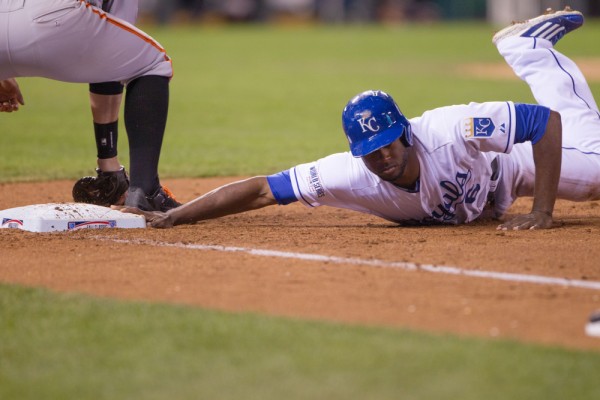
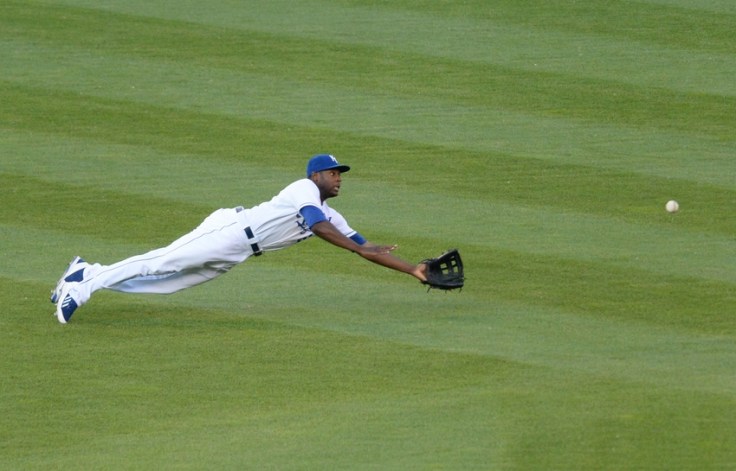
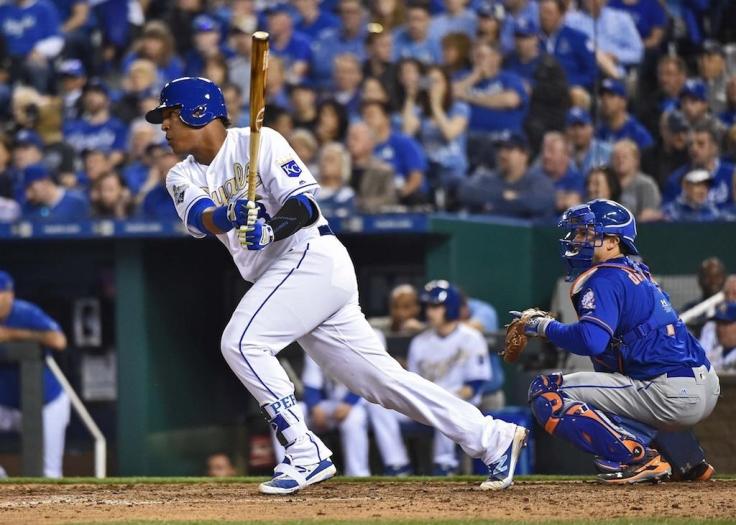
The walking wounded actually began back in Spring Training, as Jarrod Dyson, who was in line to see a big increase in playing time in right field, came down with a strained oblique. In May, starters Kris Medlen and Chris Young would both venture to the disabled list, after struggling through their previous few starts. Late in May, Alex Gordon and Mike Moustakas would collide chasing a foul ball  in Chicago and the news was grim; Gordon would miss a month with a wrist injury while Moustakas would have a torn ACL and was expected to miss the rest of the season. A week after that collision, catcher Salvador Perez would incur a quad contusion after third baseman Cheslor Cuthbert would run into Salvy while chasing a pop fly. Luckily, Perez would sit out for a week but not have to make an appearance on the disabled list. The injury bug would return in June, with outfielder Brett Eibner(after only being recalled a few days earlier) going on the DL on June 1st with a left ankle sprain, returning after two weeks. Lorenzo Cain would make his first DL appearance in two years, pulling up lame and grabbing his hamstring after running out a ground ball just a few weeks ago. To cap it all off, closer Wade Davis, a man who some of us believe is actually a machine, would deal with a forearm strain and land on the DL with Cain just this past week. If you are taking notes at home, that is four Royals All-Stars that have seen time on the DL so far this season and that is just through 88 games. One of the biggest strengths for Kansas City the last two years was their health, as they were able to make two big playoff runs while dealing with very limited injuries to their main nucleus. The pendulum always swings back around and it appears the Royals dance with lady luck has ended on the injury front.

kc3

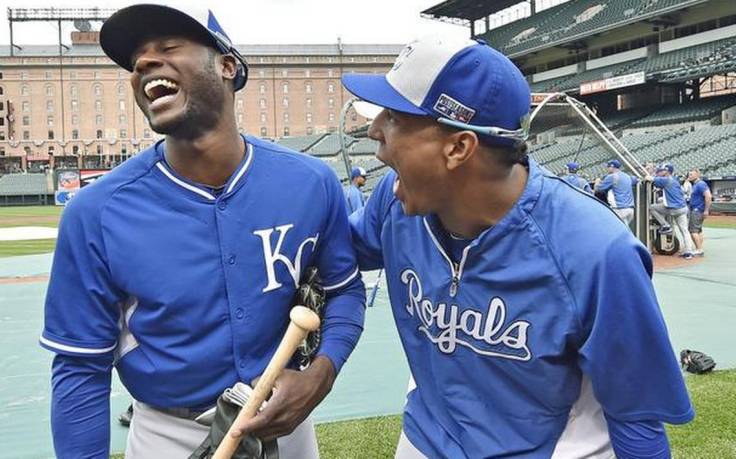
Speaking of turbulence, the Royals starting pitching has been more than just rocky so far in 2016. Kansas City starting pitching is next to last in innings pitched, 3rd highest in walks per 9, 1st in home runs per 9, 4th highest ERA, highest FIP, and lowest WAR in the American League. The only area where the starting pitching is moderately succeeding is strikeouts per 9, which is the 3rd highest in the league. With these numbers it is easy to see why the Royals have struggled and are currently looking for upgrades on the trade market. Chris Young, who was a vital part of the Royals playoff run last year, has allowed the most home runs in the American League(26 in only 56 innings pitched) and has been banished to the bullpen. Ian Kennedy has been about what was expected from him; at times he has looked phenomenal and has shut down other teams, while others he has been a victim of the long-ball, allowing the second most home runs in the AL( 21). Yordano Ventura has not looked like the ace that he could be capable of, as he has struggled(including inciting a melee in Baltimore) and others he has put together some very quality starts(like just this past Friday). Edinson Volquez hasn’t been as consistent as he was in 2015, yo-yoing from start to start. The one shining light has been the re-emergence of Danny Duffy, who has looked like a pitcher who has figured something out. Duffy started the year in the  bullpen but was moved to the rotation in May and has been splendid ever since. He has thrown 81 innings to this point, striking out over 10 batters per 9, walking less than 2 per 9 and stranding runners at an 83% clip. Duffy’s numbers just jump out on the page: highest K-BB% in a Royals uniform, highest soft hit % of his career, and the fastest average fastball velocity of his career. If the Royals can get some more consistency from Volquez and Ventura, while picking up a cheap arm in a trade, they might be able to stabilize the rotation and improve on numbers that shouldn’t be hard to improve upon.

kc4

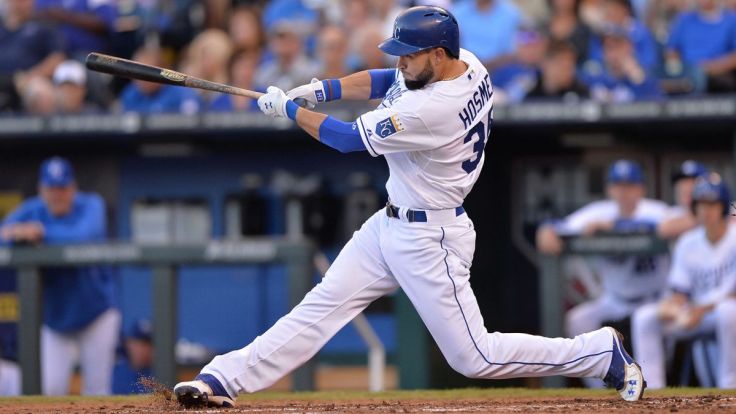
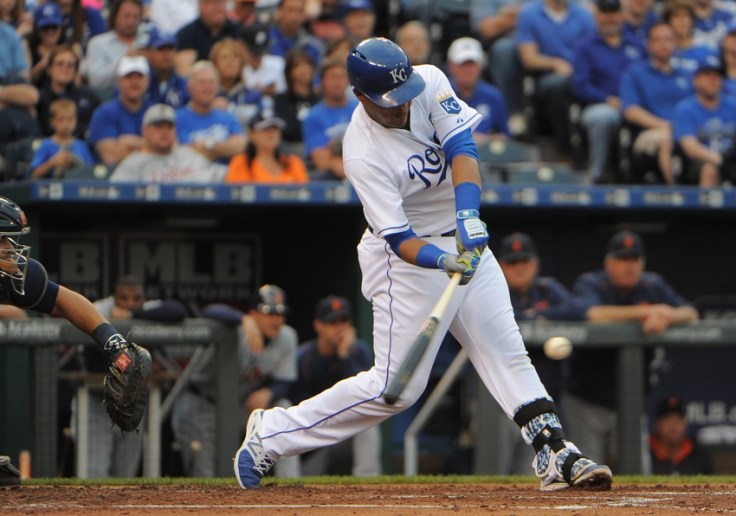
While the starting pitching has been a major trouble area, the offense has been very bi-polar. Much like the last few years, the Kansas City offense is a very streaky bunch. As a team they are next to last in runs, last in RBI’s, home runs, walk %, isolated power, and 12th in wRC+. Most other offensive categories the Royals are around the middle of the pack, but the Royals also get their runs in a different manner than most other American League teams. Eric Hosmer has turned in a season worthy of his All-Star starting nod, hitting .299/.355/.476 with 13 home runs and 49 RBI’s. Salvador Perez has seen an increase in power this season and has turned into a serious threat in the middle of the lineup(writers note: he even hit a home run right after I typed this). Paulo Orlando has been a pleasant surprise this year, hitting .324/.347/.417, sacrificing some of the power we saw from him last year for a better on base percentage. Lorenzo Cain struggled in April, but came on like wildfire in May and was putting up good numbers before his injury this month. Kendrys Morales struggled through the first two months of the season, but looked like a completely different hitter in June, a month where he put up video game numbers. Even Mike Moustakas was putting up great power numbers before his injury in May. But the real surprise of the offense has been the call-ups Kansas City has been using to fill the holes for injured players.

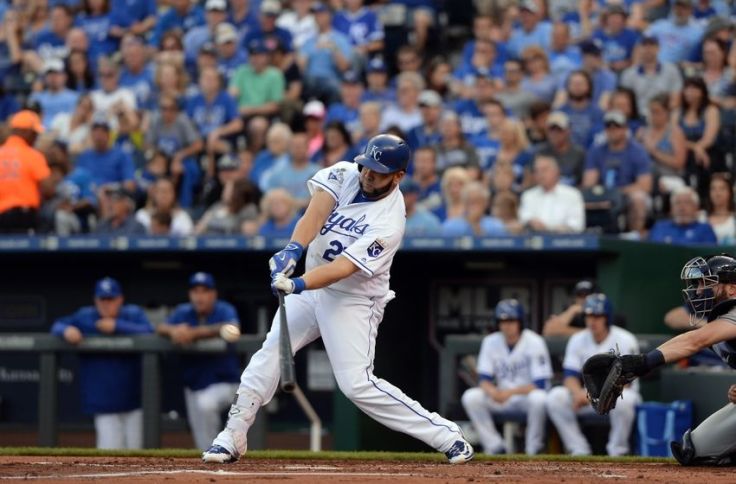
MLB: Houston Astros at Kansas City Royals
(Credit: John Rieger-USA TODAY)

The great thing about this Royals team is not only the depth that they have compared to years past, but the amount of production we have seen from players that were not expected to contribute. Whit Merrifield has been a life-changer for Kansas City, posting a line of .291/.313/.407 with 1.4 bWar in just 46 games. Whit was originally supposed to fill the super utility role for Kansas City, but instead ended up taking the second base job from the now released Omar Infante. Cheslor Cuthbert, who saw some time in Kansas City last year, was recalled to take over at third base for Moustakas and struggled a bit the first few weeks of seeing regular playing time. Since May 27(right around the Moose injury), Cuthbert is hitting .293/.331/.471 with 7 home runs, 22 RBI’s and a BAbip of .343. Defensively, he is not quite the glovesman that Moustakas is, but he has proved to be more than capable, with an UZR of 6.2 and making 83% of plays that are considered unlikely(which are considered normally to be made 10-40% of the time). The man who has seen the least amount of time out of this group is Brett Eibner, as he has only played in 18 games. Eibner has been productive in that span, hitting .269/.333/.500 with a BAbip of .343 and a wRC+ of 116. Eibner has 8 extra base hits in his 18 games and is a bat that can supply the power the Royals heavily covet. All three players have stepped in when the Royals have needed them to and have produced in many a tight situation. It wasn’t expected for these three to be heavy contributors, but so far in 2016 they have probably helped this team stay in the pennant race.

kc6

While this Royals team isn’t gliding into a postseason berth like they did last year, they are still very much in contention, even being 7 games out in the American League Central but only 4 1/2 games out of a wild card spot. The hope is that the Royals can stabilize the rotation while hitting a bit more consistently, which should increase their chances of a playoff spot. Injuries have hurt Kansas City so far this year but they haven’t crippled them and that has allowed them to stay in the race. We have seen over the last couple seasons that this is a team that strives on adversity. If that stays true to form, then we should be seeing a stellar second half from our ‘Boys in Blue’.


Wader, Disabled List Please

kc1

Over the last couple years there has been one aspect of the Kansas City Royals success that has made me nervous. That one thing was how the team dealt with very few major injuries, as for the most part the key parts of the roster were kept healthy and on the field. 2016 has felt a bit like the back payment for that good luck is being paid up. In May, All-Stars Alex Gordon and Mike Moustakas collided in foul territory chasing a foul ball, leaving Alex out for about a month and losing Moose for the rest of the season. Just last week Lorenzo Cain was bitten by the injury bug, going down to a hamstring injury that will leave him out until the Royals return from the All-Star break. Even catcher Salvador Perez missed a week of action due to injury, but luckily avoided the disabled list. It appears the Royals All-Stars are falling off one by one and that was added to today when closer Wade Davis, he of the bionic arm, was placed on the 15-day DL with a forearm strain.

kc2

The first thing to pop in most people’s heads when mentioning a forearm injury is a ligament injury in the elbow, which Royals management is saying is not the case with Davis:

The strain, Yost said, was located on the top of the forearm, and not a flexor-pronator strain, the ailment commonly associated with ligament damage in the elbow. Yost said the injury was similar to one that forced starter Chris Young to the disabled list earlier this season.

Alright, well that doesn’t sound bad at all. In fact, it appears as if the Royals are trying to nip the strain in the bud before it gets any worse. Davis had first felt the strain last week in St. Louis, and he also had a similar injury last September. Last year he was shut down for about a week and was all good to go for the playoffs. Sounds like Kansas City is hoping for more of the same this year.
MLB: Kansas City Royals at Houston Astros

(Credit: Thomas B. Shea-USA TODAY)

With the injury to Davis, I was curious to see if his velocity had seen a decrease recently and if so, if  it was noticeable. This first chart shows his velocity on his pitches all year and there really isn’t a noticeable change:

Brooksbaseball-Chart

There is a very slight decrease in Davis’ cutter, but outside of that everything has been moving in an upward direction, even just slightly. There was also a slight change when it comes to whether Wade was facing a right-handed or left-handed batter:

Brooksbaseball-Chart (1)

The decrease to righties was very slight, about 1 MPH difference, so nothing major to worry about. There was a slight difference from outing to outing, which is almost to be expected with an injury like this:

Wade had said he felt tightness during his June 30th outing against St. Louis, which would be the 94.7 MPH velocity you see above. The Royals seem like they are concerned but we aren’t seeing the big drop in velocity like we saw last year in Greg Holland, where he was down in the high to mid 80 MPH range, so there isn’t a reason to get too worried yet. The real test will be on whether Davis feels better in a week or if the tightness is still there. Most likely he will play catch for now and the team will get feedback from him on how he is feeling. In other words, it literally is a feeling out process for Wade and the Royals.

kc4

So who will fill the closer role from Davis while he is away? For the time being, it appears to be a match-up role:

If I had to guess, Kelvin Herrera will get first shot, since he has been a dominating force for most of this year. I also wouldn’t be surprised to see Joakim Soria get a save opportunity during his absence, as Yost likes his past success as a closer. I know some fans have soured on Soria, but he has been more than solid for the most part this season. Hell, I could even see Luke Hochevar getting an opportunity to close out the game if he looks like a good option. The good news for the Royals is that the team is loaded in the pen with solid arms, as it might be the deepest part of the team.

kc5

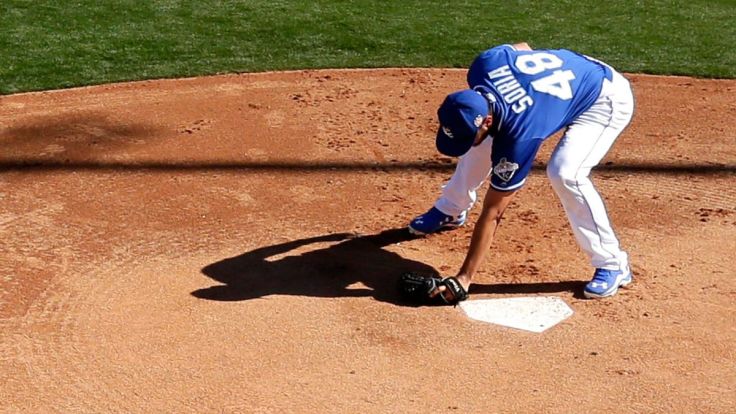
If there was a word to describe this 2016 season for the Royals, it would be ‘adversity’. This team has been dealt one crushing injury blow after another and yet are still a contender in the American League. Luckily, it sounds like everyone involved feels good about Davis’ chances of being back in the fold by next weekend:
For the most part this looks to be just a minor bump in the road that Kansas City is just being cautious about. I would worry more if there was a major decrease in velocity, or this was a ligament instead of a muscle. Instead, we are looking at a nice little dose of ‘R & R’ for the cyborg before he returns to give hitters fits of hopelessness. This is just one more struggle for this team to overcome if they want to return to October baseball….and if there was one team to handle adversity, well…

Selection Tuesday: Which Royals Are All-Star Worthy

kc1

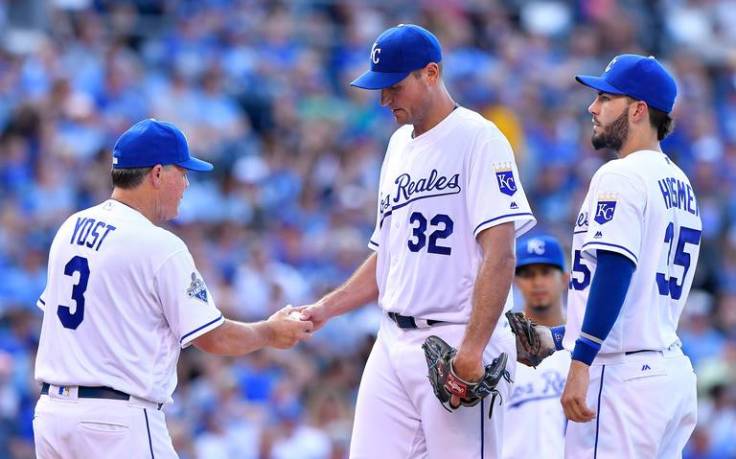
On Tuesday, Major League Baseball will announce the All-Star team rosters and it appears that the litany of Kansas City Royals players on the roster will not be as hefty as they were in 2015. With that being said, manager Ned Yost will once again be at the helm of the American League All-Star team and will have a say in some of the participants of the team. There will be Royal blue in San Diego on July 12, but how much? Let’s go ahead and look at my predictions for the Royals and who will be joining Yost at Petco Park next week.

All-Star Locks

kc2

Salvador Perez

Salvy, a fan favorite not only in Kansas City but all around Major League Baseball, was leading the AL catcher position last we checked so the likelihood of him going is about 99.999999%. Normally Perez gets to the All-Star game on his charming positivity and his stellar defense behind the dish. But this year you can add a lethal bat to the mix; .281/.315/.490, 12 home runs, 37 RBI’s, 110 wRC+ and 2.1 WAR. I remember back in 2012 when former Cardinals manager Tony LaRussa was being interviewed the day before the All-Star game and was asked about Perez, who was in his first full major league season. LaRussa had compared Sal to Cardinals elite receiver Yadier Molina, which at the time was the highest of compliments. At this stage, it feels like Salvy has overtaken Molina and is the standard-bearer for catchers, at least in the American League. This won’t be a shock and will be well deserved when Perez starts next week in San Diego.

kc3

Eric Hosmer

Hosmer has been battling the first base position out with the Tigers Miguel Cabrera for the starting nod and deservedly so. Hosmer has produced like a star so far in 2016, hitting .303/.361/.490 with 13 home runs, 49 RBI’s, 127 wRC+ and a 0.4 WAR(with his defensive metrics dragging this number down). Hosmer has looked the part this year of offensive force rather than just potential,  and at this point is probably more worthy of starting the game than Cabrera. Hosmer is a lock either way to be on the roster, it’s just a matter of whether he is voted in or heads to San Diego as a reserve.

kc4

Wade Davis

I’m sure there will be someone out there, somewhere, who will say Wade doesn’t deserve to go to San Diego next week because he “isn’t quite as dominant” as he has been the last two years. That is pretty much the equivalent of Mike Trout’s numbers falling a smidge but still being an MVP candidate. Davis has thrown 29 innings so far this year, and while his numbers don’t pop out at you like in the past(K rate is down, walk rate is up) he is still producing. Wade has an ERA of 1.23, FIP of 2.69, and is still stranding 87% of his runners on base. He is easily one of the top five relievers in the game and deserves to be an All-Star. No way Ned doesn’t make that happen, if he isn’t voted there by the players. Wade will be an All-Star, period.

All-Star Probables

kc5

Lorenzo Cain

This will be a complicated pick, but one that should happen. Cain is currently on the disabled list, which means he would be unable to play in the All-Star game, but he can always be picked as a reserve and then have someone else take his spot; not like that has never happened before in All-Star’s past. Cain is hitting .290/.336/.416 with 8 home runs, 39 RBI’s, 1.9 WAR with 9 defensive runs saved. Sure, Cain is not tearing it up offensively the way he did in 2015(April was not kind to Lorenzo), but he is still considered one of the elite center fielders in the game and that’s what this game is for: the best of the best. It will interesting to see if Cain gets a spot, as it would be another honor that he could use when negotiating a new contract with Kansas City after the 2017 season. I feel he is worthy, but he might end up being a borderline selection by the players and coaches.

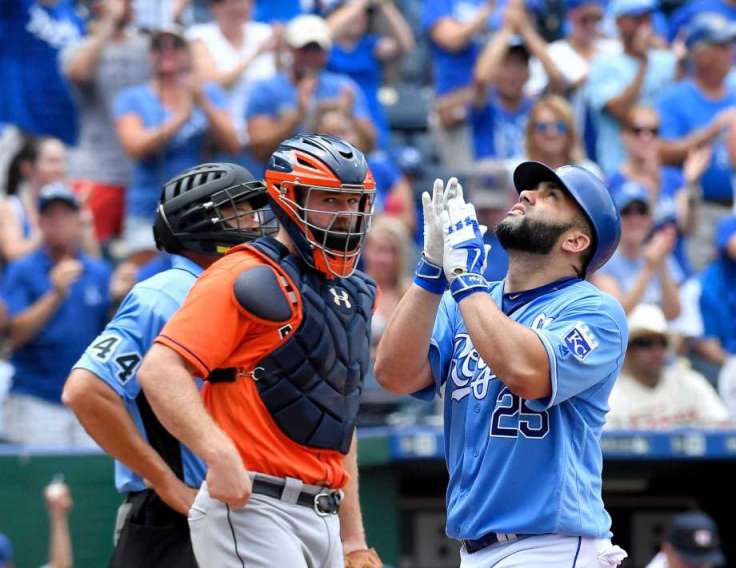
MLB: Detroit Tigers at Kansas City Royals
(Credit: Peter G. Aiken-USA TODAY)

Kelvin Herrera

To me this is an easy pick but Herrera could be cast aside for another Royals reliever this year(more on that in just a bit). Herrera has put up dominating numbers this: 11.41 strikeouts per 9, 1.63 walks per 9, 87% left on base percentage, 1.40 ERA, 2.01 FIP and 1.3 WAR, all over 38 innings of work. Herrera added a slider to his repertoire late in 2015 and it has made him even more unhittable than he was before. The Royals aren’t the defending World Champions without Herrera and he has continued to be the bridge to Wade Davis this year to help lock down the late innings for the Royals. Herrera is an All-Star; now we will see if he actually gets the honor or is passed over for a bullpen brother.

All-Star Longshots

kc7

Luke Hochevar

Yep, bet you probably didn’t see this coming. Above, I mentioned Herrera could get passed over for another Royals reliever and of course I was talking about Hochevar. Hoch, a man who I once despised, has been one of the most reliable Royals relievers this year and the numbers back that up: 10.16 strikeouts per 9, 2.03 walks per 9, 79% left on base percentage, 2.90 ERA and 0.4 WAR over 31 innings. Sure, these aren’t eye-popping numbers like Davis or Herrera, but they are more than solid and worthy of the adulation. Now, if Hoch gets picked it will be by manager Ned Yost, who will want to reward Luke for his hard work out of the pen and the fact he doesn’t get a lot of the recognition that his bullpen mates get. Yost has asked Hochevar to perform in a lot of high-leverage situations this year and for the most part he has been highly effective in that role. If he is rewarded with the honor, it will show just how loyal a man like Yost is and a nice nod for a guy who turned his career around after being a failure in the rotation.

kc8

Whit Merrifield

Okay, okay, I know; Whit has played in only 40 games for Kansas City and more than likely has no business even being in this discussion. But…those 40 games have been stellar with steady production from a guy who is supposed to just be an afterthought after the season started. Instead, Merrifield has posted a line of .308/.328/.426 with 26 runs scored, 15 RBI’s, a .385 BAbip, 100 wRC+ and 1.3 WAR…all in 40 games! Merrifield is 8th in WAR for second baseman in the American League and while Robinson Cano, Jose Altuve and Ian Kinsler are all worthy of roster spots this year, the story of Whitley Merrifield would make a great story. It’s not going to happen and for the most part, it shouldn’t. But it’s hard not to root for this guy and everything he has accomplished in about six weeks. To see him gaining an All-Star nod would be about as warm and fuzzy as one can imagine. Think of watching ‘Toy Story’ while cuddling with a bunch of puppies and you will be close…not quite, but close. So Merrifield isn’t going to San Diego, but I felt like I should at least mention him. Rock on, Whitley.

kc9

The Royals aren’t going to send as many players to San Diego as they did last year in Cincinnati(no bus needed this year. Sorry, Rex) but I would expect a healthy dose of Kansas City blue at the festivities next week. For years Royals fans would hem and haw about who actually deserved to get Kansas City’s lone spot at the game, and there were even years were no one was really worthy(hello, Mark Redman!). The Royals will have enough players going this year to where you should probably pay attention to the game to see if any of the players end up playing pivotal roles. Just don’t take the game too seriously; it is an exhibition game after all. An exhibition game where Salvy could throw a runner out, Hosmer could hit a home run and Wade could record the final out. Sure, there is a good chance none of that happens, but you never quite know.


The Awakening of Kendrys Morales

kc1

When June began there were many a question pointed in the direction of Kansas City Royals DH Kendrys Morales. Morales was mired in a two month-long hitting slump and at that point was hitting a paltry .193/.262/.330 with 6 home runs, 21 RBI’s and more strike outs than actual hits. Morales looked lost and there was concern that maybe Kansas City needed to go out and get a bat to replace him if the slump continued much longer. Even I wondered if Carlos Beltran would be a better option than Morales while deep down hoping that Kendrys would find his swing and take off like a rocket offensively. Well, it took a lot longer than expected, but the slugger we saw in 2015 win the Silver Slugger award for American League DH is back to form and has been tearing the hide off the ball these last few weeks. But this begs an even bigger question than we were asking a month ago: What has changed for Morales?

kc2

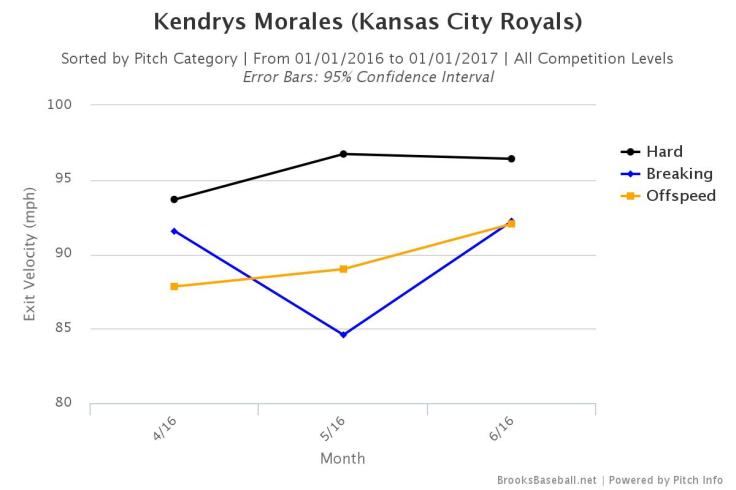
One of my initial beliefs about Morales’ improvement has been his ability to hit breaking balls and off-speed pitches. Early in the season it appeared he was really struggling trying to make contact and pitchers had picked up on that. But in June it seemed as if Morales was actually pounding those same pitches he was missing the first two months of the season:

Brooksbaseball-Chart

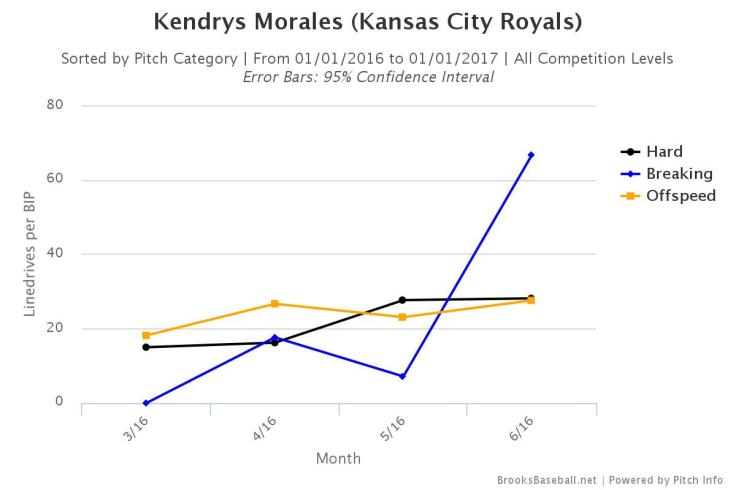
The chart above confirms my suspicions as Morales’ exit velocity on breaking balls and off-speed stuff has taken a steady rise in a positive direction. This made me also wonder if he was not only hitting those pitches harder, but also improving his line-drive rate on balls in play:

Brooksbaseball-Chart (1)

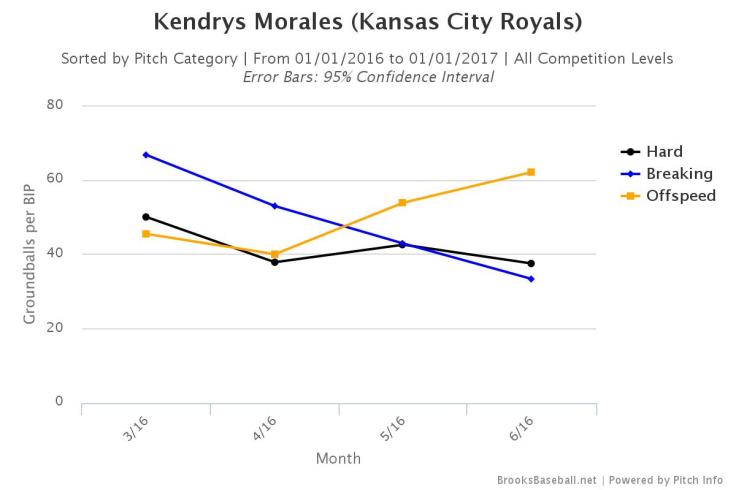
That turned out to be a big 10-4 as Morales’ line drive rate on breaking balls jumped from an average of 7.14 in May to 66.67 in June. If you have watched a number of Royals games this past month, you are well aware of how Kendrys has been scalding the ball and by that I mean not in the form of ground balls:

Brooksbaseball-Chart (2)

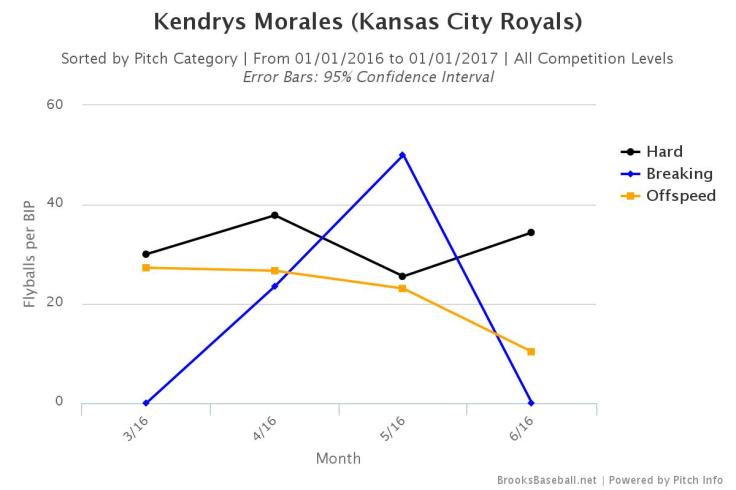
This is also confirmed, at least on breaking balls. It does appear as if Morales saw a jump on ground balls off the off-speed pitch, which Isn’t too big of a shock. This probably should not be seen as completely negative, as it is better than popping those pitches up, where at least a well hit ground ball can find a hole. This seemed to be proven by Morales’ ground ball chart:

Brooksbaseball-Chart (3)

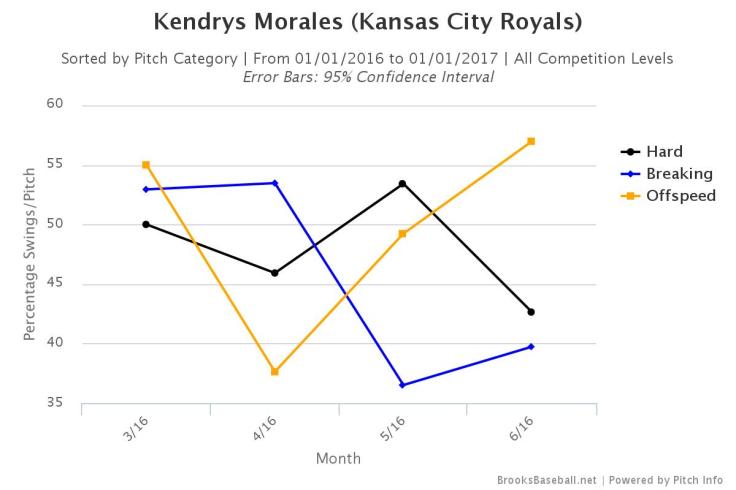
Last month Morales was hitting breaking balls in the air a lot, as it spiked the highest in May. In June, it is at the very bottom and is actually at zero. Rather than giving the other team an easy out by hitting it in the air, Morales has been getting enough of the bat on the ball to either hit the ball on the ground or line the ball into the field of play. Not only has Morales been hitting off-speed pitches, it also is the pitch he is swinging at the most in the last month:

Brooksbaseball-Chart (4)

This tells me that Morales felt more comfortable in June swinging at the off-speed pitch and probably even expected to see more change-ups than fastballs. Teams had obviously started throwing Morales a certain way, seeing that he was struggling catching up to the off-speed pitch and it makes one wonder if he will start seeing more fastballs with the way he has been hitting as of late.

kc3

So we have looked at Morales’ improvement with breaking balls and the off-speed pitch, but the overall numbers are even more impressive. Over the last month, Morales has put up a line of .402/.453/.655 with 5 home runs, 18 RBI’s and 12 total extra base hits. His strike outs have also steadily fallen, as he had 21 in April, 18 in May and down to 17 strike outs in June. One stat that really points out why Morales has seen this success is batting average on balls in play(BAbip). During the first two months of the season Morales posted BAbip’s of .270 and .157 respectively; in June he hit a whopping .462! Morales was not only hitting the ball better, but he was also finding holes in the other team’s defense at a higher rate as well.  It shouldn’t be surprising that Morales ended up with an OPS+ of 190 throughout the month, as those are the two forms of attack for him in June; get on base and accumulate extra base hits. Morales ended up with only one more home run in June than May, but hit 7 doubles while only racking up 1 double in May. Oh, and Morales saw a big uptick in his batting average in the last month. He would start the month hitting .193, and would finish it hitting .262. We could probably dig up numbers all day comparing April/May to June and be blown away but more than anything it shows what Kendrys is capable of when he is in the zone. The numbers Morales put up last month weren’t just impressive for a guy who had been slumping all season, they would be impressive for the Mike Trout’s and Bryce Harper’s of the world as well. That is elite company, to say the least.

kc4

With this big of a turnaround, one has to wonder just what changed for Morales. We can speculate all day but if you have followed baseball for even a small bit you know the slightest change can make a difference. Earlier in the week I had a friend suggest that he believed that Morales had been staying on his back foot longer than normal and honestly, a change like that could make a batter see the ball better out of the pitcher’s hand and also give him more time to prepare for something slower than a fastball. Whatever approach Morales changed has worked and has made him look like the hitter who was spraying the ball with authority throughout much of 2015. With the trade deadline looming, having Kendrys on point leaves the Royals front office with one less position to worry about when looking at trade targets. Now if the rest of the Kansas City offense can help him out(and if Cleveland finally decides to lose a game) the Royals could be sitting pretty headed into the last couple months of the season. One minute we are cursing the slumping player, the next praising him. Piling on the adulation is way more productive than wondering what the hell is going on with someone like Morales. I’m just glad he chose to wake up his bat when he did.

Cain Is Not Able, Heads To DL

kc1

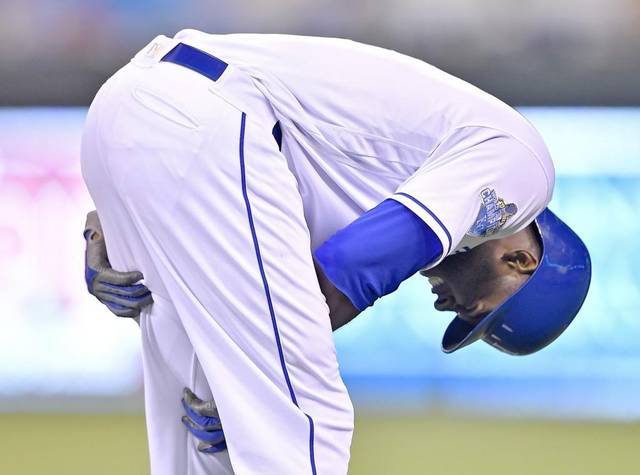
On Tuesday evening, the injury bug hit the Kansas City Royals yet again. This time, it struck All-Star centerfielder Lorenzo Cain, as he pulled up lame running out a ground ball. As most know that follow the Royals, this is not the first time Cain has dealt with a leg injury. In fact, the Royals have spent the last few years trying to get him to kick the habit of lunging at the first base bag when running out grounders and for the most part he has been successful. Unfortunately, this time Cain is dealing with a strained left hamstring and was placed on the disabled list on Wednesday. So what effect will this have on Kansas City?

kc2

Let’s state the obvious first: it is never good to lose a player of Cain’s caliber, let alone the person who is probably the best player on the team. The Royals will obviously miss his stellar defense in center field, but this might turn out to be a nice break for Cain. Cain hasn’t been tearing it up offensively in June, hitting .280/..309/.333 with 6 RBI’s. He’s not hitting poorly, but he’s also not producing the way he was in May; .351/.387/.577 with 6 home runs and 25 RBI’s throughout the second month of the season. It is easy to see where some of the Royals struggles earlier this month can be traced back to Cain, as he has driven in about 20 runs less this month. I feel like I am dogging Cain for the past month, which I’m not; there is no way he would drive in 25 RBI’s every month. But with him batting in the middle of the Kansas City batting order, you would hope he would have contributed a bit more over the span of a full month. Sometimes a player needs to take a step back from the everyday grind of baseball to recharge and get back into a groove. Cain will be allotted that time for the next couple weeks.

kc3

So who will take Cain’s place in his absence? I would have to believe we will see more Jarrod Dyson, as he is a solid fit in center field. Dyson has had a rough June(.229/.357/.257 in only 43 plate appearances) as he has seen his playing time dwindle with Paulo Orlando seeing the majority of playing time in right field due to his hot hitting. Dyson will bring most of the same stellar defense that Cain brings to the table, but offensively he will be a few steps back. There’s also a chance that Brett Eibner, who was recalled again from Omaha once Cain went to the DL, could see some time in center, a position he has played in the minors. Playing Eibner in center field could be interesting, as he is a step back defensively but would add another power bat to the Royals lineup. The Royals tend to put an emphasis on defense the majority of the time, so Eibner would probably see less playing time but it might be a good litmus test to see how he does defensively for a couple of weeks until Cain is back.

kc4

Speaking of Cain coming back, you might be wondering about the timetable for his return. The word is that Cain has a Grade 1+ strained left hamstring, which is defined as follows:

With a grade 1 hamstring strain you may have tightness in back of the thigh but will be able to walk normally. You will be aware of some hamstring discomfort and unable to run at full speed. There will be mild swelling and spasm. Bend your knee against resistance is unlikely to reproduce much pain.

This would be why most didn’t notice a limp after Tuesday night’s game:

This would also explain why they are expecting him to return right after the All-Star break:

In other words, the injury came at an opportune time. With the All-Star break just a few weeks away, that gives the Royals just a tad over two weeks to let Cain rest and get healed without losing him for a long stretch of games. I would also say he will not be playing every single game upon his return, as they will want to monitor the hamstring and make sure not to re-aggravate it. The fact this isn’t Cain’s first leg injury is a concern, but an injury like this would be much more painful during the pennant stretch than it is in late June/early July.

kc5

An injury to an All-Star is never a good deal for any team,  but the Royals should be able to hold the team together during Cain’s absence. Kendrys Morales is on a hot streak offensively and with Alex Gordon back in the fold the Royals offense isn’t as patched together as it was a month ago. If there is a real concern here, it is that Cain has had a myriad of leg injuries throughout his career, most notably back in 2012. You have to hope for the Royals sake that this is just a lone event and not a sign of things to come. Cain has stayed healthy for almost a two-year stretch(his last DL stint was in April of 2014) and the Royals need him healthy if they are going to make a return appearance in the playoffs. The Royals have the depth to wait out this injury and shouldn’t notice a big drop-off in his absence. If you really want a sign as to how the Royals have changed over the last 4-6 years, here it is. The Royals will be without their best player for a few weeks and there isn’t a giant alarm going off. This is progress, folks.

Wanna Be Starting Something

MLB: ALCS-Toronto Blue Jays at Kansas City Royals
(Credit: Peter G. Aiken-USA TODAY)

Back in May, I discussed how the starting pitching had become a major issue for the Kansas City Royals. Luckily, not too long after that the starters stabilized and even with Chris Young and Kris Medlen on the disabled list, the Royals starters improved upon what at the time was a woeful performance. No one was going to confuse their starting staff with the Atlanta Braves rotations of the 1990’s or the Baltimore Orioles starters in the 1970’s, but there was some notable improvement, especially once Danny Duffy returned to the rotation. But the glaring weakness of this Royals team is still the starting five and I’m not so sure help is on the way.

kc2

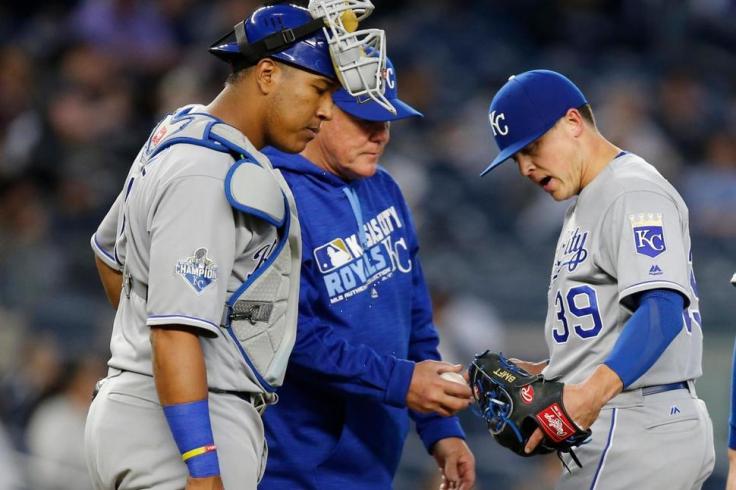
On Friday night, the normally steady Edinson Volquez had one of the worst starts of not only his career, but in baseball history. Volquez only threw one complete inning, allowing 8 hits, 3 walks and 11 earned runs. This earned him the honor of worst game score in Royals history, -18, which toppled the old record of -11, held by Jeremy Guthrie from last year and Zack Greinke in 2005. Chris Young followed that the next night by pitching 2.1 innings, and allowing 7 runs. Luckily, the Royals got some solid bullpen work both days from Dillon Gee, Brian Flynn, Peter Moylan and Chien-Ming Wang(oh, and Drew Butera). This is after Ian Kennedy only worked 4 innings on Tuesday and while Yordano Ventura is serving his 8 game suspension. The Royals starters are struggling and it’s easy when looking at the numbers to see why.

Indians Royals Baseball
 (AP Photo/David Dermer)

The Royals starters are 13th in the American League in innings pitched, the second highest in walks per 9 and 4th highest in home runs per 9. The only thing saving them from being last in the league is the fact they are stranding the most runners on base(a league leading 76.8%) and the Angels and Twins starters have actually performed worst this year. Back in May, both Medlen and Ventura were averaging 7 walks per 9 innings; Medlen is currently out on rehab assignment and Ventura has lowered his rate to 4 walks per 9. Chris Young and Ian Kennedy are 1 and 3 respectively in home runs allowed in the American League, with Jered Weaver of the Angels sandwiched between the two Royals. If the Royals are going to stay in the pennant race come September, this has to improve. But how?

kc4

Unfortunately, there isn’t much help on the horizon. Medlen is close to being back, but if he pitches the way he was earlier in the season I’m not for sure that is an improvement. Mike Minor was once thought of as an option, but he was shut down from his rehab assignment a few weeks ago for shoulder fatigue and hasn’t been heard of since. Same for two top Royals prospects, Kyle Zimmer and Miguel Almonte. Almonte did return to action on June 9th, but the longest start he has had since then was only 4 innings. Alec Mills was recently recalled to AAA Omaha, but I doubt he is ready yet for a rotation spot. So there are really no answers within the organization. What about outside the organization?

kc5

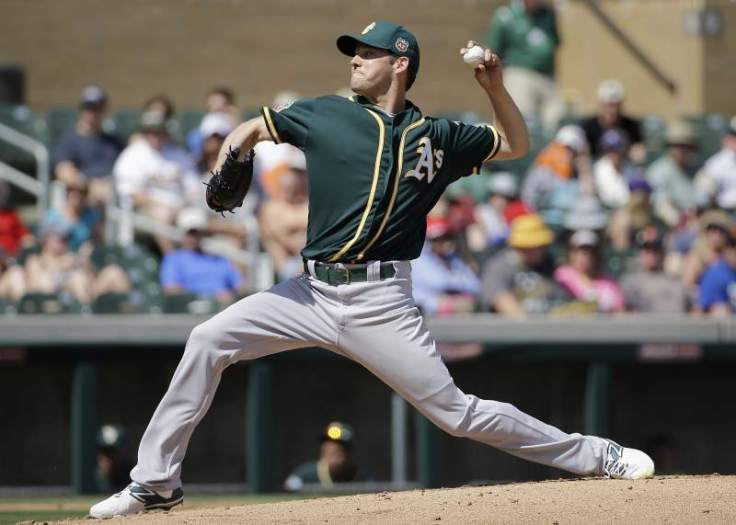
Unfortunately, the Royals don’t have much to deal, especially after last year’s Cueto and Zobrist trades that took a large chunk of their pitching depth.It’s conceivable that the Royals could go out and make a trade, although it wouldn’t be for much. More than likely it would have to be a middle to back end of the rotation type starter and someone that Kansas City could get fairly cheap. Someone like a Rich Hill of Oakland would probably be within their price range and would be a nice fit in the middle of this rotation.

kc6

If the Royals are going to contend they are going to have to improve from within. Young and Kennedy would do good to keep the ball down low, pitch on the corners and avoid the middle of the plate. Yordano needs to keep his cool and use his fastball to set-up his off-speed stuff. All the Kansas City pitchers would be wise to lower their walk total and let the Royals defense do their job. More than anything, they need to limit the amount of base runners that are on the base paths; the current amount is just a recipe for disaster. This all seems like basic stuff that I’m sure they are trying to do anyway, but at this point whatever they are trying to do is not working.

kc7

So the main solution to the Royals problem is a bit more consistency from their starters. In reality, all they really need to do is go 5 to 6 innings, allowing 3 runs or less(which is essentially a quality start) and then hand the game over to the bullpen. All of the Royals starters are capable of doing this and while it is unrealistic to expect this out of them every start, it is realistic to expect it the majority of the time. It appears rather funny to sit here and tell them to ‘just pitch better’ but essentially that is what will have to happen. There is no hero coming, riding in on a white horse. For the most part, the rotation they have now will decide whether or not this Kansas City team is playing again come October. This is the hand they dealt themselves,  and more than likely it is the hand that will decide their fate.

Welcome To The Jungle

kc1

“Some things will never change. Some things will always be the same.” ~Thomas Wolfe, You Can’t Go Home Again.

It’s hard sometimes to visit the past. As much as we want to look at the past through rose-colored glasses, most times the truth is that there was just as much bad as good. Go ahead, look back at an old relationship and really dissect what worked and what didn’t. There is a reason you parted ways. This holds true in baseball as well; if a player leaves a team, there is normally a reason. For the most part, Joakim Soria was a positive when it came to his first go-around with the Kansas City Royals. Multiple time All-Star, reliable closer, and even racked some American League Cy Young  and MVP votes back in 2010. Sure, there was the rough patch he had in 2010 when  he was using a cutter way too often(and saw him get hit hard because he hadn’t mastered the pitch), but those five years of glory endeared him to the Royals fanbase. Unfortunately, Soria was part of the losing years in Kansas City, the years that aren’t always looked back on fondly. It wasn’t his fault, but it’s hard not to associate him with that era of losing.

kc2

So when the Royals signed Soria to a 3 year deal this past offseason, it was mostly met with cheers and adulation. Soria had put up some good numbers last year during his stint in Pittsburgh and was only entering his age 32 season. But there were reasons to be concerned; I for one wasn’t fond of the length of the deal nor the amount of dollars spent. I wasn’t Anti-Soria, but my feeling was that solid relief pitching could not only be found on the cheap, but younger relief pitching wouldn’t be that hard to find. Instead, the Royals latched themselves to Soria for three years with the hope that he still had some of that old glory left in his arm. In some ways Soria hadn’t changed much; his average velocity is still on par with years past and he still uses his four seam fastball to set up a nasty change-up that is a real worm killer. Soria was known to throw the change-up to generate more swings and misses, as it is slightly firmer than the usual change and has more natural sink to it. The feeling was that Soria could help set-up for closer Wade Davis while also using his past closing experience to help in case of emergency.

kc3

The first month of the 2016 season wasn’t a warm welcome back to the fold for Soria. Call it nerves, call it bad pitch location or just bad luck, but in his first outing back he would only throw 2/3 of an inning, allowing 3 hits, 3 runs and 2 walks. In fact, just chalk up April as a bad month; 12 games, 11 innings pitched while giving up 8 runs and posting an ERA of 5.73. Many a Royals fan was already wanting him to be pushed back to less intensive work, a few even wanting him to only pitch during blow outs or in mop up duty. But the truth was that Soria just wasn’t pitching as bad as it appeared; his line-drive rate was down and his hard hit rate also leaned downward. This told me that hitters were just not hitting the ball very hard off of him. This was even more evident when looking at his BAbip, which stood at .355. Luckily, things would turn around starting in May.

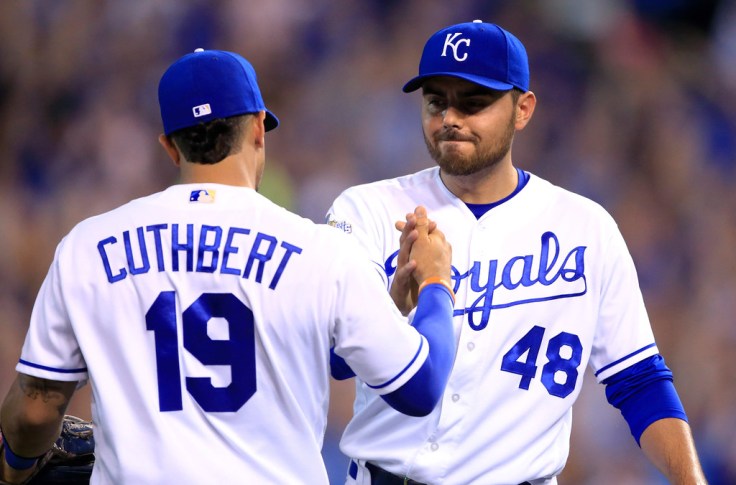
Cheslor Cuthbert, Joakim Soria
(AP Photo/Orlin Wagner)

May would lead to more prosperity for Soria; 12 games, 13 innings thrown only allowing 2 runs and posting an ERA of 1.35 while his BAbip lowered to .222. In fact, since May Soria has been one of the most reliable Royals relievers. Over his last 22 appearances, Soria has given up only 5 runs over 24 innings, putting up an ERA of 1.88 while almost striking out a batter per inning(striking out 21 over those 24 innings). So what has changed?

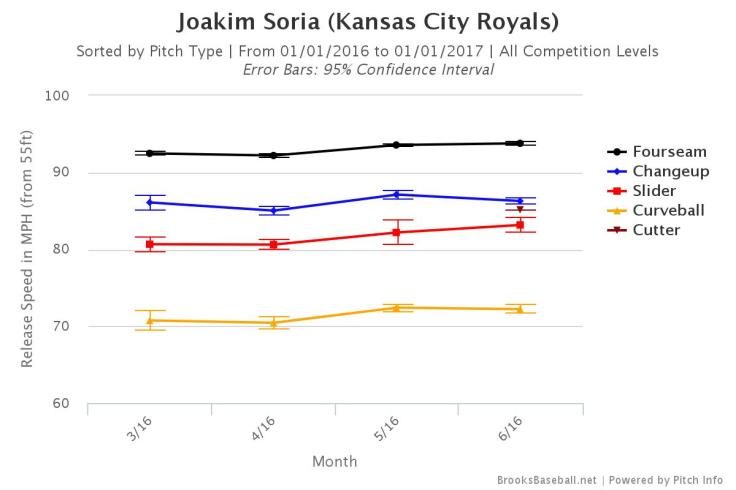
Brooksbaseball-Chart

For one, it appears his velocity has gone up. There is a slight decrease in the speed of his change-up, but to me that is actually a good thing, as it puts more distance between his fastball and his off-speed stuff. This is a good sign.

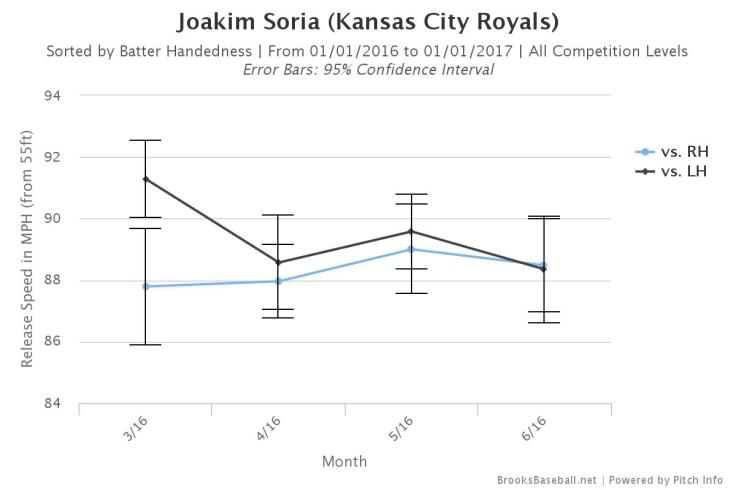
Brooksbaseball-Chart (1)

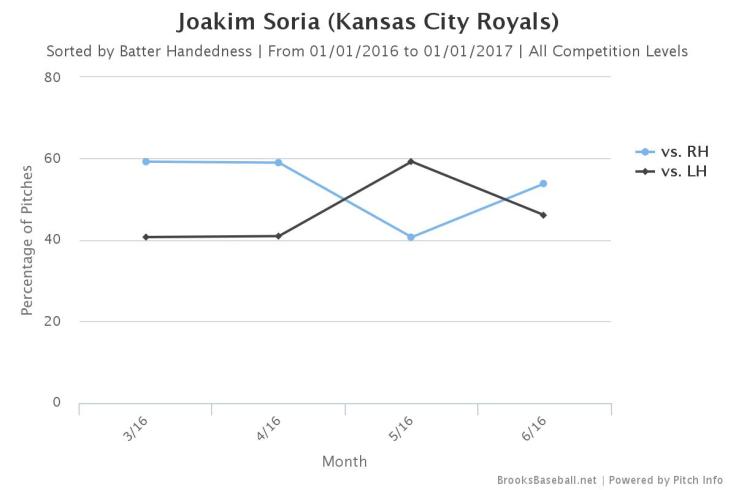
It also looks as if left-handed hitters have hard a harder time hitting him, as the release speed has changed by a decent amount from the beginning of the season.Right-handed hitters speed has gone up, but not by very much. This is also shown in the percentage of pitches:

Brooksbaseball-Chart (2)

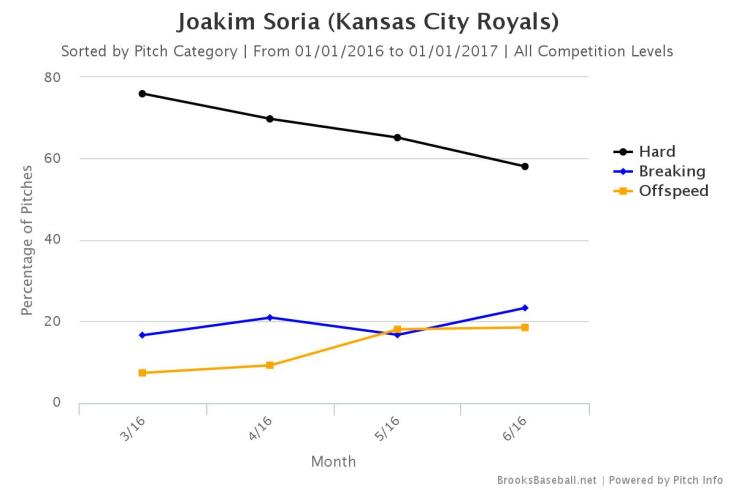
So what is Soria doing differently from April? He has drastically increased the use of his off-speed pitches:

Brooksbaseball-Chart (3)

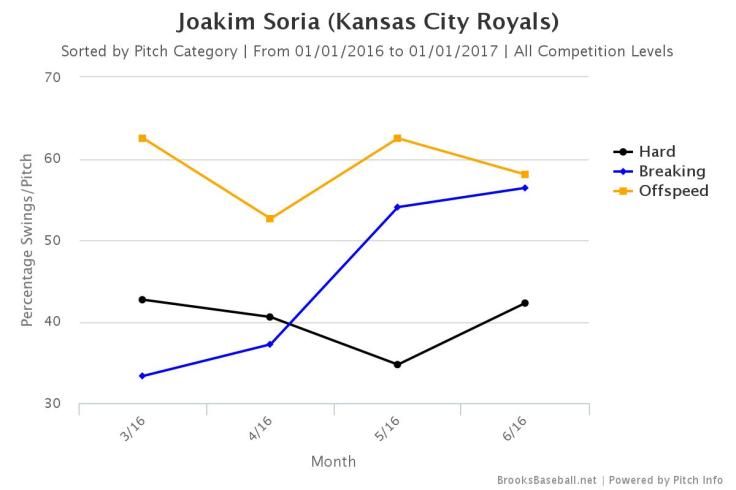
If you notice, the percentage of hard stuff has been drastically reduced by Soria, while both his breaking balls and off-speed pitches have seen an increase since April. This change in philosophy can also be seen in the pitches that batters are swinging at:

Brooksbaseball-Chart (4)

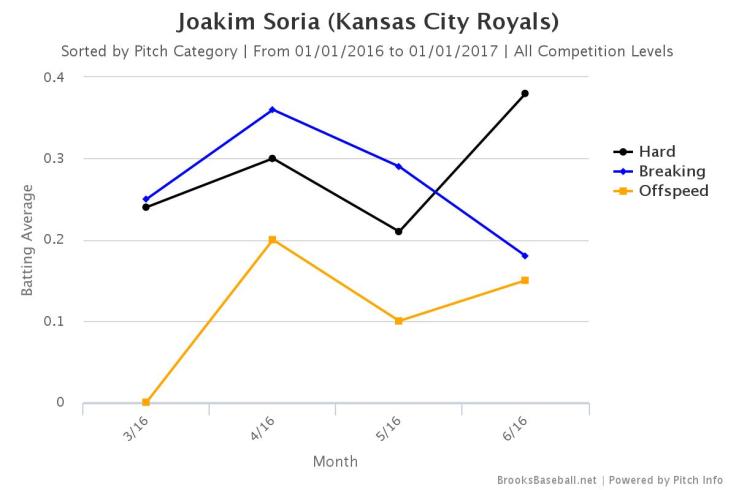
Hitters are swinging at more of his breaking balls thrown and is also seeing their batting average go down on breaking balls as well:

Brooksbaseball-Chart (5)

It goes to show how a slight change in philosophy can change everything. Batters are hitting better against Soria’s hard stuff, but they aren’t seeing those pitches nearly as much as early in the season. As has always been the case for him, he is using his fastball to set up his off-speed stuff, and because of that the results are looking more and more like they did back in his heyday.

MLB: Kansas City Royals at Houston Astros
(Credit: Troy Taormina-USA TODAY)

I’m not sure who to give credit to for the change in Soria’s pitch usage(my gut thinking is it was probably pitching coach Dave Eiland) but whomever it was should get a raise. Normally players at Soria’s age start to see a regression; less foot or bat speed, or a decrease in velocity for pitchers. Thankfully for Soria, he seems to have skirted the enivitable…for now.  There is no way to tell if we will be able to say the same by the end of his contract, but for now he is a main cog in the Kansas City bullpen. Players come and go for your favorite baseball team and a select few hold a special spot in your memory. Normally, if a player returns it is at the tail end of his career and he is but a shell of his former self. Thankfully, we are still seeing top shelf Joakim Soria. Sometimes you can go home again.

Salvy Power

kc1

Salvador Perez holds many roles for the Kansas City Royals; clubhouse leader, Lorenzo Cain’s BFF, backup broadcaster, leader of the pitching staff and middle of the order power threat. In 2015, Perez would hit 21 home runs, a new high for a Kansas City catcher. Despite this career high, Salvy’s other numbers weren’t as impressive. Walk rate was the lowest of his career. Strike out rate was the highest it had ever been. Hard hit rate was the lowest it had been since his rookie campaign. Line drive rate was one of the lowest of his career. Most importantly, his wRC+(which weighs runs per plate appearance while being park and league adjusted) was the lowest of his career, at 87(league average is 100). It really appeared as if Perez’s numbers were already starting to skew downwards, which was not good for a player coming into his age 26 season. Most Royals fans are well aware of Salvy’s lack of patience at the plate and most don’t expect him to walk much, but would prefer he became a bit more selective at the plate. All this information makes it even more impressive when discussing what Perez has done so far in 2016.

kc2

Over the last month Perez has been the hottest hitting Royal, putting up a line of .411/.436/.689 with 6 home runs, 14 RBI’s and an OPS of 1.125. Perez, a notorious free-swinger, is still swinging at a lot of pitches(in fact he is pretty much on par with his totals for the last two seasons), but there is a slight change in his approach. Last year, Perez was making contact with pitches outside the strike zone about 73% of the time; so far this year he is at 62%. Meanwhile, pitches inside the strike zone he is actually making a bit more contact, up to 91.4% from 90.7%. This tells me that he is laying off the pitches outside the strike zone a bit more this year while focusing more of his attention on pitches within the meat of the plate. The funny part to all of this is that Salvy’s strikeout rate is up by quite a bit(22%, up from 14% last year) while his contact rate is also down, to 78% from last year’s 83%. You would think that a guy who is making less contact would not see his numbers go up, but they have. In fact, Salvy has been a beast in the power department so far this year.

kc3

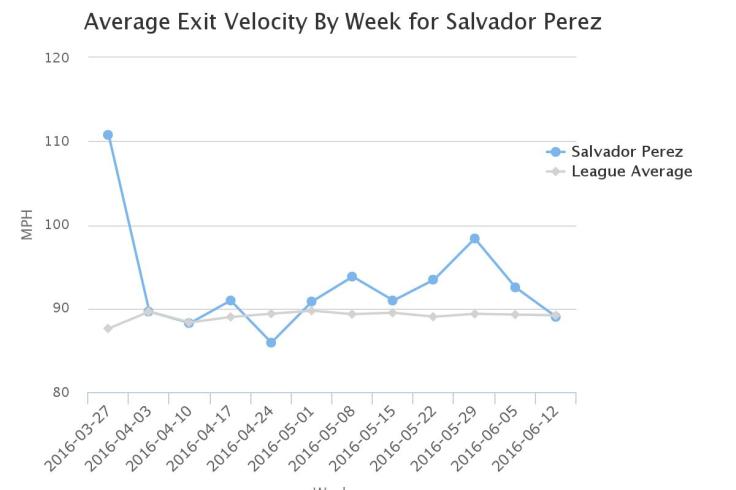
The power numbers are where Perez is really stepping up his game. His hard hit rate is significantly up this year, 36% from last year’s 24%, and his fly ball rate has also soared, 48.8% from 37.4%. Of course because of this, Perez has a higher home run to fly ball ratio(14.3%) and a lower ground ball rate(26.7% from last year’s 41.9%). To me this all screams of someone driving the ball much more and realizing he can do more damage on pitches closer to the middle of the plate. This is even more evident when looking at Salvy’s exit velocity:

chart

As you can tell, outside of a brief dip the week of April 24th, Perez has been not only above league average, but even close to averaging 100MPH on hit balls for a few weeks. Now, while his approach with pitches outside the zone has changed, he is still a very pull-heavy hitter, as he is pulling the ball the most he has since 2014. Slugging, On Base Plus Slugging, Isolated Power and Weighted on Base Average have all gone way up so far in 2016. Hell, Salvy’s BAbip over the last month is a ridiculous .508! These numbers speak of a player on track for a career year.

Salvador Perez
(AP Photo/Charlie Riedel)

Speaking of career highs, at his current rate, Perez is on track to have career highs in doubles, home runs, RBI’s, batting average, on base percentage, slugging and with a little luck, possibly even WAR. He also already has 11 walks this year, only 6 behind last year’s total. His career high for free passes is 24, which I’m not quite ready to say he could topple, although if he keeps hitting like this he will surely see his intentional walks go up. I know there was an increased effort this year for Perez to be more patient at the plate. To me, being more patient at the plate doesn’t always mean more walks as much as waiting for a good pitch to hit and drive. I’ve long felt that Royals hitting coach Dale Sveum has been teaching these guys to look for a pitch to drive and because of that we have seen higher power numbers from Lorenzo Cain, Eric Hosmer and Mike Moustakas. I’m starting to think the same philosophy is being soaked up from Salvy and it is paying off in spades.

kc5

So do I believe he will be able to keep this up all season? Perez is a very streaky hitter and I would assume at some point we are going to start seeing a lull in his numbers. That being said, I think even with that he can still keep himself with numbers higher than what he accumulated last year. Is he going to hit .300 all year? Probably not, but the power numbers could be here to stay. The bigger concern for Kansas City is to keep Perez rested and make sure they are not over-working him behind the plate. The Royals have a solid backup receiver in Drew Butera and with Kendrys Morales slumping much of this season, it seems like a solid idea to give Salvy’s knees a rest and start him at DH occasionally. More than anything, Kansas City needs Salvy to stay healthy the rest of the year for them to stay in contention in the American League Central. Perez has long been regarded as one of the top defensive catchers in the game and rightfully so; but now, outside of a Jonathan Lucroy or Buster Posey, he is making the case as one of the best all-around catchers, period. Perez is as special as they get and I really hope Kansas City fans are savoring what they have with him. If he keeps this up, the hardware won’t be stopping anytime soon.


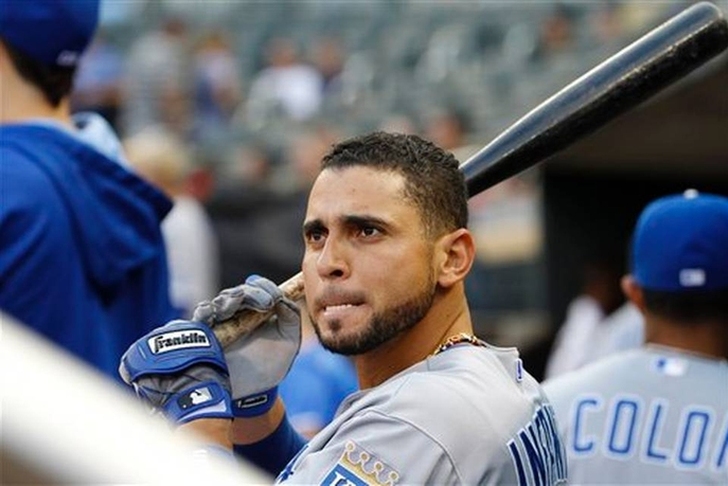
Happy Trails, Omar

kc1

Sometimes things just don’t work out. That’s a good way to describe the Kansas City Royals parting ways with second baseman Omar Infante on Wednesday. This wasn’t a shocking move in the fact that it happened; the timing was the only thing that caught most off-guard. Infante had been relegated to third-string second baseman thanks to the hot start that Whit Merrifield has gotten off to and the fact that Omar had struggled on both offense AND defense this year. The Royals still owe Infante another $17.75 million, which includes a buyout of his 2018 option and the fact that Kansas City was willing to eat the rest of his contract shows you the albatross that Infante had become to the Kansas City roster. But at the end of the day, this was the best choice for everyone involved.

kc2

Not everything was all downtrodden when it comes to the Royals signing of Infante. The Royals signed Infante before the 2014 season to a 4 year, $30.25 million deal with a team option for 2018 and at the time it felt like a good signing. The Royals had struggled at second base for years and before Infante, Kansas City was saddled with my favorite punching bag, Chris Getz. Infante was coming off of a solid 2013 campaign in Detroit, where he put up a line of .318/.345/.450 with an OPS+ of 115 and a bWAR of 2.5. Sure, he was entering his age 32 season with the feeling of regression lurking in the shadows, but all he really had to do was give the Royals an upgrade at offense and solid defense and they would be happy. Unfortunately, the momentum started to shift from almost the very beginning.

kc3

In Infante’s six game in a Royals uniform, he took a fastball to the jaw courtesy of Heath Bell. To say he hasn’t been the same since would be an understatement:


For Infante’s almost 2.5 years in Kansas City, he hit .238/.269/.328 with an OPS+ of 62 and a bWAR of -0.2. Infante did put up above average defensive numbers for the first two years of his deal but even that took a dip this year, falling below replacement level. For the longest time, Infante’s litany of injuries (jaw, shoulder, elbow) were blamed for his struggles, but that seemed to be rectified this past offseason, as Infante had surgery in November to remove bone chips from his right elbow. The belief was now that Omar was healthy, we would see the guy who had performed so well in 2013. Instead, he struggled even more this year, most notably on defense. The move to his right to backhand a grounder was a normal task in the past; this year he struggled on a consistent basis making that move. It appeared his range had continued to decline and there was very little zip on the ball whenever he would make the throw to first. In fact, I can’t even remember the last time I saw Omar throw the ball over the top; every throw I saw from him this year was sidearm. The injuries had seemed to take a toll on his body and the guy who was once a solid defensive second baseman had now become a liability on the field. Infante would bumble a ball in Cleveland a few weeks ago and that would be the last time he would start a game in a Kansas City uniform. Infante was regulated to the bench moving forward, as utility man Merrifield would see the majority of starts moving forward. Christian Colon would be recalled last week and even he was getting multiple starts at second base instead of Infante. It was obvious the end was near.

kc4

There were a couple Omar highlights that I will probably remember for awhile. There was the home run in Game 2 of the 2014 World Series:


Oh Hunter Strickland, you insidious gas can! There was also Infante’s walk-off against the Angels in June 2014(a game I was actually in attendance for):


But there is one highlight that will be hard to ever forget. Last year in Cleveland, Infante and Alcides Escobar pulled off a highlight reel play that still is fun to watch today:


Yep, that was in the 9th inning of a one run game. That’s as big time as it gets! Sure, there aren’t a ton of Omar highlights during his time in Kansas City, but these won’t fade from my memory anytime soon.

kc5

So what should be the game plan for the Royals at second base moving forward? At the current moment, Whit Merrifield seems to be acclimating himself to major league baseball quite well, so I would assume he would continue to see the majority of playing time there. Christian Colon will also figure into their plans, getting a few starts a week at the position:

There has been an interesting rumor floating around over the last couple days:

Now, I’m not 100% sold this will happen. For one, Reyes hasn’t played much second base in his career, just a few games back in 2004. That would be a minor hurdle. The bigger hurdle to jump would be the character issue. Reyes is coming off of a domestic abuse issue and will probably be highly scrutinized for the immediate future. Royals GM Dayton Moore has made it a priority to bring in players who are great clubhouse guys, players who will fit in with the family environment in Kansas City. Moore has occasionally veered off the path(Jose Guillen immediately comes to mind, even Alex Rios wasn’t considered a high character guy) but this just feels like too much media coverage just to fill a slight hole. The plus to it would be that Merrifield could go back to being the utility guy that is probably better suited for him and Reyes would be a major offensive upgrade over Infante. The Royals also wouldn’t have to pay him much, as the Rockies are on the hook for the remainder of Reye’s 2016 salary. But my gut tells me this won’t happen; if I’m wrong there could be a whole batch of issues for us to discuss then. For now, the Royals will just go with Merrifield and Colon and see if someone becomes available that could strengthen the team down the stretch drive.

kc6

No matter how much flak we have given Omar these last couple seasons, I still don’t consider this a bad signing. Sure, I didn’t love that it was a four year deal, but unfortunately that is what a small market team like the Royals has to do since they can’t offer a player more money. No one saw Infante’s regression being so steep, so fast. The good news is we are in the middle of June, with three and a half months left in the season. This could have been so much worse if Infante was still holding up a roster spot into August, taking up space while rarely being used. Infante seemed like a nice enough guy, but it just didn’t work out between him and the Royals. The Royals can now move forward and Omar can see if he is able to latch on to a new team for the rest of the season. That being said, there is one more thing you can do; Vote Omar. Yes, the All-Star balloting is still going on and Infante is listed at second base. Go ahead and go to Royals.com and #VoteOmar. I know, he doesn’t deserve it, but it will burn the chaps of all the people who take All-Star voting seriously. You at least owe us this, Omar. Happy trails.

Whit is a Hit

kc1

Baseball might just be the best sport when it comes to stories that grab us and give us the belief that if you try hard enough anything can happen. You’ve heard the stories before; the player who toils in the minors for years on end before finally getting their shot at the ‘Big Show'(not the wrestler; that is a whole other article) while producing at such a high level that was never thought possible. Many Kansas City Royals fans remember Mike Aviles, who stormed on the scene in 2008 and ended up finishing 4th that year in the American League Rookie of the Year vote. Aviles has never quite reached those same heights since then, but he has turned it into a successful baseball career as a backup utility player. Eight years later, it looks like Whit Merrifield is looking to improve on what Aviles did all those years ago.

MLB: Game two-Boston Red Sox at Kansas City Royals
(Credit: Denny Medley-USA TODAY)

This is not only a great feel good story, but I could almost say I foreshadowed part of this with my article about Whit during Spring Training. The funny part is during the spring, Whit was mainly just thought of as a backup, someone who could fill in anywhere on the field and would be used as more of an insurance piece than an actual part of the lineup. There was a belief by some that Whit had earned a spot on the roster when the team broke camp, but unfortunately he was sent back to Omaha to start the year in AAA. Luckily, there is always a need for a guy who can play 3/4 of the position’s on the field and Merrifield got the call to the majors on May 18th. The initial thought was that Whit would be a backup infielder mostly, as he took the roster spot of infielder Christian Colon. But the stars must have been aligned for Merrifield, as four days later Alex Gordon and Mike Moustakas collided in foul territory during a game against the White Sox, eventually leading to both being placed on the disabled list. Between the Royals injuries piling up and Omar Infante’s disappearing act(62 OPS+ so far this year, which is actually an improvement over 2015) led to more playing time for Whit. Boy, has he taken advantage of it!

kc3

So far in 22 games, Merrifield has played second base, third base and left field, with manager Ned Yost saying recently that he would see the majority of his time at second base, unofficially supplanting Infante from the starting job. The solid defense at second isn’t a big shocker(the most errors in one season at 2B in the minors has been 5, if you are into that sort of thing. He also has 3 defensive runs saved already for Kansas City) but the bat has been a bit of a surprise. So far this year he is hitting .330/.344/.484with a wRC+(weighted runs created, basically accumulating all offensive production and is park adjusted) of 123 and 0.8 fWAR. I think we all tend to think that some of this is sustainable and some of it will regulate itself. But which stats should we believe in when it comes to Merrifield, and which should we hold off on?

kc4

Let’s start with the average and on base percentage. I think both of those should still hold up fairly well, although I can’t imagine Whit would hit in the .330 range all year long. If you look at his line during his seven seasons in the minors, he hit .274/.334/.399. The batting average and on base are very respectable numbers and I would tend to lean toward those being about what Kansas City should expect from him. The slugging percentage is down from what he is producing right now, but Whit has never been known for his power numbers. Merrifield has only hit 40 career minor league homers, which is slightly less than 6 a season if you average it out. But while he probably won’t give you many long balls, he might just rack up a nice amount of doubles. Whit has hit 161 career doubles during his time in the minors, averaging about 23 a year. But only going back to 2014, he put together a 41 double season, which is very impressive. Kauffman Stadium could elevate his amount of doubles hit, if he is able to take advantage of the gaps in the huge outfield at ‘The K’.

kc5

Merrifield also currently has a .412 batting average on balls in play. This just seems highly implausible to sustain, as there would have to be a certain amount of luck involved. This could also change if he starts making more contact, although an 84% contact rate isn’t too bad. The 19 strikeouts worries me a bit, since that almost equals one per game, but the more time he spends in the majors the more likely he is to lower that, especially if Dale Sveum gets ahold of him. You can also chalk up 3 stolen bases so far, which I like. I can see many a hit and run used when Whit is on base and he actually does have decent speed(just for note, he did pile on 32 stolen bases last year during his time in Omaha). Whit has looked like a good fit at the top of the Royals lineup, giving them a guy who can get on base and also supply some speed to go with it.

kc6

One more item I want to look at with Whit; exit velocity. Merrifield started out hot for the Royals upon his promotion and they also seemed to catch him at a good time, as he was smoking the ball early on:

chart

It’s obvious to see the drop, falling from above the 94 MPH line to below league average this past week. I tend to think he would average himself out, where on average his exit velocity would be sitting in 90-92 MPH range. Merrifield has a very nice, compact swing with very little movement which I think helps him make solid contact on a regular basis. This will be something to follow over the next few weeks, as he continues to see regular playing time and gets more comfortable at the big league level.

kc7

The comparisons have been flying when it comes to Merrifield and most of them feel fairly accurate. I’ve seen the Willie Bloomquist comp, which I tend to think might be the closest comparison you can make with Whit. Ryan Lefebvre mentioned over the weekend that at the plate he looked a lot like former Rangers infielder Michael Young, and I totally see that when he is batting. I’ve often referred to him as a “Poor Man’s Ben Zobrist”, mainly for his ability to play all over the diamond but apparently I wasn’t too far off; when he was scouted back in college, scouts wrote Zobrist’s name in the report as a similar player. No matter the comparison, what you can say for a fact is that Merrifield has looked like a million bucks so far in Kansas City and it’s hard not to root for the guy who made his big league debut at 27 years old. Logic tells us that there will be a regression on Whit’s part but it’s hard not to think ‘what if?’ when it comes to him keeping up this pace. Even if Whit ends up being the next Mike Aviles or has a career like Willie Bloomquist, is that such a bad thing? Both have ended up with long careers and have contributed as steady backups. But that is possibly the worst case scenario. The best case scenario is that Merrifield becomes a super utility starter that floats around for the team wherever is needed. Either scenario is a respectable one for a guy who has fought hard to get to this point. It has taken Merrifield seven years to get to the majors and by the way he is playing he doesn’t want to go back anytime soon. He might not be the ‘Royals Offensive Savior’ that he is playing like now but he is a guy who should be able to hold down a major league roster spot. Now doesn’t seem like the right time to bet against Whit Merrifield. All he will do is prove everyone wrong.

Create a free website or blog at WordPress.com.

Up ↑