Dayton Moore’s Altered Masterplan

kc1
Credit: Ed Zurga/Getty Images

As the Kansas City Royals muddle through a rough 2018 campaign, it isn’t hard to veer off course and try to entertain yourself in different ways. Some focus on other sports, while others pick up a new hobby. For myself, I try to play a fun game of ‘Rex Bingo’ as I watch the bullpen implode or the offense struggle to muster three hits (and trust me, this game will be explained at a later date).

But Royals General Manager Dayton Moore has found a new, creative way of dealing with the Royals holding the second worst record in baseball. As the Moustakas trade was going down in the late hours of Friday night, Moore decided to throw a Molotov cocktail into a nice, peaceful losing season. Moore was tired of Rome burning:

“We didn’t want to do a prospect-type deal in this case, because of the nature of where we are at the major-league level and what we’re trying to accomplish,” Moore said on a conference call with reporters. “We don’t like losing games and we don’t like where we are right now with the major-league team, so we wanted to try to seek talent that was going to help us sooner than later.”

We’ve all known that Kansas City would be rebuilding this year and for the last few years Moore has done a good job of reminding every one of what expectations should be. But this shift in thinking lit Royals fandom into a fury that started stirring more questions than answers for Moore. In other words, what exactly is Dayton Moore focused on right now, rebuilding or the wins and losses of a bad Royals team?
kc2
Credit: Getty Images

Before we go down this path, do remember that most baseball analysts have applauded the Moustakas trade and what Kansas City received in the deal. Personally, I felt it was a bigger haul than expected for a player who was essentially a two-month rental. So by no means are we questioning the value of the trade.

To go a step further, there really aren’t a ton of complaints about the Kelvin Herrera trade or the Jon Jay deal. Both moves helped replenish the farm system and coupled with the recent draft have deepened the value in the minor leagues. In both regards, it feels like Moore has done right by the future of the organization.

But the one question that is always posed when deals like these are made is whether or not the team was able to get the best value in return. Sometimes it is about filling a need, and other times it is about getting the best players available. Even when it comes to the Moose trade, these deals have felt like proper value considering who was traded, how much time was left on the players contract and whether or not the Royals were willing to eat salary (which is almost always never).
kc3
Credit: Ed Zurga/Getty Images

But Moore’s quote about wanting to improve the current roster feels like a big 180 degree turn. To be honest, in some ways it is hard to fathom why he would even care about wins or losses when the focus should be on development and planning for the future. If the current Royals team gets even 10 more wins than what they are on pace for, does it matter? In the scope of the bigger picture, are those extra wins helping this team become a contender sooner or appeasing some other master?

Because as much as the focus should be on procuring the future by letting some of the prospects play, it is important to also remember that baseball is a business. At the end of the day, upper management is (and should be) concerned about how much money is coming in and/or how much is going out. If we are being honest here, the Royals losing hurts business. Less wins equal fewer customers rolling through the turnstiles and that is a big part of the business side of this team.

But lets also not forget that the Royals are currently working on a new television deal, as the organization looks to replace one of the worst deals in baseball. It’s probably a safe assumption that the team will make a ridiculous amount of money off any new deal no matter how the performance on the field goes. But a winning team is easier to sell than one that has taken up residence near the bottom of the league.

kc4
Credit: Denny Medley-USA TODAY Sports

So if Kansas City is trying to max out this new deal, they would obviously want to put their best foot forward. That would involve improving the ‘on the field product’ from what we have seen in the first half of the season. Now, Moore isn’t involved in these negotiations but he is the guy who would be able to make moves to improve the product on the diamond…and that involves seeking talent that can help them sooner rather than later.

So could this recent change in attitude be a byproduct of the TV deal? Possibly. It could also just be a knee-jerk reaction to all of the losing. The losing has obviously caused a stir in upper management:

“I’m embarrassed the way our major-league team has performed. OK? I didn’t necessarily expect us to be in the playoffs this year, but I didn’t expect us to be on pace to lose 100-plus games,” Moore said. “That’s embarrassing to me personally, it’s embarrassing to our organization. Mr. Glass doesn’t expect that, either, and so we’ve got to do a better job of that. (Former Tigers general manager) Bill Lajoie told me this a long time ago: major-league players aren’t paid to play, they’re paid to win. And so it’s our responsibility to get players on this major-league team that understand that and they have to go out and compete.”

At one point Moore had said he expected the Royals to be on pace to win 25 more games than the pace they are currently on. Most of us guessed before the season that the team would win in the vicinity of 68-76 games this year. The Royals have performed below expectations and obviously that is not sitting well with Moore or Glass.

Image result for dayton moore 2018

The good news is that as of right now, none of the moves made so far this season has led to a younger player not receiving the playing time he would need to develop. Sure, Alcides Escobar is still taking up residence in the lineup almost everyday but we knew that before the year began. As of right now, no one is being blocked.

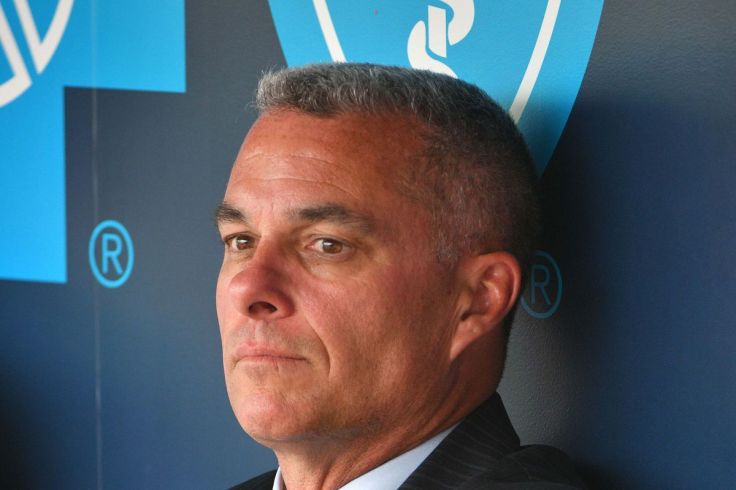
But you do start to wonder where Moore’s head is. Is the rebuild still on with just slight alterations? Is he more willing to look at a player closer to being big league ready than one that is a few years away, even if the younger talent has a higher ceiling? Or will he start looking at veterans to help the bleeding stop?
kc5
Credit: Denny Medley-USA TODAY Sports

Last week, Dan Szymborski of Fangraphs had some pointed comments toward the Kansas City front office. One of them really hits home right now:

While I’m not at a point where I’m ready to rally together the villagers with pitchforks and torches and ask for Moore’s head, I am asking the same question: Is there a master plan? And if there is, is it going to change again in a few more weeks? If there are more major changes, don’t be surprised when the villagers already have their weapons in tow.
Kansas City Wish Fulfillment

kc1
Credit: John Sleezer/KC Star

If you are taking stock of the first half of the Kansas City Royals 2018 season, most of your return would be a muddled mess. The Royals were in shambles, whether it was the offense, the rotation or the bullpen. Essentially the only reliability sat in their defense, which is leading the American League in UZR while coming in 8th in defensive runs saved.

But this isn’t a piece to prop up the defense or even bash the ineptitude we have seen for the first three and a half months of the season. Instead, this is that nugget of positivity you keep hoping for. This is the dream scenario where the blocks fall into place like on a Tetris grid.

What we’ve compiled is a wish list of sorts. It’s a few items of interest that if swayed the proper direction could benefit the Royals for the rest of this season into next. By no means should you take this as ‘This is how the Royals win the American League Central’, as that is just crazy talk. No, this is a view of ‘what could be’ if Kansas City plays their cards right these next few months.

Kc2

Trading Up

With the trade deadline looming in less than a week (July 31 to be exact), the Royals are in a good position to make some moves and add some depth to the organization. Mike Moustakas appears to be the main chip that Dayton Moore has to deal and a number of teams (Boston and Atlanta among them) have shown interest in the power-hitting slugger.

But after Moose there aren’t any certainties. Whit Merrifield would be a great acquisition for a team looking to pick up a versatile fielder with the ability to get on base, but Kansas City is in a position where they don’t have to deal him if they don’t like the offers they are receiving. At this point the likelihood of a Whit trade feels like a 50/50 chance…at best.

Two other names to keep an eye on would be Lucas Duda and Jason Hammel. Duda has been hitting .310/.394/.414 over his last nine games coming into Tuesday with a BABIP of .421. While on the surface Hammel’s shift to the bullpen has been a mixed bag, his velocity has gone up (as expected) and he appears to be assimilating to his new role.

Duda could possibly be dealt in August after clearing waivers to a team looking for a power bat but Hammel feels less likely. The combination of a poor season coupled with a high salary(that Kansas City is probably unwilling to eat) makes the likelihood of a trade probably slim. But if the Royals are given the opportunity, they should take it.

Image result for Adalberto Mondesi 2018

Playing Younger

With the talk of veterans being dealt, that should open up more opportunities for some of the younger talent in the Kansas City farm system. One of the advantages of a rebuild is players getting a chance to prove themselves on a fairly regular basis. That opportunity appears to be looming.

We’ve already seen extended tryouts for guys like Adalberto Mondesi and Hunter Dozier. The pitching staff has been littered with youth, from Brad Keller and Burch Smith (two Rule 5 draftees) to Tim Hill and now Heath Fillmyer. Maybe I’m being selfish, but I would love to see a larger youth movement implemented these last two months.

At this point, I am game to hand out opportunities like pieces of PEZ. Would you like to see another youngster in the rotation? Let’s see what Trevor Oaks can do on an extended basis. How about the bullpen? We’ve heard about Richard Lovelady for a while, but it’s not too far-fetched to give Kevin Lenik an opportunity as well.

Offensively there aren’t as many options, but names like Ryan O’Hearn and Frank Schwindel could be interesting come September (despite their performances so far this season). Even guys we have seen already, like Cam Gallagher and Ramon Torres, could see some playing time as the season wears on.

Obviously not all of these names are going to produce and some will even show that they are not worth keeping around. But if a team is truly rebuilding, you owe it to yourself to hand out these opportunities and let the players run with it. Good or bad, it’s simply a matter of going out and proving their worth…and luckily, the Royals have the time to allow that to happen.

kc4
Credit: Christian Petersen/Getty Images

The Rotation we were Expecting

Before the season started, a number of us felt like the Royals rotation could be a major plus for the team. In fact, I was one of those proponents:

While on the surface this is an underwhelming group of arms, there is potential here that could be reached if circumstances go the right way.

Most of the high expectations came from thinking the starters could outperform their 2017 numbers. Unfortunately, Ian Kennedy and Jason Hammel have not while Jakob Junis appeared to be on a fast-track to success early in the season and he has since fallen on hard times. There was also that Nate Karns guy, but who even knows if we will see him this season, as he rebounds from thoracic outlet syndrome surgery.

But there is some hope. Danny Duffy has looked superb over his last 11 starts, posting a 2.58 ERA while holding batters to a line of .217/.303/.296. Heath Fillmyer has been nothing short of sensational since being put in the rotation. Then there is Brad Keller, who has possibly been the biggest bright spot for Kansas City in a season full of dim bulbs.

If the Royals can get Junis back to his early season self (and his start over the weekend was encouraging) and audition either Burch Smith or Trevor Oaks for an extended period, this could be a rotation similar to what was originally expected. It won’t challenge the Atlanta Braves rotations of the early 90’s, but it doesn’t have far to go to top how the rotation performed in the first half.

kc5
Credit: Getty Images

Fulfilled Expectations

While the other wishes were part of a grander scale, there are a few more items to keep your eye on in the second half that would drastically improve the ballclub.

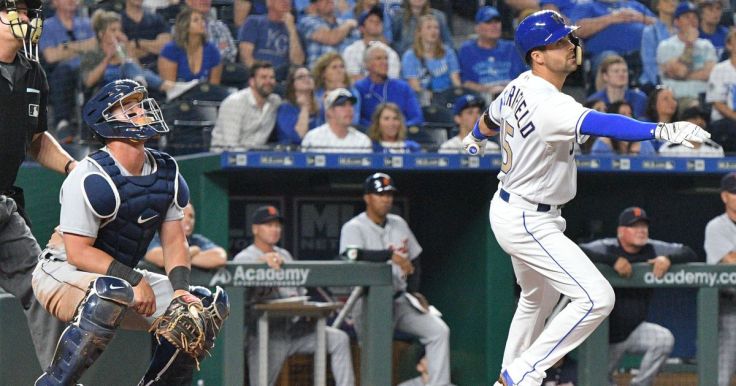
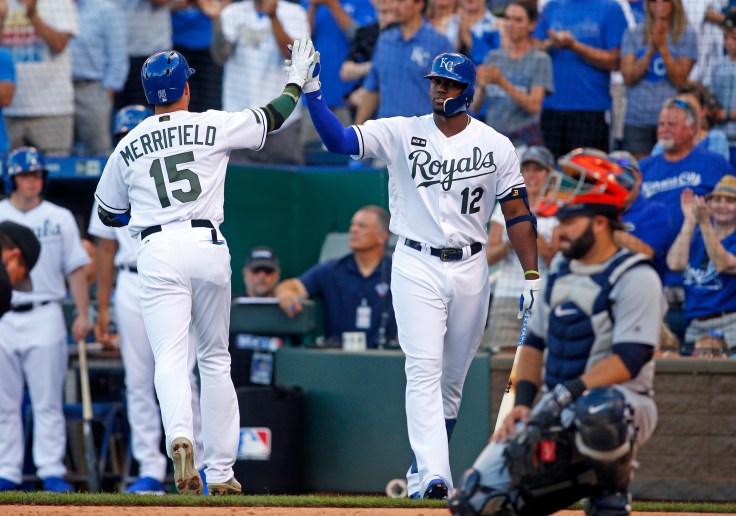
Keep an eye on Whit Merrifield (if he isn’t traded) as he is on pace to topple most of his stats from 2017. Whit is currently hitting .299/.370/.420 with a wRC+ of 118 and 3.0 fWAR. While his power numbers have seen a slight decline (slugging percentage and ISO have seen the biggest dip) his overall numbers have been an improvement.

The rest of his numbers appear to have improved ( in fact his WAR is already better  than 2017), as his walk rate has seen an increase and his BABIP has risen to .356. While his strike out rate has gone up, we have also seen an uptick in the hard hit rate. If you are purely a fan of Whit’s power you might be disappointed, but otherwise it will be fun to watch him wrap up what appears to be his new peak this season.

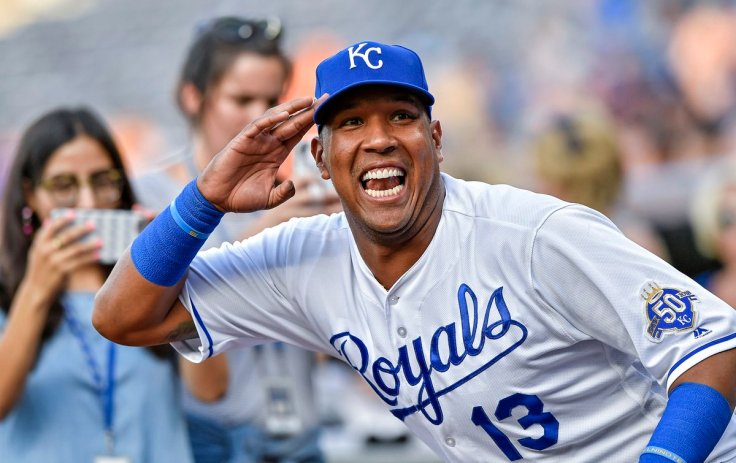
Another interesting player to watch is Salvador Perez. A few weeks ago I took a look at Perez and his struggles. In that piece, I mentioned how it might not take much to turn around his season:

I’ll go a step further and say that if he combined that with his hard hit rate and maybe (just maybe) a dash of better luck on the balls he hits into play, Salvy could go from being the ‘disappearing hitter’ he was in June to helping ignite what little offense the Royals can muster on a consistent basis.

That luck has finally come around, as Salvy is hitting .269/.286/.481 over his last 13 games with 3 home runs and 12 RBI’s. But the improvement shows up in his BABIP, where he is hitting .314 in that span and contributing on almost a daily basis.

To break that down even further, Perez is hitting .273/.286/.576 in the last eight games with  an OPS of .861. While it may be just a small sample size, Salvy has been seeing more pitches per at bat while looking for a pitch to drive. It’s not hard to imagine him turning things around the next couple months and ending up with numbers comparable to year’s past.

Image result for Kansas City royals July 2018

Obviously we would all like to see the Royals turn themselves back into contenders during the second half, but that just isn’t realistic. The good news is that their performance in the first half has set the bar very low for the last half of the season. It gives Kansas City a chance to show they aren’t quite as bad as they’ve played to this point.

There is a number of things you can wish for, but your best bet is to wish for improvement. Moving forward wins and losses shouldn’t matter as much as how the development is coming along for this team. It should be about finding out what they have and what they should keep moving forward. That is what should be at the top of any Royals fan’s wish list.

That and to never see Brandon Maurer in a high-leverage situation ever again.


Happy Trails, Moose

kc1
Credit: Thearon W. Henderson/Getty Images

The inevitable became reality late Friday night, as Mike Moustakas officially turned in his Kansas City blue, as Moose was dealt to the Milwaukee Brewers for outfielder Brett Phillips and pitcher Jorge Lopez. This was a move expected all the way back in Spring Training when Kansas City was able to re-sign Moustakas to a new contract before the beginning of the season. For those that wonder whether the Royals were willing to cover the remainder of his deal, you need not worry:

So Moose is now officially a Brewer and the Royals were able to acquire some young talent to help them. So lets discuss all the parties involved and where this leaves them.

kc2
Credit: AP Photo/Ed Zurga

The trade puts Moustakas instantly into a playoff race, as Milwaukee is 1.5 games out in the NL Central and 1.5 games up for the first Wild Card spot in the National League. Production-wise, Moose is hitting .248/.308/.463 this year with 20 home runs, 105 wRC+ and 1.7 fWAR. Moustakas has also seen a slight uptick in his walk rate and a slight decrease in his strike out rate. The most impressive stat for him this year is his hard hit rate, which has been elevated by a large margin, 43.7% to last year’s 31.9%. Some of that could be attributed to the leg injuries he dealt with the last half of 2017, which appeared to sap some of his power as the season progressed.

Moose leaves behind a legacy in Kansas City of being the ultimate gamer, which even teammates can attest to:

His manager also thought very fondly of him:

Moose is the guy who broke Steve Balboni’s 32-year reign as the Royals single-season home run record of 36, as he hit 38 last year. More than anything, he was a fan favorite who dealt with offensive issues throughout his time in Kansas City but found a way to make himself better, which endeared him to the fanbase. In many ways, it was easier for us fans to sympathize with someone like Moose because he did struggle and worked hard to improve himself.

kc3
Credit: Orlando Ramirez-USA TODAY Sports

On the other side of the trade is Brett Phillips. Phillips was ranked as the tenth-best prospect for the Brewers this year and is a toolsy outfielder. Here is a scouting report from last summer on his offensive ability:

Phillips is an above-average to plus runner and when he does make contact, he hits the ball hard to all fields, so he may be able to carry above-average batting averages on balls in play going forward. Given his strikeout rate, however, his hit tool will probably only be fringe-average at best and it doesn’t appear as though he’ll ever consistently hit for a high batting average. Even if he’s ultimately only a .230-.240 hitter, Maverick should at least be able to post respectable on-base numbers thanks to his patient approach at the dish. He looks to have the power to hit between 15-20 home runs on an annual basis, and should be a threat to steal 15 or more bases.

So the good news is that Phillips is a patient hitter and has a decent amount of power, power that should improve as he continues to develop. The bad news is the strike outs, which have continued to slow down his progress:

According to the scouts at Baseball Prospectus, Phillips can struggle to remain consistent with his mechanics at times and has plenty of swing-and-miss within the strike zone. Phillips has struck out in 30% of his plate appearances dating back to midseason-2015 and owns only a .249 batting average since that time.

Defensively, Phillips is a gem:

Phillips has the tools to be an outstanding defender in the outfield. He is an outstanding athlete and has enough speed to play in center, though he’s ceded most of the playing time there to Lewis Brinson this season. His plus-plus arms features outstanding velocity and carry on his throws and plays best in right field. He is still working on reading trajectories in center field and can have issues going back on balls at times, but that shouldn’t be much of a concern going forward. If it all comes together for him, Phillips should be an above-average centerfielder or excellent right fielder.

So with Phillips the Royals have acquired an outfielder who could be above average at the plate if he can just control his whiffs. Also, he has one of the best laughs in baseball:

https://youtu.be/kpG-fUv9vZs

Phillips will get the chance to be a regular outfielder for Kansas City and at this point looks to be a good choice for the future of this organization.

kc4
Credit: Mark J. Rebilas-USA TODAY Sports

Lopez is another top Milwaukee prospect who is in his age 25 season. The Royals aren’t for sure what role to use Lopez in yet but either way he has the stuff needed for the big leagues:

He can get his fastball up to 95 and has a pretty decent change-up, but his best pitch is his powerhouse curveball. He was unhittable with it in Double-A in ‘15 but the thin air in the higher altitudes of Colorado Springs and some of the other PCL parks in 2016 lessened the effectiveness of this pitch and he was unable to adjust.

Lopez has been pitching out of the bullpen for the most part these last two seasons and with his high-octane fastball could very well end up in that role for Kansas City. For the moment, Lopez has been sent to AAA where he will be fully evaluated but expect to see him on the big league roster by the end of the year.

kc5
Credit: Dylan Buell/Getty Images

Overall, it feels like a pretty good haul for Kansas City considering that Moustakas is a two-month rental for Milwaukee. Personally, I felt the Royals would end up with a lot less than what they got in the trade, so the fact they were able to get two former Top 100 prospects for just a couple of months of Moose feels like a solid trade for Dayton Moore.

Moore had an interesting comment after the trade was made pertaining to what he was looking for in return. To say it caught Royals fans eyes would be an understatement:

It’s obvious that Moore is looking to improve the big league club sooner rather than later and there have been some concerns raised about wanting to speed up the current rebuild. I’m not ready to lambaste GMDM yet, but you do have to wonder if his attention should be focused more on the future than the wins and losses column of the current squad.

kc6
Credit: Associated Press

So after thinking Moustakas was gone after the end of the 2017 season, the truth was that us Royals fans got an extra four months of “The Man we call Moose”. The good news is that the team can now move forward and officially make plans for the future. Every fan will have a favorite Moose moment and I am no different. One play will always stick out for me when it comes to Mike Moustakas’ tenure in Kansas City:

While the home runs were sometimes majestic and many helped the Royals win, that catch personified what Moose really is: a grinder, a man who always got his jersey dirty and a player who never gave up.

Moustakas was the guy who knew he needed to work on his defense after his rookie year and would spend the following winter transforming himself into an above-average defender. Moustakas was the guy who knew he needed to learn how to hit the ball to the opposite field to counteract the shift and did just that before the 2015 campaign.

Moustakas was also the guy who improved his power numbers as he got older and embraced his role as being a clubhouse leader. More than anything, Moose was a guy who embodied the attitude of the 2014-2015 Royals: Never die, never give up and never admit defeat. Moose was a perfect fit for those teams and without him Kansas City would have never been able to win a world championship. Thank you, Moose. You will always be ‘Forever Royal’.

Did Yordano Ventura’s Tragic Death Slow Down the Royals Rebuild?

kc1
Credit: John Sleezer/KC Star

(Writers Note: The intention of this article is to see the effect that Yordano Ventura’s death had on the Kansas City Royals organization and the building of the roster. In no way, shape or form, is it trying to trivialize his passing. Hopefully you, the reader, see that he was a vital part of the Royals future and a beloved player within the Kansas City fanbase. This is purely a ‘What If’ article.)  

January 22, 2017 is a date that will always be a painful reminder of how fragile life can be, as that was the day that former Kansas City Royals pitcher Yordano Ventura passed away. Ventura’s death was only four months after the passing of Miami Marlins pitcher Jose Fernandez and the similarities between the two pitchers was remarkable.

But maybe the biggest similarity was the effect both deaths had on their respective organizations. Both left a giant hole in not only their rotations but also the locker rooms. The loss of each not only forced their organizations to take a second look at their future, but also to reassess what path they were already on for 2017.

We’ve seen what it did for the Marlins. Miami finished 77-85 last year and they spent the winter dismantling their roster, as key players like Giancarlo Stanton and Christin Yelich were sent to greener pastures. The Marlins threw up the white flag and decided to begin what feels like the umpteenth million rebuild during their 25 year history.

Rangers Royals Baseball
Credit: Associated Press

But despite being told that Kansas City is in a “rebuild”, it sure doesn’t feel like it at times. The Royals have a very veteran heavy roster and while that could (should) very well change by August, as of now it feels like they are straddling a fence. Because of that I have to wonder: did Yordano Ventura’s passing slow down the Kansas City rebuild?

Before we head down this path I feel the need to clarify a couple of things. First, I won’t dabble in any possible deals the team could have made or should have made. Instead we will look at the pitching moves made since his passing and determine whether or not they would have still taken place.

Second, there is no way to determine how the Royals would have done with Ventura still on the team so that won’t be discussed as well. The honesty of this is that there is no surefire way to know how things would have developed with Yo'(unless you know something about time travel I don’t. If that’s the case, quit holding out on us!) so this is just an estimated guess based off of how the front office has acted over the last couple of years.

kc3
Credit: AP Photo/Orlin Wagner

Let’s start with the three moves made not that long after Ventura’s death last year. Brandon Moss was signed on February 1st, Jason Hammel on February 5th, and Travis Wood on February 13. It’s hard to tell if Moss’ signing was directly connected to Ventura, especially since the team had been looking for another bat throughout the winter. More than likely the Moss signing would have still happened, even without Ventura’s loss.

Hammel and Wood totally felt like a reaction to losing Yordano. The Royals rotation at that point looked set with Danny Duffy, Ian Kennedy, Ventura, newly acquired Nate Karns and Jason Vargas. The team even had Chris Young, Matt Strahm and Jake Junis as backup options for the rotation, so there wasn’t any real need for Hammel or Wood at that time.

One could make the argument that the Royals might have had interest in Wood as a reliever, which is very possible considering that had been his role for the majority of the previous two seasons. But if not, then Kansas City would have never signed them and we could take their contracts off the books, not only for 2017 but 2018 as well.

kc4
Credit: Associated Press

Let’s move to the winter and the Royals deal with the White Sox and Dodgers. In that trade, Scott Alexander would go to Los Angeles while Soria would eventually end up in Chicago. One has to wonder if Kansas City would have been compelled to deal either reliever if the team had never signed Hammel or Wood.

The crux of this trade was moving Soria’s contract, which might not have been as important without those signings. If that is the case, then the trade might have never happened and Alexander and Soria would have stayed in Kansas City.

We could easily see a scenario where Soria would have still been shopped, but even if that is the case I doubt they would have felt moving him was important enough to lose the club control that Alexander would have (which runs through the 2022 season). This would mean the Royals would have kept two big cogs in their bullpen and we might have not seen the likes of Tim Hill, Brad Keller and Burch Smith when the season began (which would have meant some tough decisions, considering Keller and Smith were Rule 5 draft picks).

kc5
Credit: Ronald Martinez/Getty Images

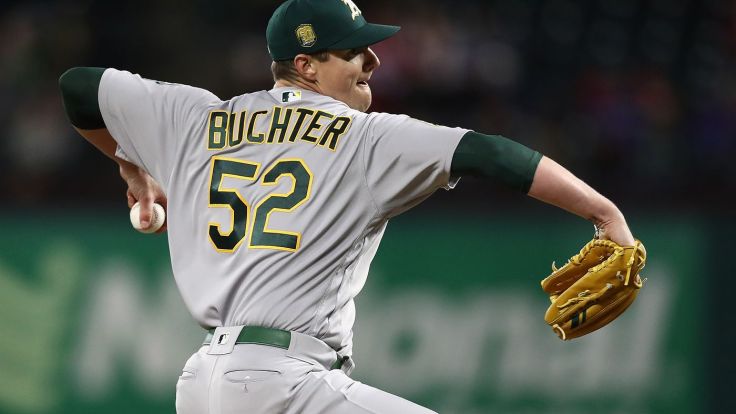
Then at the end of January, the Royals traded Moss and Ryan Buchter to Oakland for pitchers Jesse Hahn and Heath Fillmyer. This is a trade that feels like it would have happened no matter what. Moss had an awful season in 2017 (.207/.279/.428, -1.0 bWAR) and trading him would probably allow the Royals to move a portion of his salary commitment.

The interesting part of this becomes whether or not Buchter would have actually been a Royal. We all remember the ill-fated trade with San Diego but that trade happened for two reasons. One, the Royals needed pitching. Two, the Royals were still in the hunt for a playoff spot, 1.5 games out in the AL Central while holding down the second Wild Card.

I could see the Royals needing pitching, even with Yordano still in the picture. It’s very possible the deal could have gone down, but that is also trying to determine where Kansas City would have been in the standings. This is probably a good place to mention that Ventura finished 2016 with an ERA+ of 97 and a bWAR of 1.6. While some felt he was going to turn the corner in 2017, there was no guarantee that would happen.

So with that in mind, we’ll go with the San Diego trade still going down. Almost every team can use more pitching and it’s easy to see the Royals in a situation where they would need more arms. In other words, this is a deal that just reeks of fate.

kc6
Credit: AP Photo/Charlie Riedel

So with all these moves out-of-the-way, we can start assessing whether or not the rebuild was slowed down by the passing of Ventura. With what we saw in 2017, it was very apparent the Royals were going to stick with the core group (Hosmer, Moustakas, Cain, etc.) and give them every opportunity to clinch a playoff spot. So any idea that they would be dealt was probably slim and none from the very beginning.

It’s probably also safe to say that if Kansas City had somehow found their way to the playoffs last year with Ventura, that would be one more reason to not completely tear the whole thing down and start over. The Royals would have still had a nice nucleus together (Perez, Whit, Duffy, Ventura, etc.) and with the way the free agent market collapsed this winter it’s possible Dayton might have been even more aggressive than he was.

It also appears Moore has never been down with a real “rebuild”. Back in March Dayton had this to say about how competitive the team would be this season:

“I believe that we can put a strong, competitive team on the field each and every night and also develop in the minor leagues,” he said. “I believe we can build our farm system back to the level it was in 2010 and 2011, and maybe even do it better and still win games at the major-league level.

“You can’t just turn it on and turn it off. If you want a winning culture, you’ve got to do everything in your power each day to win.”

It just doesn’t feel like the front office has ever been behind a full rebuild with this club. In fact, it has sounded like they would be content with piecing together the roster as needed, letting the younger talent filter in when they were ready and letting them get comfortable at their own pace.

Image result for kansas city royals june 2017

So with all that in mind, my guess is that Yordano Ventura’s untimely passing didn’t slow down a Kansas City rebuild. As much as moves made after his passing felt like a knee-jerk reaction to his death, the team had already committed to being “all in” for 2017 and even taking on less payroll wouldn’t have deterred that frame of mind.

Unless…the Royals decided to deal Yordano. While in some circles that might sound crazy, it might not be as far-fetched as you think. In fact, in the winter before the 2017 campaign, the Houston Astros were rumored to have shown interest in Ventura:

Royals starters Danny Duffy and Yordano Ventura are two of the pitchers on the Astros’ list of rotation targets, MLB.com’s Brian McTaggart reports.  The two K.C. arms join several other previously-known names (i.e. Jose QuintanaChris ArcherJake Odorizzi and other Tampa Bay’s starters) as potential trade fits for a Houston team looking to upgrade its starting pitching.

Now, showing interest isn’t the same thing as on the trading block. But if you are any team, you should probably be willing to listen to any offers on any player, just in case a team is willing to go way overboard just to acquire a player. While Ventura could have been under club control until 2021(with the help of club options), that might have been a selling point for Kansas City:

Their willingness to least listen to other clubs’ offers could be due to doubts about his personality, or it could just be due diligence, as Ventura’s years of control could net K.C. a nice return in a trade.

If a team was willing to offer a nice package of talent for Yordano, Moore would have to at least listen. One would think if a deal actually went down and the Royals were able to acquire young talent, it’s possible the rebuild could have sped up a bit.

kc7
Credit: Royals.com

In fact, that might have been one of the few scenarios where guys like Hosmer and Cain would be dealt before the trade deadline. While it feels like a long shot, it could have very well happened considering in the last year the Astros have picked up both Justin Verlander and Gerrit Cole to improve their starting rotation.

While I highly doubt Kansas City would have dealt Ventura, it does show how one or two moves can sway a team in different directions. Ventura very well could have gone from a building block for the team to an asset to fill multiple holes on the roster.

Image result for yordano ventura july 2016

So while his death probably didn’t slow down the Royals rebuild, it definitely changed the fabric of the team and the organization. Ventura is that hole that hasn’t been filled and it could be generations before they have another pitcher with his potential.

While it would be nice to say losing one player was the cause for the lack of youth on this Royals roster, the answer is far deeper than that. Trades, injuries, bad judgment and bad luck all play a part in why the Royals aren’t rebuilding more than they are right now.
Maybe in a different dimension or a different universe (Earth 2 or even Earth 81) this is all different and the Royals are still a potent contender in the American League. But in this reality, they are a team trying to build themselves back up without many pieces. While Yordano’s death was tragic, it is not the cause of their current situation. It’s just not that simple.

The Royals Want All the College Pitchers

kc1

Stop me if you’ve heard this before: the 2018 MLB Draft will go down as one of the most pivotal in the history of the Kansas City Royals, one way or the other. The Royals farm system has been continuously ranked as one of the worst in baseball by almost every publication around. With Kansas City getting compensation picks this year from the free agent losses of Lorenzo Cain and Eric Hosmer, this year’s draft was the perfect time to re-stock the farm and begin the slow climb back up to contender. If their goal was to make a big splash, then they have succeeded.

kc2
Credit: Steven Branscombe-USA TODAY Sports

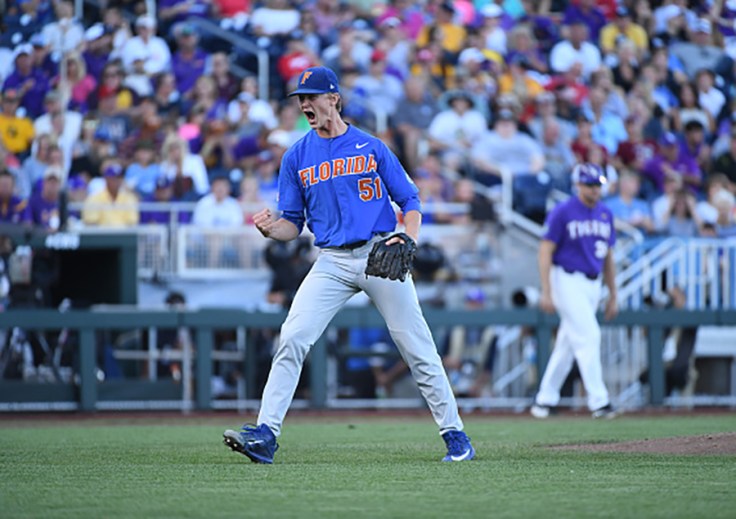
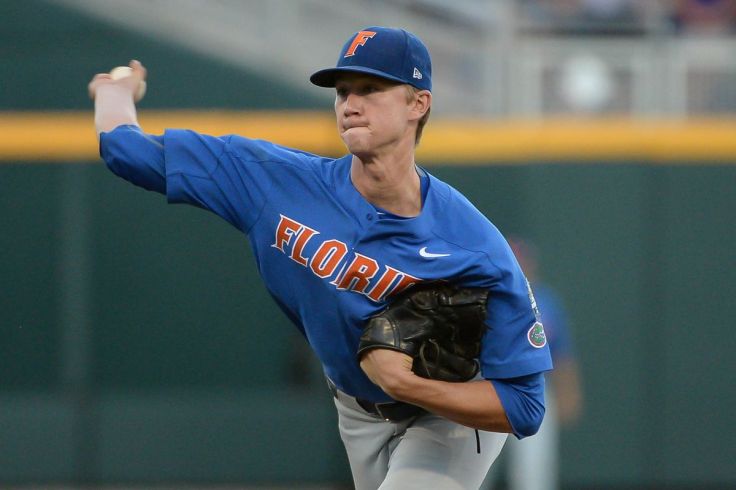
The Royals first pick was at #18 and their pick was Baseball America’s College Player of the Year Brady Singer from Florida. Most had Singer going in the top five of the draft and some felt the lowest he would drop would be around #10. So what did Kansas City get with their top pick? Here is part of the scouting report from MinorLeagueBall.com:

Singer is listed at 6-5, 210 (he was 180 in high school), born August 4th, 1996. His fastball is his best pitch, up to 95-96 with boring action in on right-handed hitters when things are going well. He can also show a plus slider and has made good strides with his change-up this spring; a recent in-person report from Burke Granger at 2080 Baseball describes the change with “above average deception and tumble, parachuting out of the zone.” One of the few complaints about Singer in 2017 was the need for a better change-up and it sounds like things are going well in that department.

So why did he drop to #18? I’m sure sign-ability came into play, but there were also some concerns by some scouts when it came to Singer:

Despite the good statistics, several observers have noted Singer’s harder pitches, especially the fastball, flattening out at times this year. This is traced to changes in his arm angle although the exact cause/effect chain is a bit unclear from a distance.

His delivery has always been somewhat unusual with a three-quarters approach and some whippy action. His arm angle and release point looked higher at times this year and this has been enough to lower his projection in the eyes of some very respected observers.

So there are a few worries about Singer, but overall he has a plus arm that is already pretty far along in his development. What this means is as long as things go according to plan, Singer could be in the majors by the end of 2019. This was a great pick for the Royals and one that could pay off sooner rather than later.

2017 College World Series: TCU defeats Florida 9-2
Credit: Steve Cheng

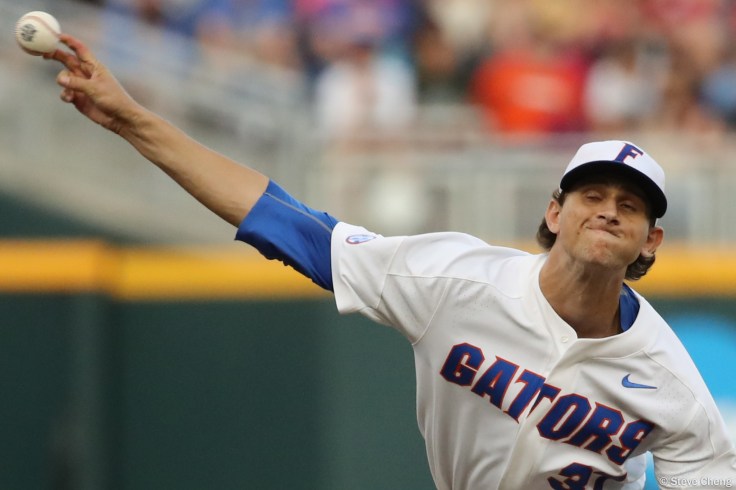
With the 33rd pick in the draft, the Royals would draft Singer’s teammate at Florida, Jackson Kowar. Kowar is an interesting pick, as evidenced by the reports on him this season:

As a prep his fastball was generally 88-92 with higher peaks. In college that’s up to 92-95 with peaks as high as 97-98.

His best secondary pitch is his change-up, drawing plus ratings. Development of his breaking ball has been key this spring and while it is sharper and more consistent than in 2017, it is still his third pitch behind the fastball and change. Further refinement of the breaking stuff and general sharpening of his command will obviously be the first items on his agenda as a pro.

So while Kowar isn’t as far along as Singer, there are a few scouts that preferred him to Singer:

When Kowar is at his best he shows three plus pitches. He’s not as close to being a finished product as Brady Singer but in some ways Kowar is a more conventional prospect than his teammate and some scouts like Kowar better.

Kowar might be the more interesting pick to watch out of the two Florida boys, and I like the idea of the two teammates getting to move through the Royals system together.

kc5

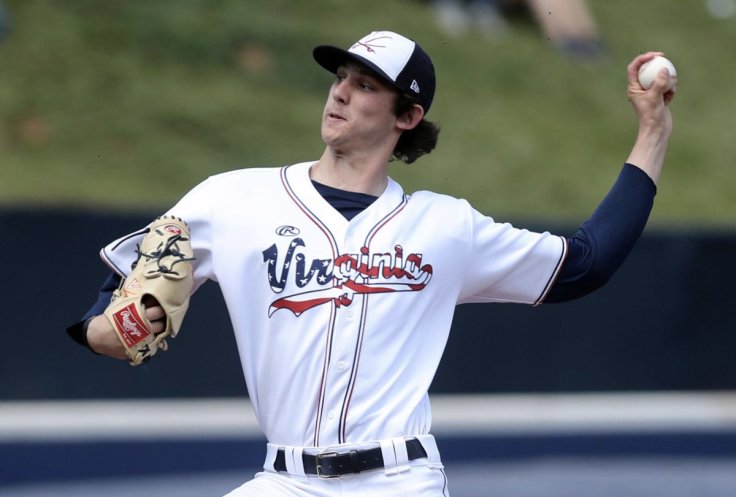
At #34, Kansas City would stay in the college ranks and draft left-handed pitcher Daniel Lynch from Virginia. Here is an assessment of Lynch earlier in the year:

A lean and narrow 6’4’’, Lynch won’t overpower hitters and needs to hit spots to have success. He throws from a clean abbreviated windup, getting consistent extension over his front half with little overall effort in his mechanics. He repeats well, able to stay around the zone with a four-pitch mix. The fastball has fringy velocity, sitting right around 90 mph while ranging anywhere from 88-to-93 mph without a lot of lateral movement. He’ll mix a cutter in the mid-80s as well, though the pitch has light, sweeping action and doesn’t project to be more than a wrinkle pitch to keep hitters off his fastball. Lynch commanded both sides of the plate with his four-seam fastball and cutter, though the loud contact allowed shows the limited margin for error he has within the zone. He’s more comfortable with a changeup than a breaking ball, showing more confidence in a fading low-80s circle-change that can get righties out on their front foot.

While Singer and Kowar would probably be ranked as power arms, Lynch appears to rely more on location:

Lynch projects to be a finesse lefty at the professional level. Scouts cite his thin frame as reason to wonder if his already fringy stuff backs up when he pitches on a more demanding schedule in the minor leagues. The best-case ceiling is that of a fifth starter who can soak up back-rotation innings, though he could fit a long or situational reliever if he ultimately lacks the stuff to face lineups more than once pitching out of the rotation.

So through their first three picks, Kansas City went with college pitchers with a good amount of upside. Their next pick didn’t stray far from the pattern.

kc6
Credit: Stanford University

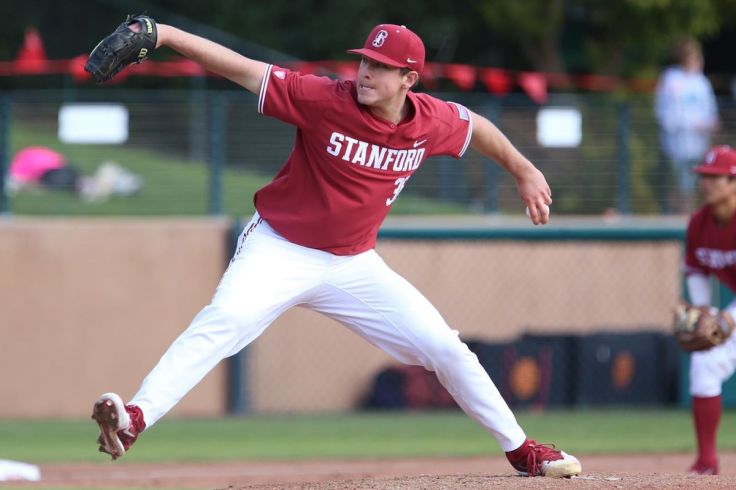
With the 40th pick (a competitive balance pick), the Royals would draft Stanford lefty Kris Bubic. Bubic has a delivery similar to Dodgers star Clayton Kershaw but that is where most of the similarities end:

Bubic is armed with a fastball that works best in the low-90s. He has a little reach-back velocity and can touch 95 MPH. It has some natural arm-side run, as is common with most lefties. What really has him on a path to success is a plus-changeup. He’s able to repeat his delivery and arm slot with it, giving it the look of a fastball. It has good fade down-and-away to right-handers, but he isn’t afraid to throw it against any hitter in any count. His curveball is a work in progress. He didn’t use it much during his first two seasons with the Cardinal, but it has improved enough this season to be a viable third pitch.

The good news is that while his ceiling is a bit unknown, his floor is higher than most:

A standout in the Cape Cod League last year, Bubic has the ceiling of a low-end No. 2 starter should everything click. More likely, he’s a solid No. 3/4 guy who thrives with his command/control profile and a borderline double-plus changeup. He could move quickly if he takes well to professional instruction. But don’t expect much more velocity, as he’s physically maxed out.

I’m interested to see how Bubic develops and he feels like a pitcher to keep an eye on. His change-up should get him places and it will be interesting to see what the Royals will want to do with his curve.

kc7
Credit: Joe Murphy/University of Memphis

At this point it just made sense to continue on the trajectory they were on, so the Royals drafted another college pitcher, going with Memphis right-hander Jonathan Bowlan at #58:

The Memphis product has a solid fastball in the low-90s. The slider will flash better than average at its best, while an average changeup completes his arsenal. Not really a guy who will punch out a lot of hitters unless there is a serious uptick in stuff, Bowlan is probably a fifth starter or middle reliever within a few years.

Bowlan appears to be a underslot signing for Kansas City, but it also felt like the Royals had a direction they wanted to go in once Singer fell to them and they just went with it.

kc3
Credit: Steven Branscombe-USA TODAY Sports

So what direction might that be? Maybe it’s just what lingers on the surface, but it appears Kansas City went the safe route with their picks on the first day by going with college pitchers. The Royals have been burned in the past by prep pitchers, so maybe they felt going with the older, more mature arms would garner a higher success rate than going with a high school player who has more talent but would take much longer to develop.

It also would make sense that the college pitchers could possibly start at a higher level, possibly in A ball. Maybe someplace like Lexington, where Royals prospects Nick Pratto, MJ Melendez and Seuly Matias are currently playing at. Maybe, just maybe, the Kansas City brain-trust remembers how the core players from their 2015 championship (Eric Hosmer, Mike Moustakas, Danny Duffy, Salvador Perez, etc.) came up through the minors together and won together on their way to the major leagues. Maybe…they are looking to repeat history. I could just be reaching here, but if I’m not it’s definitely not the worst idea in the world.

kc8

The one thing we absolutely can determine from the draft is that the Kansas City Royals have done a good job of replenishing the farm system, especially with their pitching. It will be years before we can determine the true value of these players and where they rank among other former Royals draftees.

The one thing we can say is the team went in with a game plan and it appears they followed it down to the letter. The baseball draft always feels like a crap-shoot and as far as we know none of these picks will truly leave their mark. But there is a chance they could be the next Splittorff, Saberhagen, or Duffy. Pitching is the currency of the sport and the Royals just increased how much they have sitting in the bank.


The Resurgence of Alex Gordon

kc1
Credit: Ed Zurga/Getty Images

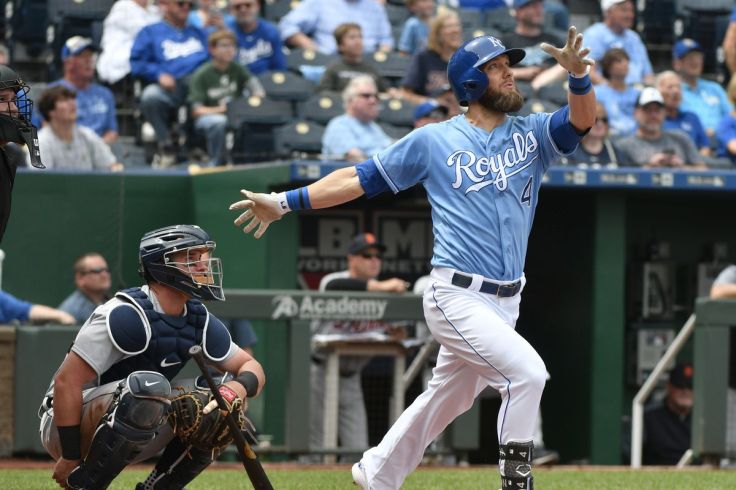
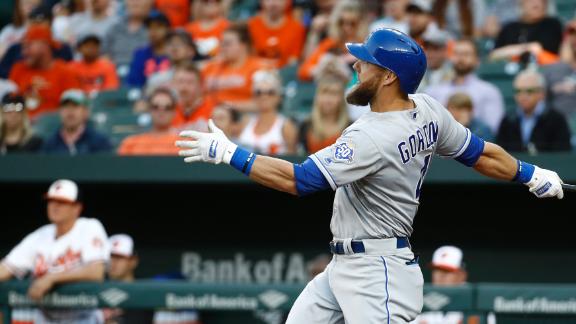
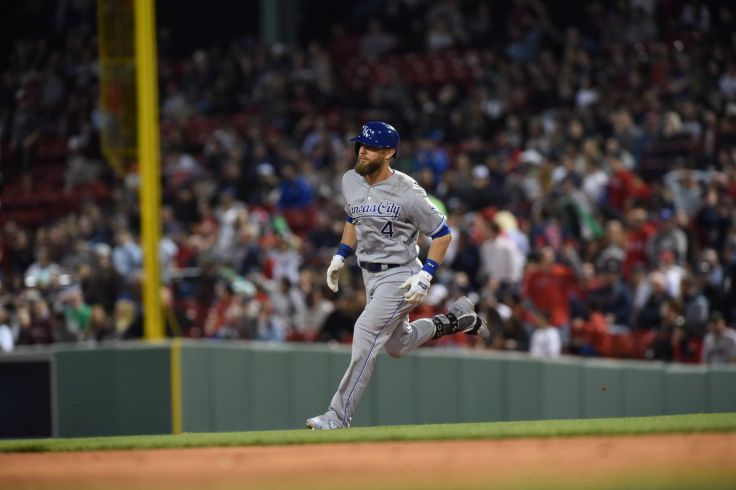
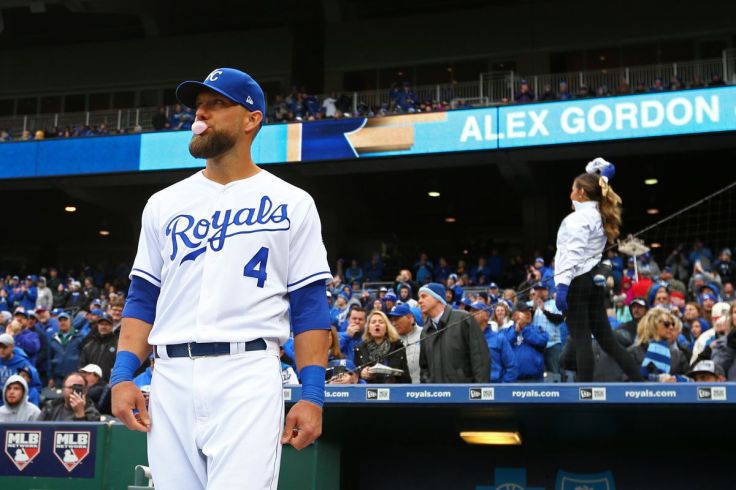
The last two years have been hard for Alex Gordon fans.

It was difficult to understand how a guy who was once one of the most well-rounded players in the game had turned into one of the least productive batters in all of baseball. It wasn’t just the elevated strike outs in 2016 or even the 29.2% hard hit rate last year. It wasn’t even a wRC+ of 62 last year that was tied with teammate Alcides Escobar and only better than Texas’ Rougned Odor for qualified batters in all of baseball.

No, it was just as much Alex fouling off pitches he used to scorch. It was him pulling the ball to the right side when he used to take a pitch to the opposite field. It was him looking lost at the plate and not appearing to have a real plan while he was up there.

kc2
Credit: Patrick Semansky-AP Photo

Call it what you want. Maybe it was him trying to live up to the massive contract he signed after 2015. Maybe he was in his head too much. Maybe it was a slight tweak in his mechanics or a change in approach at the plate.

I myself have long felt the wrist injury he suffered when colliding with Mike Moustakas in 2016 was a big factor in some of the issues he was dealing with. Or maybe it was just the natural regression that occurs to every athlete and had finally took up residence on his physical doorstep.

Whatever the case may be, after two years of sub-par productivity and a litany of injuries in between it really felt like the Alex Gordon of our past was just that: in the past. But a new year brings new promise and since his return from the disabled list he has looked like the Alex of old.

kc3
Credit: AP Photo/Patrick Semansky

The numbers so far speak of a revitalized Gordon, as he ended Thursday hitting .303/.352/.439 after going 3 for 4 on the day with his second home run of the year and two runs scored. The most promising stats for Alex have to be his hard hit rate and exit velocity. His hard hit rate is at 38% (his career high is 36.9%) and the exit velocity is at 89.7% according to Baseball Savant, a good 2 to 4% higher from the last two seasons.

It is still very early for Gordon, as he has compiled just 71 plate appearances so far. In other words, it’s a small sample size. But the last two years have seen him not hit the ball very hard whereas now he looks more comfortable at the dish and it might be just a minor change in his mechanics that have done the trick:

Alex Gordon starts with his hands. This, he says, is where the adjustment began, where a mini renaissance was born. His hand path to the baseball is different; a little flatter, he says, in the hitting zone longer. He’s trying to keep his hands back longer. He’s seeking to load quicker. He’s trying to stride straight at the pitcher.

You may not have noticed these tweaks if you watched Gordon over the last week. They are minor in scale, insignificant to the untrained eye. “A lot of little things,” he says. But inside the batting cage at Kansas City’s Kauffman Stadium, as hitting coach Terry Bradshaw looks on, Gordon has sought to find his swing.

He wants to beat the shifts that have haunted him in the last two seasons. He wants to stay back and go the other way. He wants to give himself a chance.

“I feel like my swing is a little bit different than it was at the beginning of the season,” Gordon says.

This swing has led to him hitting the ball to the opposite field at a higher rate this year (26..0%) than any year since 2013. I’ve long felt Alex was a better hitter when hitting to the left side of the diamond while focusing on the gaps in the outfield. At one point he was a guy who could rack up 50 doubles in a full season (51 back in 2012) and make a good living off taking the ball the opposite way.

kc4
Credit: Bob DeChiara-USA TODAY Sports

So should we expect Gordon to return to past glory? I’m pretty sure the Alex we saw in 2011-2015 is probably in the past; I mean the man is 34 years old and his body has taken a beating over the last three seasons. But this resurgence is probably closer to what most of us expected when he returned to Kansas City in January of 2016. We knew that the aging process would bring regression, but we also figured that the dedication to keeping his body in tip-top shape might slow down the regression a bit.

But if he can keep his approach at the plate consistent and just work on being comfortable, there is reason to believe he can maintain a pace where he is productive again and possibly even above replacement level at the plate.

kc5
Credit: Jay Biggerstaff-USA TODAY Sports

There’s still a long way to go and many peaks and valleys along the way. But for those of us that have cheered and placed him up on a higher mantle, it’s hard not to smile real big when thinking about how he is performing right now. It’s nice to see that the Alex we love hasn’t completely left the building.
 

The Royals Just Don’t Walk the Walk

Image result for jorge soler 2018

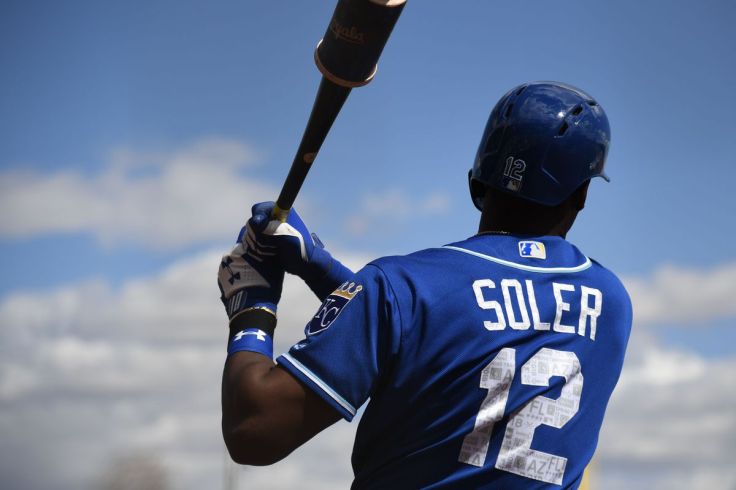
Even in the middle of a calamity there appears a glint of hope. For the Kansas City Royals 2018 season, that glint would be the performance of Jorge Soler and more to the point, his ability to draw walks. The problem is, the Royals as a whole just aren’t big fans of a patient eye.

I’m not spilling any major secrets when I say that Kansas City has not been a team to embrace the ability to work a count and take a free base. For years this team has almost looked at patience at the plate with a “well, I guess if we have to” type mentality. The Royals championships teams of the last few years were built on making contact with an emphasis on putting the ball in play.

lc2
Credit: Getty Images

Over the course of the Royals 50 year history, they have had only six instances of players with 100+ walk seasons, with John Mayberry’s 122 walks back in 1973 being the ultimate peak. In fact, the numbers don’t get much better when discussing walks and the Royals. 2013 was the last time the team wasn’t last in the league in walks and 2010 was the last time they were able to breach the top ten in the American League.

In fact the highest walk total for a Royals player in the last decade was Billy Butler’s 79 back in 2013, which garnered an 11.8% walk rate. The highest walk rate in club history was Mayberry’s 19.1%, which he compiled back in the before-mentioned 1973 campaign. This leads us to what Soler is doing and why it is so special.

MLB: Detroit Tigers at Kansas City Royals
Credit: Getty Images

So far Soler has 18 walks in his 24 games, putting him 6th in the American league for his total and 11th in actual walk rate. His rate currently sits at 18.2%, which if he was able to maintain it would give him the second highest walk rate among qualified batters in Royals history, just a smidgen above Darrel Porter’s 17.8% back in 1979.

So what Soler is doing so far is something that Royals’ fans haven’t seen in many moons but is something we should see more often, if I’m being frank. I’ve long been a proponent of the ability to produce a walk and tend to believe there is a direct correlation for teams that take more walks to produce more success.

kc4
Credit: Steve Mitchell

Looking back over the last five years, every year the team that led the league in bases on balls also made an appearance in the playoffs.  2012 was the last year that the team who led all of baseball in walk rate (the Tampa Bay Rays) didn’t make it to the postseason. Before that it was 2006, when the Red Sox led all of baseball but fell short to the Yankees. In most years, the teams that rank near the top of the leader-board in walks are the ones who continue to play into October.

My belief has always been that the value of drawing a walk goes beyond just getting another runner on base. If a batter is taking a number of pitches, that should be driving up the pitcher’s pitch count. The higher that pitch count gets, the earlier a team has to dip into their bullpen. The earlier you get into a team’s bullpen, the more taxed they become. Being a patient hitting team has a very immediate trickle-down effect.

kc5
Credit: AP Photo/Paul Sancya

There is also the whole “extra base-runner” thing which is always a positive. Just go back and look at the first inning of the Royals game on Monday. Whit Merrifield gets a hit, followed by a Soler walk and Mike Moustakas getting hit by a pitch to load the bases. Walks by Salvador Perez and Lucas Duda would follow and by the time the inning was done the Royals had put a three spot on the board.

Now if Kansas City was better at hitting with runners in scoring position that score would have been higher, but that isn’t the point here. The point is that the walks doled out led to extra base-runners which led to more scoring opportunities. More opportunities tend to led to more runs, which is the whole name of the game.

I also believe if the Royals were a bit more patient they might not be such a streaky offensive team. Remember last year’s scoreless streak? That might have been avoided (or at least halted a lot sooner) if the team took more walks. Patience is normally less streaky than hitting and if they had taken more walks the Royals might have been able to muster up a couple of more rallies and been able to squeak out a few more “W’s” during some close games.

kc6
Credit: Joe Camporeale-USA TODAY Sports

I’m not saying that if this team walked more that their success would turn around or that what Soler is doing should be done by every player. I highly doubt we will ever see Alcides Escobar or Salvador Perez rack up walk totals like Joey Votto. But a heavier emphasis on patience, especially starting at the minor league level, could go a long way.

So maybe some of Soler’s teammates should take a cue from him and force the opposing pitchers to throw them strikes. It’s not a glamorous part of the game or even one that will gain you admiration from some in the fan base. But a few more walks could lead to a few more runs and at this point, the Royals need to cross the plate more often if they want to win more games this season.

Go Hard

MLB: Cleveland Indians at Kansas City Royals
Credit: USA Today Sports Images

It’s been very obvious early this season that a big part of the Kansas City Royals struggles have been on the offensive side of the game. Most of the numbers speak to that fact: the Royals are last in the AL in home runs, runs, RBI’s, ISO, slugging percentage, and WAR. To use the word ‘anemic’ when speaking of the Royals hitting would be appropriate and speak volumes to a portion of the team’s poor start.

But while the team had only two players with a home run going into Tuesday’s doubleheader (Mike Moustakas and Lucas Duda have now been joined by Abraham Almonte and Alcides Escobar), there is one part of their game that should be looked at as a glimmer of hope over the coming months. In fact, it’s a statistic you would never think the team would be doing so well in:

That’s right, the Royals have the second highest hard-hit rate right now in the American League going into play on Tuesday. Wouldn’t have guessed that, would you? So how is the team doing it and why has the team struggled so hard to score runs in the early going?

kc2
Credit: Associated Press

When I first saw this number it made me want to go look up the team’s batting average on balls in play. While they aren’t at the bottom of the league in BABIP, they are 11th, at .284. This would explain a bit of bad luck for Kansas City and explains the big disparity between the amount of balls that are hit hard and the low amount of runs scored.

Next, I wanted to see how often the team was hitting the ball on the ground compared to in the air or even line drives. The Royals still have a fairly high ground ball rate, 40.6%, which leaves them at 11th in the AL. But the team is also in the top five in both line drives (21.8%) and fly balls (37.6%), which is a good sign.

kc3
Credit: John Sleezer/KC Star

We’ve seen a number of shifts on the Royals this year and I personally have seen a number of pulled balls scorched off the bat right to a defender in the early part of the season (with Soler’s blast to third base on Opening Day instantly flashing in my mind). But the Royals have actually been hitting the ball to the opposite field at a nice 26.8% clip so far this year, good enough for 6th in the league. They also aren’t pulling the ball as much, just 39.5%, which is 13th in the AL.

So how much are they making contact? Looks like they are sitting at 77.1% which is actually a bit lower than I would have expected, considering this is a team that makes a lot of contact. That also means that they are swinging at a number of pitches both inside and outside of the zone: 85.7% inside of the strike zone, 62.3% outside of the zone. They are also swinging at a lot of first pitch strikes, as they sit in 5th in the American League at 60.1%. None of this should shock anyone who has watched this team over the last four years and is just a continuation of their mantra of putting the ball in play.

kc4
Credit: Associated Press

They’ve also continued their issues with runners in scoring position. The Royals are hitting .215/.321/.290 with RISP and that last number (slugging percentage) is the real death-blow. Sometimes it is just as much about when you are hitting the ball hard as how often you are pummeling it. This could definitely be a big factor into how this team is hitting the ball so hard yet have very few runs to account for.

The biggest takeaway from filtering through the numbers is that the Royals hitters are doing a number of things right and if the team can get a little bit of good luck, some warmer weather and maybe even games played on consecutive days, we could start seeing the offense improve. New hitting coach Terry Bradshaw is obviously doing some good with the hitters and it’s just a matter of time before they start climbing out of this funk.

kc5
Credit: Getty Images

This will never be a lineup that will strike fear in the hearts of pitchers but it can be a successful one. Getting Salvador Perez back will help, as will the uptick in temperatures. This team might never be one that takes a lot of walks or goes deep into the count, but if they hit the ball hard consistently while continuing to lift, the numbers will rise. Patience might be a virtue, but it can also be the key to unlocking Kansas City’s success.


Lost Opportunities

MLB: Baltimore Orioles at Kansas City Royals

The other day Matthew LaMar wrote about Hunter Dozier and the unwillingness of the Kansas City Royals to give him an opportunity when a spot has become available on the roster. Matthew wrote up a number of reasons why the team might have passed him over and some of them might carry some weight, especially among those in the Royals front office or even their scouting department.

But Dozier is not the first prospect in the Kansas City farm system to be passed over despite not having anyone of actual value holding them back. In fact, over the years the team has found a way to not see what they have with their younger talent. There for a long time, the Royals were infamous for bypassing younger players for older ones with more big league experience.

kc2

Justin Huber was one of the first names to pop in my mind when I thought of players not given a chance to perform. Huber was a highly touted prospect in the New York Mets system when they traded him to the Royals before the 2004 trade deadline for…Jose Bautista. Huber was initially a catcher, but after the trade he tore cartilage in his left knee and underwent surgery that would end his career behind the dish. The Royals would move him to first base and eventually shift him to the outfield later in his career.

Huber consistently was slugging in the .450-.475 range for most of his minor league years in New York and during his first season in the Kansas City organization hit .326/.417/.560 over 527 plate appearances. He would get a slight audition with the major league club that year, playing in 25 games while hitting just .218/.271/.256  over 85 plate appearances.

He would end up back in Omaha to start 2006 but would end up only getting 11 plate appearances that year. I specifically remember the team recalling him in May of that year for a series against Minnesota and he would only get one at bat, a pinch-hitting appearance on May 3rd.

At the time the Royals had Doug Mientkiewicz at first base and while he was a good hitter with a great glove, he also was in his age 32 season and was a one year solution at first. In layman’s terms, no one of major value was blocking Huber from getting playing time. Alas it was not to be, as Huber would play eight more games for the Royals in 2007 before being traded to San Diego in March of 2008.

kc3
Credit: Gregory Shamus/Getty Images

Speaking of first baseman, Kila Ka’aihue is another player who the Royals dragged their feet on. Ka’aihue put up a monster year in 2008, hitting .314/.456/.628 with 37 home runs and 100 RBI’s while splitting time in AA and AAA. The Royals gave him 24 plate appearances that September and he looked to at least be an option in 2009.

Instead, Ka’aihue would spend the entire 2009 season in Omaha, hitting .252/.392/.433 with 17 home runs and 57 RBI’s. Meanwhile, the Royals had a 1B/DH combo of Billy Butler and…Mike Jacobs. Jacobs was awful during his only season in Kansas City, hitting .228/.297/.401 with an OPS+ of 84. He would be released by Kansas City in December of that year.

Ka’aihue would get a bit of a chance in May of the following year, as he was recalled to Kansas City but would still see the majority of his playing time in Omaha. He finished the 2010 season on a bit of a hot streak with 8 home runs and 25 RBI’s.

But we knew what would happen next. Eric Hosmer was on the horizon and with Billy Butler firmly entrenched at DH, that left Ka’aihue without a spot. He would end his Kansas City career with only 326 plate appearances in a four-year span, hitting .216/.309/.375.

kc4

Finally, there is the tale of Johnny Giavotella. Giavotella moved quickly through the Kansas City farm system and by the end of 2011 had posted wRC+ seasons of 123, 108, 139 and 118 and was easily the best second base prospect in the organization.

Giavotella was recalled in August of 2011 and two days after would hit his first major league home run off of Max Scherzer. Gio would spend the last two months in Kansas City, hitting .247/.273/.376 with a wRC+ of 72. He would spend 2012 bouncing back and forth between AAA and the majors, compiling 189 plate appearances and a wRC+ of 55.

At the time, “Mistake Free” Chris Getz was the Royals second baseman and while he was decent on defense, he was below average with the bat. The Royals liked Getz’s glove and Giavotella’s defense obviously hurt him in the Royals’ eyes. The fact he hadn’t hit during his short trials probably didn’t help matters either.

By the end of 2014 he was designated for assignment and would end his Royals career getting 465 plate appearances (over four years), hitting .238/.277/.334 and an OPS+ of 67. It always felt like Johnny was never given a prolonged look at the position to truly see what he was capable of and the question was always what would happen if he was just told to go out there and play on a day-to-day basis.

That is the issue with all of these players and what appears could happen to Dozier. None of the names I mentioned above were ever really truly given a chance to get comfortable and play on a consistent basis in Kansas City. The chances they were given were sporadic at best and it was frustrating to watch replacement level veterans filling spots on a number of Royals teams that, to be honest, just weren’t going anywhere.

That is the point of this whole thing. I’m not saying that Ka’aihue, Giavotella or Huber (or even someone like Jose Martinez years later) would have been top shelf offensive stars and would plant themselves in the Royals lineups for years and years. For all we know they would have produced exactly like they did in their short time with the team.

kc5
Credit: MLB.com

But they should have been given the chance to see what they could do, especially since no one was blocking them. We saw Hosmer and Mike Moustakas struggle for years to reach a level of success in the big leagues and the organization allowed them that time to figure it out on a yearly basis.

The players mentioned weren’t afforded that same chance and because of that we are forever left with questions with what could have been. The Royals have an opportunity over the next couple of years to give a number of players the chance to prove their worth and the time to let them fail and pick themselves back up. Sure, not every prospect is going to succeed and a number of them won’t be keepers. But you never know unless you give them the opportunity.

Not allowing someone like Dozier or even someone like Ryan O’Hearn an opportunity after all the time that has been invested in them feels like a loss of resources. At least find out what these guys can and can’t do; if the Royals want to cut bait after that then they are perfectly within their rights. But don’t leave questions left unanswered.

The 2018 Fake Royals Predictions

kc1

With the Royals just a few days away from kicking off this 2018 campaign, I thought it would be good to throw out some predictions. But not the normal sort of predictions. No, I traveled down a different road.

So here are your 2018 Royals fake predictions. I’ve done these in the past and they were wildly popular. These are all jokes, so please don’t take any of this too seriously. They are just meant as amusement as we get ready to kick off the new season. So without further ado, here are your ‘Fake Royals Predictions’!

kc3
Credit:Associated Press
  • After a near-death experience in the offseason, manager Ned Yost has grown a greater appreciation for the men and women of the media that he interacts with on a regular basis. Rather than snarky sound bites and short, abrupt answers, Ned gives the media answers with heartfelt, thought provoking feeling and life affirming positivity. Then they have a group hug when the session is over.
  • On Opening Day, Lucas Duda will make his official Royals debut…and will be awarded a 2015 World Championship ring.
  • With Lorenzo Cain off to Milwaukee, Salvador Perez is in need of a new best friend that he can harass and shoot instagram videos of. Luckily, that honor has been bestowed onto Jon Jay. Unbeknownst to Jay, he agreed to it when he signed his contract, as it was slipped in there thanks to some sneaky maneuvering by Salvy.

Image result for fun alex gordon

  • Alex Gordon’s offensive struggles continue as the season begins, forcing him to try everything in the book to get out of this two-year funk. Gordon even resorts to eating junk food, which actually does improve his production…at first.
  • After appearing in all 162 games for three of the last four seasons, Alcides Escobar goes to Ned Yost 25 games into the season and asks for a day off because he is tired. Escobar falls asleep and awakens the last week of September, missing almost the entire season.
  • After giving up a dozen home runs, Ian Kennedy finally decides to become a different pitcher, one who focuses on ground balls. He then goes from giving up long bombs to inside the park home runs, still leading the league in home runs allowed.
kc6
Credit: John Sleezer/KC Star
  • A number of Royals fans attempt to play ‘Rex Bingo’ (a game my family created last year) during a lazy May afternoon game but everyone hits bingo by the second inning. All the mentions of ‘hands’ and ‘sneaking cheese by a hungry rat’ seems to have caused their boards to fill up super fast.
  • Jason Hammel asks to be moved to the bullpen and puts up good numbers through the first half. Come to find out after the All-Star break that Hammel and Luke Hochevar had a ‘Parent Trap’ moment and it was Luke all along these last two seasons.
  • In Whit Merrifield’s never-ending quest to ‘beef up’, he increases his protein intake and starts adding even more muscle mass to his frame. Whit sees a spike in his home runs yet again, but on the diamond he becomes a defensive liability. Think Daniel Murphy crossed with Alberto Callaspo at second base.
  • Steve Physioc realizes that the notes he is given before each game are to be used to help him during the broadcast. Not only does he start sounding like a competent announcer, he also receives less glares from Denny Matthews.
  • Danny Duffy stays healthy.
  • The Royals swap out one debonair first base coach for another, as Mitch Maier takes over for Rusty Kuntz. While many will miss Rusty, it doesn’t take long for the fans to warm up to the former Royals outfielder. A petition is started and Maier will get his own bobblehead night in 2019.

Image result for fun kelvin herrera

  • While trying to forget a rough 2017, Kelvin Herrera decides to add an eephus pitch to his repertoire. Herrera finds success again, but it kills the Royals time of game. The pace of play Gods are angered.
  • Richard Lovelady tires of all the talk of his name and little discussion on his actual statistics. This leads him to change his name to something very bland and vanilla. You can now legally call him ‘Tim Collins’.
  • As the Royals attempt to stay as ‘pure’ as humanly possible, they start attending workshops over the summer discussing the ill effects of watching cartoon animals who don’t wear pants.

kc2

  • Mike Moustakas was only able to land a $6.5 million deal this winter to return to Kansas City. The cut in pay has made it harder on Moose, as he no longer can afford his Stouffer Fit Kitchen Meals.
  • Brian Flynn will not fall through a barn…at least not for the first month of the season. All bets off after that.
  • Jorge Soler will hit the ball so hard this year that he will actually knock the cover off the ball. Also, Soler will swing and miss so hard that he will knock the cover off the ball.
  • and finally, the Royals will replace hitting coach Terry Bradshaw in May as the offense struggles. He will be replaced with former Pittsburgh Steelers quarterback Terry Bradshaw. Somehow, the offense will become the best in the league.
kc4
Credit: John Sleezer/KC Star

So there you go, my 2018 fake Royals predictions. Hopefully you took them as they meant to be, which is all in jest. I will seriously crack up laughing if even one of these come true. I’m sure there is one or two I missed. So what fake predictions do you have for the upcoming season? What would amuse you if it happened to the Royals in 2018?


Create a free website or blog at WordPress.com.

Up ↑