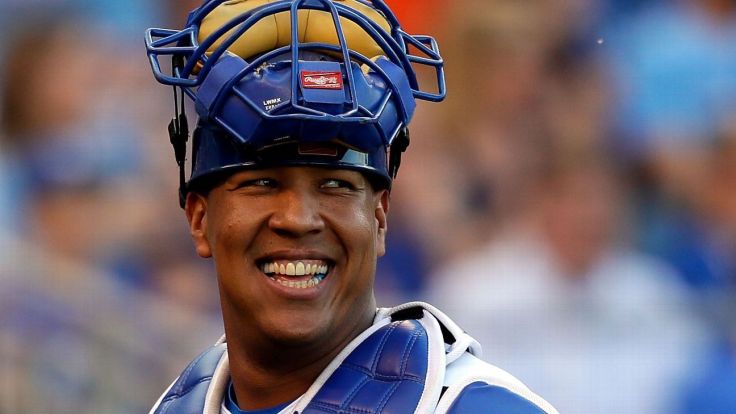
After a lengthy layoff, Bleeding Royal Blue Radio returns with a jam packed episode! Sean Thornton is joined this week by Scott Hayes as they discuss Salvador Perez’s return, the Kelvin Herrera injury, the wild American League Wild Card race, some playoff discussion, Mike Trout’s push for the AL MVP, MLB’s Little League game and much much more. Listen, share and leave any feedback here.
As they say, July was a very, very good month for the Kansas City Royals. The Royals went 16-10, pulling themselves within a few games of the Cleveland Indians in the American League Central and taking over the second wild card spot in the AL. They pulled off a nine game winning streak near the end of the month before falling to Boston on July 29th. The month was very good for Kansas City but do the numbers speak to that as well? Let’s take a look at how you break down the month of July for Kansas City.
Let’s begin with the pitching, which has been the strong point for Kansas City throughout most of the season. Overall, here is how the Royals ranked in the league:
Innings Pitched-4th
K/9-13th
BB/9-13th (which means they had the 3rd best walk rate in the AL)
HR/9-14th (2nd lowest in the league)
LOB%-8th
HR/FB-15th (Best in the AL)
ERA-6th lowest
FIP-4th lowest
fWAR-5th
So those are the overall pitching numbers in July. Let’s break them farther down, starting with the starting pitching:
IP-8th
K/9-11th
BB/9-15th (Best in the AL)
HR/9-8th
LOB%-10th
HR/FB-14th (2nd best in the AL)
ERA-10th
FIP-6th
fWAR-6th
So just based off these numbers, the Royals rotation was about in the middle of starters numbers in July to slightly better. How about the relievers?
IP-3rd
K/9-14th
BB/9-9th
HR/9-14th (2nd best in the AL)
LOB%-3rd
HR/FB-14th (2nd best in the AL)
ERA-1st
FIP-3rd
fWAR-3rd
Just like in years past, the bullpen carries a good bulk of the Royals pitching. The one change is obvious in the strike outs per 9 rate, which was one of the lowest in the league for July. The Kansas City bullpen used to be built on power arms. Now, the relievers are allowing the stellar Royals defense to do the work. It becomes even more evident by the fact that the Royals bullpen has the second highest ground ball rate in the AL for the month at 53.6%. So the pitching held up their end; how about the offense?
On the surface it appeared the Royals offense was above average this past month, but we all know the numbers won’t lie:
HR-3rd
Runs-2nd
RBI’s-3rd
BB%-15th
K%-10th
ISO-3rd
BABIP-5th
Batting Average-3rd
OBP-5th
Slugging-2nd
wOBA-3rd
wRC+-4th
fWAR-3rd
For a team that can really struggle offensively, the Royals bats were the biggest part of their successful month. The fact that the team ranks in the Top 5 of the league in most offensive categories was a boost to their winning record in the last 31 days. We all know this team can be streaky, so a cold spell could be just around the corner, but if they continue to put up numbers like this, the Royals should be able to stay in contention over the last couple months of the season.
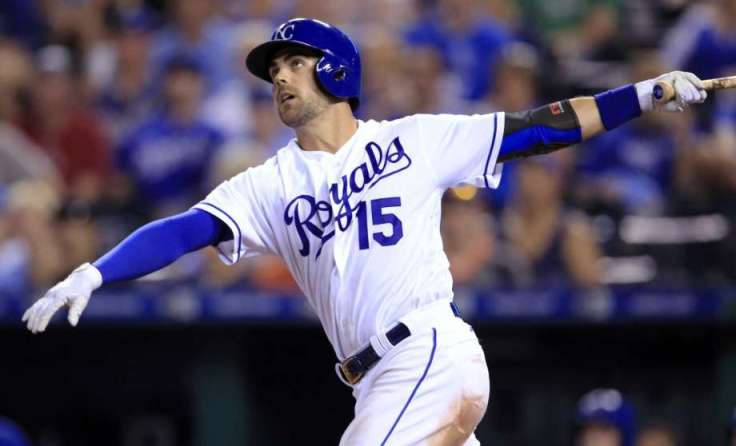
Speaking of the offense, who really led the way for the Royals in July? My money would have been on Eric Hosmer, but alas it was ‘Two Hit’ Whit Merrifield who led the team in fWAR throughout the month. Hosmer and Mike Moustakas were vital contributors to the team’s success and helped lead a major offensive charge throughout July:
Home Runs-Mike Moustakas, 9
Runs-Eric Hosmer, 22
RBI’s-Hosmer & Moustakas, 21
ISO-Moustakas, .309
BABIP-Hosmer, .423
Batting Average-Hosmer, .379
OBP-Hosmer, .434
Slugging-Moustakas, .596
wOBA-Hosmer, .430
wRC+-Hosmer, 172
So what will be on the plate for August? There is no way to really guess that, although the recent injury to Salvador Perez could mean a dip in some of those offensive stats. What I can say is that if they produce anything close to what they did in July this Royals team might be able to elevate themselves further along in the American League Central. With less than sixty games left, it is ‘do or die’ time for any team looking to capture a postseason berth and Kansas City will have to weather some bumps in the road. Luckily, a large chunk of these players have been through the grind before…but will that be enough to get them to October?
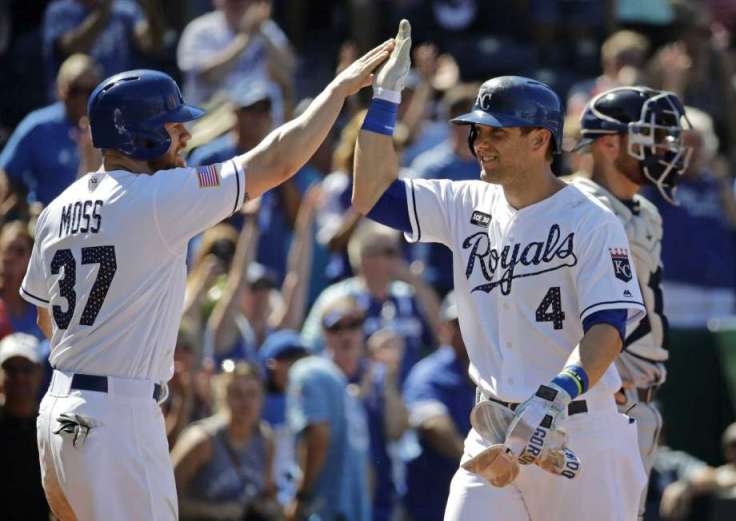
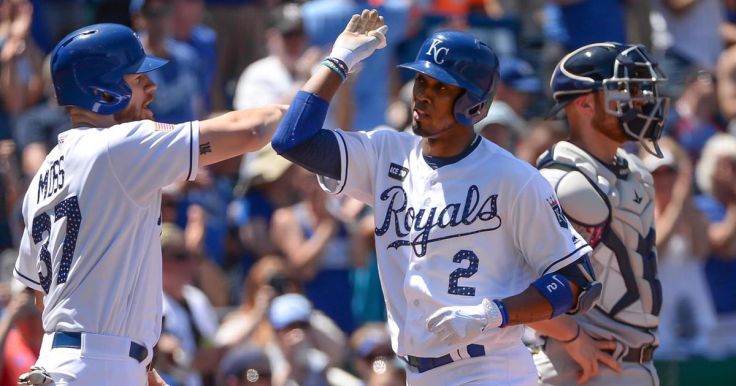
We all remember April. April was not kind to the Kansas City Royals and in large part it was due to the lack of offense. The Royals were last in almost every offensive category in the American League (outside of home runs and ISO) and produced a wRC+ of 57 as a team (league average is 100). While almost the entire team was struggling, the most glaring weakness was the bottom of the lineup, which consisted of Brandon Moss, Alcides Escobar and Alex Gordon. The last third of the lineup continued their struggle through May before June started to see a bit of life. But over the last few weeks, this trifecta that was denoted ‘The Black Hole of Death’ has awoken from their slumber and helped guide the Royals to where they now sit 1.5 games out of first place in the American League Central and tied for the second wild card spot in the AL. So how has this group gone from basement dwellers to driving forces behind a Kansas City Surge?
Let’s start by looking at where this group started at in April with a look at their slash lines:
Moss: .167/.250/.367, -0.3 fWAR
Escobar: .171/.200/.220, -0.4 fWAR
Gordon: .184/.268/.218, -0.3fWAR
The numbers didn’t see a big uptick in May:
Moss: .203/.266/.508, 0.0 fWAR
Escobar: .197/.220/.248, -0.5 fWAR
Gordon: .164/.307/.192, -0.1 fWAR
Now remember, WAR factors in defense and Moss for the most part doesn’t see a whole lot of time on the field. So what might be the most telling sign of how badly Escobar and Gordon were performing is looking at the WAR statistic; both players are former Gold Glove winners and are still great defensively. The fact that both put together below replacement level performances really shows you how lackluster they were with the bats. Also, take a look at Escobar and Gordon’s slugging percentage in April and May: both months, Escobar had a higher slugging percentage than Alex, which shows that Gordon wasn’t driving the ball at all in those two months. Escobar is not known to get a bunch of extra base hits while Gordon in the past has been known as a guy who can rack up a decent amount of doubles and home runs. At that point, one would wonder how much better this Royals team could be just by getting replacement level play from the bottom third of the batting order. Luckily, June would see their bats start to wake up.
All it took was a trip to the west coast and warmer weather to get a pulse from these three (or at least two of the three):
Moss: .156/.240/.178, -0.5 fWAR
Escobar: .294/.301/.412, 0.5 fWAR
Gordon: .231/.295/.436, 0.3 fWAR
Moss’ June was not pleasant, as he only drove in one run the entire month and had a wRC+ of 13. Gordon actually went deep three times and a lot of his production can be attributed to hitting coach Dale Sveum working on his stance and having Gordon use his legs a bit more to help him drive the ball. The Royals as a team had a great offensive month in June but the best was yet to come in July:
Moss: .326/.392/.630, 0.5 fWAR
Escobar: .271/.320/.414, 0.4 fWAR
Gordon: .254/.318/.407, 0.3 fWAR
While Moss was almost invisible in June, his July has seen his numbers drastically move upward, thanks to something that doesn’t have a stat to quantify it: confidence:
“Before the last couple of weeks, I’d get to two strikes (and) not to say that you knew it was over, but you knew you probably missed your chance,” he said, smiling and adding, “Been seeing the ball a lot better and have better balance at the plate, so it’s not a panic any more.”
Escobar has gone with a more balanced attack, spraying the ball all over the field. In July, Escobar is pulling the ball 30.7% of the time, hitting the ball up the middle 35.5%, and the opposite way 33.9%. Gordon appears to be taking the ball to the opposite field more, 28.6% compared to 13.1% last month. Gordon is also focusing more on off-speed pitches to hit, as his wCH/c (which is a linear weight against change-ups) is sitting at 1.69 in July, compared to -3.67 in April. Gordon has always been a better hitter when he isn’t pulling the ball as much and most of his big hits in the last week have been to the opposite field:
So for the month, these three are almost all above the league average for wRC+ (Moss is above with 168, Escobar and Gordon are almost there with 94 and 91 respectively) and all have a wOBA of .313 or higher. Kansas City has sought any offense from the bottom three and it has finally come to fruition. The next big question is ‘Can they sustain?’ this pace?
Credit: Kansas City Star
With a little over two months left in the season, there is no reason to think these three hitters can’t continue this pace of production or something close to it. Moss might not slug at a .620 clip but as long as meets a happy medium between his low and his high that should keep him at a respectable level. Both Escobar and Gordon are performing at levels that are very sustainable and would be more than accepted if they can keep it up. Moss and Gordon are well-known to be streaky hitters so the highs and lows could be a bit extreme, but as long as they evened out to respectable numbers it should mark an improvement. The Royals have waited all season for these guys to hit and now comes the hard part-maintaining it. These three don’t need to carry the offense, they just need to contribute.
A funny thing happened in June; the Kansas City Royals kicked it into another gear, going 17-9 and putting them near the top of the American League Central. As of this writing, the Royals are 3 games out in the division, half a game out of the wild card. It feels very apparent that the team is making another one of their patented runs, a run that has been christened ‘The Last Ride’ due to a number of key players becoming free agents at the end of the year. It is ‘Do or die’ at this point and the Royals appear to be saying ‘We aren’t dead yet’. Despite all of this, there are some that believe Kansas City should still sell before the trade deadline and start acquiring pieces for the future. The farm system is weak and depleted and has been ranked by numerous sources (including Baseball America and mlb.com) as one of the worst in baseball. So…should the Royals buy or sell?
The argument for buying is simple: they are within reaching distance of a playoff spot and have performed way more consistently through the last 4-6 weeks than during their horrid April. Over the last 30 days, the Royals are 5th in home runs, have the 4th lowest strike out rate, 4th best ISO (Isolated Power), 4th best slugging percentage, and 2nd best WPA. The WPA (or Win Probability Added) might be the most telling, as it determines each player’s contribution to a win. Also, they have the best Clutch stat in the American League over the last 30 days, a stat that measures how players perform in high leverage situations. Overall, the offense has awoken and has performed more along the lines of their expectations. When I was deciding on my predictions back in April, I felt that overall the offense was going to bounce back from a rather lackluster 2016 and produce closer to their 2015 numbers. But the first month of the season made me question whether I had raised my expectations too high and was betting more on hope than reality. The pitching has been mostly efficient during that same span, as they were able to keep the team on pace while enduring injuries to two of their starters (Danny Duffy and Nate Karns) while dealing with a few struggles from some of their younger arms (Eric Skoglund, Jake Junis, Luke Farrell). Over the last month, the Royals pitchers have the 5th best walks per 9, 4th best HR per 9, 4th best LOB%, have the best HR/FB%, 3rd best ERA, and 5th best FIP in the American League. Considering the state of the rotation during this span, it gives one comfort especially now that Duffy has returned to action. The numbers are all on the incline, which is a positive sign for a team wanting to play October baseball. This makes me believe they should be buyers, but what they will be able to buy is another issue.
While in theory buying appears to make the most sense, the big question being asked for the Royals is ‘who can they offer?’ if a deal goes down. To be honest, not much. It would seem that anyone dealt off the main roster would leave a hole on the team and the farm system is pretty thin on tradeable talent. One would think they would go after a starter for the back-end of the rotation, someone who wouldn’t cost much but would eat up innings and be a notch above the performances we have seen from Junis and Skoglund. The Royals sent scouts to go watch Jose Quintana of the White Sox, but I’m pretty certain Kansas City would not be able to assimilate a package for the lefty that would fit what Chicago is looking for. A rotation “rental” might be the way to go for the Royals, someone like Scott Feldman , Lance Lynn or Alex Cobb, a veteran arm that wouldn’t cost the team very much. I can also see the Royals looking for another arm for the pen, as Kansas City has sent scouts to look at Philadelphia’s Pat Neshek who will be a free agent at the end of the season. The Royals were able to make big deals back in 2015 that netted them Johnny Cueto and Ben Zobrist; I would not expect a deal of that magnitude, but I can see them scouring cheaper options that would improve on the current roster.
So why should the Royals sell? There are some analysts who believe that with how weak the Kansas City farm system is, they would be best suited to sell at the deadline so their rebuild after this year doesn’t drag on for a 3-6 year period. Amongst those who believe the team should swing into sell mode is former MLB General Manager Jim Bowden:
.@JimBowdenMLB: "(The Royals) are all in… I think it's a mistake… What is this Royals team going to look like in '18, '19 & '20?" pic.twitter.com/LdLYqbDQKe
— MLB Network Radio (@MLBNetworkRadio) July 5, 2017
Look, I get the arguments that are made that say if Kansas City doesn’t sell, the rebuild will be a huge task to bounce back from. I am very well aware that the farm system is one of the weakest in the game and probably won’t really be supplying steady, regular major league talent for a couple more years. But…I can live with that if it means we get one more season with a run in October. As a fan for 33 years, I know what it is like to be at the bottom looking up; been there, done that. But I also remember the 20 year period where the Royals played very few (if any at all) meaningful games. In my eyes, the Royals have this one more year to give the fans and the nucleus of this team one more playoff run for us to etch into our memories. Baseball’s parity has never looked better and with the second wild card, it opens up a whole other realm for teams that are on the fringe of the postseason. After all these years, I have confidence in the Kansas City front office that they will be able to assemble a game plan for the future, that is if they haven’t already. From Dayton Moore’s interviews, I have gotten the vibe that they are very well aware of the position they are in and what that means for the future of the franchise. That makes me believe that they aren’t blindly walking into this scenario like ostriches with their head’s stuck in the ground. They are aware and feel this is the best course of action to take. I also believe that if the Royals are able to make it to October, the money made from playoff baseball will help the team in the years to follow, whether it is used to sign free agents or help with something like scouting. It would be a major disservice to this team, the organization, the fanbase and even baseball to dismantle this team when they are within breathing distance of a playoff spot. A small market team like the Royals succeeding is good for baseball and helps build interest all across the game.
At the end of April the Royals looked like sellers that were just biding time until July. The last six weeks have been proof that baseball is a long season and one month does not make an entire season. I don’t know if I would label Kansas City as a team that will win the World Series but I also won’t count them out either. The last four seasons have shown us that this Royals team loves to defy logic and are never truly out of a race. Wasn’t it Han Solo who wasn’t a big fan of odds?
Maybe it’s just me, but when ending the story of these last few years of Kansas City Royals baseball it seems fitting that the end should be a team that never says quit and bounced back from a horrible start to reach the playoffs. Maybe I’m a sucker for a good story or maybe the homer in me just believes in this team. No matter which it is, it makes sense to let this play out and see where the Royals end up. It could be a let down or…it could be the storybook ending we all have wished and hoped for.
As the Kansas City Royals get ready for a weekend series against the Minnesota Twins, Sean chats with Panda Pete from Twins and Losses about the upcoming series between the two teams, the state of the American League Central, parity in the American League Wild Card race, the upcoming Player’s Weekend and closer’s entrance music. Enjoy and any feedback is much appreciated.
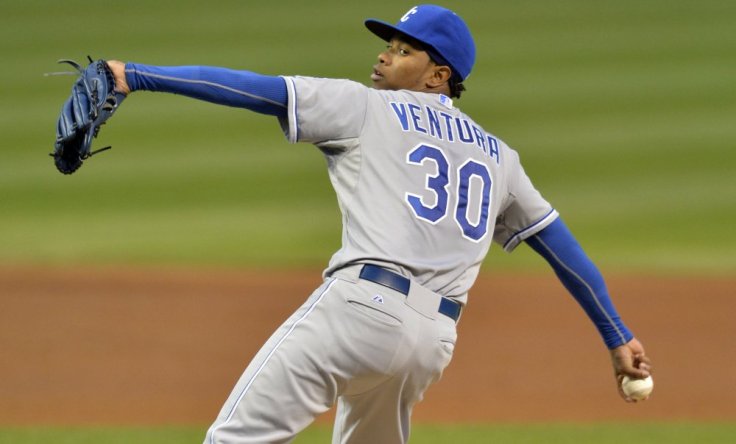
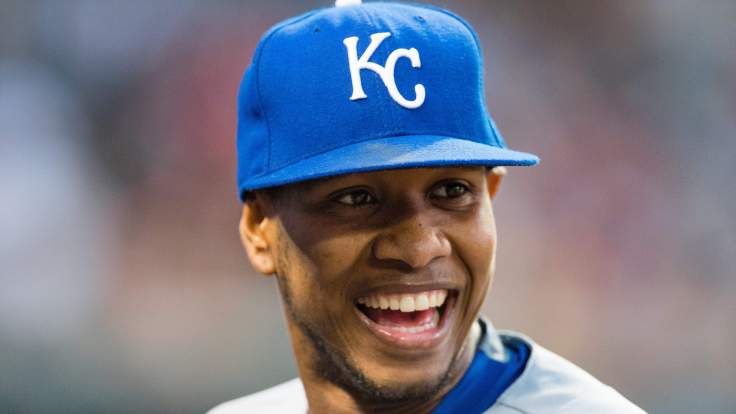
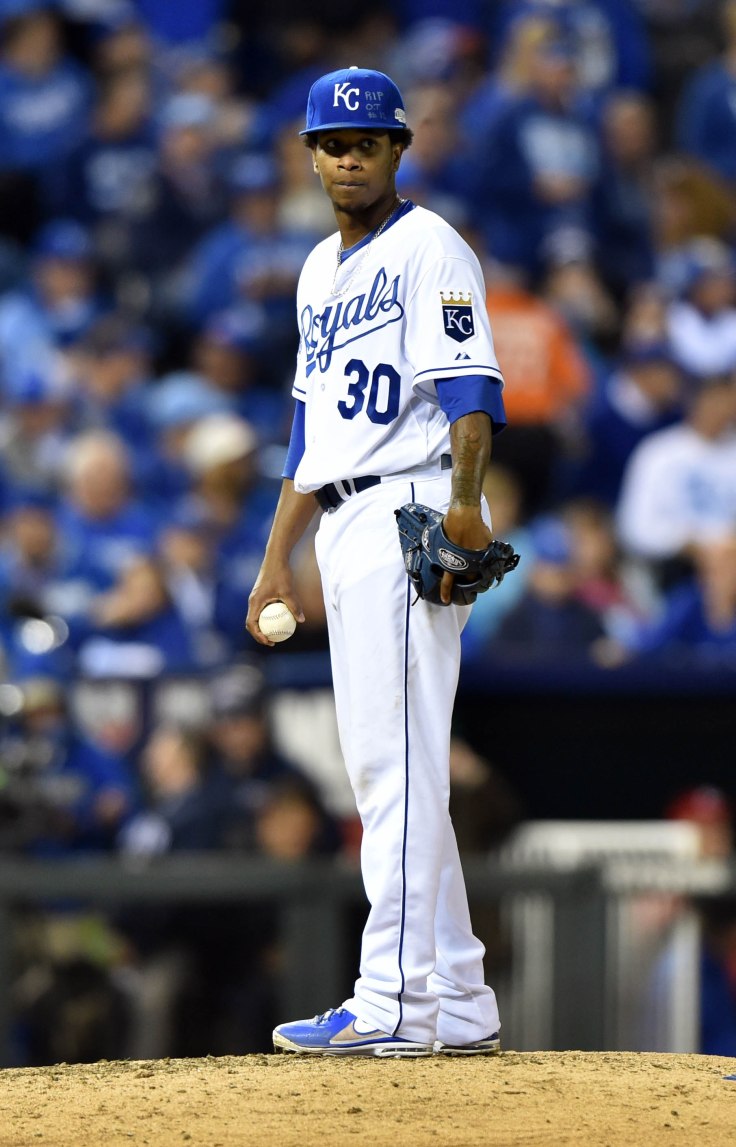
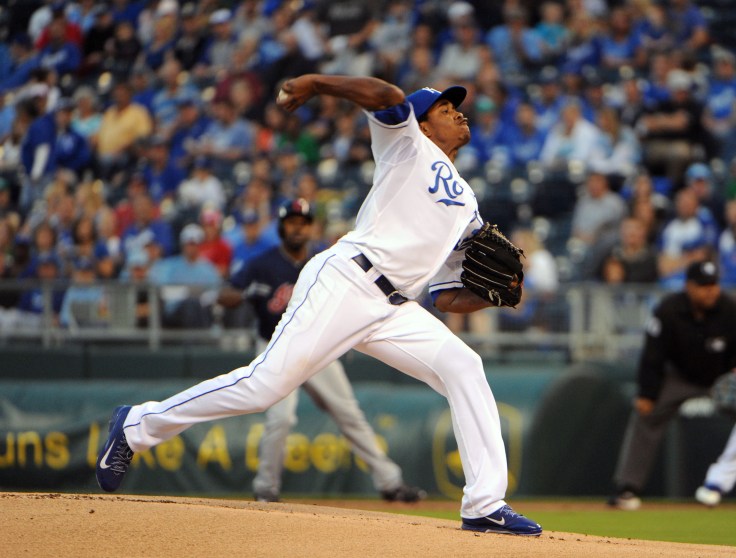
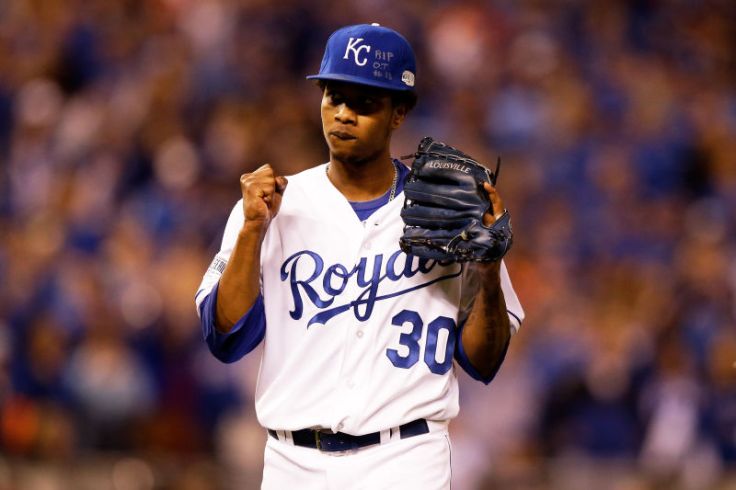
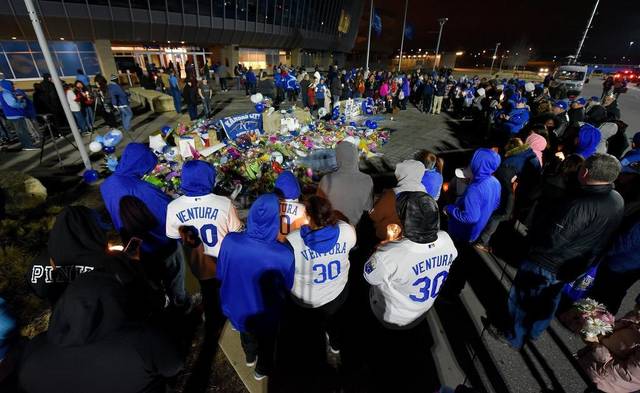
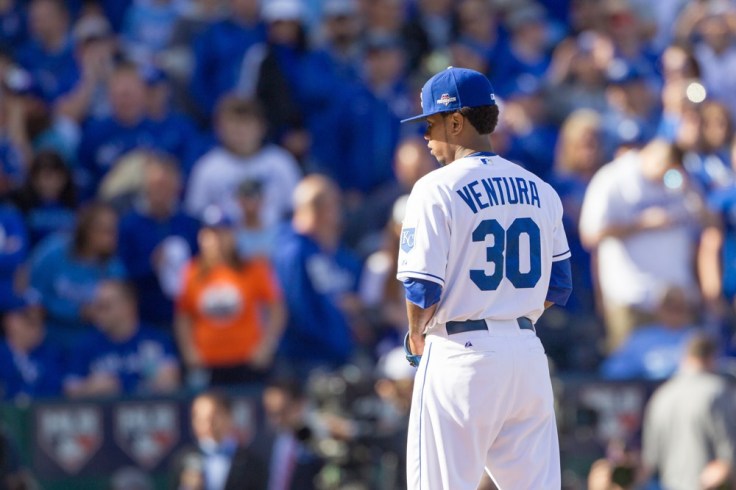
You often hear that “baseball is a kid’s game”, a phrase that bears a ton of truth. For many fans, they fall in love with the game at a young age and never lose that youthful exuberance when at the ballpark. Players are no different, as many play as if they are still ten years old, kicking dirt on a backfield while playing a pick up game with friends. The realities of life sometimes slip away during the span of a baseball game, as all the daily worries seem to slide into a separate filter, only to be untapped at a later date. Last year, baseball lost a grown up kid in Jose Fernandez, an elite pitcher who’s life was taken all too soon. On Sunday, Kansas City Royals pitcher Yordano Ventura, just 25, fell to the same fate, dying from a traffic crash in the Dominican Republic. Ventura was not wearing a seat belt and was thrown from his vehicle after losing control of it on the highway. Apparently there was some thick fog when the accident happened. For a guy who only pitched three full seasons in the majors, there are a ton of memories for Royals fans to remember him by.
Ventura first started showing up on most Royals fan’s radar in late 2012, a season where he fanned 130 batters in 109 minor league innings. His ascension in the Royals farm system continued in 2013, where he struck out 155 hitters in just 134 innings and was a September call-up that year, starting three games while throwing just 15 innings and producing an ERA+ of 120. The report back then was pretty simple; lanky righthander with a power arm that would sometimes allow too many baserunners. He was already getting comparisons with Hall of Fame pitcher Pedro Martinez, as there were even questions on whether or not his frame could hold up to a full major league season. That would be put to the test in 2014, as Ventura made the team out of Spring Training, throwing 183 innings, posting an ERA+ of 123, a FIP of 3.60 and a strike out to walk ratio of 2.30. Ventura would end up 6th in the Amiercan League Rookie of the Year voting. He was already cementing his spot in the Kansas City rotation and would further that even more in October.
It’s funny looking back at it now, but Ventura would make his playoff debut in the 2014 Wild Card game against Oakland, in a very controversial outing at the time. Ventura would be brought in from the bullpen after the 6th inning had started, and would face only three batters; one would single,Brandon Moss would hit a home run, and he would get one batter out.
After the homer, the Royals would be down 6-2 at that point and even to this day, it felt like a weird move to make. Why would you bring in a rookie, who had started all but one game all season, in the middle of the inning with a runner on base rather than bring him in during a clean inning? It seemed like a move that could have cost manager Ned Yost his job. Luckily for Yost, the Royals would come back and win the game in extra innings and moving forward we would only see Ventura start in the postseason.
In fact, it was during that postseason that he would pitch the greatest game of his career. In Game 6 of the 2014 World Series, with the Royals on the edge of elimination, Ventura would pitch in honor of his friend Oscar Tavares (a Cardinals prospect who had five days earlier passed away from a car accident) and throw a gem against the San Francisco Giants, pitching seven shutout innings, striking out 4 while only allowing 3 hits.
It was hard at that point not imagining Ventura being the future of the Royals starting rotation and putting together a string of memorable outings. Over the years, Kansas City had a number of excellent pitchers to hang their hat on: Saberhagen, Busby, Leonard, Cone and Greinke just to name a few. At this point it felt like we would be able to add Ventura to the list. But that wasn’t how things played out.
While the Royals were better in 2015, Ventura seemed to fall down a peg. Ventura would throw 20 less innings in 2015, while his ERA+ was right around league average (103) and his bWAR fell (3.2 to 1.9), his strike out to walk ratio and FIP would slightly improve. 2016 wasn’t any better, as his ERA+ fell below league average (98), while his FIP and WHIP both rose to career highs.His strike out to walk ratio also fell, as his strike out total fell while his walk total increased. It was obvious to some at this point that Ventura’s real battle was going to be harnessing his emotions while on the mound.
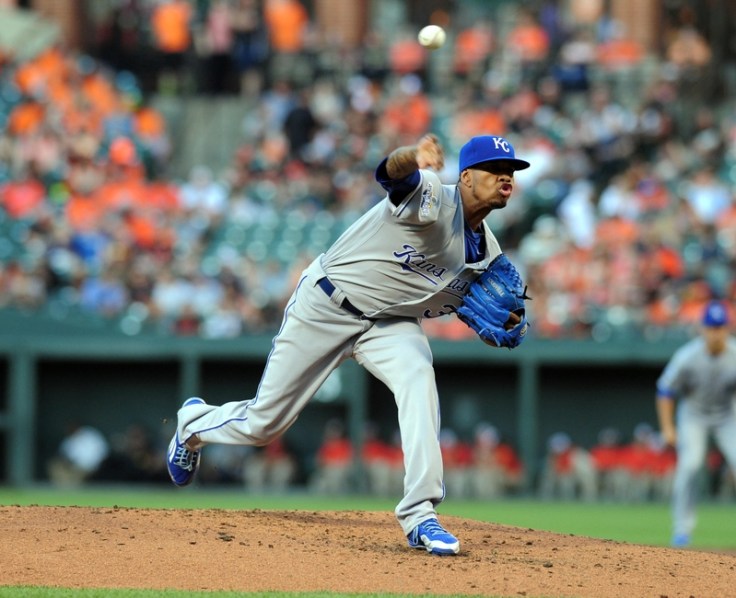
The first bout of his emotions getting the better of him occurred in 2015, as early in the season Ventura would get upset at a Mike Trout single that breezed by his head. It was chalked up to just being a heat of the moment type thing, at least until the incident against Oakland later in the month. After some bad feelings on Friday night (thanks to an aggressive Brett Lawrie slide), Ventura would give up a home run to Josh Reddick in what to that point had been a rocky outing for the young flamethrower. Ventura would follow by plunking Lawrie with a 100 mph fastball and the benches would empty. I was at the ballpark for that game (which I was super excited about since it was the first Yordano game I was getting to see in person) and was disappointed with Ventura’s obvious decision to get himself taken out of the game. Ventura would get ejected again in his next start, as Adam Eaton of Chicago would get under his skin and start a melee. A reputation would be earned at this point for Ventura, that of being a hot-head, and other teams would try to take advantage of this by trying to get him riled up and off his game. That reputation would hit an apex in June of last year as he would tussle with Manny Machado of the Orioles, hitting him and causing everyone to question Ventura’s mental stability on the mound.
But was this really who Yordano Ventura was? The answer, like most things, was more complicated than that.
For all the posturing and cockiness, there was a guy with a big heart inside of Ventura. Many of the Royals players, while frustrated with his shenanigans on the mound, considered him their “younger brother”, disappointed with his actions but supporting him all the same, knowing he was still young and finding his way. They saw the kid who would get upset after a tough loss, feeling like he let the team down with his performance on the field and hoping to work better. For every outburst, there were just as many (if not more) days where you could see a smiling Ventura, loving where he was at considering where he came from. While the Royals had become disappointed with his behavior sometimes, they saw the kid who was watching tape, listening to what his coaches were telling him and who was one of the hardest working guys on the team. Ventura was human, like most of us and with that comes the good and the bad.
As a fan, most of us were equal parts enthralled and impatient with him. For every outing where he struggled to keep his cool, there was one that gave you hope that the ceiling was starting to be reached. For every emotional outburst there was a perfect setup of a batter, luring the batters in with the heat before finishing them off with the nastiest of curveballs. For a team that has struggled producing quality starting pitching, Ventura was that hope that the Royals had finally found their Marichal, their Martinez, their Fernandez. He was the scrawny kid from the Dominican Republic who was signed at 16 years old, throwing in the mid 80’s, hoping he would grow to be something more. He had grown to be something more…but unfortunately we will never find out just how much more.
No human being should meet their fate at the age of 25, let alone an athlete who hasn’t reached the peak of their career yet. There was so much more life to live, so much more for Ventura to give and I don’t even mean on the mound. What most people will remember from Yordano Ventura won’t be the fastball, or the fights or the swagger. No, most people will remember that smile, a smile that was infectious and was a little kid’s smile in a grown man’s body. Even at 25, Ventura was just a little kid getting to throw a baseball for a living. That will stay with me much longer than individual accomplishments or frustration I had with him as a player. Ventura was that sign of hope that all of us look for in our baseball team’s, that hope that tomorrow will be a brighter day. While today was a dark one for baseball fans, I promise tomorrow will be brighter. As fans, our days were brighter with the hope that Yordano Ventura’s arm and smile brought us.
Here we are again, on the verge of another World Series. As much as I love Spring and the beginning of the baseball season, October is still the best time to be a fan of the sport. Like most ‘seamheads’, I have been spending the last few weeks enjoying postseason baseball and all the intrigue and drama that surrounds it. Since I’ve been fairly silent this month (mostly due to other responsibilities), I thought I would pass along some of my thoughts from the playoffs so far, as we get ready for one long-standing streak to fall once the Fall Classic is over, as either the Chicago Cubs or Cleveland Indians eviscerate a drought that has been going on before even some of our parents were born. So what’s been on my mind this October? All of what is to follow and more…
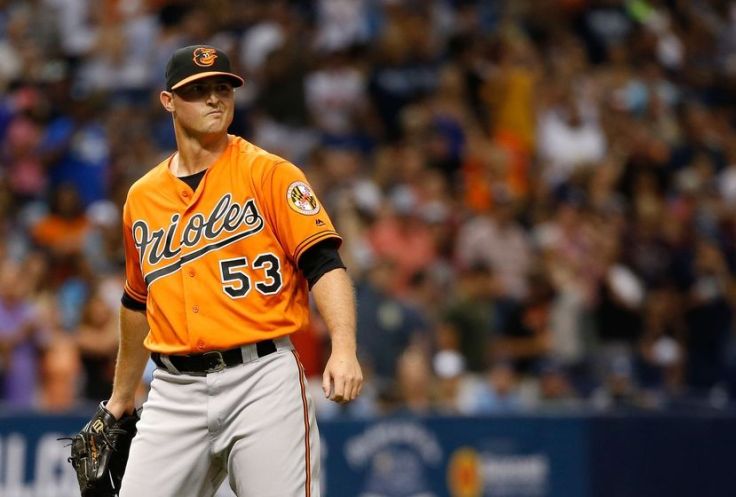
Weeks later and I still have a hard time figuring out how Buck Showalter went the entire American League Wild Card game without bringing in stud closer Zach Britton. Look, I get that most managers like to wait (especially on the road) till the very end of the game to bring in their closer, but when the playoffs are involved, you don’t chance it the way Buck did. There has been a movement for managers to use their closers in a different manner than most are accustomed to; not waiting for a save situation and using your best pitcher in the most high leverage situation possible. Showalter, who I consider to be one of the best managers in the game and one who isn’t shackled to conventional thinking, seemed to fall back into a frame of mind that is actually fairly normal in today’s game and it might have cost his team the chance to advance to the ALDS. The hope is that Showalter’s mistake (and yes, it was a mistake) might shine a light on reliever usage and force managers to use their closers in better situations than just the 9th inning.
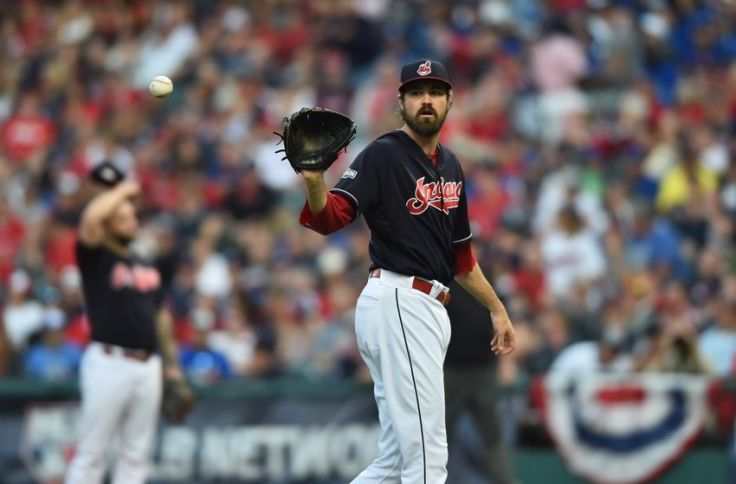
On the other end of that spectrum is Terry Francona’s use of Andrew Miller this postseason. Miller, the ALCS MVP, has been used as early as the 5th inning during the playoffs, many times for multiple innings. It might be considered unorthodox by some, but it has done nothing but garner success for Francona and the Indians. One has to wonder if teams will be on the lookout for relievers like Miller, someone with electrifying stuff and the ability to be used for more than just one inning at a time. While the argument could be made that you can’t use your bullpen during the regular season the way most teams do in October (and there is at least some truth to that), it doesn’t mean that you won’t see more managers trash the old, antiquated system and start using some relievers the way Miller is used. While Showalter was the example of what not to do with your closer, Francona is the example that managers around the game should be trying to copy when 2017 rolls around.
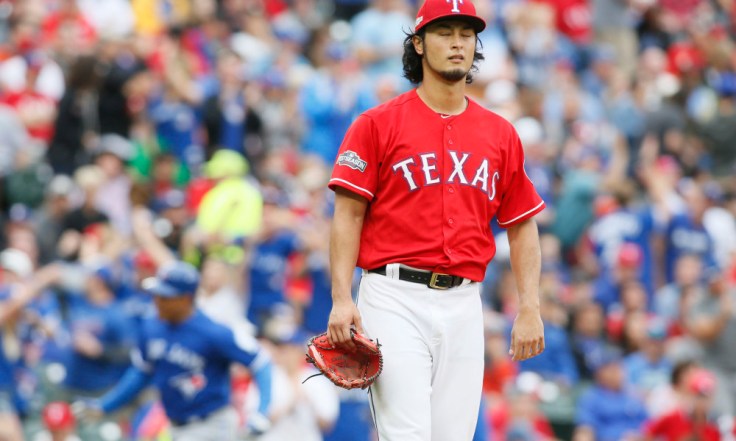
The Texas Rangers collapse in pitching took me by surprise this month. I figured with the front two of Cole Hamels and Yu Darvish and a bullpen that had been racking up a 35 inning plus scoreless streak, this team could be a dangerous one in the playoffs. Instead, Rangers pitching gave up 22 runs in three games and the team from Arlington limped out of the playoffs. While some of the credit should go to Toronto’s offense, the Rangers pitching should get more of the credit for the Blue Jay’s sweep than anything else. One would have to think that Texas will spend the offseason fortifying the rotation and making sure it is stronger headed into the next season.
Speaking of the Blue Jays, their exit from the playoffs couldn’t have come in a more appropriate manner. For a baseball fan outside Toronto, this is a hard team to like. While they are not short on talent, over the last few years we have seen the Blue Jays main hitters continuously whine and complain about one thing or another. Front and center has been Jose Bautista, a man who will never be confused with a golden gloves boxer. Bautista claimed that Toronto were victims of “circumstances” in this series and that was why their offense had gone south. Edwin Encarnacion also had to be escorted away from the home plate umpire one game, with Toronto just hopeful he wouldn’t be ejected. While there were a few pitches called strikes against the Blue Jays that might have been balls, that is a fairly common aspect of today’s game and not really something worth blaming their four games to one loss in the ALCS. In fact, Cleveland only scored 12 runs in the five games, with Toronto posting 8 runs. All the way around, it was a low scoring series. The real “circumstances” that Bautista talked about was Cleveland’s pitching and their dominance against Toronto’s bats. Kluber, Merritt, and Tomlin all silenced the Blue Jays and when you tack on their lockdown bullpen, it was easy to see why Cleveland is headed to the World Series. A big part of Toronto’s issues lie in their leadership and their tendency to make excuses rather than owning up to their own struggles. The Blue Jays temperament just isn’t one of a championship team, and it showed in the ALCS.
Has there been a more disappointing team in the postseason the last few years than the Washington Nationals? The sky seemed the limit a few years back with their blend of youngsters and veterans and two of the most intriguing players in the game (Bryce Harper and Stephen Strasburg). Instead, since 2012 the Nationals have lost in the NLDS three times. What very well could have been a dynasty has left this organization with more questions than answers. If you are Washington’s braintrust, what should you think? If you saw a team with Harper, Strasburg, Max Scherzer, Anthony Rendon, Daniel Murphy, Trea Turner and Tanner Roark, you would have to think at the least they would have made the NLCS at least once. Instead, this team now has to regroup and wonder what the missing piece is. Last year, the belief was getting rid of Matt Williams and hiring Dusty Baker would fill that needed puzzle piece. Is it the manager? Does the team need another bat? Another stud starter? Or do they need a clubhouse veteran to be this team’s glue? It will be an interesting offseason in Washington and one that might define this team’s immediate and long-term future.
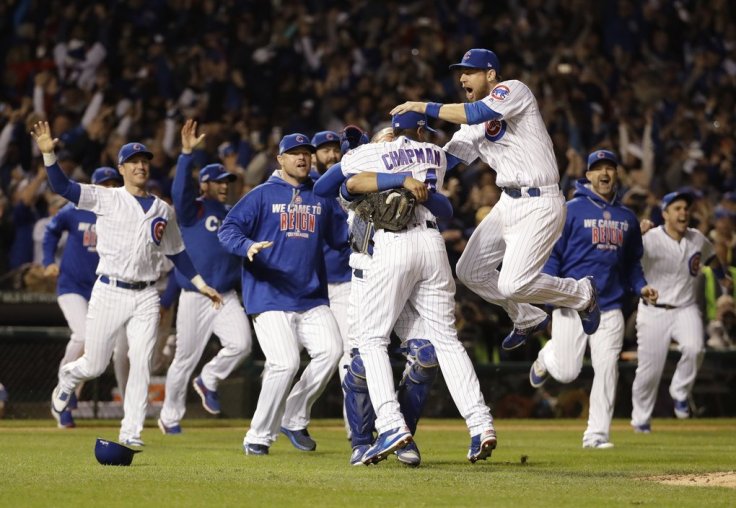
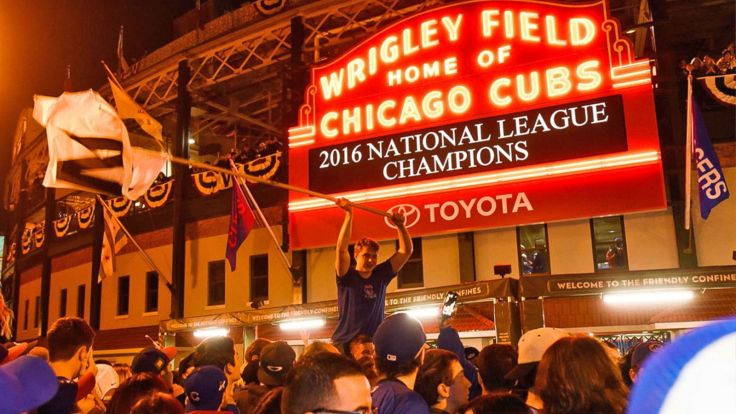
There is no better story in the playoffs this year than the Chicago Cubs. You’ve all heard the numbers on the years of futility; their last world championship was 1908, last trip to the World Series was in 1945. Last month I mentioned I was rooting for the Cubs but even if I didn’t have the emotional connection from my youth, I would probably still want to see the Cubbies rack up their first world title of the century. It’s not just the years of bad luck and bad teams, not just the old lovable stadium or long history of the franchise in general. It is a change in the culture in Chicago, brought forth by both Theo Epstein and Joe Maddon. Maddon might be one of the great motivating managers of the last 30 years, if for no reason than how loose he keeps that clubhouse. Add in the mix of exciting youngsters and grizzled veterans and you have a recipe for not only a championship but also possibly a dynasty. I found it ironic that Chicago bounced the Dodgers from the playoffs, since the Cubs should probably thank Los Angeles for putting them in this position in the first place. If not for LA prying Andrew Friedman from the Rays, the Cubs would not have been able to get Maddon to manage this team. Maddon had a clause in his contract that allowed him to “look elsewhere for employment” if Friedman left the organization, which he took advantage of when Andrew left Tampa for Los Angeles. The Cubs swooped in, procured the services of Maddon and as they say, “the rest is history”. There are many a reason to root for Cleveland as well (The Revenge of Willie Mays Hayes?), but more than anything, this Cubs team just feels like a team of destiny. I know there will be Chicago fans who will be waiting for the other shoe to drop but…but what if there is no other shoe?
Finally, one has to feel for Los Angeles’ Clayton Kershaw. Kershaw, easily the best pitcher in baseball, was the victim of Chicago’s clinching win on Saturday night in Game 6 of the NLCS and because of it the narrative will be pushed again that Kershaw is not a “big game” pitcher. The funny thing is while Kershaw has had a couple of clunkers over the years (I’m looking at you, Game 1 of the 2014 NLDS), he hasn’t been nearly as bad as some would have you believe. In his 14 playoff starts, Kershaw has 8 quality starts while he has five starts of giving up 5 runs or more. Just looking at the last two years, Kershaw has thrown 38 playoff innings, compiling a 3.79 ERA while striking out 48 and allowing a .218 batting average over that span. Sure, he isn’t Madison Bumgarner or Curt Schilling in the postseason, but he isn’t worthless in the playoffs either. Even with that being said, this year in particular should not be a determining factor on how Kershaw performs in October. He would return from a back injury that kept him out for over two months on September 9th and would allow 4 earned runs the rest of the year. So obviously Kershaw was putting up Kershaw numbers, but was he 100% healthy? I didn’t feel like he was at all this October and apparently I wasn’t alone:
Andrew Friedman on Clayton Kershaw's back injury: "Most guys would not have come back at all from what he suffered."
That comment was from Saturday after the Dodgers loss to the Cubs to wrap up the NLCS. This also tells me that even 80-85% of Kershaw is probably better than most pitchers alive today. So the narrative for him will live on in some minds, but it probably shouldn’t. Clayton Kershaw is still the same pitcher in October that he is the other months of the year; he’s just not perfect like some would expect from him.
So here we are, just a day away from the World Series. It is also our reminder that at the most, we have only seven games left in this 2016 season before baseball takes a few months off (at least on the field). It has once again been a fun October, even without my Royals in the playoffs. In fact, it has been stress-free without my team to cheer on in the playoffs. No matter the outcome of the World Series, one team will slay a beast of a streak, one that sits at 68 years while the other one sits at 108 years. It should be a fun series, as we should see some stellar pitching and some clutch hitting. I always hope for a seven game series, so we get not only the greatest amount of baseball but also some high drama. We should get both and yes, I do believe this series could go all seven. So my prediction? The Cubs in seven. Sure, they won’t be able to clinch at Wrigley Field, but a win is a win. I look forward to the next week of action and what will ensue. No matter what, we the fans are the true winners. Thank you, baseball.
Quality pitching might be the greatest necessity throughout the game of baseball. You could ask 100 baseball executives, scouts or analysts, and I’m sure almost all of them would point to quality starting pitching as a constant need for every team. Point blank, you can never have enough pitching. The Kansas City Royals can be counted as one of those teams, as evident by the way their starting rotation has performed this year. It has been so vital for Kansas City that I wrote about it here and here…and here. If there ever was a season where the Royals fate would be determined by their rotation, this would be the year. In fact, you could almost say that as their starters go, so go the Royals. When they struggle, the Royals struggle. When they are glorious, the team strives. Kansas City is currently riding a hot streak and while you will hear names like Gordon, Hosmer and Orlando linked to this streak, the biggest reason for their success can be attributed to the improvement of the starting pitching.
(UPI/Bill Greenblatt)
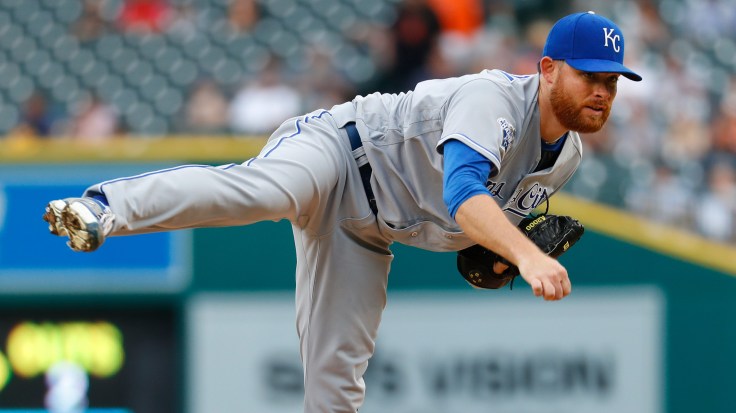
Lets start by discussing the Royals pitchers and the quality start. For those that don’t know, a quality start is considered any start where the pitcher goes at least 6 innings while allowing 3 runs or less. It’s shouldn’t be a hard standard to meet, but occasionally it is an issue and has been for Kansas City this year. Obviously leading the way is Danny Duffy and his amazing season. Duffy has reeled off six straight quality starts and has 12 overall in his 18 starts this year. Ian Kennedy has spun four straight quality starts and Yordano Ventura has three straight. Even Dillon Gee got into the act on Thursday night, spinning his best start of the season and only his second quality start of the year. The starters seem to be working deeper into the game as of late, allowing the bullpen to not log as many innings as they have been and giving them a chance to be a bit sharper. This is big, because if the Royals pitching holds the other team’s offense, there is a good chance that the bullpen will also hold them in check. The Kansas City offense has a tendency to erupt late in the game, and the starting pitching as of late has given them the opportunity to do just that.
(AP Photo/Paul Sancya)
During the month of July, the Royals scuffled and while the offense sputtered, the starting pitching wasn’t much better. For most of the year, the rotation has been near the bottom of most categories in the American League, but that has changed. The Kansas City starters have climbed up from last in innings pitched to 11th, next to last in starters WAR and FIP, and 10th in ERA. The starters have still given up the most home runs in the league and the 3rd highest walk percentage, but you can see some definite progression in the numbers. Teams are only batting .255 against Kansas City’s starters, 4th best in the league and they have the third best LOB(Left on Base) percentage of 74.7%. Their strike out numbers have risen as well, as they have the third best K rate in the league at 20.7%. There are still some flaws with the starters, as expected, but when you see the team has the second best Clutch statistic in the league(Kansas City is at 3.26 this year, with 2.00 considered an excellent number) it makes it appear as if the rotation is moving in the correct direction.
The interesting part is that the Royals have not relied as heavily on their starters the last few years and it has seen them make back to back World Series appearances. The team was actually last in the American League last year in innings pitched, 4th highest ERA and FIP, 2nd lowest starters WAR and the highest walk rate in the league(7.6%). When digesting the 2016 numbers compared to last year, it appears the only big glaring difference would be the home runs allowed by the starters. Last year they allowed 107 home runs for the entire year, 6th lowest in the league. This year they have allowed 121 homers, 14 more in 232 less innings. The long ball has hurt the team this year and can be attributed as the big difference in the rotation this year. Luckily, they have only allowed 13 home runs over the last two weeks in 85 innings, which gives them a HR/9 ratio of 1.38. That is quite a bit better than the 1.60 ratio they have for the entire season. This team is never going to be quite like the Atlanta Braves rotations of the 1990’s but there is notable improvement over the last few weeks and some of the same competitiveness seen by Atlanta back in the day.
With just forty games remaining in this 2016 season, the Royals are sitting at 62-60, 9 games out of the American League Central lead and 5.5 games out of the Wild Card. This latest hot streak has soared them back into the race and the starting pitching should get a lot of the praise for that. If this team wants to play in the postseason for the third consecutive year, they need the rotation to keep doing what they have been doing these last couple weeks. What was considered a lost cause just a few weeks ago now seems a distinct possibility for the team that has ‘been there, done that’. If the rest of the rotation follows Danny Duffy’s lead, there will be a fun comeback story to dwell on when October rolls around.
The defending World Series champion Kansas City Royals have had a very trying 2016, with a litany of injuries, slumps and starting pitching woes. While the rotation has seemed to stabilize as of late, the team still struggles to put up good numbers from their number five starter each week. Chris Young isn’t the answer. Dillon Gee isn’t the answer. Brian Flynn probably isn’t the answer either, or like the other two pitchers mentioned, has racked up better numbers out of the bullpen than out of the rotation. So who would that leave Kansas City to be their fifth starter? There seems to be a lack of depth in some regards for the spot, but if they really want to be creative there might some solutions to this season-long problem.
One fairly obvious choice would be to shuffle rookie reliever Matt Strahm into the rotation. Strahm has been a starter in the minor leagues but the Royals have been using him out of the pen since his recall. Strahm has shown electric stuff out of the bullpen, combining his 91-95 mph fastball with a slider and a change-up. He also occasionally throws a slurve, which is normally in the 77-81 mph range. Strahm’s numbers this year in the majors have been impressive; 1.80 ERA, 19.8 K/9 and a bWAR of 0.2. Obviously, if he was put back into the rotation his fastball would probably go down a notch or two, but it still can be an effective pitch with his deceptive delivery. Strahm will eventually be in the Royals rotation, so he really wouldn’t be a bad choice to get a test run under his belt this year.
Credit: Minda Haas Kuhlmann
Then there is prospect Jake Junis. Junis started the year in AA, where he put up some impressive numbers, a 3.35 ERA with 18.5 K/BB% and a FIP of 3.32 over 119 innings. Junis was recalled to AAA Omaha within the past week and threw 7 innings of 1 run ball, striking out 7 while walking none. Junis was rated as the 10th best prospect for Kansas City this year and in his age 23 season and has seen an increase in his velocity (92-94 mph, topping out at 96 mph) with a consistent curve and a change-up with good sink. The Royals could be concerned about elevating Junis too fast this season, which is understood. But with September around the corner, a couple of starts at the big league level would be a good way to get his feet wet while helping the Royals get solid innings from the fifth starters spot.
Now we get to the really creative options for the rotation. First, lets start with Mike Minor. Minor is currently on his second rehab stint in the minors for Kansas City, after the first one was shut down for “shoulder fatigue”. While Minor’s ERA has looked better, I’m sure Royals management would be concerned with most of his other numbers during this stint; he has 44 strike outs over 38.1 innings, although the 20 walks in that span would be a bit concerning. There was hope earlier in the season that Minor would be able to contribute at some point and September could be his best shot of helping the Royals out. Minor’s numbers aren’t eye-popping in the minors, but he does have big league experience and could be an upgrade over the options the Royals have thrown out there so far this year.
(AP Photo/Charlie Riedel)
Don’t like any of those ideas? Well, here are a couple of less likely options that we probably won’t see, but are at least worth mentioning. Kris Medlen has been on the disabled list since May but was scheduled to begin a rehab assignment on Tuesday. Medlen struggled in his 6 big league games this year, posting an ERA of 7.77, with 6.7 K/9, 7.4 BB/9(yes, his walk total was higher than his strike out total), and an ERA+ of 57. Even if we see Medlen this year, I would imagine it would only be a few starts, as his rehab stint will probably cover almost the entire 30 day period.
Also out on rehab assignment is Jason Vargas, who had Tommy John surgery last year. Vargas will begin his assignment at AA and will probably see some work at AAA as well. Vargas’ situation is interesting, since there was some concern that if Vargas started for the Royals this year that they would lose the $6 million insurance coverage of his contract, but it appears it would be maxed out by then anyway. Even so, I’m not so sure we see Vargas this year. It would be about 13 months after his surgery if he pitched next month for Kansas City and I’m not really for sure what Vargas or the Royals would really gain by having him throw in the big leagues this year. In my mind, let him do the rehab assignment and then shut him down until Spring Training. That being said, the Royals could think differently and we could see the Rodney Ruxin look-a-like throwing off a big league mound in September.
So there are some outside of the box options for the back-end of the Royals rotation. At this point in the season, all Kansas City really needs from their number five is 5-6 innings of 3 runs or less and most of us would be appeased with that. With the Royals still of the belief that they can claim a playoff spot, this spot in the rotation becomes even more vital. If the Royals are close to a wild card spot and the number five spot struggles, it could be the difference between playoffs or no playoffs. With the Royals winning the last three series’ and playing like a contending team, now might be the time to take a chance and see what a Strahm, Junis or Minor can do. It could make all the difference in the world.
When contemplating on just one word to describe the Kansas City Royals first half of the 2016 season, a number of words flooded my brain: struggle, streaky, battle, fluky and frustration all seemed fitting. But the one word that seems to fit more than any other is ‘adversity’, a word that has fit like a glove since before the season even started. Whether it has been the struggles of the starting rotation or the streaky offense, the Royals have not had the smooth sailing they were witness to for a large chunk of the 2015 season. Probably the biggest roadblock in front of them this season has been the litany of injuries that have occurred.
The walking wounded actually began back in Spring Training, as Jarrod Dyson, who was in line to see a big increase in playing time in right field, came down with a strained oblique. In May, starters Kris Medlen and Chris Young would both venture to the disabled list, after struggling through their previous few starts. Late in May, Alex Gordon and Mike Moustakas would collide chasing a foul ball in Chicago and the news was grim; Gordon would miss a month with a wrist injury while Moustakas would have a torn ACL and was expected to miss the rest of the season. A week after that collision, catcher Salvador Perez would incur a quad contusion after third baseman Cheslor Cuthbert would run into Salvy while chasing a pop fly. Luckily, Perez would sit out for a week but not have to make an appearance on the disabled list. The injury bug would return in June, with outfielder Brett Eibner(after only being recalled a few days earlier) going on the DL on June 1st with a left ankle sprain, returning after two weeks. Lorenzo Cain would make his first DL appearance in two years, pulling up lame and grabbing his hamstring after running out a ground ball just a few weeks ago. To cap it all off, closer Wade Davis, a man who some of us believe is actually a machine, would deal with a forearm strain and land on the DL with Cain just this past week. If you are taking notes at home, that is four Royals All-Stars that have seen time on the DL so far this season and that is just through 88 games. One of the biggest strengths for Kansas City the last two years was their health, as they were able to make two big playoff runs while dealing with very limited injuries to their main nucleus. The pendulum always swings back around and it appears the Royals dance with lady luck has ended on the injury front.
Speaking of turbulence, the Royals starting pitching has been more than just rocky so far in 2016. Kansas City starting pitching is next to last in innings pitched, 3rd highest in walks per 9, 1st in home runs per 9, 4th highest ERA, highest FIP, and lowest WAR in the American League. The only area where the starting pitching is moderately succeeding is strikeouts per 9, which is the 3rd highest in the league. With these numbers it is easy to see why the Royals have struggled and are currently looking for upgrades on the trade market. Chris Young, who was a vital part of the Royals playoff run last year, has allowed the most home runs in the American League(26 in only 56 innings pitched) and has been banished to the bullpen. Ian Kennedy has been about what was expected from him; at times he has looked phenomenal and has shut down other teams, while others he has been a victim of the long-ball, allowing the second most home runs in the AL( 21). Yordano Ventura has not looked like the ace that he could be capable of, as he has struggled(including inciting a melee in Baltimore) and others he has put together some very quality starts(like just this past Friday). Edinson Volquez hasn’t been as consistent as he was in 2015, yo-yoing from start to start. The one shining light has been the re-emergence of Danny Duffy, who has looked like a pitcher who has figured something out. Duffy started the year in the bullpen but was moved to the rotation in May and has been splendid ever since. He has thrown 81 innings to this point, striking out over 10 batters per 9, walking less than 2 per 9 and stranding runners at an 83% clip. Duffy’s numbers just jump out on the page: highest K-BB% in a Royals uniform, highest soft hit % of his career, and the fastest average fastball velocity of his career. If the Royals can get some more consistency from Volquez and Ventura, while picking up a cheap arm in a trade, they might be able to stabilize the rotation and improve on numbers that shouldn’t be hard to improve upon.
While the starting pitching has been a major trouble area, the offense has been very bi-polar. Much like the last few years, the Kansas City offense is a very streaky bunch. As a team they are next to last in runs, last in RBI’s, home runs, walk %, isolated power, and 12th in wRC+. Most other offensive categories the Royals are around the middle of the pack, but the Royals also get their runs in a different manner than most other American League teams. Eric Hosmer has turned in a season worthy of his All-Star starting nod, hitting .299/.355/.476 with 13 home runs and 49 RBI’s. Salvador Perez has seen an increase in power this season and has turned into a serious threat in the middle of the lineup(writers note: he even hit a home run right after I typed this). Paulo Orlando has been a pleasant surprise this year, hitting .324/.347/.417, sacrificing some of the power we saw from him last year for a better on base percentage. Lorenzo Cain struggled in April, but came on like wildfire in May and was putting up good numbers before his injury this month. Kendrys Morales struggled through the first two months of the season, but looked like a completely different hitter in June, a month where he put up video game numbers. Even Mike Moustakas was putting up great power numbers before his injury in May. But the real surprise of the offense has been the call-ups Kansas City has been using to fill the holes for injured players.
(Credit: John Rieger-USA TODAY)
The great thing about this Royals team is not only the depth that they have compared to years past, but the amount of production we have seen from players that were not expected to contribute. Whit Merrifield has been a life-changer for Kansas City, posting a line of .291/.313/.407 with 1.4 bWar in just 46 games. Whit was originally supposed to fill the super utility role for Kansas City, but instead ended up taking the second base job from the now released Omar Infante. Cheslor Cuthbert, who saw some time in Kansas City last year, was recalled to take over at third base for Moustakas and struggled a bit the first few weeks of seeing regular playing time. Since May 27(right around the Moose injury), Cuthbert is hitting .293/.331/.471 with 7 home runs, 22 RBI’s and a BAbip of .343. Defensively, he is not quite the glovesman that Moustakas is, but he has proved to be more than capable, with an UZR of 6.2 and making 83% of plays that are considered unlikely(which are considered normally to be made 10-40% of the time). The man who has seen the least amount of time out of this group is Brett Eibner, as he has only played in 18 games. Eibner has been productive in that span, hitting .269/.333/.500 with a BAbip of .343 and a wRC+ of 116. Eibner has 8 extra base hits in his 18 games and is a bat that can supply the power the Royals heavily covet. All three players have stepped in when the Royals have needed them to and have produced in many a tight situation. It wasn’t expected for these three to be heavy contributors, but so far in 2016 they have probably helped this team stay in the pennant race.
While this Royals team isn’t gliding into a postseason berth like they did last year, they are still very much in contention, even being 7 games out in the American League Central but only 4 1/2 games out of a wild card spot. The hope is that the Royals can stabilize the rotation while hitting a bit more consistently, which should increase their chances of a playoff spot. Injuries have hurt Kansas City so far this year but they haven’t crippled them and that has allowed them to stay in the race. We have seen over the last couple seasons that this is a team that strives on adversity. If that stays true to form, then we should be seeing a stellar second half from our ‘Boys in Blue’.















 Bleeding Royal Blue