It’s Pronounced ‘Chess-lure Cuth-bert’

kc1

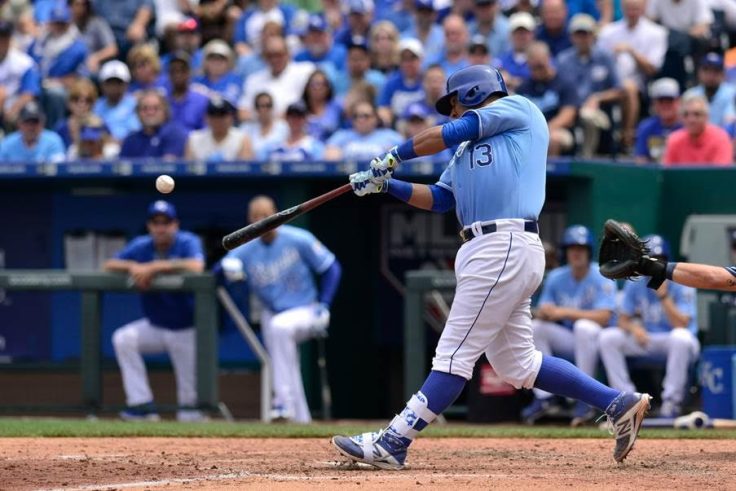
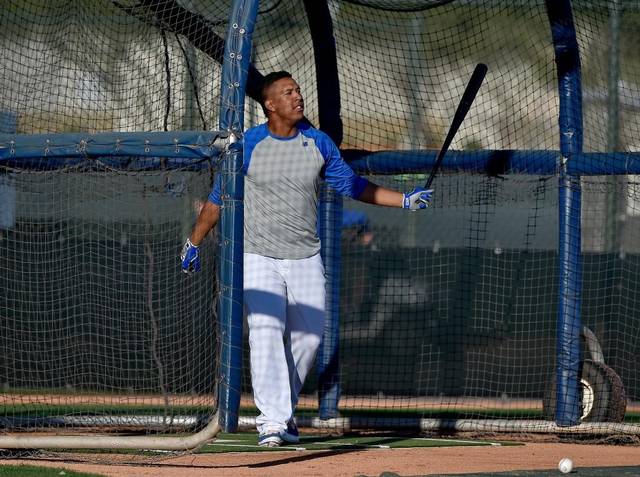
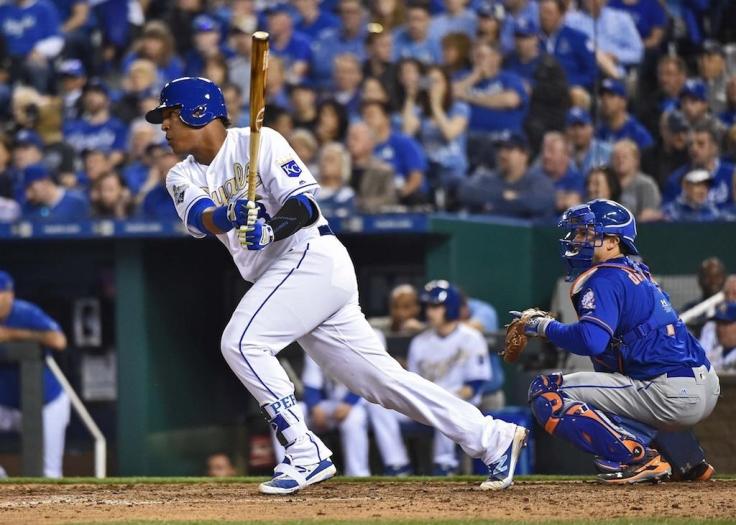
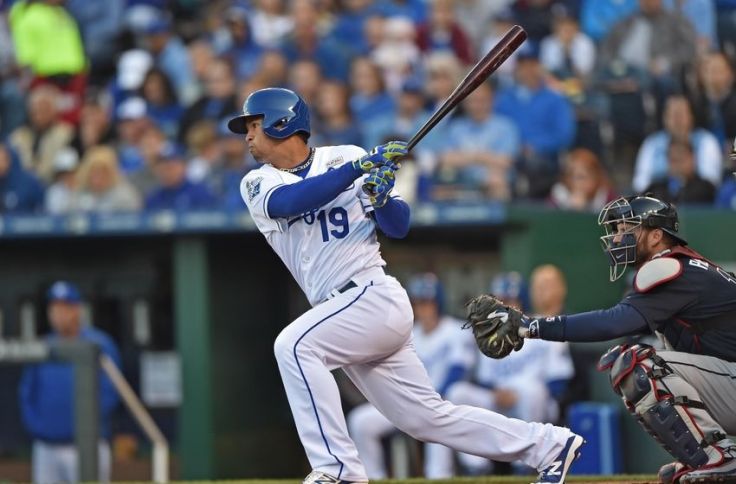
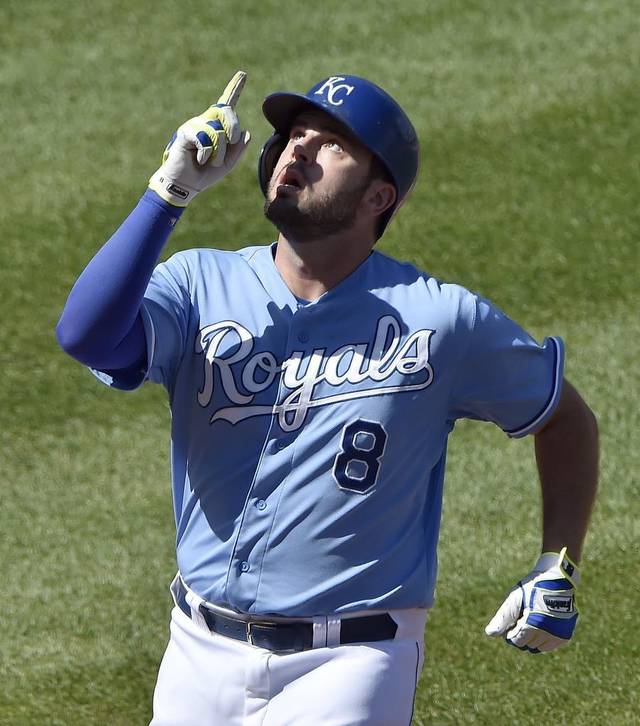
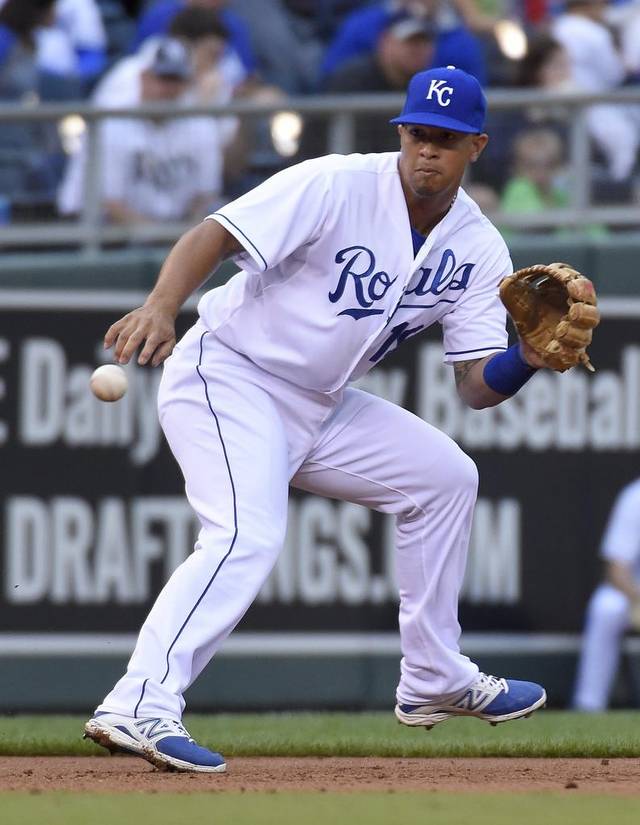
The unexpected is a regular occurrence during a baseball season. There are always players who outperform their expected production, and those that under-perform expectations. Injuries are the norm and they lead to someone getting playing time that wasn’t expecting to. Cheslor Cuthbert would fit that criteria, as no one knew that Mike Moustakas would get hurt on a collision in May and miss the rest of the 2016 season. Cuthbert was the immediate replacement, as he was having a stellar season in AAA Omaha and had seen some time last year in Kansas City. Cuthbert saw limited time for the Royals in 2015, putting up a line of .217/.280/.370 with an OPS+ of 74 and a bWAR of 0.0. It was a very small sample size(19 games, 50 plate appearances) but in a lot of ways he looked over-matched. He was only 22 years old, and it wasn’t like Cuthbert was going to unseat Moustakas anytime soon. But 2016 has been a different story for Cheslor…

Cheslor Cuthbert
(AP Photo/Tony Dejak)

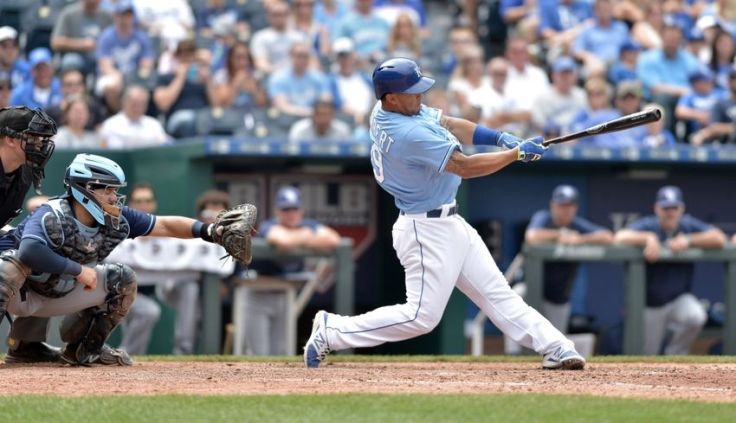
Cuthbert would make his first appearance of the year on May 7th, as Moustakas was dealing with a left thumb fracture at the time. Cheslor had been tearing it up in Omaha, hitting .333 in 24 games with 7 home runs, 28 RBI’s and 58 total bases. Moustakas would return on May 21st, with Cuthbert being shipped back to AAA. During that first stint in the big leagues this year, Cuthbert hit only .255/.269/.373 with 1 home run and 3 RBI’s. My honest assessment at the time was that he would probably be a league average hitter, good fielder but the power we had seen from him in AAA wouldn’t translate. Moose would turn around and get hurt a day later, giving Cheslor his second recall to Kansas City of the young season.
MLB: Tampa Bay Rays at Kansas City Royals
(Credit: Denny Medley-USA TODAY)

Cheslor would return to the Royals lineup on May 24, going 1 for 4 against Minnesota. At the time there wasn’t a definite on Moose’s condition. No one knew the severity of Moustakas’ ACL and wouldn’t until two days later, when it would be announced that he had a torn ACL and would miss the rest of the season. This was big for Cuthbert, on multiple levels. For one, he was the man that most figured would see the most playing time at third base. To me though, it meant something so much more. A young player often struggles mentally when they are recalled to the majors, for fear that they will not perform good enough in the little time they might see. Cuthbert now knew he was going to be given the first shot at the third base job with regular at bats and a weight had to be lifted off his chest. This was a big contributor on how he would produce in the coming months.
kc4

Starting on May 27th, Cuthbert would show the offensive prowess that he produced in AAA earlier in the year. Since that date, Cuthbert has hit .300/.331/.475 with 7 home runs, 27 RBI’s, a BAbip of .347, and has raised his average to .288. Digging a bit deeper, Cuthbert has an wRC+ of 104(with 99 total bases), and 0.7 fWAR. It’s been obvious that Cuthbert has hit for a bit more power this year in the big leagues, and it shows with a 28.3% hard hit rate, up by 15% from last year and 13.8% HR/FB rate, a good 5% higher than last year. Another positive to take on his numbers is the fact he is hitting the ball more to center field this year, hitting the ball up the middle 34.7% of the time, a good 7.7% more. Percentage wise, Cheslor is hitting the ball at about the same rate as last year, only with a bigger sample of playing time to play with. It does appear as if there is a bit of luck involved, as his BAbip of .347 is almost a full .100 points higher than last year. Where last year he was finding leather, this year he is finding grass and dirt. Offensively he has just been a shade over replacement level but the improvement has to give a person hope as the season is progressing.
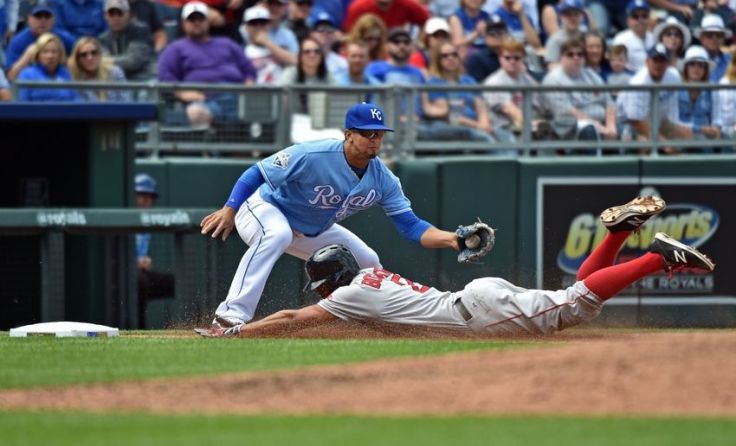
MLB: Boston Red Sox at Kansas City Royals-Game One
(Credit: Peter G. Aiken-USA TODAY)

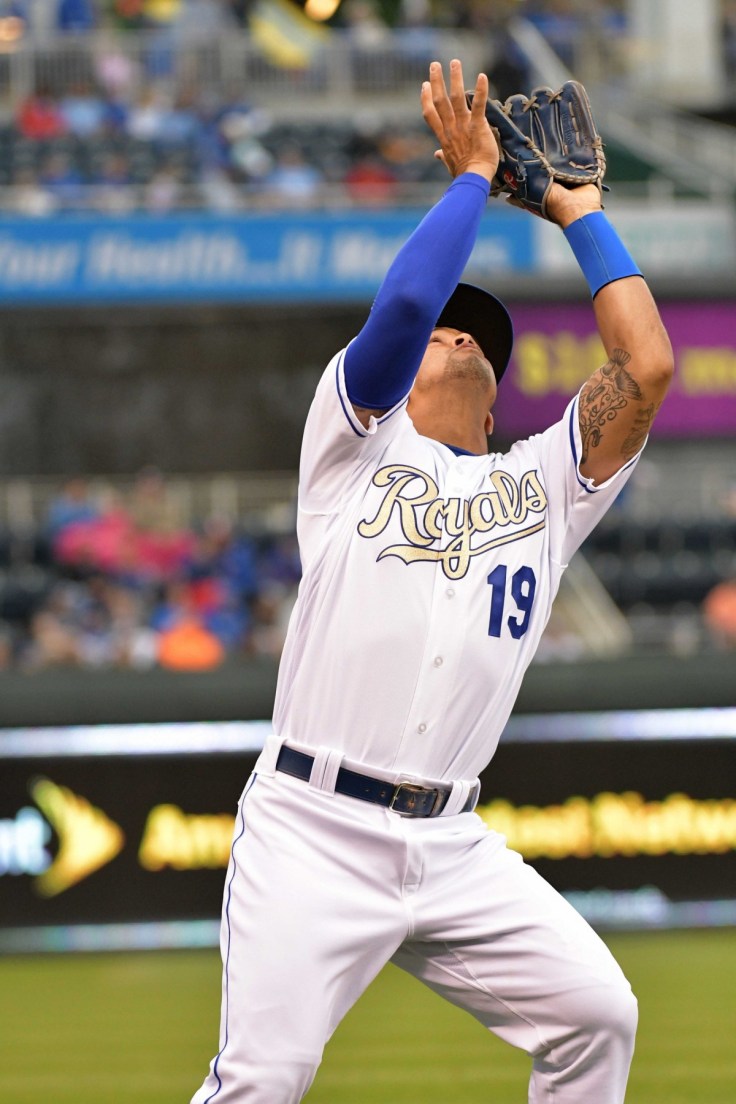
As much as Cuthbert has outperformed expectations offensively, defensively he has been as steady as expected. Cuthbert has not only been an above-average defender this year, he has excelled in a few areas that were a bit unexpected. His UZR sits at 0.4 while his defense sits at 1.2. The impressive part to me is how he is performing  on the unlikely play(which normally has a 10-40% chance of being fielded); Cheslor has been making those plays at a 62.5% clip, well above the league average. Add in the fact that he makes the likely and routine plays in the range he should and you have the making of a plus defender. Cuthbert might not make the flashy play on the corner, but he will make the majority of the plays he should and even the majority of plays slightly below average. Cheslor might not be quite the third baseman that Moustakas is, but he is a steady replacement that won’t make anyone regret the decision.

kc6

Cuthbert’s performance this year has raised some eyebrows and has forced the Royals front office to look at some new possibilities. Do you keep Cuthbert in case Moustakas leaves after 2017? Do you find a new position for him? Do you use him as trade bait? Do you move third base prospect Hunter Dozier to another position? Do you trade Dozier? There are a slew of decisions that Kansas City will have to make because Cuthbert is only 23 years old and has shown he is worth a longer look. There were some doubts about Cheslor before the season and many of them are summed up by this scouting report on scoutingbook.com:

Royals slugger Cheslor Cuthbert needs to level up a bit if he’s going to stick as a permanent MLB player. He showed readiness with a .277/.339/.421 slashline in AAA last year, leading to a 46 at-bat stint with the big club, but the .217/.280/.370 line he showed there wasn’t exactly impressive. Still, he more or less held his own and looked like he fit defensively. The bat might yet come along. He just needs more reps before we’re sure.

The bat has come along and if I was going to pick a word to describe Cuthbert it would be this: steady. Steady is what the Royals needed after losing Moustakas and Cheslor has been the answer. It has been a pleasure to watch him succeed where some expected him to fail. Now comes the hard part; deciding Cuthbert’s future in Kansas City. Luckily, a decision could be put off until next year, plenty of time for him to continue to show his worth.

The 1st Annual Mid-Season Royals Awards

kc1

We are at baseball’s halfway point, as the All-Star break is upon us and everyone is allowed a chance to take a step back, take a deep breath and relax. The Kansas City Royals are in a tie for 3rd place in the American League Central(7 games out)and still very much in a position for a playoff spot. Since we have only 74 games left in this season, let’s take one final look back at the first half of the season and what all the Royals have accomplished. With that, I am proud to announce the 1st Annual Mid-Season Royals Awards here on Bleeding Royal Blue!

kc2

Most Valuable Player

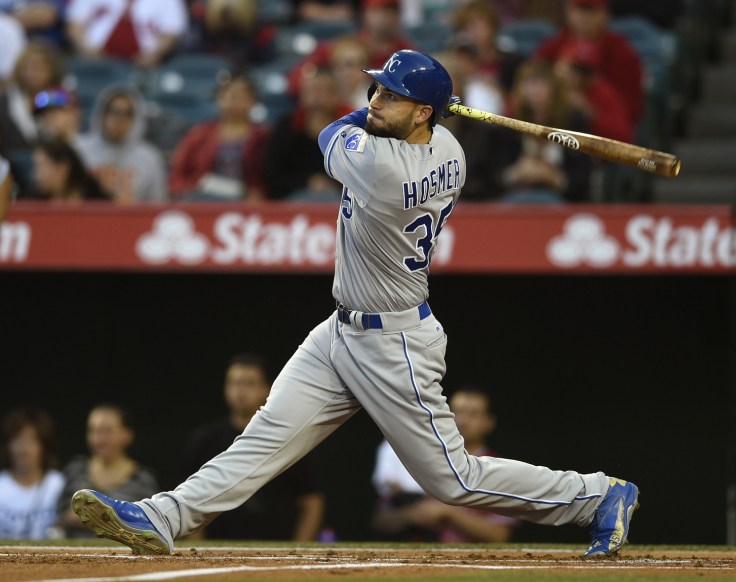
Eric Hosmer-.299/.355/.476, 13 HR, 49 RBI, 116 OPS+, 1.5 bWAR

MLB: Chicago White Sox at Kansas City Royals
(Credit: John Rieger-USA TODAY)

Best Pitcher

Danny Duffy-81.2 IP, 3.09 ERA, 145 ERA+, 3.43 FIP, 1.065 WHIP, 5.53 SO/W

MLB: JUN 13 Indians at Royals
(Photo by William Purnell/Icon Sportswire)

Rookie of the Year

Whit Merrifield-.290/.315/.409, 46 games, 18 extra base hits, 89 OPS+, 1.2 bWAR

MLB: Detroit Tigers at Kansas City Royals
(Credit: John Rieger-USA TODAY)

Comeback Player of the Year

Ian Kennedy-99.2 IP, 3.97 ERA, 113 ERA+, 1.194 WHIP, 3.12 SO/W, 1.4 WAR

kc6

Best Impersonation of a Batting Practice Pitcher

Chris Young

kc7

Best Salvy Splash

Lorenzo Cain and Mike Moustakas

kc8

Best Surprise Splash

Drew Butera on Salvador Perez

MLB: Detroit Tigers at Kansas City Royals
(Credit: Denny Medley-USA TODAY)

Best Rookie Splash

Cheslor Cuthbert

kc9

Worst Splash

Drew Butera

kc10

Best Catch

Lorenzo Cain

kc11

Best Catch, Take 2

Alcides Escobar

kc13

Best Walk-Off

May 28th-8-7 Win over the White Sox

kc14

Best Walk-Off, Take 2

May 15-4-2 Win over Atlanta

kc15

Best Hair, Player

Brett Eibner

kc16

Best Hair, Coach

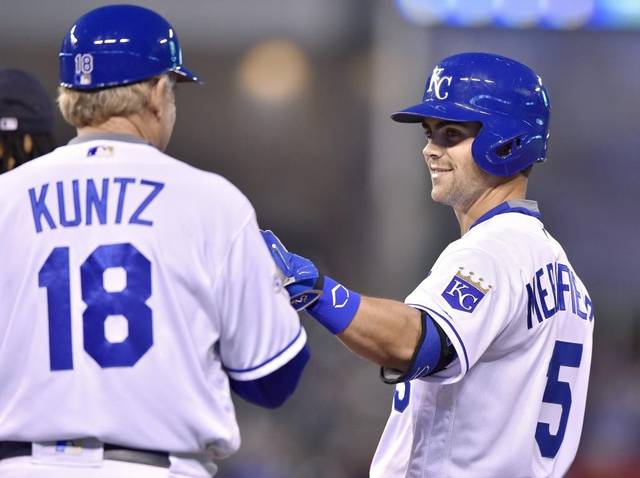
Rusty Kuntz

kc17

Best Hair Flip

Drew Butera

kc18

Best Forehead

Edinson Volquez

kc19

Best Impersonation of a Punching Bag

Yordano Ventura

kc20

In Memoriam

Omar Infante

MLB: New York Mets at Kansas City Royals
(Credit: Denny Medley-USA TODAY)

It’s been a good first half. Here’s to even more memories in the second half of the season…and a return trip to October!


In Due Time:A First Half Look At The Royals

kccelebrate

When contemplating on just one word to describe the Kansas City Royals first half of the 2016 season, a number of words flooded my brain: struggle, streaky, battle, fluky and frustration all seemed fitting. But the one word that seems to fit more than any other is ‘adversity’, a word that has fit like a glove since before the season even started. Whether it has been the struggles of the starting rotation or the streaky offense, the Royals have not had the smooth sailing they were witness to for a large chunk of the 2015 season. Probably the biggest roadblock in front of them this season has been the litany of injuries that have occurred.

kc2

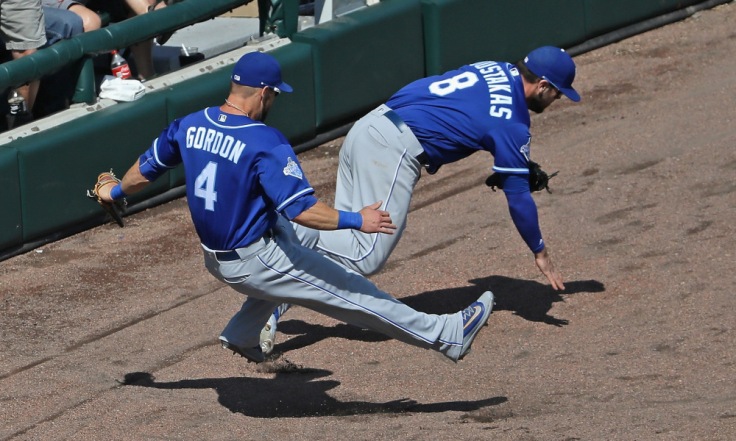
The walking wounded actually began back in Spring Training, as Jarrod Dyson, who was in line to see a big increase in playing time in right field, came down with a strained oblique. In May, starters Kris Medlen and Chris Young would both venture to the disabled list, after struggling through their previous few starts. Late in May, Alex Gordon and Mike Moustakas would collide chasing a foul ball  in Chicago and the news was grim; Gordon would miss a month with a wrist injury while Moustakas would have a torn ACL and was expected to miss the rest of the season. A week after that collision, catcher Salvador Perez would incur a quad contusion after third baseman Cheslor Cuthbert would run into Salvy while chasing a pop fly. Luckily, Perez would sit out for a week but not have to make an appearance on the disabled list. The injury bug would return in June, with outfielder Brett Eibner(after only being recalled a few days earlier) going on the DL on June 1st with a left ankle sprain, returning after two weeks. Lorenzo Cain would make his first DL appearance in two years, pulling up lame and grabbing his hamstring after running out a ground ball just a few weeks ago. To cap it all off, closer Wade Davis, a man who some of us believe is actually a machine, would deal with a forearm strain and land on the DL with Cain just this past week. If you are taking notes at home, that is four Royals All-Stars that have seen time on the DL so far this season and that is just through 88 games. One of the biggest strengths for Kansas City the last two years was their health, as they were able to make two big playoff runs while dealing with very limited injuries to their main nucleus. The pendulum always swings back around and it appears the Royals dance with lady luck has ended on the injury front.

kc3

Speaking of turbulence, the Royals starting pitching has been more than just rocky so far in 2016. Kansas City starting pitching is next to last in innings pitched, 3rd highest in walks per 9, 1st in home runs per 9, 4th highest ERA, highest FIP, and lowest WAR in the American League. The only area where the starting pitching is moderately succeeding is strikeouts per 9, which is the 3rd highest in the league. With these numbers it is easy to see why the Royals have struggled and are currently looking for upgrades on the trade market. Chris Young, who was a vital part of the Royals playoff run last year, has allowed the most home runs in the American League(26 in only 56 innings pitched) and has been banished to the bullpen. Ian Kennedy has been about what was expected from him; at times he has looked phenomenal and has shut down other teams, while others he has been a victim of the long-ball, allowing the second most home runs in the AL( 21). Yordano Ventura has not looked like the ace that he could be capable of, as he has struggled(including inciting a melee in Baltimore) and others he has put together some very quality starts(like just this past Friday). Edinson Volquez hasn’t been as consistent as he was in 2015, yo-yoing from start to start. The one shining light has been the re-emergence of Danny Duffy, who has looked like a pitcher who has figured something out. Duffy started the year in the  bullpen but was moved to the rotation in May and has been splendid ever since. He has thrown 81 innings to this point, striking out over 10 batters per 9, walking less than 2 per 9 and stranding runners at an 83% clip. Duffy’s numbers just jump out on the page: highest K-BB% in a Royals uniform, highest soft hit % of his career, and the fastest average fastball velocity of his career. If the Royals can get some more consistency from Volquez and Ventura, while picking up a cheap arm in a trade, they might be able to stabilize the rotation and improve on numbers that shouldn’t be hard to improve upon.

kc4

While the starting pitching has been a major trouble area, the offense has been very bi-polar. Much like the last few years, the Kansas City offense is a very streaky bunch. As a team they are next to last in runs, last in RBI’s, home runs, walk %, isolated power, and 12th in wRC+. Most other offensive categories the Royals are around the middle of the pack, but the Royals also get their runs in a different manner than most other American League teams. Eric Hosmer has turned in a season worthy of his All-Star starting nod, hitting .299/.355/.476 with 13 home runs and 49 RBI’s. Salvador Perez has seen an increase in power this season and has turned into a serious threat in the middle of the lineup(writers note: he even hit a home run right after I typed this). Paulo Orlando has been a pleasant surprise this year, hitting .324/.347/.417, sacrificing some of the power we saw from him last year for a better on base percentage. Lorenzo Cain struggled in April, but came on like wildfire in May and was putting up good numbers before his injury this month. Kendrys Morales struggled through the first two months of the season, but looked like a completely different hitter in June, a month where he put up video game numbers. Even Mike Moustakas was putting up great power numbers before his injury in May. But the real surprise of the offense has been the call-ups Kansas City has been using to fill the holes for injured players.
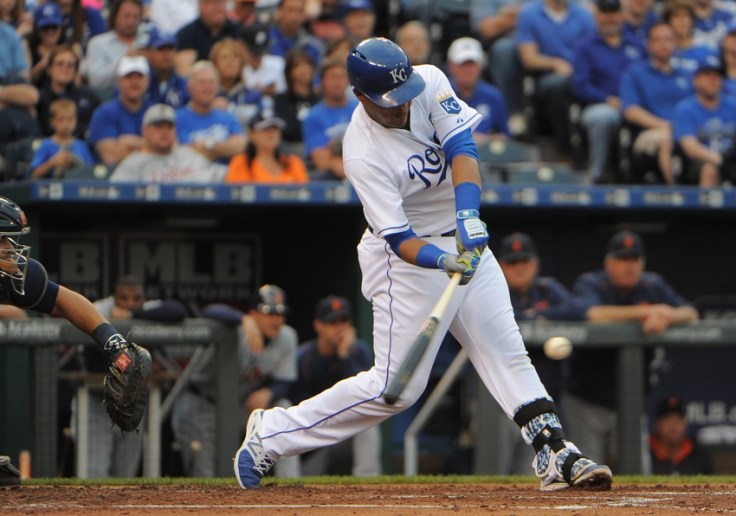
MLB: Houston Astros at Kansas City Royals
(Credit: John Rieger-USA TODAY)

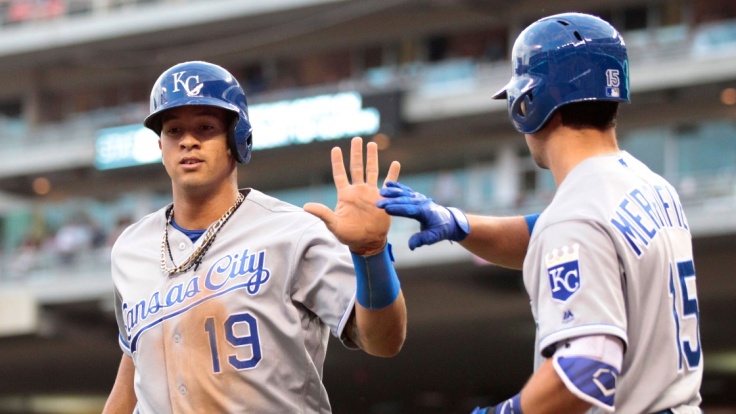
The great thing about this Royals team is not only the depth that they have compared to years past, but the amount of production we have seen from players that were not expected to contribute. Whit Merrifield has been a life-changer for Kansas City, posting a line of .291/.313/.407 with 1.4 bWar in just 46 games. Whit was originally supposed to fill the super utility role for Kansas City, but instead ended up taking the second base job from the now released Omar Infante. Cheslor Cuthbert, who saw some time in Kansas City last year, was recalled to take over at third base for Moustakas and struggled a bit the first few weeks of seeing regular playing time. Since May 27(right around the Moose injury), Cuthbert is hitting .293/.331/.471 with 7 home runs, 22 RBI’s and a BAbip of .343. Defensively, he is not quite the glovesman that Moustakas is, but he has proved to be more than capable, with an UZR of 6.2 and making 83% of plays that are considered unlikely(which are considered normally to be made 10-40% of the time). The man who has seen the least amount of time out of this group is Brett Eibner, as he has only played in 18 games. Eibner has been productive in that span, hitting .269/.333/.500 with a BAbip of .343 and a wRC+ of 116. Eibner has 8 extra base hits in his 18 games and is a bat that can supply the power the Royals heavily covet. All three players have stepped in when the Royals have needed them to and have produced in many a tight situation. It wasn’t expected for these three to be heavy contributors, but so far in 2016 they have probably helped this team stay in the pennant race.

kc6

While this Royals team isn’t gliding into a postseason berth like they did last year, they are still very much in contention, even being 7 games out in the American League Central but only 4 1/2 games out of a wild card spot. The hope is that the Royals can stabilize the rotation while hitting a bit more consistently, which should increase their chances of a playoff spot. Injuries have hurt Kansas City so far this year but they haven’t crippled them and that has allowed them to stay in the race. We have seen over the last couple seasons that this is a team that strives on adversity. If that stays true to form, then we should be seeing a stellar second half from our ‘Boys in Blue’.


Wader, Disabled List Please

kc1

Over the last couple years there has been one aspect of the Kansas City Royals success that has made me nervous. That one thing was how the team dealt with very few major injuries, as for the most part the key parts of the roster were kept healthy and on the field. 2016 has felt a bit like the back payment for that good luck is being paid up. In May, All-Stars Alex Gordon and Mike Moustakas collided in foul territory chasing a foul ball, leaving Alex out for about a month and losing Moose for the rest of the season. Just last week Lorenzo Cain was bitten by the injury bug, going down to a hamstring injury that will leave him out until the Royals return from the All-Star break. Even catcher Salvador Perez missed a week of action due to injury, but luckily avoided the disabled list. It appears the Royals All-Stars are falling off one by one and that was added to today when closer Wade Davis, he of the bionic arm, was placed on the 15-day DL with a forearm strain.

kc2

The first thing to pop in most people’s heads when mentioning a forearm injury is a ligament injury in the elbow, which Royals management is saying is not the case with Davis:

The strain, Yost said, was located on the top of the forearm, and not a flexor-pronator strain, the ailment commonly associated with ligament damage in the elbow. Yost said the injury was similar to one that forced starter Chris Young to the disabled list earlier this season.

Alright, well that doesn’t sound bad at all. In fact, it appears as if the Royals are trying to nip the strain in the bud before it gets any worse. Davis had first felt the strain last week in St. Louis, and he also had a similar injury last September. Last year he was shut down for about a week and was all good to go for the playoffs. Sounds like Kansas City is hoping for more of the same this year.
MLB: Kansas City Royals at Houston Astros

(Credit: Thomas B. Shea-USA TODAY)

With the injury to Davis, I was curious to see if his velocity had seen a decrease recently and if so, if  it was noticeable. This first chart shows his velocity on his pitches all year and there really isn’t a noticeable change:

Brooksbaseball-Chart

There is a very slight decrease in Davis’ cutter, but outside of that everything has been moving in an upward direction, even just slightly. There was also a slight change when it comes to whether Wade was facing a right-handed or left-handed batter:

Brooksbaseball-Chart (1)

The decrease to righties was very slight, about 1 MPH difference, so nothing major to worry about. There was a slight difference from outing to outing, which is almost to be expected with an injury like this:

Wade had said he felt tightness during his June 30th outing against St. Louis, which would be the 94.7 MPH velocity you see above. The Royals seem like they are concerned but we aren’t seeing the big drop in velocity like we saw last year in Greg Holland, where he was down in the high to mid 80 MPH range, so there isn’t a reason to get too worried yet. The real test will be on whether Davis feels better in a week or if the tightness is still there. Most likely he will play catch for now and the team will get feedback from him on how he is feeling. In other words, it literally is a feeling out process for Wade and the Royals.

kc4

So who will fill the closer role from Davis while he is away? For the time being, it appears to be a match-up role:

If I had to guess, Kelvin Herrera will get first shot, since he has been a dominating force for most of this year. I also wouldn’t be surprised to see Joakim Soria get a save opportunity during his absence, as Yost likes his past success as a closer. I know some fans have soured on Soria, but he has been more than solid for the most part this season. Hell, I could even see Luke Hochevar getting an opportunity to close out the game if he looks like a good option. The good news for the Royals is that the team is loaded in the pen with solid arms, as it might be the deepest part of the team.

kc5

If there was a word to describe this 2016 season for the Royals, it would be ‘adversity’. This team has been dealt one crushing injury blow after another and yet are still a contender in the American League. Luckily, it sounds like everyone involved feels good about Davis’ chances of being back in the fold by next weekend:

For the most part this looks to be just a minor bump in the road that Kansas City is just being cautious about. I would worry more if there was a major decrease in velocity, or this was a ligament instead of a muscle. Instead, we are looking at a nice little dose of ‘R & R’ for the cyborg before he returns to give hitters fits of hopelessness. This is just one more struggle for this team to overcome if they want to return to October baseball….and if there was one team to handle adversity, well…

Salvy Power

kc1

Salvador Perez holds many roles for the Kansas City Royals; clubhouse leader, Lorenzo Cain’s BFF, backup broadcaster, leader of the pitching staff and middle of the order power threat. In 2015, Perez would hit 21 home runs, a new high for a Kansas City catcher. Despite this career high, Salvy’s other numbers weren’t as impressive. Walk rate was the lowest of his career. Strike out rate was the highest it had ever been. Hard hit rate was the lowest it had been since his rookie campaign. Line drive rate was one of the lowest of his career. Most importantly, his wRC+(which weighs runs per plate appearance while being park and league adjusted) was the lowest of his career, at 87(league average is 100). It really appeared as if Perez’s numbers were already starting to skew downwards, which was not good for a player coming into his age 26 season. Most Royals fans are well aware of Salvy’s lack of patience at the plate and most don’t expect him to walk much, but would prefer he became a bit more selective at the plate. All this information makes it even more impressive when discussing what Perez has done so far in 2016.

kc2

Over the last month Perez has been the hottest hitting Royal, putting up a line of .411/.436/.689 with 6 home runs, 14 RBI’s and an OPS of 1.125. Perez, a notorious free-swinger, is still swinging at a lot of pitches(in fact he is pretty much on par with his totals for the last two seasons), but there is a slight change in his approach. Last year, Perez was making contact with pitches outside the strike zone about 73% of the time; so far this year he is at 62%. Meanwhile, pitches inside the strike zone he is actually making a bit more contact, up to 91.4% from 90.7%. This tells me that he is laying off the pitches outside the strike zone a bit more this year while focusing more of his attention on pitches within the meat of the plate. The funny part to all of this is that Salvy’s strikeout rate is up by quite a bit(22%, up from 14% last year) while his contact rate is also down, to 78% from last year’s 83%. You would think that a guy who is making less contact would not see his numbers go up, but they have. In fact, Salvy has been a beast in the power department so far this year.
kc3

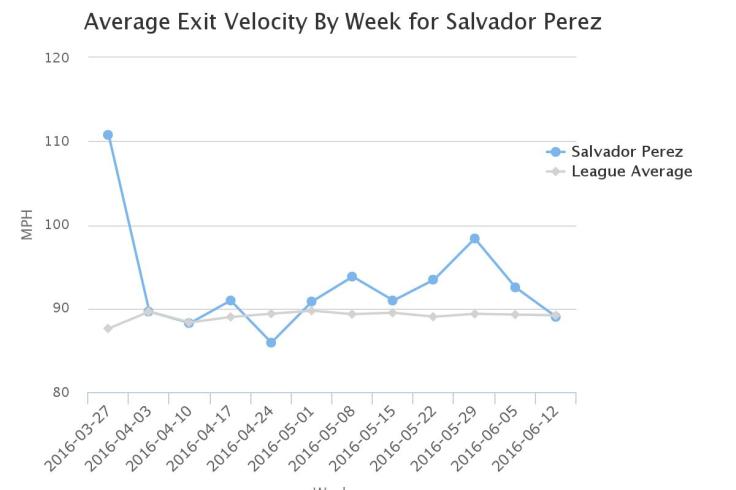
The power numbers are where Perez is really stepping up his game. His hard hit rate is significantly up this year, 36% from last year’s 24%, and his fly ball rate has also soared, 48.8% from 37.4%. Of course because of this, Perez has a higher home run to fly ball ratio(14.3%) and a lower ground ball rate(26.7% from last year’s 41.9%). To me this all screams of someone driving the ball much more and realizing he can do more damage on pitches closer to the middle of the plate. This is even more evident when looking at Salvy’s exit velocity:

chart

As you can tell, outside of a brief dip the week of April 24th, Perez has been not only above league average, but even close to averaging 100MPH on hit balls for a few weeks. Now, while his approach with pitches outside the zone has changed, he is still a very pull-heavy hitter, as he is pulling the ball the most he has since 2014. Slugging, On Base Plus Slugging, Isolated Power and Weighted on Base Average have all gone way up so far in 2016. Hell, Salvy’s BAbip over the last month is a ridiculous .508! These numbers speak of a player on track for a career year.

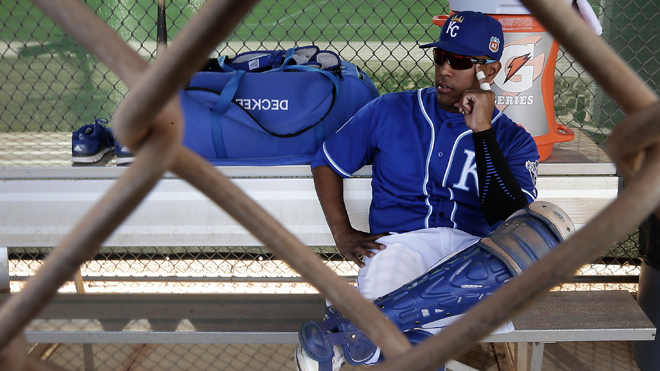
Salvador Perez
(AP Photo/Charlie Riedel)

Speaking of career highs, at his current rate, Perez is on track to have career highs in doubles, home runs, RBI’s, batting average, on base percentage, slugging and with a little luck, possibly even WAR. He also already has 11 walks this year, only 6 behind last year’s total. His career high for free passes is 24, which I’m not quite ready to say he could topple, although if he keeps hitting like this he will surely see his intentional walks go up. I know there was an increased effort this year for Perez to be more patient at the plate. To me, being more patient at the plate doesn’t always mean more walks as much as waiting for a good pitch to hit and drive. I’ve long felt that Royals hitting coach Dale Sveum has been teaching these guys to look for a pitch to drive and because of that we have seen higher power numbers from Lorenzo Cain, Eric Hosmer and Mike Moustakas. I’m starting to think the same philosophy is being soaked up from Salvy and it is paying off in spades.

kc5

So do I believe he will be able to keep this up all season? Perez is a very streaky hitter and I would assume at some point we are going to start seeing a lull in his numbers. That being said, I think even with that he can still keep himself with numbers higher than what he accumulated last year. Is he going to hit .300 all year? Probably not, but the power numbers could be here to stay. The bigger concern for Kansas City is to keep Perez rested and make sure they are not over-working him behind the plate. The Royals have a solid backup receiver in Drew Butera and with Kendrys Morales slumping much of this season, it seems like a solid idea to give Salvy’s knees a rest and start him at DH occasionally. More than anything, Kansas City needs Salvy to stay healthy the rest of the year for them to stay in contention in the American League Central. Perez has long been regarded as one of the top defensive catchers in the game and rightfully so; but now, outside of a Jonathan Lucroy or Buster Posey, he is making the case as one of the best all-around catchers, period. Perez is as special as they get and I really hope Kansas City fans are savoring what they have with him. If he keeps this up, the hardware won’t be stopping anytime soon.


Whit is a Hit

kc1

Baseball might just be the best sport when it comes to stories that grab us and give us the belief that if you try hard enough anything can happen. You’ve heard the stories before; the player who toils in the minors for years on end before finally getting their shot at the ‘Big Show'(not the wrestler; that is a whole other article) while producing at such a high level that was never thought possible. Many Kansas City Royals fans remember Mike Aviles, who stormed on the scene in 2008 and ended up finishing 4th that year in the American League Rookie of the Year vote. Aviles has never quite reached those same heights since then, but he has turned it into a successful baseball career as a backup utility player. Eight years later, it looks like Whit Merrifield is looking to improve on what Aviles did all those years ago.

MLB: Game two-Boston Red Sox at Kansas City Royals
(Credit: Denny Medley-USA TODAY)

This is not only a great feel good story, but I could almost say I foreshadowed part of this with my article about Whit during Spring Training. The funny part is during the spring, Whit was mainly just thought of as a backup, someone who could fill in anywhere on the field and would be used as more of an insurance piece than an actual part of the lineup. There was a belief by some that Whit had earned a spot on the roster when the team broke camp, but unfortunately he was sent back to Omaha to start the year in AAA. Luckily, there is always a need for a guy who can play 3/4 of the position’s on the field and Merrifield got the call to the majors on May 18th. The initial thought was that Whit would be a backup infielder mostly, as he took the roster spot of infielder Christian Colon. But the stars must have been aligned for Merrifield, as four days later Alex Gordon and Mike Moustakas collided in foul territory during a game against the White Sox, eventually leading to both being placed on the disabled list. Between the Royals injuries piling up and Omar Infante’s disappearing act(62 OPS+ so far this year, which is actually an improvement over 2015) led to more playing time for Whit. Boy, has he taken advantage of it!

kc3

So far in 22 games, Merrifield has played second base, third base and left field, with manager Ned Yost saying recently that he would see the majority of his time at second base, unofficially supplanting Infante from the starting job. The solid defense at second isn’t a big shocker(the most errors in one season at 2B in the minors has been 5, if you are into that sort of thing. He also has 3 defensive runs saved already for Kansas City) but the bat has been a bit of a surprise. So far this year he is hitting .330/.344/.484with a wRC+(weighted runs created, basically accumulating all offensive production and is park adjusted) of 123 and 0.8 fWAR. I think we all tend to think that some of this is sustainable and some of it will regulate itself. But which stats should we believe in when it comes to Merrifield, and which should we hold off on?

kc4

Let’s start with the average and on base percentage. I think both of those should still hold up fairly well, although I can’t imagine Whit would hit in the .330 range all year long. If you look at his line during his seven seasons in the minors, he hit .274/.334/.399. The batting average and on base are very respectable numbers and I would tend to lean toward those being about what Kansas City should expect from him. The slugging percentage is down from what he is producing right now, but Whit has never been known for his power numbers. Merrifield has only hit 40 career minor league homers, which is slightly less than 6 a season if you average it out. But while he probably won’t give you many long balls, he might just rack up a nice amount of doubles. Whit has hit 161 career doubles during his time in the minors, averaging about 23 a year. But only going back to 2014, he put together a 41 double season, which is very impressive. Kauffman Stadium could elevate his amount of doubles hit, if he is able to take advantage of the gaps in the huge outfield at ‘The K’.

kc5

Merrifield also currently has a .412 batting average on balls in play. This just seems highly implausible to sustain, as there would have to be a certain amount of luck involved. This could also change if he starts making more contact, although an 84% contact rate isn’t too bad. The 19 strikeouts worries me a bit, since that almost equals one per game, but the more time he spends in the majors the more likely he is to lower that, especially if Dale Sveum gets ahold of him. You can also chalk up 3 stolen bases so far, which I like. I can see many a hit and run used when Whit is on base and he actually does have decent speed(just for note, he did pile on 32 stolen bases last year during his time in Omaha). Whit has looked like a good fit at the top of the Royals lineup, giving them a guy who can get on base and also supply some speed to go with it.

kc6

One more item I want to look at with Whit; exit velocity. Merrifield started out hot for the Royals upon his promotion and they also seemed to catch him at a good time, as he was smoking the ball early on:

chart

It’s obvious to see the drop, falling from above the 94 MPH line to below league average this past week. I tend to think he would average himself out, where on average his exit velocity would be sitting in 90-92 MPH range. Merrifield has a very nice, compact swing with very little movement which I think helps him make solid contact on a regular basis. This will be something to follow over the next few weeks, as he continues to see regular playing time and gets more comfortable at the big league level.

kc7

The comparisons have been flying when it comes to Merrifield and most of them feel fairly accurate. I’ve seen the Willie Bloomquist comp, which I tend to think might be the closest comparison you can make with Whit. Ryan Lefebvre mentioned over the weekend that at the plate he looked a lot like former Rangers infielder Michael Young, and I totally see that when he is batting. I’ve often referred to him as a “Poor Man’s Ben Zobrist”, mainly for his ability to play all over the diamond but apparently I wasn’t too far off; when he was scouted back in college, scouts wrote Zobrist’s name in the report as a similar player. No matter the comparison, what you can say for a fact is that Merrifield has looked like a million bucks so far in Kansas City and it’s hard not to root for the guy who made his big league debut at 27 years old. Logic tells us that there will be a regression on Whit’s part but it’s hard not to think ‘what if?’ when it comes to him keeping up this pace. Even if Whit ends up being the next Mike Aviles or has a career like Willie Bloomquist, is that such a bad thing? Both have ended up with long careers and have contributed as steady backups. But that is possibly the worst case scenario. The best case scenario is that Merrifield becomes a super utility starter that floats around for the team wherever is needed. Either scenario is a respectable one for a guy who has fought hard to get to this point. It has taken Merrifield seven years to get to the majors and by the way he is playing he doesn’t want to go back anytime soon. He might not be the ‘Royals Offensive Savior’ that he is playing like now but he is a guy who should be able to hold down a major league roster spot. Now doesn’t seem like the right time to bet against Whit Merrifield. All he will do is prove everyone wrong.

Opportunity Knocks

GTY 533514782 S SPO BBO BBA USA IL
(Photo by Jonathan Daniel/Getty Images)

This past Sunday, Kansas City Royals left fielder Alex Gordon and third baseman Mike Moustakas collided in foul territory chasing after a fly ball. The collision looked nasty for both parties, with it seemingly being worse on Gordon, as he seemed to bang his head on the back of the tarp lined against the stands. Gordon was taken out of the game in the following inning and the news for him dropped on Monday:

The initial diagnosis was that Gordon would miss about 3-4 weeks , which would mean Gordon will probably be back in late June:

Moustakas meanwhile was considered “day to day”(but aren’t we all) by the club with a contusion to his knee. Moose had sat out the entire three game series in Minnesota this week and went in for more tests on Thursday. The news was not positive:

A torn ACL is bad news, as it means Moustakas will be out for the remainder of the 2016 season, a season that saw his power numbers soar. With the Royals losing two All-Stars for a significant amount of time, this means that someone will have to attempt to fill their shoes. It appears for the moment that Cheslor Cuthbert and Brett Eibner will get that opportunity.

kc2

This is not Cuthbert’s first rodeo with the Royals, as he spent a bit of time with Kansas City last year while also working on his second stint so far this year. Last year Cuthbert produced a line of .217/.280/.370 in the big leagues with 1 homer, 8 RBI’s and an OPS+ of 75 in just 19 games. So far this year in 15 games, Cuthbert has a line of .237/.250/.339 1 home run, 3 RBI’s and an OPS+ of 60. Obviously both years have been just a small sample size for Cheslor, but in that time he has shown an ability to get on base and has played slightly above average defense at third base. Cuthbert got off to a hot start down in Omaha this year and while he got off to a quick start his first few games in Kansas City (.286/.310/.464 in his first seven games), he has tapered off just a bit over the last eight games. I don’t believe Cuthbert will produce the kind of power Moustakas was producing early this year, but he does have a little pop in his bat and is more than adequate on defense. Now that Cheslor knows he will probably be seeing regular playing time for the Royals(and I’m sure the occasional Whit Merrifield start sprinkled in there as well), it will be interesting to see if he relaxes a bit and embraces the playing time he will be receiving the rest of this season.

21127002726_152aa0a735_z
Credit: Minda Haas Kuhlmann

Then there is Eibner, just recalled earlier today. Eibner has been an intriguing prospect for Kansas City, a former second round draft pick back in 2010. Eibner put together a strong 2015 campaign for the Royals AAA team in Omaha(.303/.364/.514 with 19 homers, 81 RBI’s and 200 total bases) and was looking to do the same early in 2016(.309/.411/.537 with 10 homers, 28 RBI’s and 80 total bases in just 41 games). Now what Eibner brings to the mix is not only a solid bat and solid glove, but also a little bit of speed. Many have felt Eibner should have been given a shot at playing a bit in right field last year in Kansas City and his name was even thrown around a bit this year. I wouldn’t be surprised to see him get regular playing time on the corners in the outfield while Gordon is out, with some mix of Paulo Orlando and Jarrod Dyson in right,  while Eibner and Merrifield patrol left. You hear a lot about players just wanting a chance to prove themselves and Eibner looks to be getting his now.

kc3

I know many will view Gordon and Moustakas’ injuries as a negative(and trust me, it is) but there is also a positive to them missing time. The positive is that the Royals will now get a chance to view Cuthbert, Eibner and Merrifield on a semi-regular basis and assess just how they help the team moving forward. Obviously how they play will determine how much we see of them this season but if any of them produce on a consistent basis, that might help their spot in the organization in future years. Merrifield’s versatility is a big bonus for this Royals team and probably has the best chance of sticking but both Cuthbert and Eibner could increase their value this year. With Moustakas becoming a free agent after the 2017 season and right field not fully secured, both could work their way into a spot on the team. You hear a lot spoken from teams about “grabbing the brass ring” and “play well to force their hand”, and all three players have a chance to do just that moving forward. They might not be future All-Stars or middle of the lineup producers, but your entire team is not made up of MVP caliber players. Sometimes you just need a steady hand that a manager knows he can rely on.

kc4

Opportunity is a beautiful thing, as it can spread surprise and unlock production in an unlikely way. Losing Gordon for a month and Moose for the rest of the year are big blows to a team that is hoping to contend again this year, but it’s not always the end of the world. The Royals have been a lucky team these last few years as they have not had to deal with very many major injuries to their key players. The true mettle of a team can be measured by how they react to adversity and things are as adverse as they have been in Kansas City in awhile. Eibner, Merrifield and Cuthbert have an opportunity before them that most did not expect when the season began. Moving forward, it will be interesting to see if any of them step up and lock themselves into a regular spot on the roster. To be continued…


Tapped Potential

kc1

Back in May of 2011, Eric Hosmer made his major league debut for the Kansas City Royals with expectations soaring through the roof. The world was his oyster and the belief was that Hosmer had the potential to be a future middle of the order run producer and possibly even future MVP candidate. Unfortunately, life and baseball don’t normally follow a movie script. Hosmer would struggle mightily in 2012 and would be up and down offensively from 2013 to 2015. Defensively he would accumulate a few Gold Gloves at first base and would be a big part of two Royals World Series teams. He had built up a nice career but maybe not the one everyone was hoping for. Luckily, sometimes it just takes a bit of time for a baseball player to figure things out, which is what has happened for Eric Hosmer in 2016.

kc2

To this point in the new campaign, Hosmer has looked like the offensive force most of us expected upon his arrival. This year he is batting .311/.367/.522 with 8 home runs, 21 RBI’s and an OPS+ of 140 (or a wRC+of 145 if you prefer that). He has already racked up 1.1 bWAR and has become a complete player. The lone knock on Hos had been a lack of power, or more to the point that he seemed to prefer an opposite field approach to driving a ball for power. Now, I am a proponent of hitting the ball to all fields, which Hosmer is still doing(30% of his hits to left, 30 to center and 38.9 to right) but there is also a time for driving the ball, especially with good pitch recognition. Hosmer has so far racked up 17 extra base hits out of his 50 hits, or 34% of the time. His ground ball percentage is up(58 from 52 last year) but his fly ball percentage is up as well(26 to 24). Add in an ISO of .211(up from .162 last year) and you have the making of a guy more fitted to hit in the middle of the order. So what do the numbers tell us?

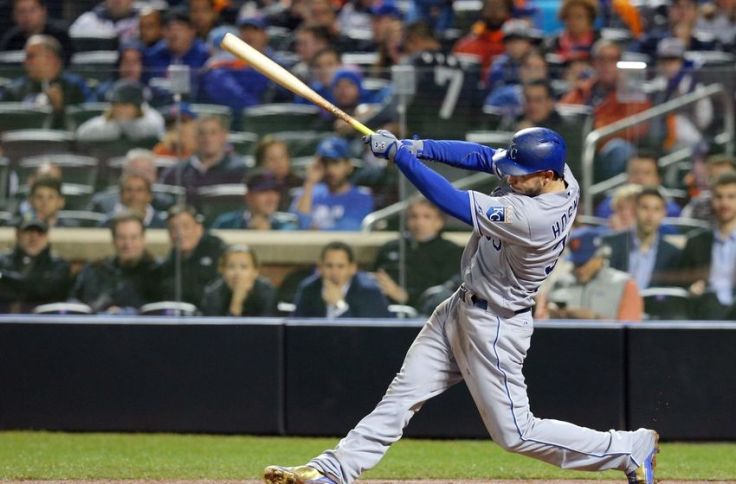
MLB: World Series-Kansas City Royals at New York Mets
(Credit: Brad Penner-USA TODAY)

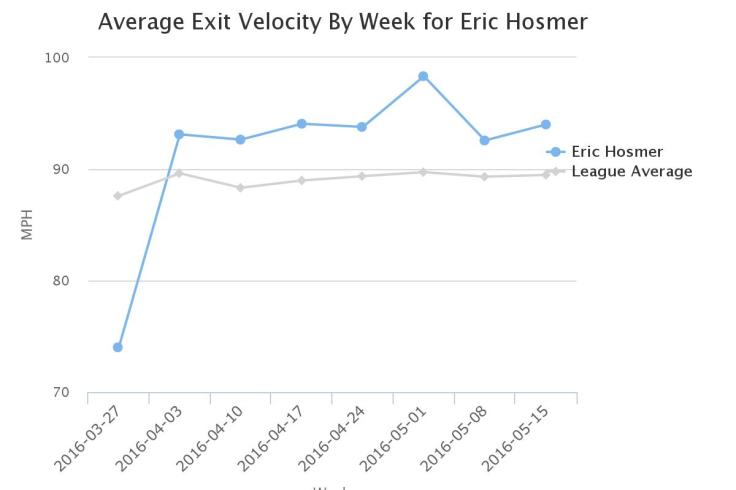
What it tells me is that Hosmer’s main approach (which has always been to hit according to the situation) hasn’t drastically changed, but his ability to lift the ball has improved. Hosmer’s hard hit percentage this year is up, 35 from last year’s 32.9 and his HR/FB percentage is way up, 23 to 15. Obviously there is a smaller sample size at this point in the season compared to 2015 but even a slight dip should keep his numbers above what he did last year. What is most impressive is the increase in Hosmer’s exit velocity this year. Not only has his exit velocity gone up but it has progressively gone up:

chart

Hosmer has an average exit velocity this year of 93.5 mph, compared to 90.4 mph in 2015. Many of his home runs have not been ‘barely shots’, as he has had some massive bombs this year like last week against Boston. It shows that Hosmer has been taking advantage of pitchers mistakes, something he wasn’t doing earlier in his career. The fact that he is but 26 years old really makes one wonder what he will be able to do when he actually enters the prime of his career.

kc4

There is no way to tell whether or not Hosmer will be able to keep up this pace, especially since over his career he has been an extremely streaky hitter. Just looking at 2015, by month Hosmer had slugging percentage’s of .488, .520, .322, .577, .434, and .410. There is an over.250 percent difference between his best and worst month. For as steady and consistent as he has been this year, Hosmer has a history of going from the top of the mountain to the depths of the basement. The hope this year is that Hosmer has started figuring things out and won’t fall to the inconsistentcy of his earlier years. It’s just two months(yes, small sample size; take a drink) but so far this year he has slugged .506 and .542. Time will tell but his numbers are definitely potruding in the correct direction.

kc5

The Royals count on Eric Hosmer for a number of items-clubhouse leadership, popular hairstyles, steady, Gold Glove award winning defense(even if the defensive metrics don’t always agree) and a run producing bat in the middle of their batting order. Over the years he hasn’t always lived up to that last one but this year he has been the rock in the middle of a questionable Royals offense. Hosmer will be a free agent after the 2017 season and he looks primed to cash in when the time comes. There is no way to tell if that means a longer stay in Kansas City or elsewhere, but he has picked an excellent time to improve on his value. He has taken that power potential and made it a reality, a consistency long-needed in Kansas City. Earlier in the year I thought Steve Balboni might have his single season home run mark(36) threatened by Mike Moustakas; now I’m wondering if maybe ‘Bye Bye’ Balboni should worry about both Moose and Hos. For Royals fans, this is a good problem to have.

Dayton’s Farm


26612532492_ece8547543_z
Credit: Minda Haas Kuhlmann

From about 2009 on, I have regularly followed the Kansas City Royals minor  league teams to keep track of the development of the prospects throughout the Royals farm system. Initially it was done to get a glimpse into brighter days, as the big league club was struggling and the likes of Eric Hosmer, Mike Moustakas and Salvador Perez were all being touted as the future of the organization. Luckily, I enjoyed keeping track of the future big league stars in the minors and have continued following the development of the Royals prospects. So while the Royals are now the World Champions of baseball, their farm system is still chugging away with a number of players who will end up contributing to the big league club. Today, let’s look at some of the players who are putting up good numbers down on the farm.

26352810231_638e25c96f_z
Credit: Minda Haas Kuhlmann

Let’s begin with the Royals AAA team, the Omaha Storm Chasers. The Chasers are about 21 games into the new season and have gotten some solid hitting from their lineup in the first few weeks of the 2016 campaign. Jorge Bonifacio has been the big bopper so far, as he is currently riding a 10-game hitting streak into Saturday’s game. Bonifacio, the brother of former Royal Emilio Bonifacio, has been hitting at a .333/.341/.571 clip with 4 home runs, 17 RBI’s and 48 total bases. Bonifacio has had some competition though, as Cheslor Cuthbert has been tearing it up as well, hitting .325/.393/.584 with 5 home runs, 23 RBI’s and 45 total bases. But it hasn’t just been the hitters stealing the show for the Chasers so far this year, as Brooks Pounders is 2-0 in his first 4 starts, with an ERA of 2.25 and a WHIP of 1.20 to lead the Chasers pitching staff.

kc3

Meanwhile, let’s mosey on over to the Royals AA affiliate, the Northwest Arkansas Naturals. The name on most people’s lips on this team is Raul Mondesi Jr, who is one of the Royals top prospects. While Mondesi has shown some decent power this year for really the first time in his career( 4 home runs so far, 8 total extra base hits), the early staple of the Naturals lineup has been former #1 Draft Pick Hunter Dozier. Dozier is hitting .299/.405/.627 with 5 homers, 14 RBI’s and 42 total bases. On the pitching side, the team has been bolstered by two guys I have talked about before, Alec Mills and Matt Strahm. Both have 4 starts under their belt so far this year, ERA’s under 2.00 and WHIP’s under 1.00 while striking out a combined 41 batters over 45 innings. I still think their future is tied to the bullpen, but so far they have been the horses of the Naturals’ rotation.

kc4

The final stop on this Royals minor league tour is Kansas City’s High A ball affiliate, the Wilmington Blue Rocks. A player who has been steadily rising on the Royals prospect board is first baseman Ryan O’Hearn. O’Hearn has been a ‘One Man Wrecking Machine’ in Wilmington, putting up a line of .366/.424/.707 with 7 home runs, 18 RBI’s and 58 total bases in just 21 games. On the pitching side, the Blue Rocks have been led by Pedro Fernandez, a fireballing righty who has been almost unhittable so far this year. Fernandez has struck out 23 over 22 innings so far this year, posting a 1.21 ERA and a WHIP just a hair over 1.00(1.03). These two players are the best prospects in Wilmington at the moment and I would have to think will be in AA before the year is up.

kc5

So a quick trip through the Royals farm system shows a number of prospects are putting up stellar numbers in the early going of 2016. It’s still too early to tell just how many of these players will end up helping the Royals, although one would think at least a few will see time in Kansas City before the season is over. What this shows is that while the Royals are one of the older teams in the American League, there is still youth in the minors that could be helping the team in the near future.

Moose’s Power Surge

kc1

When I initially started this piece, my plan was take a look at Mike Moustakas’ home run history, broken down by month each year. But as I took a deeper look at Moose’s 2015 home run numbers, something jumped off the page at me. After hitting either  two or three homers for each of the first four months of the year, he exploded for five home runs in August and seven(7!) in September/October. When you add in the four home runs he has already hit through the first eleven games of this season, I have to ask a question: is Moustakas finally living up to his expected power potential?

kc2

While Moustakas was coming up through the Royals minor league system, the expectation was that he had a good chance of producing some great power numbers. Here is a scouting report back  in 2009 from MLB.com:

Plus bat speed and a good swing translate to outstanding raw power, though he showed more of it in 2008 than last year. He does have the ability to hit the ball out to all fields.

There was also this about his upside potential:

Middle-of-the-order run producer who is a constant home run threat.

Also, this scouting report of Moose back when he was drafted in 2007:

Moustakas can flat-out hit and has potential to hit for average and power.

He’s a left-handed hitter with serious power. He homered three times in this game.

So there was a prevalent thought even back when he was in high school, that Moustakas could be a major power threat in the middle of Kansas City’s batting order. Even his minor league numbers showed a hitter with plus power, including 36 home runs in 2010 as he split time in AA and AAA.

kc3

Some of that power has translated over in the big leagues. Moose connected for 20 homers in 2012 with a slugging percentage of .412 and wrapped up last year with 22 and .470 respectively. In fact, the last two months of 2015 might have been a window into some of the power predicted by scouts before he was even drafted. Not only was there the 12 home runs during that span, but also 17 doubles and a slugging percentage of .562. So there seemed to be a change in philosophy in Moustakas from his approach at the plate early in 2015 and the numbers agree with that. Early in the season, Moose’s Fly Ball % hovered in the 30’s but jumped to the upper 40’s starting in July. His Home Run to Fly Ball % also jumped, from below 10% to 13.5% in August and a whopping 17.9% in September. A big part of his early season success was attributed to a philosophy of hitting the ball to the opposite field, as shown by his Pull % lingering in the mid to upper 30’s. August and September saw those numbers rise into the 40’s, while his opposite field numbers falling down into the 20’s. It definitely appeared on the surface that Moustakas was trying to drive the ball more in the second half of the season, with definite success showing up over the last two months of the season.

kc4

It also appears as if Moose’s pitch recognition has improved as well. Last year it became very apparent that teammate Lorenzo Cain had figured out which balls he could drive and which ones he should just go with, leading to his best season to date. I tend to believe a big part of Moustakas’ success late last year and early this year can be attributed to better pitch recognition as well and realizing which pitches to pull and which ones to just go with. So far this year he has avoided rolling the ball over to second base and instead has taken those pitches the opposite way, while pitches that he can scorch(and let’s be honest, most of those are fastballs placed middle to in on him) he has been driving to the deeper portions of right field. Pitch recognition is sometimes a hard facet of the game to grasp, but when a player picks up on it, that normally means a whole new world has been opened to them.

kc5

So it is early into 2016 (and everything is a small sample size) but it does appear as if Moose’s approach at the dish is very comparable to how he ended 2015. Moose has opened up the new campaign with 4 home runs in just 11 games and his numbers show they aren’t too far off from the end of last year. Obviously his Pull % is higher(57.5) but the Oppo & Cent % are both close to his last few months of ’15, while his Fly Ball % is on par. There are a few numbers that are inflated by it being so early in the season(Moose’s ISO is up over .300 and his Home Run to Fly Ball ratio is a solid 26.7 over last year’s 11.2%) but some of those numbers will even out as more games are played and he racks up more at bats. With the advanced attention being paid to taking the ball deep though, that could also mean that Moose could approach the 30 home run plateau, which is very rare in Royals history. There have been only ten(10!!!) 30+ home runs seasons in Royals history, with the last player to hit that high water mark being Jermaine Dye(with 33) back in 2000. Billy Butler came close with 29 in 2012, but fell just short of adding his name to a list that includes Chili Davis, Gary Gaetti, Dean Palmer and the Steve Balboni, who holds the season mark with 36 back in 1985. So Moustakas will look to achieve something that is very rare in Royals history, but not completely impossible.

kc6

So if Moustakas increases his home run total this year and approaches or passes 30 dingers, is that a plus or a minus for Kansas City? I have to admit I am quite partial to the Moustakas that was flinging the ball all over the field early last year and something about “Oppo-Moose” stirs warm fuzzies in my belly. But I am also aware that Kansas City has longed for a power threat on their team for years now and they might have just produced one. Since this Royals lineup is filled with good, solid bats like Cain, Eric Hosmer and Alex Gordon, I tend to believe that having Moose provide more pop might help balance the offense out a bit more. If Mike can hit above .270 while still producing around 30 bombs, then it has to be considered a win/win for the Royals. If he is languishing around .250 or below then the extra homers are not worth it. I think there is a good chance we see a big season this year from Moustakas(as long as he can avoid injury; he did miss Friday’s game due to slight hamstring soreness) and while I don’t believe we will see him topple Balboni’s season best mark, I do think he could get close. It will be interesting to follow Moose’s power numbers this year and see how they progress. Will he trail off or continue to bomb away? We will know soon enough…

Create a free website or blog at WordPress.com.

Up ↑