With only two weeks until Opening Day, we are getting closer and closer to finding out just who will be the final survivors for the Kansas City Royals opening 25, since a few spots are still open. The Royals will probably start the season with four bench players and to this point a couple players seem fairly close to locks. One spot is the backup to catcher Salvador Perez and my money is on Drew Butera beating out Tony Cruz for that spot. Another spot is probably Christian Colon’s to have, as he would be the backup infielder assuming Omar Infante starts the year as the primary second baseman. That would leave two spots and there is a good chance Reymond Fuentes will win one of them, as he has had an excellent spring so far, hitting .375 with two home runs, 6 RBI’s and an OPS of 1.191. This would leave one open bench spot to divide between Clint Barmes, Travis Snider and Whit Merrifield.
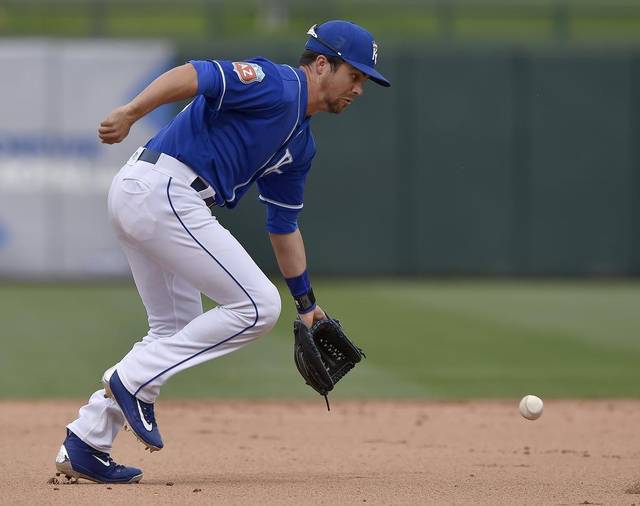
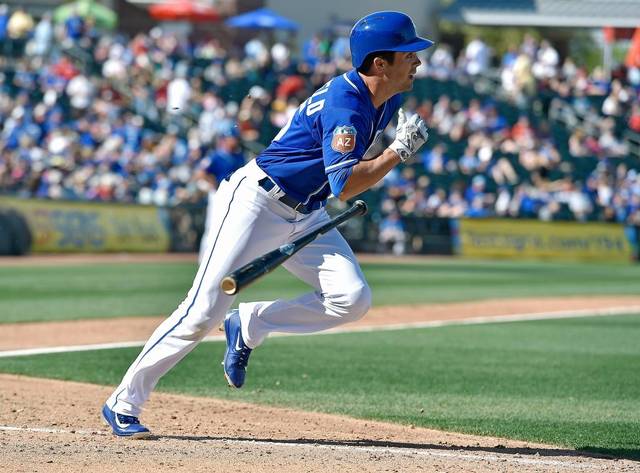
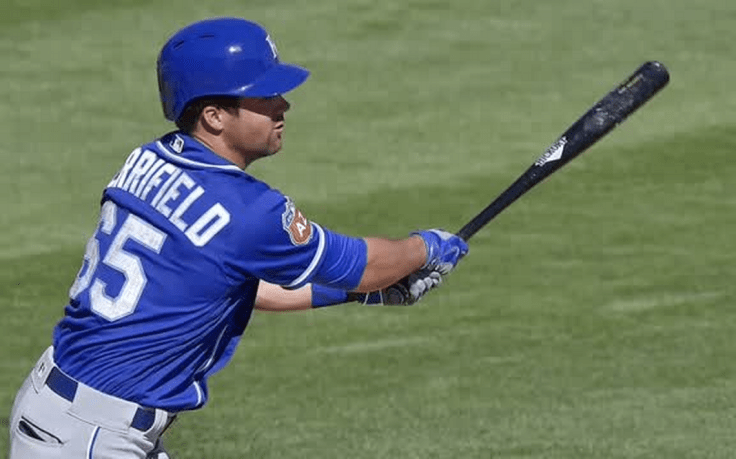
Merrifield is the most interesting name of the group this spring, as he has bounced around the Royals minor league system since he was drafted in 2010, and is probably past the point of being referred to as a prospect. But what he has done is gain twenty pounds this offseason as he tried to gain bulk on his frame and give himself a greater opportunity to make the Royals roster. The 27 year old began his college career playing the outfield but over the years has learned to play all four infield positions as well, which he did in 2015 for the Royals AAA team in Omaha( A year ago, he played 57 games at second base, 35 in left field, 15 at third base and 14 at first base). This versatility is what gives him an edge and could punch his ticket for a roster spot to start the year.
It also doesn’t hurt that he has had a good spring, hitting .389 with an RBI and an OPS of 1.151. The Royals are known to keep a small bench so they can stash more arms in the bullpen, so a player like Merrifield would be invaluable, as he could fill in almost anywhere on the diamond other than behind the dish. He appears to be the kind of player manager Ned Yost loves, a scrapper who does the little things like moving runners over, bunting and stealing a base or two. It’s not a lock that Merrifield will win a roster spot this spring, but it has to be intriguing to Kansas City management to have a player like Merrifield stowed away for future use.
Super utility players have become all the rage in baseball the last few years and the Royals have employed a few of the bigger name ones over the years. There was Ben Zobrist last year, Emilio Bonifacio in 2013 and before that Willie Bloomquist was plopped into that role in 2009 and 2010. Merrifield might not get the notoriety that those players have, but the Royals don’t need him to have his name up in lights. They just need him to fill whatever role is needed for that day and time. Those seven meals a day he threw down this past winter might give him the major league job he has coveted for years now…and the Royals could be better because of it.
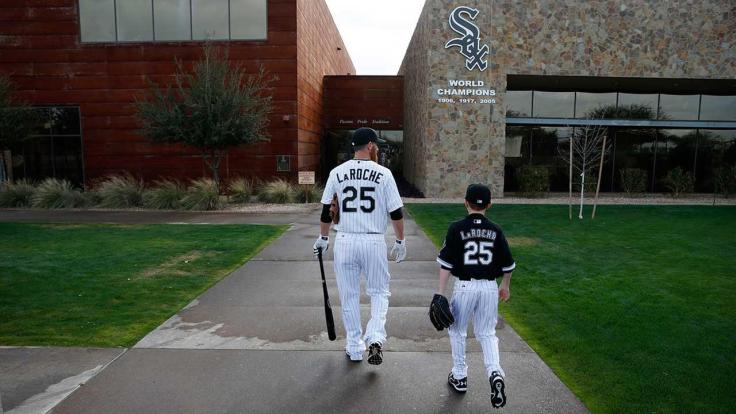
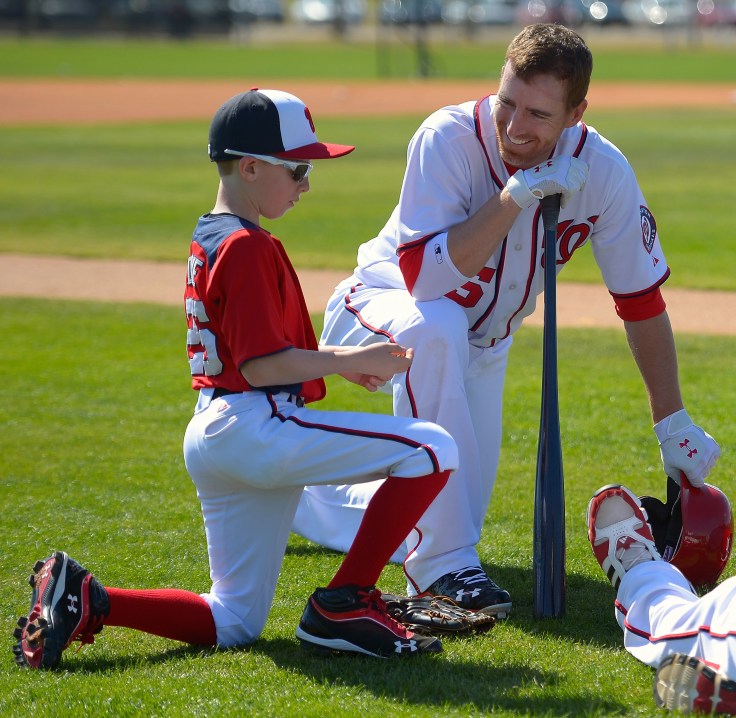
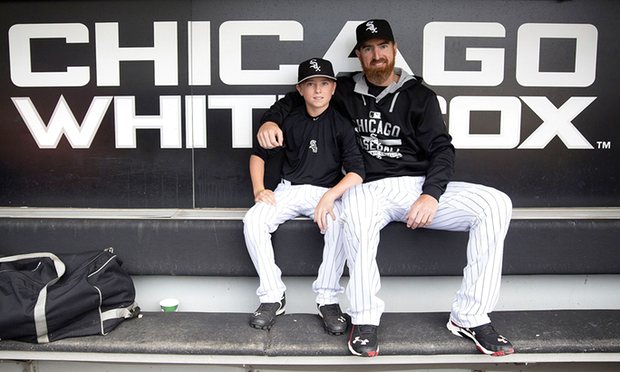
Most of us know that baseball is a kid’s game, played by adults who get paid millions of dollars. Despite all the money made professionally by Major League Baseball, at it’s core it is a game beloved and cherished by kids. No matter the popularity, I doubt this ever changes. Baseball has long had a tradition of it’s players having their kids tag along with the team in the clubhouse, as guys like Prince Fielder, Ken Griffey, Jr. and Brian McRae are just a few player’s sons who frequented many a trip to the ballpark and would end up playing the game at its highest level. Adam LaRoche was another of those sons(his dad was former pitcher Dave LaRoche) who would end up playing in the big leagues and over the last couple seasons has had his now 14 year old son, Drake, tag along for a large chunk of the season. Problem is, earlier this week LaRoche stepped away from the game after Chicago White Sox Executive Vice President Kenny Williams told him to limit the amount of time Drake was in the White Sox clubhouse this year. Many have taken shots at LaRoche for this action, but this development is all about priorities.
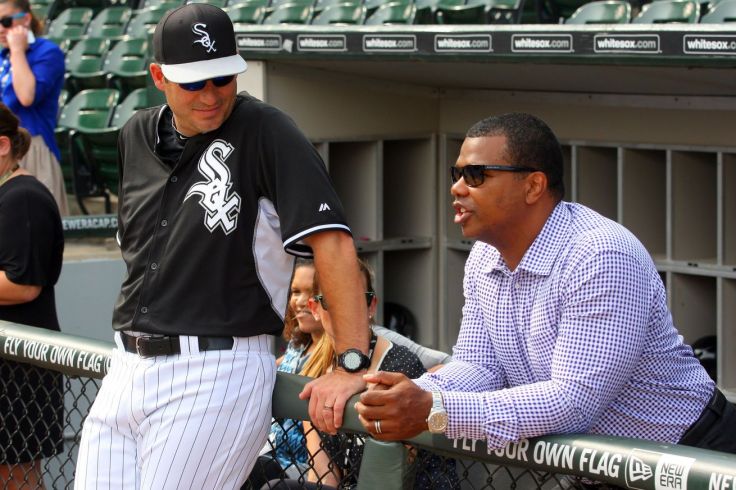
There is a number of issues to bring up with this situation, so let’s start first with Williams comments on the situation and what he talked to LaRoche about:
“It is true I asked Adam to dial it back,” Williams confirmed that point in a phone conversation with MLB.com on Wednesday. “I felt 100 percent was a bit much. So I asked that he dial it back. I said I think even 50 percent is a bit much.
“We are focused on trying to get everybody on the same page on some things with regards to preparing for this season. And I don’t want that to be misconstrued as Drake was a distraction. I’m not saying that.
“You’ve been around this kid. He’s a great kid. And everyone loves him,” Williams said. “I just thought at this point in time, where we are right now, that 100 percent was a little much. So I asked him to dial it back.”
Alright, let’s start here. I think we can all understand part of this, as we all work jobs and aren’t allowed to take our kids to work with us every day. Some jobs allow you to occasionally bring your kid with you, but not most. So that part you can kind of understand, although the argument can be made that baseball is not a normal job. In fact, to varying degree’s this has been a part of the game for decades now. But at the least, we can understand not wanting a kid around the workplace 100% of the time. I will say that the oddest part of this is the timing of Williams request, as he decided to do this halfway through Spring Training. This seems like the sort of edict that should have been brought down either at the end of last season or before LaRoche was headed to Arizona. Deciding a few weeks in seems odd and weirdly timed.
The other part that struck me was that in my mind this felt like a decision the players should be making, not someone from the front office. Apparently I wasn’t alone:
Player agent offered interesting take on LaRoche, #WhiteSox. Said rules on sons in clubhouse should be determined by players, not execs.
The fellow players are the ones who would have to be around Drake the most and if they had an issue I’m sure LaRoche could understand that and even acquiesce to it. It is the players clubhouse and what is allowed there is normally dictated to a large degree on what the players feel is appropriate. That being said, it has become obvious the players were not only okay with the young LaRoche being around, they stood up to Williams about it. This paragraph alone tells you quite a bit about how the majority of the White Sox players felt:
Ace pitcher Chris Sale reportedly tore into Williams during a tense clubhouse meeting after the decision was announced, with Sale telling Williams he isn’t in the clubhouse enough to know the deal. Sale wasn’t alone; players evenconsidered boycotting a game. From all reports, LaRoche had the OK of general manager Rick Hahn and manager Robin Ventura to bring Drake around as much as he wanted. The reversal from on high apparently bothered teammates as much as anything.
A few other players spoke out in support of having Drake around, including Adam Eaton. It does appear that even if a few players complained about the situation(and there’s a good chance they did) they would have been the minority and definitely didn’t seem to be speaking for the leaders of this team.
(AP Photo/John Locher)
The other part I find interesting is how highly the team speaks of this young man. Drake is not ony there spending time with his dad(which I will get to in a moment), but he is also helping out. Many spoke of how he would clean cleats and fetch balls while he was there, so he was helping out the team in a small capacity. I know there are some that believe a young man his age shouldn’t be around a big league clubhouse, but I actually think this is great for him to learn some old school life lessons. I’m not saying the kid shouldn’t be in school like a normal kid, but he also has a chance to encounter something very few people do in life and will be able to come away from the experience with a different view of life than most would. There are lessons here of responsibility, character building exercises and simple occurrences that he will end up running up against in life. For instance,most of the players have to be at the fields by a certain time and be ready to work out before the game. Don’t most of us have to be at work on time, ready to go when we are expected to be there? Doing chores like the ones mentioned above build character and show he has to earn his keep while he is there rather than just hang around and play ball. Most importantly, he is learning the responsibility a parent has to his child and how vital it is to his development.
To me, that is what this is really about. LaRoche is at a point in his career where spending time with his son is possibly the most important it has ever been. A ballplayer spends 7+ months on the road, zig-zagging across the country and a lot of that time is spent away from the family. What good parent would not want to spend more time with his kids, as long as he gets permission, which is what LaRoche did? I can not begin to express how much respect I have for Adam, as he has shown how high a priority his family is. As much as many people enjoy their jobs, family should always be the highest of priorities for a ballplayer with one. What LaRoche has done is tell the White Sox “my family comes first and if you can’t understand that, I will leave.” While he can rescind his retirement papers within a few days, the fact that LaRoche is willing to walk away from a job that pays him $13 million a season in the name of family speaks volumes. Many athletes miss valuable time with their children because of their job; LaRoche has been interweaving the two for years now and up until this point teams have been willing to work with him. I respect the hell out of him for that and wish more people did this in general, not just athletes.
The other part of this is just how badly Williams misread his locker room. For a guy who not only is a VP but also a former player, to come down on this and not realize what it would do to the morale of this team is mind boggling. In just a few short days, he has lost one of the most respected players in the game and alienated his locker room. For a team that is hoping to contend, this is a giant fumble and one that could cost this White Sox team for quite awhile. There also seems to be a loss in trust with the front office, which doesn’t bode well for not only this 2016 team but also players who would consider coming to Chicago in the future. This misstep could affect the team now, the rest of the season and well into the future.
I’ve heard people say LaRoche is in the wrong here, that he owes his teammates and that a kid shouldn’t be in a major league clubhouse. Honestly, this issue is more about character, family and one’s personal belief system than anything else. We all have a line that we aren’t willing to cross when it comes to juggling our jobs and our family. Some people’s line is farther away than others, but there is a line. LaRoche has decided where his line is and is standing firmly in front of it. We might all choose a different path for our lives and that is fine, but no one can tell Adam LaRoche what is best for him and his family. There is always a deal-breaker, and the White Sox found his. Your child should always be your top priority and parents that go the extra mile to spend as much time with their kids should be praised, not condemned for it. I commend LaRoche for his choice and agree 100% with his decision. As much as we all love baseball, it is just a game. Thank you, Adam, for that reminder.
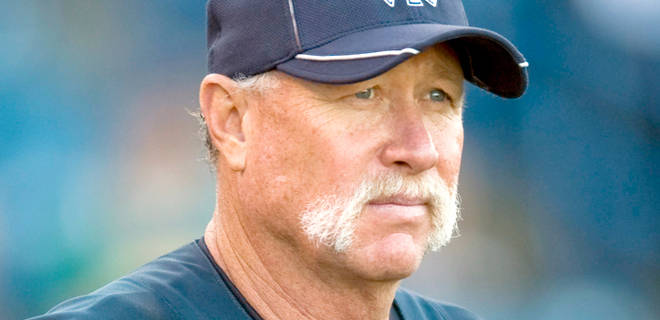
Baseball, like any other sport, is a constantly evolving game, one that is a reminder of one’s youth while also parading the youth of today. It is also a game that’s history holds more weight than any other sport, a history that seeps into almost every baseball conversation as the players of today look to stamp their name in the annals of history with the likes of baseball immortals. There is always a former player who will comment on the changes in the game, mostly just fondly remembering the game and how it was in their day. But sometimes a legend steps over the proverbial line in the sand, taking aim at not only the game but individual players who they feel don’t hold up to the standards of yesteday. Goose Gossage went on a tirade on Thursday that will forever change how he is viewed by everyone in and out of baseball, and not in a positive way.
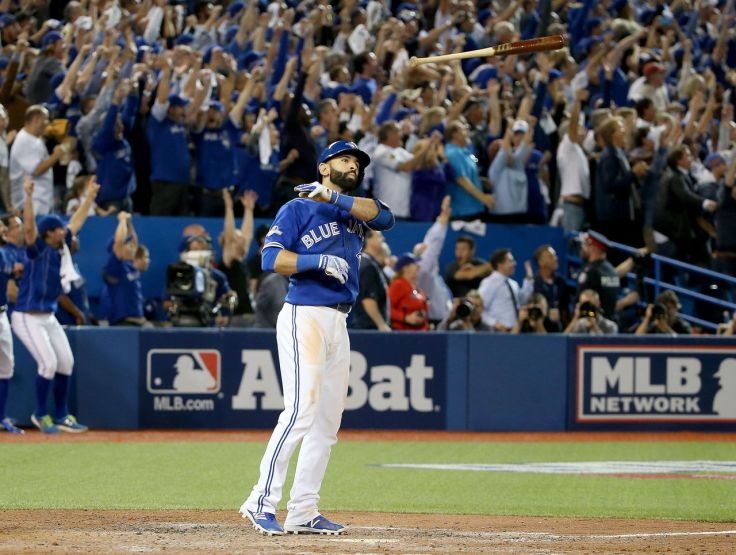
Let’s start with the interview in question. You can check it out here in all of it’s glory. If you aren’t a fan of salty language you might want to bypass on clicking on the link. Gossage’s main beef was with Blue Jays outfielder Jose Bautista and more accurately his bat flip in Game 5 of the ALDS:
“Bautista is a f—ing disgrace to the game,” Gossage told ESPN. “He’s embarrassing to all the Latin players, whoever played before him. Throwing his bat and acting like a fool, like all those guys in Toronto. [Yoenis] Cespedes, same thing.”
If you have read this blog before you will know I am not the biggest Bautista fan in the world. Great player, a needed cog in the middle of that Toronto order, but not a great leader for the younger Blue Jays’ players. But to say he is a disgrace to the game is a bit much. All this because of a bat flip? There is an argument to be made that pitchers are allowed to pump a fist here and there and celebrate after getting a big strikeout. The batter’s equivalent is the bat flip, and none were bigger than at that point in the ALDS. I’m sure that Gossage, as a former pitcher, is of the thinking that a batter should never get to celebrate any big play, no matter the circumstance. It’s even worse when you factor in that he is ’embarrassing to all latin players, whoever played before him’. I’m not going to point a finger and say ‘racist’, but it would have been just as easy to say ‘all players who came before him’. Singling out the latin players wasn’t a smart move on Gossage’s part. Luckily, Bautista took the high road on Goose’s comments:
“He’s a great ambassador for the game,” Bautista told ESPN after being informed of Gossage’s comments. “I don’t agree with him. I’m disappointed that he made those comments, but I’m not going to get into it with him. I would never say anything about him, no matter what he said about me. I have too much good stuff to worry about his comments. Today is my first game [of the spring], getting ready for a new season; hopefully, we will whoop some more ass.”
Kudos to Joey Bats for not taking a shot back. Although, it didn’t stop him from getting a bit cheeky:
Bautista 1, Gossage 0. It does appear as if Gossage speaks for a number of old school players who would prefer players not show excitement or to be exuberant whenever they accomplish something big during a game. This is something that needs to change.
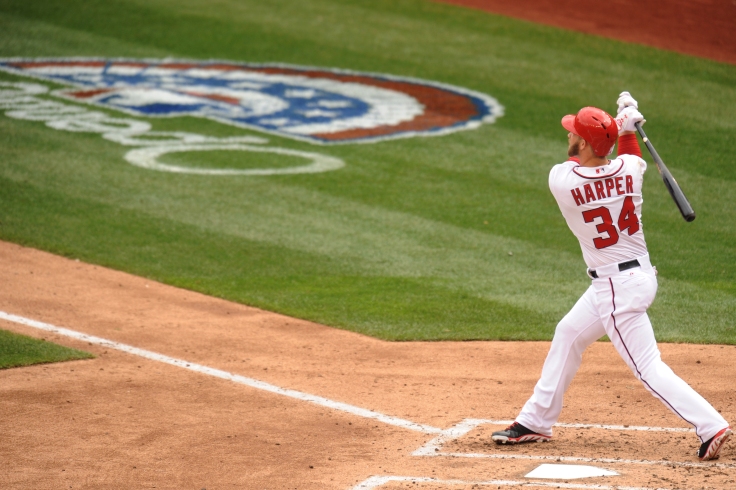
For the longest time baseball has been so tied to tradition that the fun aspect of the sport is sometimes thrown in the corner and not allowed to be a part of the game. This has caused generations of kids to decide to go play other sports, sports that allow more personality from their players and allow them more freedom. Bryce Harper of the Nationals, the reigning NL MVP, has taken baseball to task for just that, claiming baseball is “a tired sport, because you can’t express yourself. You can’t do what people in other sports do. I’m not saying baseball is, you know, boring or anything like that, but it’s the excitement of the young guys who are coming into the game now who have flair.” Harper continued: “If a guy pumps his fist at me on the mound, I’m going to go: ‘Yeah, you got me. Good for you. Hopefully I get you next time.’ That’s what makes the game fun.” In a sport where salaries are larger than anywhere else, it is sad to see young fans gravitate to other sports, when sometimes all it would take is a little leniency in some of the rules. This is especially true for the unwritten rules of baseball, which are mostly nonsensical, out of date and interpreted in different manners from different players. Sometimes it is good to remember that this is a kid’s game, played by adults who get to make a healthy living off of it. Harper is right and old school players like Gossage should want more kids to love baseball the way they do, which means allowing looser rules on celebrations and discarding the majority of baseball’s unwritten rules.
(Credit: Jason O. Watson-US PRESSWIRE)
Sorry for the detour; back to Gossage. Goose would go on to complain about the sabermetric community and their affect on baseball:
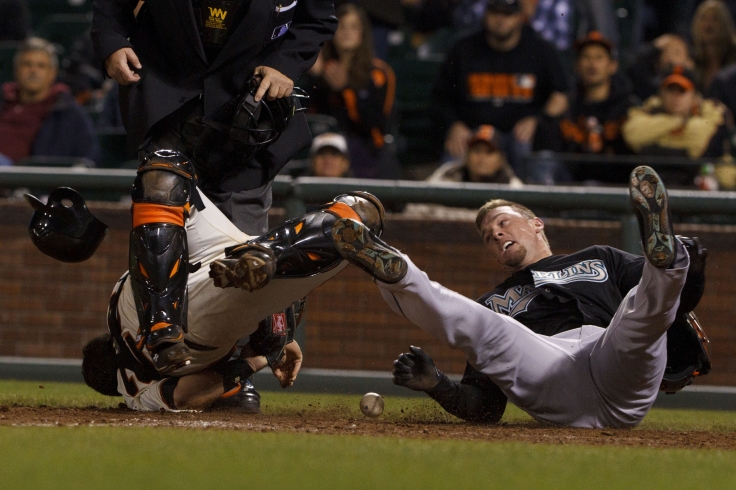
“It is a joke,” Gossage said. “The game is becoming a freaking joke because of the nerds who are running it. I’ll tell you what has happened, these guys played rotisserie baseball at Harvard or wherever the f— they went, and they thought they figured the f—ing game out. They don’t know s—. A bunch of f—ing nerds running the game. You can’t slide into second base. You can’t take out the f—ing catcher because [Buster] Posey was in the wrong position and they are going to change all the rules. You can’t pitch inside anymore. I’d like to knock some of these f—ers on their ass and see how they would do against pitchers in the old days.”
My first instinct when reading this was to laugh. Yes, that is how serious I took these comments. As someone who loves stats, loves advanced metrics and believes they have just as much of a place on the game as a solid hit and run, I find it comical that Gossage feels he needs to blame “nerds” for ruining the game. Maybe it’s just me, but what advanced metrics gives you is a deeper look at the game, especially when it comes to the true value of a player. What is even more laughable about his comment is that if sabermetrics had been around when he was playing, he would probably be a guy the SABR community would applaud. If you look deeper at his words, it sounds more and more like Goose wished baseball was played more like a game called “Beanball”, where if anyone steps out of line or does something that the opposing player doesn’t like, then you must hurt him. I guess Gossage just wishes the game was more violent. Maybe he would be appeased with gladiator fights in the Roman Colosseum. Honestly, it really shows ignorance on his part to act like more players getting injured and unable to play is the better direction for baseball to go. To say Gossage is out of touch would be an understatement.
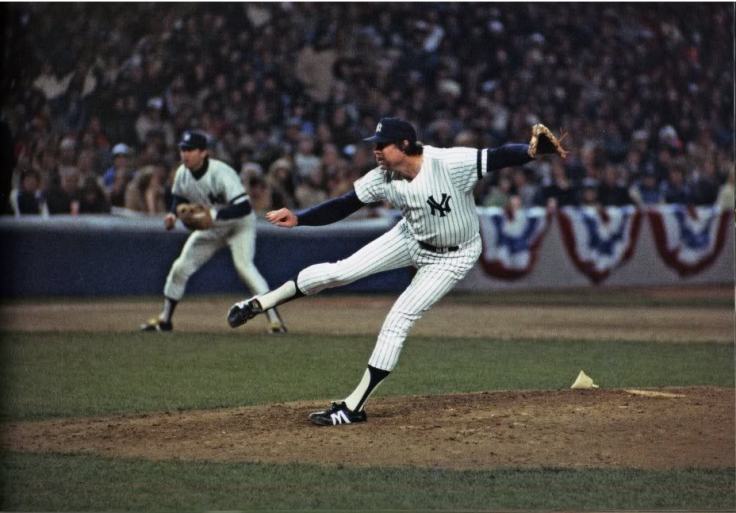
The most discerning part of Gossage’s comments are the fact they come across as bitter. Bitter because of change. Bitter because he doesn’t understand how the game has evolved. Bitter that he isn’t at the forefront of anything anymore. I am as big a proponent of “old school” as there is. I think players should know the history of the game and understand how the game was played before them. If a former player wants to give advice to the current crop of youngsters, I feel like they should listen and take note of the life lessons they are being taught. I honestly believe there is a place in the game for former players and they can help enhance the development process of many a young player in the game of baseball. But there is no place in the game for the ignorance spewed by Rich Gossage. The only thing to learn from what Gossage spit out is what not to do. There is a place for Gossage in this game(especially as a Hall of Famer), but not if this behavior is what he brings to the table. Unfortunately, there is a chance this will be what he is remembered for. Or this:
Sorry, Goose. The game will evolve, with or without you. It’s up to you to make a choice whether you want to be a positive or negative part of the past, present and future.
Right field for the Kansas City Royals has turned into an open audition this spring, as scheduled starter Jarrod Dyson is dealing with a strained oblique that will probably keep him sidelined until the middle of April at the earliest. About three weeks ago I discussed some of the possibilities the Royals would have in right field this season, and while Dyson and Orlando were expected to get the majority of playing time, there were also a few wild card candidates for Kansas City to keep an eye on. One of those players with an outside chance was 27 year old outfielder Jose Martinez, an outfielder who had been playing in an independent league in 2014. Martinez had a stellar 2015 season for the Royals Triple A team in Omaha, but before that he was a marginal prospect at best. So is Martinez for real? Let’s find out.
Martinez was initially ticketed for Double A Northwest Arkansas for the 2015 campaign, but once Paulo Orlando made the big league roster, Martinez was elevated to Omaha instead. Martinez took advantage of the opportunity, as he was one of the best players in the Pacific Coast League last year, leading the minors in batting and OBP, with a .384 average and an OBP of .461, while also slugging .563. While those numbers are all impressive, when you dig deeper it paints an even better picture for Martinez. Jose seemed to master the strike zone last year, slapping together a 12.1% K rate and 13.9% walk rate. While the strikeout rate is fairly close to his entire minor league career, the walk rate took a steep incline up, as his previous high was 9% in 2014, a year in which he played in 66 games in High A ball. Throw in an insane BABIP of .434 and you have a guy who spent the summer just flat out raking and terrorizing PCL pitchers. There is a prevalent thought that his season was the outlier of his career, which is true, but there are reasons to think it might not be as far fetched as first thought.
So how was this season not as flukish as it appears at first glance? For one, he has been a pretty good hitter off and on throughout his minor league career, at least when it comes to getting on base. He hasn’t been as consistent on a year to year basis, but you can see where a guy like Martinez could be a serious prospect if he really pieced all his tools together. Second, he actually was a significant prospect at one time. Back in 2007, Martinez was the Chicago White Sox’s number 7 prospect before his age 18 season. Sometimes with age, a player picks up on parts of the game that a younger player might not be able to decipher during their younger years. There is no way to know for sure if something clicked with Martinez last year that will stick, but if he had hit earlier in his career the way he did in 2015, he would probably have already been at the least a big league backup right now.
But there even more reasons to think Martinez might still be blossoming. For one, he has a very smooth, flat, line drive swing that makes for a very consistent hitter, which Martinez was in 2015. There is also the outside chance that his power has not even fully developed, as in the last ten years players between 6’6 and 6’8(Martinez is 6’7) had a combined ISO(isolated power mark) of .223. Martinez had his highest ISO last year (.179) and also put up career best power numbers and the most extra base hits of his career as well. It’s very possible that Martinez is just now reaching his power potential, and when you add in his ability to get on base, you have a player who could contribute in the majors. 2015 also saw Martinez have one of the best hard hit rates in the entire Royals organization, a sign that he wasn’t just getting lucky hits. In fact, Martinez is the perfect hitter for what the Royals like, a contact hitter who puts the ball in play at a very high rate.
So is Martinez the real deal and someone who could see playing time for the Royals this year? I feel the Royals are taking a wait and see attitude with Martinez, wanting him to prove that his career season last year was not a fluke. ZiPS is projecting Martinez’s numbers to go down a tad but still very solid; .280/.330/.391 with a BABIP of .328.Obviously ZiPS is going off his past numbers a bit, so the numbers are bound to even out. I tend to think that while something like his BABIP might take a healthy plunge(.434 is just really insane) I can still see Martinez putting up above average numbers to prove last year wasn’t a fluke. While the chances of Martinez being a big league regular are probably a tad slim(and his age doesn’t help him in this regard), it is not inconceivable to imagine Martinez being a backup outfielder for Kansas City this year. With Dyson down for a few weeks and the uncertainty that goes along with Travis Snider and Brett Eibner, Martinez could very well slide into a big league job to start the 2015 campaign. Last year was all about the 29 year old rookie Paulo Orlando; could 2016 be all about 27 year old rookie Jose Martinez?
For most baseball fans, certain players stick out. They aren’t hard to find, as they stand out as having a certain ‘it’ about them and it’s fairly obvious to point out when it is right in front of your eyes. Having ‘it’ basically means a player moves like he was born to play this game, whether it be running the bases, throwing a ball or vaporizing a pitch into the upper reaches of the bleachers. Then there are those players that have the look and feel of a leader, just by how they carry themselves. It was pretty obvious from day one that Salvador Perez was one of those leaders, a catcher who was the field general in every sense of the word. Early on in his career Royals management felt the same and locked him into a very team-friendly deal that gave Salvy a commitment and made it to where all he had to worry about was his play on the diamond. It was soon evident that this deal was below market value and the deal was almost a ‘steal’ for Kansas City. The rumblings this winter were that Perez and the Royals were trying to restructure a new deal that would compensate Perez while also extending the contract further into the future. The deal was finally struck on Wednesday, as Salvy looks to now be a Royal through the 2021 season.
The new, restructured deal for Perez will start in 2017 and will keep him in Royal blue through his age 31 season:
Confirmed: Perez deal 5-year extension starting in 17. Total value: $52.5M, including $6M signing bonus. On it: @jeffpassan, @jonheyman.
Perez will be making a very team-friendly $2M this year, $3M in ’17, $7.5M in ’18, $10M in ’19; $13M in ’20-21. Curious about any options, since we all know Dayton Moore loves him some mutual options?
Source: There are no options in Salvador Perez's contract. A straight five-year deal that starts in 2017 and ends in 2021.
Add in a $6M bonus and the Royals showed Perez how much he is appreciated by the organization and restructured a contract that technically they didn’t have to do. This deal is a message to the nucleus of the Royals that will be eligible for free agency after the 2017 season: if you work with us and stay loyal, we will stay loyal to you. The deal makes sense for the team, as Salvy is a fan favorite, the on-field leader, gold glover and possibly even leader of the pitching staff. Perez’s true value is in his defense, as he is considered one of the top catchers in the game, a perennial All-Star who is not only an agile defender, but knows his pitching staff in and out. Add in the pop in his bat(a career high in home runs in 2015) and you have the makings of a future Royals Hall of Famer, a player who will probably receive a statue and his number retired once his career is over. If you meet a Royals fan that doesn’t love Salvy, then that person isn’t really a Royals fan. But the question has to be asked, a question I even hate mentioning because of the high status of Perez with Kansas City: Will Perez still be playing catcher by the end of this contract?
(Photo by Harry How/Getty Images)
This is an honest question that needs to be asked, because Perez’s workload over the last few seasons has been, well, ridiculous. In fact, Perez has caught more innings than any other catcher in baseball over the last three seasons:
As the tweet above from Craig says, this does not even include postseason totals, or the innings Perez caught at the end of the 2014 season when he was part of an all-star team that did a tour of Japan. That is a lot of innings for any catcher, yet alone one who has had a knee surgery. Perez is easily one of the most durable catchers in baseball and that has shown by looking at the game totals for him since 2013, where he played the fewest games at 138. The bad thing is that I have been saying for years that the Royals need to give Salvy a lot more rest than they give him. I talked about it as far back as 2013 and my opinion hasn’t changed since then. Now that the Royals have made a long-term investment in Perez, they need to treat him as such. That means Perez should get a break once a week and I mean a real break, where he doesn’t come into the game once the Royals get into the later innings. Over the years we have seen many a catcher break down from their overuse behind the dish and that has also limited their productivity. In fact, we probably have already seen the beginning of this decline.
Back in 2011, everyone was surprised at how well Perez hit during his first stint in the big leagues, posting a line of .331/.361/.473 while putting up an OPS+ of 128. The thought at the time was that maybe Perez would be a better hitter than first thought. Since then he has been on a gradual decline, putting up an OPS+ the last two years of 91 and 89. His home run total reached a new high in 2015, but almost every other offensive stat saw a dip. It is very well known throughout baseball that Perez swings at almost everything, as Salvy was one of the leaders in swinging at pitches outside of the strike zone and had the lowest walk rate in the league. Is there a correlation between the amount of games played and the decline in his offensive stats? There is no way to 100% know for sure if there is, but one has to think so. Perez will probably never be a league leader in walks, but one wonders if he is able to get regular rest if that means some of his numbers will see an upward trajectory.
The other note of interest with Perez’s offense concerns him being able to stay healthy. If he isn’t able to stay healthy, the Royals at some point will have to consider moving Perez to a different position, especially if they feel that crouching behind the plate on a regular basis is hurting his health. So if Salvy moves to another position, is he going to produce enough offense to warrant not only the money he is being paid but also the playing time he will receive? This is an easy answer right now, since what he brings to the table as a catcher outweighs the lack of productivity with his bat. But once he is unable to wear the shin guards, it is highly questionable that his bat will produce enough to warrant a place in the starting lineup. It’s not fun to broach this subject, but it is something Kansas City management has to take into consideration and probably did before they signed him to this new contract. In some ways, yes, he will have earned that spot just because of what he has done the last few years for the Royals. But if his offense continues to decline at the current rate, he could be hurting the team more than helping.
Overall, this is about as positive a signing as the Royals could have, one that could benefit the team for years to come in many facets of the team. If anything, Royals management has shown a commitment to their players in a way that many organizations have ceased doing for years now. What this contract does is put Perez in the forefront of Kansas City’s plans past 2017 and into the next decade. To show this isn’t just about the money, Perez has shown himself to be a classy guy as well:
One cool part of Salvador Perez's new deal: He'll donate $1M to Kansas City's new Urban Youth Academy and the field will be named after him.
It’s kind of hard not to root for this guy. He is the real deal and probably will go down as one of the top five Royals of all-time. Yes, that is a lofty prediction but one that Perez is more than capable of upholding. More than anything, the message from this signing is that loyalty is rewarded with loyalty.
One of the fun things about Spring Training is that anything is possible, and the opportunities are endless. In fact, every spring is spent with fans trying to predict how their favorite team will stack the lineup to start the season. In some ways it is a pointless activity but it’s always interesting to compare how you would position the starting lineup as opposed to the manager in the dugout. With that being said, here is how I would stack the starting nine for the Kansas City Royals to kick off their 2016 campaign.
Batting leadoff would be left fielder Alex Gordon. Years ago Gordon was actually the regular at the top of the order but the Royals have spent the last few years trying to utilize some of his power and put him anywhere from fourth to eighth in the order. My reasoning for having Gordon leadoff is that he is one of the few Royals to put up a good walk rate, has decent speed and has proven success in this role. I really like Gordon’s ability to get on base and feel like it is best suited for this spot in the lineup. I know it is highly unlikely this will happen, but Gordon would be my choice.
Batting in the two hole would be Lorenzo Cain. Last year Cain spent most of the year in the third spot in the order and turned in a career year that netted him a third place finish in the American League MVP vote. Now, it might seem odd to move Cain out of the third spot after the year he had, but I like having the Royals best two players hitting back to back in the order, as it allows Cain use his speed a bit more early in the game and makes it harder for pitchers to pitch around the Royals top of the order. I have no issue with Cain batting third, but I would like to see what he could do batting second.
Hitting third in my Royals batting order would be Eric Hosmer. It’s long been said that you bat your best hitter in the third spot in the order and this could be the year that Hosmer takes that leap and puts up MVP caliber numbers. Hosmer put together a solid 2015 campaign and was an RBI machine in the postseason. If Gordon and Cain got on base consistently, Hosmer would get even more RBI opportunities and give the Royals more runs on the scoreboard. Batting Hosmer third could be a win-win situation.
The “Cleanup Spot” could go to Kendrys Morales, the Royals RBI leader in 2015. The four hole has long been where you plug in your power guy and Morales is that for Kansas City. Even if we see a slight fall in extra base hits, Morales batting cleanup would give Morales even more of a chance to drive in runners than he did last year batting fifth.
In the fifth spot would be Salvador Perez. Salvy isn’t the most patient hitter in baseball, but he did put up career high home run totals in 2015 and could see better pitches hitting behind Morales. Now that Perez is signed long-term in Kansas City, its time to give the man more rest and one has to wonder if his offensive numbers would hit an upward trajectory with more time to rest his weary bones.
Despite coming off of a career season, I would bat Mike Moustakas sixth this season for the Royals. Moustakas looked like a changed man the first few months of the season, as he consistently was hitting the ball to the opposite field, forcing teams to scrap the shifts against him which were prevalent in 2014. The second half of the 2015 season saw him pull the ball at a greater rate, although still occasionally taking the ball the opposite way. So which player is Moose? I would like to say he would be more like the guy we saw in the first half of the season, but we will have to wait and see. If he continues to show that growth this season then he is more than capable of batting back near the top of the order. I would prefer to be convinced first before sliding him back.
(Credit: Matt Marton-USA TODAY)
The seventh, eighth and ninth spots in the order are pretty interchangeable, but I would go with Omar Infante/Christian Colon batting seventh. Infante will probably win this job and if he does he is good to bat near the bottom of the order while still occasionally driving in some runs from this spot.
Eighth would be Alcides Escobar, the man who Ned Yost will have lead-off this year. None of us can explain why it works, but batting Escobar at the top of the order, a guy who rarely walks and batted .257 last year, seemed to be a sparkplug for this Royals team during the playoffs. Honestly, Escobar just doesn’t get on base enough for my taste, which is why I would bat him near the bottom of the order. We know how this will play out, but Escobar’s bat seems to justify me batting him eighth in the Royals batting order.
(Credit: Denny Medley-USA TODAY)
Batting at the bottom of the Royals lineup would be the Jarrod Dyson/Paulo Orlando platoon. I really like batting these two here for two reasons. First, neither will produce much offensively and will see the least amount of at bats in this spot. Second, if they do get on base, their speed could be utilized when the batting order flips back around to the team’s best hitters in Gordon and Cain and you could even see the hit and run used quite a bit. I actually think batting the right field duo here is the perfect spot for them.
(AP Photo/Charlie Riedel)
So how do I think the line-up will actually shake out? Knowing manager Ned Yost and what he has said so far this spring, the line-up looks to be Escobar, Moustakas, Cain, Hosmer, Morales, Gordon, Perez, Infante/Colon, Dyson/Orlando. It’s not too far off from the batting order we saw in October last year and that seemed to work out okay. How would you stack the Royals? Who knows what would actually be the most productive order for the Royals, but it sure is fun moving it around to see what comes out of it.
Last week I was posed the question of whether there was anyone in Kansas City Royals camp that could surprise the team this spring. I discussed a few non-roster invitees, but no prospects and there are a few reasons for that. For one, this team is pretty close to a set roster and will only have a few spots open for competition. The other reason is that there are very few Royals prospects on the verge of breaking into the big leagues. If you look at the top of most prospect lists for Kansas City, you will see Raul Mondesi, Kyle Zimmer and even Bubba Starling taking up space. Starling is probably (at the least) another year away, while Zimmer has to stay healthy first before he can be considered to help Kansas City this year. I do believe we will see Mondesi this year, in fact I wouldn’t be shocked if he is the starting second baseman by August. Defensively he is ready, but his offense is still a work in progress. But after these three? Well, the farm system has taken a hit the last few years, and is currently anywhere from 18 to 23 in most MLB depth lists. Is that a fair position to put the Royals farm system in?
I believe so, since the team lost a number of top prospects this past summer in the Johnny Cueto and Ben Zobrist trades. Sean Manaea went to Oakland for Zobrist and he is now the A’s top prospect. Cody Reed was a part of the Cueto deal and he is currently number two on the Reds prospect charts. This is all without mentioning Brandon Finnegan, the former number one draft choice who was dealt with Reed to Cincinnati last summer. It sounds like a lot of talent dealt, and it was, but think of it this way; without those trades, the Royals probably aren’t world champions, so at the end of the day it was worth it. The other thing to remember is that a number of main talents are in the lower minor leagues for Kansas City, players that have been stockpiled over the last few drafts. Guys like Foster Griffin, Nolan Watson, Ashe Russell, Ryan O’Hearn and Chase Vallot are all players you should store in the back of your mind for future reference, although none will be seeing the major leagues anytime soon. The Royals front office and scouting department has done a nice job over the last few years re-stocking their minor leagues with players who will hopefully be the next wave of talent that rises through the minors together, but they won’t be part of the big picture for a few more years. So who could we see this year in Kansas City?
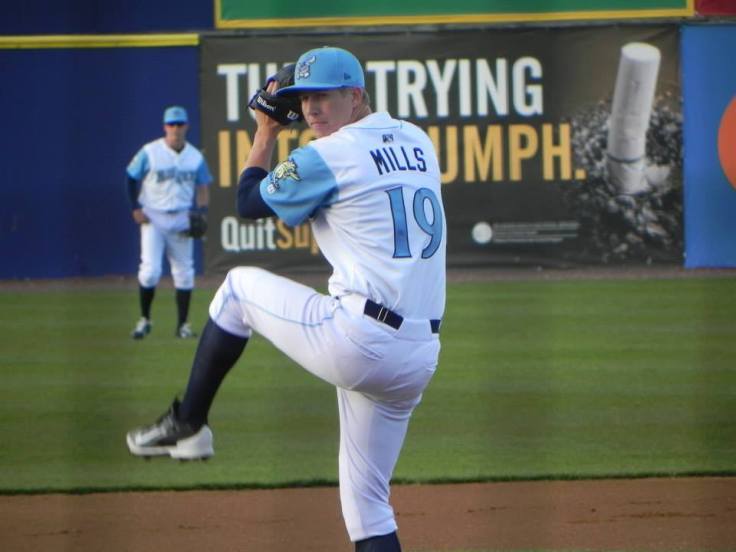
There are obvious choices, like Cheslor Cuthbert and Miguel Almonte, players we saw off and on throughout the 2015 campaign. A few other prospects worth mentioning are Matt Strahm and Alec Mills, two pitchers who have steadily risen through Kansas City’s farm system. Strahm is a lefty who could see some time out of the bullpen this year, while Mills is another power arm with a nice array of pitches in his arsenal. Mills finished the year in high A ball, striking out 111 batters while walking only 14. Either guy could be contributing for the Royals out of the bullpen by the end of the year.
So there are prospects that can contribute this season, but not many. Just looking at the surface, it appears the Royals have neglected the farm. But in reality it is a steady process that will take a few years to fully bloom. This is what happens when you win; you don’t get the higher draft picks that are on the fast track to the big leagues. Instead you accumulate arms and athletes and hope a few over-exceed expectations. The future is bright, but it gleams brighter the deeper you look.
Remember back when the Kansas City Royals signed Ian Kennedy to fill out their rotation? Word leaked out during that time that the Royals were still on the hunt for another starter, most likely just for depth purposes. Everything stayed quiet on the Royals front, that was until Friday, a day after pitchers and catchers reported to Royals Spring Training camp:
#Royals sign LHP Mike Minor to a 2-year deal with a mutual option for 2018. Minor pitched for Atlanta the last five seasons.
I was instantly elated and felt this was another stellar move from GM Dayton Moore. So who is Mike Minor and how can he help the Royals moving forward? I’m glad you asked.
Minor is a former first round draft pick of the Atlanta Braves who will be entering his age 28 season for Kansas City. Minor sat out the 2015 season due to shoulder surgery, as he went in to fix the labrum in his left shoulder back in May. Over his five year major league career, Minor has produced a slightly below league average ERA+(93) and a career FIP of 3.90 while accumulating over 652 innings. Minor doesn’t have blow you away stuff, as he uses four pitches in his arsenal (fastball around 90 mph, slider, knuckle-curve and change-up) but over his career has produced good strikeout and walk rates. There is a lot of hope within the Royals organization that the team’s medical staff will be able to help Minor, as he is about nine months removed from surgery at this point:
“We’re trusting (trainer) Nick Kenney and our medical team,” Royals general manager Dayton Moore said, “along with Mike’s work ethic and dedication to get back to perform successfully at the major leagues. (It) led us to a conclusion to give him a two-year deal.”
It is looking like we will see Minor back in the big leagues sometime around late May, early June:
“We don’t anticipate him being ready for the first six weeks to two months (of the regular season),” Moore said.
So the signing seemed to be done to have Minor help out the team later in the year, and in a lot of ways, be more helpful in 2017. If the signing seems familiar, it should.
It seems familiar cause it is very similar to the deal former teammate Kris Medlen signed with Kansas City about a year ago. Medlen was coming off of a major surgery(Tommy John) and the signing was for him to help later in the season(last year) with more emphasis on the following season. Much like Medlen, Minor could fill various roles for Kansas City, either out of the bullpen as another left-handed arm or in the rotation if needed. Overall, Minor’s role on the team in 2016 is one of doing whatever is needed, although his strength would mainly be in the rotation:
“Hopefully, we’d have him in a position to give us some depth the second half — probably before that,” Moore said. “But realistically, around that period of time.”
This also shows the team is allowing him to not rush to action and rehab at his own pace:
“We wouldn’t put limitations on him,” Moore said. “The important thing is to move at a rate that ensures his long-term health. And that’s why it was important to get him on a two-year deal; not just one year, because not always, but usually you see them better the following year.”
The contract gives Minor the luxury of knowing he is set for 2017 and anything he is able to contribute this year is purely an added bonus. This is also the kind of signing the Royals have to make.
Don’t let the world championship, nor the big contract signings of Alex Gordon and Ian Kennedy fool you; the Royals are still a small market baseball team. That means that the Royals have to look at guys coming off bad seasons and/or injuries to help fill out their team. The Royals will never be allowed to have an unlimited payroll(or at least the likelihood is very, very low) so scrounging for guys like Minor is pretty much the modus operandi for Dayton Moore and his front office staff. That being said, there is some risk involved in this signing.
The risk is quite obvious; what if Minor isn’t able to bounce back from surgery or continues to show lingering issues? That is the risk any team takes when signing a player coming back from a major injury and the Royals are just like the other 29 teams in baseball, as they know there is always that chance. The one positive aspect of this is the Royals training staff has shown a propensity the last 3-4 years of keeping players healthy and not rushing a player back out on the field before they are ready. I tend to think if the Royals really felt Minor might not be able to bounce back, they wouldn’t have signed him to a two year deal in the first place. This kind of risk will always be there, but I tend to believe if the Royals had any trepidation, we wouldn’t be discussing this signing right now.
If one would look at the Royals rotation, especially looking onward into 2017, there are more questions than answers. With that said, having Mike Minor in the fold for the foreseeable future can only be viewed as a plus for the organization. I’m not for sure we should expect much from him in 2016, in fact it could be very comparable to what Medlen contributed last year. What you can probably expect is to pencil his name into the rotation for the 2017 season. Things could still go sideways, but at this moment it looks like the Royals front office found themselves another solid arm for their starting forces. Moore has had issues developing starting pitching throughout his run in Kansas City’s front office, but finding pitching in the bargain bin has become a specialty of his.
Throughout the 2015 season, there was always speculation on who should be playing right field for the Kansas City Royals. Alex Rios was the incumbent at the position, but his lackluster play throughout the summer(plus the myriad of injuries and illnesses) made one wonder if the Royals would be better off employing a platoon in right of Jarrod Dyson and Paulo Orlando. Rios would actually put together a good September and a solid postseason for Kansas City, so this question seemed rather moot by the end of the season. But that question looks to be finally answered, as manager Ned Yost confirmed at Fanfest that the Royals would likely be employing “some sort of platoon” of Dyson and Orlando to start the 2016 season. So this begs the question: just how productive would a Dyson/Orlando platoon be?
(AP Photo/Eric Risberg)
Jarrod Dyson has been an intriguing player for his entire career, mostly because of his speed. Dyson has game-changing speed, the kind that any team would covet, which it appears he was this offseason:
Jarrod Dyson is the Royals player that drew the most trade interest from other clubs, according to JJ Piccolo. https://t.co/NXCsa9yyA2
The Royals, over the years, have done a good job of taking advantage of that speed but not misusing Dyson to where his flaws would be more prominent. Offensively, Dyson is slightly below league average throughout his career(career 83 OPS+) while stealing bases at an 86% clip(he has only been caught stealing 23 times in his career out of 169 attempts). Dyson doesn’t accumulate very many extra base hits, as he has only 61 over his 6 year career, mostly doubles and triples. His main issue has been hitting lefties, which has been a major struggle for Dyson. Over his career, Dyson has a line of .211/.288/.249 against left-handers, striking out 21% of the time against them. For the most Kansas City has sheltered him against this struggle, as he has only accumulated 243 plate appearances against lefties in his career. Defensively, Dyson is above average(which is shown by his WAR, 9.6 over his career in limited action), which is a major reason why the Royals are set to go with Dyson getting the majority of the time in right this year. His UZR is well above average, while he has racked up 43 DRS(defensive runs saved) in limited playing time over his career. Dyson doesn’t always take great routes, but he normally makes up for it with his speed. I know there was a prevalent thought by the national media in 2014 that Dyson was a better defender than Lorenzo Cain, but that couldn’t be farther from the truth. A lot of Dyson’s flaws are hid by his speed, which helps him get to balls that most players would not, while Cain actually is a more than average efficient defender. Dyson probably won’t provide much pop(and he probably should bat near the bottom of the order)but his speed and defense should make it alright for the Royals to start the year with Dyson getting more than usual playing time. I would even say Dyson could top 50 stolen bases in a year if given the time to do it. But he won’t see all the time in right field…
Paulo Orlando is entering his age 30 season, coming off a rookie campaign that saw him in the middle of a number of big Royals wins while getting a decent amount of playing time due to Rios and Alex Gordon spending time on the disabled list. Orlando became a fan favorite early on, for his great defense and propensity to hit triples. Over time, his flaws showed the more he played, so much like Dyson, Orlando platooning with Jarrod would help his productivity. Orlando had a line of .249/.269/.444 in 2015 with an OPS+ of 90 and a WAR of 1.0. Paulo has some pop in his bat and was a sprinter in Brazil before beginning his baseball career, so he is also exceptionally fast. He also became a regular defensive replacement late in the season for Rios, as he is another above average defender in the Kansas City outfield. Orlando probably wouldn’t be a good fit for the Royals as a regular, but splitting time with Dyson should help hide some of his flaws while also giving him a chance to add some production for the bottom of the order.
I know there will be a few Royals fans that will bring up minor leaguers Brett Eibner and Jose Martinez as possible players to see time in right field, but barring a major injury I can’t imagine either will see much time in Kansas City in 2016. Eibner had a good year in Omaha in 2015, putting up a line of .303/.364/.514 with 19 home runs and 81 RBI’s, pretty much a career year for him in the minors. Unfortunately, the Royals see him as a fourth outfielder type who would only really see time in the big leagues because of an injury or if he really tore it up in AAA in 2016.Martinez literally came out of nowhere in 2015 to post a .384/.461/.563 line and win the PCL batting title for Omaha. Martinez had bounced around for quite awhile with the White Sox and Braves farm systems, never getting higher than AA. Martinez is entering his age 27 season and while he did open a bunch of eyes with his batting last season, there are just as many people wondering if it was a fluke or if he is able to repeat that performance. If he shows last year wasn’t the outlier of his career, then it’s possible we could see him up with the Royals at some point. But that is a big ‘if’ coming from a guy Kansas City found in the independent leagues. There is one more possibility for time in right field this year, and that is Travis Snider. I discussed his chances earlier this month, which look very promising. I see Snider getting a decent look this spring and could even force his way onto the Kansas City bench if things go his way this spring. Snider is the most intriguing of this bunch, as he still seems to have some potential in him that could be untapped, especially if hitting coach Dale Sveum gets ahold of him and teaches him the ‘Royal Way’ of putting the ball in play.
So with all that thrown out there, here is the big question: would a Dyson/Orlando platoon produce more than last year’s right fielder Alex Rios? For this exercise, I decided to use Steamer Projections to compare the expectations from Rios for this year(if he ever signs with a team; I have literally seen nothing this winter connecting him to any team–at all) to Dyson and Orlando. Steamer has Rios with a line of .249/.287/.369 with 6 home runs and 33 RBI’s(in a projected 76 games). Dyson is set at .250/.309/.341 with 3 homers and 31 RBI’s, while Orlando is projected to hit .254/.289/.363 with 4 home runs and 23 RBI’s. Just looking at the numbers, it looks like average and on-base would be close, with the Dyson/Orlando platoon maybe accumulating a better OBP. It probably seems obvious, but Rios has the better slugging percentage, although one wonders if Dyson would get a few more extra base hits with the added playing time. The stats are eerily similar when putting them up against each other, so offensively it would seem to be fairly close to even, with Rios adding a touch more power while the Dyson/Orlando combo would add more speed. Throw in that Jarrod and Paulo are both better defenders than Rios, and it would appear the Royals might be slightly improved this year in right with the two of them platooning. Oh, and cheaper as well, with Dyson and Orlando combined making just over $2 million this year while Rios cost the Royals $11 million in 2015. Advantage would seem to favor the 2016 Royals at this point.
But will this scenario play out all year? Probably not. As much as the Dyson/Orlando platoon in right field can suffice for Kansas City to start out the year, it would seem sensible that the team would look to improve the position before the July trade deadline. The team wouldn’t have to go out and get a top of the line right fielder, but an outfielder that could handle the job full-time while providing more offense could be found and probably not at an insane cost for the Royals. This would also open the team up to using Dyson in more pinch running situations while allowing Orlando to be a late inning defensive replacement if the new right fielder wasn’t skilled as such. As long as the Royals are contending I have to believe this is how the situation will play out and it actually is a best case scenario. The fact that the Royals are in a position where they spend a few months this summer finding out the true value of Dyson and Orlando while also knowing they can always go out and pick up another outfielder is a position that Kansas City has been fairly foreign to until the last few seasons. Dyson and Orlando are both valuable pieces of the Kansas City Royals roster, but their true value is as part-timers. I’m sure we will revisit this subject again come July but I lean toward having the same answer. The platoon will work for now, but definitely not the long-term answer for Kansas City.
Headed into Spring Training 2016, the Kansas City Royals have very little when it comes to major concerns on their roster. There is right field (which looks like a platoon between Jarrod Dyson and Paulo Orlando), the 5th spot in the starting rotation, the backup catcher battle and a few bullpen spots. But there also is a battle at second base, where Omar Infante looks to reclaim his spot while upstart Christian Colon looks to pry playing time away from the veteran. It would appear on first look that it is Infante’s job to lose, but there is always a chance Colon could take over, especially since Infante’s numbers the last few years have been less than stellar. Word last month from the almighty GM, Dayton Moore was that Colon would get a chance to win the job away from Infante this spring. So this begs the question: who should the Royals start at second base?
Let’s start with the man we all figure will win the job, Omar Infante. Infante is getting ready for his age 34 season, year 3 of a 4 year deal with Kansas City. To say Infante has been lacking offense the last two seasons would be a bit of an understatement. Infante’s OPS+ the last two seasons has been 76 and 49(league average is 100), miles away from the 115 he produced for Detroit back in 2013. He was actually able to produce a positive WAR in 2014(0.8) but slipped to -0.8 in 2015. Pretty much every offensive statistic has suffered in his two years in Kansas City, although he did have a number of clutch hits for the team in 2014. It’s not even just the main offensive numbers; fly ball % is down, his groundball rate is up and his hard hit rate has suffered as well. None of this is too surprising, as Infante is at that age where regression starts to sit in, so a dip in the numbers shouldn’t be too shocking.
Defensively, it has been a different story, as Omar actually held his own on defense this past year. Infante was able to post a positive dWAR, a big bump in his UZR, and a slight increase in his defensive runs saved. If ever you wondered why manager Ned Yost continued to pencil Infante into the lineup everyday, looking at his defensive numbers should explain it. The real detriment to Infante the last two seasons(and why there is at least some optimism in his return) has been the litany of injuries that he has dealt with during his time in Kansas City. In just two seasons, Infante has dealt with a jaw sprain, a shoulder sprain, an oblique strain(which sidelined him at the end of 2015), and a bone spur in his right elbow that required surgery this past November. Outside of the first week of the 2014 season, I’m pretty sure we haven’t seen a completely healthy Infante during his time in Royal blue. A healthy Infante would go a long ways toward not only sewing up a starting spot but also increasing his value in any way possible.
So what about Christian Colon? Well, his numbers are a bit harder to decipher because of limited time in the majors. Offensively, he has been better than Infante the last two seasons numbers wise, but once again this is in limited action. Colon has put up an OPS+ of 139 and 91 the last two seasons, but that is in 21 and 43 games. He has compiled a positive WAR(0.7 and 0.6) and defensively has been a slightly above average fielder. I went ahead and looked at his numbers in AAA Omaha, and Colon played about how you would figure; an average hitter with little power, decent speed and a positive increase in his BB/K rate. It’s hard to really get a read on what kind of major league player Colon would be, but it would appear he is about replacement level.
If you believe Moore, this will be a serious competition between the two players. In fact he all but said that last month when talking to MLB.com:
“We’ll just evaluate,” Moore told MLB.com. “We’re going to play the best players. Omar is a terrific second baseman. I know offensively he has not performed the way he has liked or the way we expect him to. I just know we’re going to put the best team out there each and every night, and I know Omar is capable of being that guy. But we like Christian Colon, too. But you need them all to win, as you know. It’s a team, and you count on everyone to perform. I don’t know if Omar, at this point, is going to play 162 games.”
Go ahead, look at that last sentence. Moore basically implies they aren’t for sure Infante can stay healthy the whole season. You can understand why, after the list of injuries I mentioned above, but this also makes you wonder if something else is in the mix.
There is something else in the mix, and that ‘something else’ would be hot prospect Raul Mondesi Jr. Mondesi is entering his age 20 season and finished last year in AA Northwest Arkansas in the Royals farm system. Mondesi is still a very raw talent, but it is conceivable he could make a big jump this season. One downside is that Mondesi has only played 18 professional games at second base, although it will be interesting to see what they do with him when he starts the year in the minors. If he is playing second fairly often early on, then it is possible the Royals would be looking at him as a possible solution in the big leagues later in the summer. I don’t think we will see Mondesi in the mix to start the year, but I have a hunch we will see him before the year is up.
So what is the final verdict? Going just off of numbers, it would seem like a dead heat. Infante and Colon’s ‘Steamer Projections’ are fairly similar: Infante has a projected line of .253/.284/.352 with a wRC+(weighted runs created) of 71, while Colon’s line would be .264/.316/..352 with an 83 wRC+. The numbers show that Colon might have a slight edge offensively, but not by much. It would seem Infante would have the edge defensively, which the Royals highly value. Infante would probably also have the edge because of his contract; it’s hard to justify benching the guy who’s making $7.8 million this year, especially since he is almost untradeable. Here is what I believe will happen: Infante will win the job out of Spring Training and will hold onto it until/if he gets hurt. Even if Infante is able to stay healthy, I really believe by August we will see Mondesi holding down the second base job. The Infante-Colon combo is not a permanent answer, especially for a team that has aspirations of making the postseason again this year. Instead it is the current answer, not the permanent one. Come August, second base could look much different for the Royals.















 Bleeding Royal Blue