(Credit: Aaron Judge: Luke Hales / Getty Images; Bobby Witt Jr.: Jess Rapfogel / Getty Images)
Like most Kansas City Royals fans, I’m still in a bit of shock that the team is in the postseason. The expectation was that they would be better this year (how could they be worse, right?) but expecting a 30 win increase felt very unrealistic. But here we are. Not only have the Royals reached the postseason, but they won their Wild Card matchup against the Baltimore Orioles to move on to the American League Divisional Series.
The ALDS started on Saturday night in New York, as the Royals are taking on their back-in-the-day rivals, the New York Yankees. The Yankees came away victorious on Saturday night but not without a little bit of controversy. If you still scan the wasteland of Twitter (and yes, I refuse to call it by any other name) you probably saw a lot of opinions on not only the umpiring in the game, but also replay, MLB and even the Yankees. So today, let’s take a look at some of these opinions and sort out the difference between reality and opinion.
MLB Doesn’t Want the Royals to Win
(Credit: Vincent Carchietta-Imagn Images)
This has been a popular narrative for years, that Major League Baseball doesn’t want the smaller market teams to win, instead hoping the larger markets win out bring their larger fanbases with them. If we are being honest, there is probably a bit of truth here, although I would argue the TV networks want this more than MLB. There is something to be said for the smaller markets to come out victorious, as people love rooting for an underdog.
In this argument, the Royals are the obvious underdogs while the Yankees would be that large market that television networks covet. If some of you remember (and I’m sure a number of you do), the Royals were in this position back in 2014 and 2015 and I don’t believe the numbers for the World Series either year tanked. Having the variety in the playoffs is a plus and one that allows a number of different fanbases to not only cheer on their team but also be part of October baseball.
I’m sure there are certain scenarios that MLB would love to see, whether it be for ratings, attendance or even social media activity. Sometimes it doesn’t even have anything to do with a team or market as much as compelling action that makes it harder for any fan to turn away. At the end of the day, MLB wins either way, whether it is is the ‘Up and Coming’ team or the teams you love to hate (I’m looking at you, Yankees/Dodgers/Astros). So the narrative that MLB hates your team…well, I just don’t believe that is true.
The Umpires Wanted the Yankees to Win
(Credit: Adam Hunger/Associated Press)
One of my big pet peeves in sports is fans laying the blame for their team’s woes on the officiating. To me it’s a cop out and ignoring the things your team did wrong in the game. Nine times out of ten, there is an easier explanation as to why the game turned out the way it did and it normally has nothing to do with a bad call on the field. So how did the home plate umpire do on Saturday Night?
So overall, the ump called a pretty good game. I do feel like there are a couple of things here that should be addressed. First off, yes, there were a few calls that were missed & in crucial parts of the game. While it’s not great, it does happen & if it turns into walk, that also means three balls were thrown before then that got you to that point. This is why most baseball experts insist on throwing strikes.
Second, there were a few calls that while they might have slightly looked outside of the strike zone & were called strikes, this was being called for both teams. The pitch that was called strike three on Bobby Witt Jr in the ninth? That pitch was being called a strike to Juan Soto as well. To me, as long as an ump is fairly consistent, I’m not going to complain.
Finally, while the box for the strike zone we see on TV is close to accurate, it is not 100%. I’ve always looked at it like anything around the edges that pretty much hugs the box is probably a strike. You might be wondering why they don’t just make the box accurate? It’s because the zone is technically an invisible thing that while we know essentially where it is, it can also be up for interpretation. Also, every outlet (Fox, TBS, ESPN, Bally, etc.) has a different size box for television. So when you are watching a game, just remember there is some leeway to the zone you are seeing & you shouldn’t take the box as a literal thing. But then again, what would we have to argue about then?
Replay Screwed the Royals
(Credit: Adam Hunger/Associated Press)
This is the narrative that has gotten the most traction & it is easy to see why. In the bottom of the 7th inning, Jazz Chisholm Jr was on first when he attempted to steal a base:
So on the replay it did look like Chisholm was tagged before he touched the base. It was hard to tell, as the play was close & most of the angles made it to where you couldn’t tell. There was one angle where it looked like Michael Massey tagged him just a hair before he got to the bag, but it very much felt like a bang-bang play.
I instantly said ‘They aren’t going to overturn it’. I’ve watched a lot of baseball over the years. The last couple years, I am normally watching a game every day. I am the diehard fan who will just watch a game to watch a game. What I can tell you from watching all those games is that normally when a play that is thisclose happens, on replay it comes back as the call stands, due to not having clear and concise evidence that they should change the call. It is almost like clockwork, to the point that it feels very predictable.
Now realize, I am not saying this is right or that we should just accept that. What I am saying is that it’s been like this for years and MLB appears to have no issue with it. With a call like that being so close, it’s hard for me to get too upset that it isn’t reversed. Yes, I would have liked for it to be turned over but I am realistic in recognizing that it probably won’t happen.
I also believe they should have non-umpires in the review room for replay to help make those calls. As of now, there are umpires reviewing the plays & making the decisions. Umpires that know the other umps who are calling the games they are reviewing. Is there a bias there? Inherently, yes. I am not saying that reviews aren’t being overturned because they don’t want their fellow umps to look bad. What I am saying is that whether they are aware or subconsciously doing it, there is a chance they are siding with their brethren. Having a non-umpire in the room to me would just help in the decision making and help any biases.
All that being said, you are not in those situations without giving up baserunners. The Royals all game long were allowing the leadoff hitter on base for a number of those innings. Chisholm got a leadoff hit. Also, if Salvador Perez had made a better throw it wouldn’t have been as close and Chisholm would have probably been called out. Replay not overturning that call didn’t cost the Royals the game. It didn’t help but it wasn’t THE deciding factor…and it definitely wasn’t the umpires looking out for the Yankees. It was just the status-quo for MLB replay.
(Credit: Brad Penner Imagn Images)
At the end of the day, the Royals lost Game 1 of the ALDS for a number of reasons. Whether it was the eight walks allowed by their pitching, or the lack of execution with runners in scoring position or even the 1 for 14 at the plate from Kansas City’s Big Three (Witt, Pasquantino, Perez) , you can find numerous reasons for why the Royals fell short in this matchup. Personally, I felt like the offense felt more alive than it has been in weeks and if the bullpen had been a little bit better we might have seen the Royals come away with a victory in Game 1. I even thought they handled Gerrit Cole pretty well, which is a good sign if this series gets to a Game 4.
People like to push a lot of narratives when it comes to big matchups like this but normally facts are the most logical way to go when analyzing the final results. It’s easy to blame an umpire, or the Yankees, or even MLB for why something doesn’t go the way you want it to. When it comes right down to it, the Yankees made a few less mistakes than the Royals and that is why they came out on top. The good news? Game 2 is Monday night. As we all know, the Royals mantra this year has been to not worry about tomorrow and focus on today. Hopefully that holds true for what we see Monday in the Bronx.
With the MLB postseason in the stretch run, I thought I would run through a few topics that are hitting the baseball news cycle this month and put a bit of a personal slant on it. With that being said, let’s start with our Kansas City Royals.
The Wrong Choice?
If you are a Royals fan, you are probably well aware that former St. Louis Cardinals manager Mike Matheny is the frontrunner to take over for Ned Yost in the dugout. You are also probably aware that Royals fans have been very adamant about their dislike of Matheny and the feeling that he would be a horrible choice to take the helm in KC. In fact, if you thought Yost caught a lot of flak, it’s nothing compared to Matheny and he hasn’t even been hired yet.
If you are unaware of why many of us within the fanbase are not fond of Matheny, it basically comes down to his dealings with the players near the end of his run in St. Louis. Matheny wasn’t even talking to outfielder Dexter Fowler and it even sounds like he allowed bullying to go on in the bullpen. Go ahead and read this to get a better idea of what was going on while he was with the Cardinals and there is also this from a few Cardinals fans. To say there is some skepticism about Mike and his handling of the clubhouse would be an understatement.
While I have concerns with all of this (and worry how this could effect a young team like the Royals), there is another issue that I have with the idea of WHY exactly Royals GM Dayton Moore would hire a man with this much baggage. It has to do with Matheny’s faith and how Moore seems to want to surround himself with people who are very religious and wear it like a badge of honor on their sleeves.
I almost hate to keep bringing this up, since I have no issue with what anyone believes in or doesn’t believe in. To me, it comes down to whether or not you are qualified to do the job at hand and no matter what team, you should hire the person best suited for the job. If Matheny was coming off a great run in St. Louis and was a good fit for Kansas City, I couldn’t care less what his religious beliefs were. If he was the best choice, he should be the man hired to take over for Ned.
But instead, it feels like Dayton is continuing to hire based more on faith rather than logic. I’m all for giving someone a second chance and the Cardinals job was Matheny’s first managing job. It would be ridiculous to think he didn’t learn anything from it. But the Royals are in a position where they are a young team that needs proper leadership to help them grow and eventually flourish at the big league level, to the point of them possibly contending within a couple of years. Hiring someone like Matheny, who doesn’t appear to work as well with younger talent as well as veterans, would seem to be a weird hire for a team that is in full-blown rebuild mode.
The Royals have two coaches in-house (Pedro Grifol and Vance Wilson) who have had their names tossed around in managing circles and would appear to both be good choices for any team that is considering hiring them. Both have been with the Royals organization for years and have seen many off the current roster make their way through the Kansas City farm system. Both have good relationships with the players and embrace advanced analytics, which every team is now using to help the development of their players.
This feels like a no-brainer, but you have to really worry about a team that thinks Matheny is a good fit to lead the Royals into the next realm of their development. Maybe Grifol has been the choice all along and we’ve all spent a ton of time worrying about nothing. But it doesn’t feel that way and it feels like the beginning of the downfall of Dayton Moore. I hope I’m wrong, because what awaits us if Matheny is hired could be tough to endure when all Moore has to do is make the best choice for the team.
Nationals Devil Magic
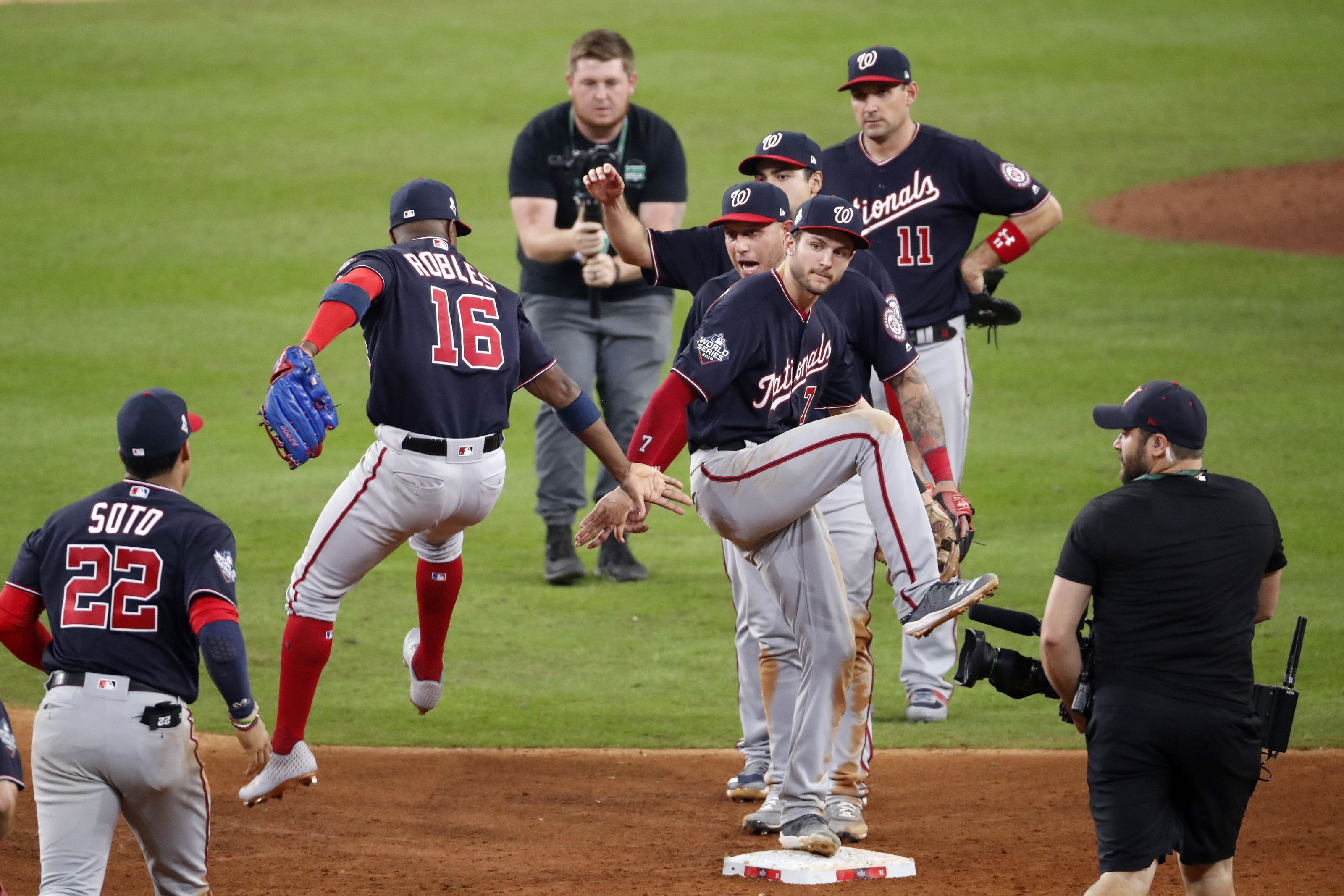
The funnest team to watch this postseason has been the Washington Nationals. Not only are they an underdog (going from the Wild Card game to the World Series), but they are a jovial team that appears to enjoy each other’s company. In fact, it hit me the other day that part of why I like watching this Nationals team as much as I do could be because they remind me of the 2014-2015 Royals teams that had a little bit of luck on their side.
Offensively there appears to be a lot of the Royals formula in their style. This is a team that just finds a way to get on base and numerous times this postseason has managed to compile multiple run innings by “moving the line”. Washington has a bit more power than those Royals teams, but they know how to keep an inning alive and make their baserunners count.
Pitching-wise, their rotation is miles better than Kansas City’s was, but the Royals had an edge when it came to their bullpen. Switching around the roles, the Nationals lean on a dominant rotation while the Royals leaned on their dominant bullpen. There are slight differences (and it makes the late innings a bit more stressful if you are a Washington fan), but you can see enough of a similarity that it’s not hard for a Royals fan to cheer for their brethren in D.C.
If Washington can seal the deal, they would have a giant monkey off their back, much like the Royals did in 2014. The hard part for them was winning a playoff series, which they had never done before. Since then, they have been playing with house money and you can tell how much looser they are on the field…just like when the Royals won the Wild Card game in 2014. Bottom line is while they aren’t carbon copies, they are close enough that it has been easy to get behind the Nationals this October. I can only hope they are able to do what the Royals did in 2015.
Everything’s Coming Up Soto
(Credit: AP Photo/David J. Phillip)
The biggest joy I have received from this postseason has been the attention given to Nationals outfielder Juan Soto. Soto, who just turned 21 (I know, you hadn’t heard that yet), has flown under the radar these last two years, especially to the casual baseball fan. But for those of us that follow it more closely, his success is something we pretty much expected. In fact, he probably should have been praised more before even getting to the playoffs.
With all the hoopla for Ronald Acuna, Jr. these last two seasons (and trust me, it’s deserved), Soto is right there with Acuna. I would even go so far as to say they are very similar players, as the numbers will attest. First, Acuna:
Now, Soto:
As you can see, the two have very similar numbers, with Acuna utilizing his speed more and probably the better defender. With that said, it has been nice to see Soto get the attention that Acuna has been receiving since before his recall to the majors. In some ways these two will be linked together till the end of time, much like Harper and Trout or Williams and DiMaggio. I’m not saying these two are on that level, but in the same regard they could be at the level soon.
So enjoy watching Soto in these next few games. It’s a treat that we get to appreciate him on the biggest stage with the biggest spotlight.
The World Series is nearing the end. Award season is just around the corner. And after that? I would like to say Hot Stove season, but the last two winters it has been anything but hot. So enjoy this week. While Major League Baseball has dealt with the de-juicing of the baseballs, the fiasco with the Houston Astros front office, and the news of a possible restructuring of the minor leagues, baseball needs a strong finish to the postseason and hope for an active offseason. The ball is in your court, baseball. Be smart with your next move.
The World Series is in the rear-view mirror and free agency has officially begun. That also means we are engulfed in award season, as the BBWAA has unveiled their winners throughout the last week. Meanwhile, my fellow writers in the IBWAA have also chosen their triumphant few and to the victor go the spoils. For the fifth year, I was able to vote as part of this illustrious group and decide on who was truly worthy. If you want to check out my voting record over the years, you just have a few clicks to adhere to: 2014, 2015, 2016 and 2017. As always, it is a true honor to have this opportunity to vote and I always vote with the utmost respect. With that being said, here are my picks to win awards in 2018:
American League MVP: Mookie Betts
Every year, I plan to pencil in Mike Trout for this award and most years that is how the vote ends up happening. Even last year, despite missing noticeable time due to an injury (or an upgrade, for those that believe Trout is a cyborg) he was my choice for MVP because of the sheer level of production he was putting up. But this year, Trout’s banner year just wasn’t quite enough to topple the year Mookie Betts had.
Bett’s numbers speak of a new level for him: .346/.438/.640, 32 home runs, 80 RBI’s, an OPS+ of 186, 10.9 bWAR and 10.4 fWAR. Betts lead the American League in runs, batting average, slugging percentage and WAR all while helping lead the charge for the Red Sox to procure another world championship.
But it wasn’t just the core numbers that won Betts this award. Mookie posted the highest extra base hit % of his career (13.7%), a great AB/HR ratio (16.3%), all while raising his walk rate to 13.2%, the highest of his career.
But what truly sealed the deal for me was his Win Probability Added, which lead the American League. Betts posted a 6.0 WPA according to Baseball-reference and a 5.77 for Fangraphs. The other candidates, most notably Trout and teammate JD Martinez are far enough away that this is a no-contest for me. Betts not only tore up the rest of the league, but was the most vital cog of the Red Sox’s arsenal.
With Betts posting another great year offensively and defensively (and the third consecutive above six wins a season) it will be interesting to see if the conversation starts of his place on the hierarchy of baseball’s elite. Trout has held the mantle for years, but if Betts keeps up at this pace, we could have to start inserting him into the conversation of ‘Best Player in Baseball’ sooner rather than later.
My Top 3: 1-Betts, 2-Martinez, 3-Trout
IBWAA Winner: Mookie Betts
BBWAA Winner: Mookie Betts
National League MVP: Christian Yelich
When the season began for the Milwaukee Brewers, their big offseason acquisition was former Kansas City Royals outfielder Lorenzo Cain. But the other pick-up turned out to be even more notable, as the team went and acquired Christian Yelich from the Miami Marlins. While Cain had a great season, Yelich performed out of this world and garnered himself an MVP trophy.
Yelich has always had the talent to make himself an elite producer and in 2018 he elevated his game to a new stratosphere. By the time the season had wrapped up, Yelich led the NL in batting average, slugging percentage, OPS, OPS+, total bases and WAR (both bWAR and fWAR) among position players in the league.
What really pushed Yelich over the edge was the second half of the season:
Down the stretch, Yelich was a monster as he hit a robust .370/.508/.804 in the final month of the season, not only cementing this award but also wrapping up a playoff spot for the Brewers.
The biggest change in his game was the elevation of the ball. The funny thing is, Yelich actually saw his fly ball rate go down (23.5%) from last year (25.2%), but he also saw his ground ball rate drop as well (down to 51.8% from last year’s 55.4%). But the increase happened in his line drive rate, which soared to 24.7%, up from 19.4% in 2017. Yelich was making better contact on the ball and it showed in his final numbers.
The cherry on top of the sundae for Yelich is his WPA, which lead in the NL for position players at 6.02. In fact, next on the list is Paul Goldschmidt, who posted a 4.66 WPA. That huge gap (as well as stellar defense) not only helped the Brewers but showed that Christian Yelich is far and away the winner of the National League Most Valuable Player award.
My Top 3: 1-Yelich, 2-Cain, 3-Carpenter
IBWAA Winner: Christian Yelich
BBWAA Winner: Christian Yelich
Credit: Brian Blanco/Getty Images
American League Cy Young Award: Blake Snell
This was easily the hardest vote for me and one that took me awhile to be comfortable with. Snell and Justin Verlander both put up stellar performances in 2018 but only one man can win, and my vote went to Snell despite a few issues that in years past would probably cost him an opportunity to win this award.
Let’s start with the “dark print”, or where Snell lead the league. Snell was first in ERA (1.89), ERA+ (219) and hits per 9 (5.6). There were two more categories that Snell lead in, which I want to focus on a bit deeper. First is RE24 (Run Expectancy, or for pitchers Runs Saved), where Snell lead with 48.4. To give you an idea of just how impressive that number is, the only pitcher better than Snell this past year was Jacob deGrom, who had an absolutely amazing year for the Mets. Also, Snell’s previous high in this category was 1.6…seriously.
The other stat Snell lead in was wins at 21, and I found this a bit amusing. Over the last few years, there has been a progressive movement to “Kill the Win”, with MLB analyst Brian Kenny leading the charge. The reasoning being that there are so many factors involved in a pitcher getting a “W” that doesn’t even involve the pitcher that it feels like an empty statistic. If we are being honest, I never look at a pitcher’s win total anymore. The only time I am even aware of it is if it is mentioned in a broadcast or in an article. The win to me doesn’t factor into how I vote, so I don’t even give it a second thought.
That being said, the other numbers did enough to help his case. But he did receive some stiff competition from Verlander, who lead in strike outs, WHIP, strike out to walk ratio and pitchers WAR. The most notable difference between the two pitchers was innings pitched. Verlander threw an impressive 214 innings over his 34 starts this season, while Snell threw only 180.2 innings over 31 starts.
For some, that would be a deal-breaker. There is a case that can be made that the extra 33 innings thrown by Verlander should count for a bit more and I can see that argument. There aren’t many pitchers that toss 200+ innings in today’s game and having that kind of stallion to ride can be a difference maker.
But for me, the numbers just leaned too far to Snell’s side to get me to throw my vote to Verlander. It was a tough choice and I honestly believe either pitcher is worthy of the award, but at the end of the day I picked Snell, as did both the BBWAA and the IBWAA.
My Top 3: 1-Snell, 2-Verlander, 3-Kluber
IBWAA winner: Blake Snell
BBWAA winner: Blake Snell
National League Cy Young Award: Jacob deGrom
I don’t get to do this very often but…I predicted this at the beginning of the year. Yep, I took a big swing and actually connected for a change. Honestly, this felt like a natural progression for deGrom and it felt like at some point he would put everything all together. That year was 2018.
In fact deGrom absolutely dominated this year and pretty much ran away with this award. deGrom lead the NL in ERA, ERA+, FIP, HR/9, WPA, RE24 and WAR. Dominance isn’t always a given when it comes to pitchers but this year was truly the year of deGrom.
To give you a deeper view of his dominance, let’s break down a few of the numbers. Batters hit .196/.244/.277 against deGrom, only taking him deep ten times this year. In fact, deGrom only gave up 40 total extra base hits this year over 217 innings. To give you a better view of how big a deal that is, the Anderson twins (Chase and Tyler, and yes, I am aware they aren’t actually twins) both gave up 30 home runs this year, or almost deGrom’s entire extra base total.
Want to go deeper? deGrom gave up 215 total bases. That number is actually pretty close to his 2016 number of 213 total bases. Oh, that was in 69 less innings then he accumulated this year. In other words, deGrom was a machine this year that no one could shut down.
There were even some analysts that felt deGrom was worthy of the NL MVP award this year, and it’s not too far of a reach. deGrom posted an insane 9.6 bWAR and 8.8 fWAR this year, both fairly large numbers for a starting pitcher. Throw in the 5.85 WPA and you have an argument that determines the value of deGrom is possibly on par with any hitter in the league.
I’ve always viewed the MVP as a hitter’s award, unless there is a pitcher that blows away the rest of the competition. By that, I mean there are players who play every day who are having really, really good seasons but not quite great. If that happens and there is a pitcher who has being insanely dominate, I would vote for the pitcher. In this case, Yelich had an amazing season and because he is out on the field every day, 162 games a year, my vote went to him.
I know that probably feels like I am slighting pitchers, but I am a firm believer in the mental aspect of the game and the wear and tear it has on position players. To say it is a grind would probably be an understatement. So while deGrom was out of this world this year, so was Yelich.
Luckily for the Cy Young award, there is no argument. deGrom wins this hands down and can put his season up there with such greats as Gooden, Gibson and Kershaw. Jacob deGrom was the best pitcher in the National League this year, period.
My Top 3: 1-deGrom, 2-Scherzer, 3-Freeland
IBWAA Winner: Jacob deGrom
BBWAA Winner: Jacob deGrom
Credit: Christian Petersen/Getty Images
American League Rookie of the Year: Shohei Ohtani
This felt like a slam-dunk for me and I was a bit surprised to hear some backlash from Yankees fans, but the best rookie in the American League this year was Shohei Ohtani. Sure, there were some great performances from Gleyber Torres, Brad Keller and Miguel Andujar, but none of them did what Ohtani did.
Let’s start there: Shohei Ohtani did things this year that hadn’t been done in a century. In. A. Century. Over the last 100+ years of baseball no one has achieved the feats that Ohtani did this year:
Ohtani is also the first player since Ruth in 1919 to throw 50 innings and hit 15 doubles, or to throw 50 innings and draw 25 walks, or to throw 50 innings and drive in (or score) more than 35 runs, or to throw 50 innings and make 200 plate appearances. He’s also the first player since George Sisler in 1915 to throw 50 innings and steal more than eight bases. You get where I’m going with this. Even Ohtani’s abbreviated rookie run was something no one had seen since before the Black Sox scandal, and it happened in a league that’s vastly more talented and specialized than the one Ruth revolutionized.
You get where we are going with this. Ohtani broke down the norms of what is expected of a major league ballplayer. He was a successful pitcher and hitter in 2018 but that isn’t even all of it. He did all of this while playing in a different league than he was used to. He did all of this while playing in a completely different country than he was used to. If that wasn’t enough, he pretty much made it look easy.
.285/.361/.564 batting line. 22 home runs, 61 RBI’s. OPS+ of 152. 126 ERA+. 1.6 WPA. 29% K rate. All while shuffling in between being a hitter and a pitcher. In a new league. In a new country. If he would have just put up average stats and been an average performer it still would have been impressive. But the fact he made it look easy shows what a true talent he is.
So sure, Andujar, Torres and Keller had great seasons. Any other year it is a different conversation and even possibly a battle for the winner. But this is a no-contest. Ohtani is the Rookie of the Year and no one came close to what he did.
My Top 3: 1-Ohtani, 2-Torres, 3-Keller
IBWAA Winner: Shohei Ohtani
BBWAA Winner: Shohei Ohtani
Credit: Brad Mills-USA TODAY Sports
National League Rookie of the Year: Juan Soto
I mentioned earlier that the AL Cy Young was the toughest one to pick a winner, but a close second was this race. Juan Soto and Ronald Acuna were not only two rookies that shined in 2018, but they were pretty close to equals as well.
The two rookies tied for fWAR (3.7), were separated by four homers, 6 RBI’s, and .001 in batting average. Soto had a slightly higher OBP, while Acuna’s slugging was a bit higher. wRC+? Soto 146, Acuna 143. In other words, either player was worthy of being the best of 2018, but only one could win.
In matters like this, where two competitors are so close that you would have to break a tie, I normally lean toward value. Looking at WPA, Soto had the sizable lead, 3.46 to Acuna’s 1.96. RE24 is a bit closer, but still a runaway for Soto (30.45 to 26.69). Finally, with the Clutch stat on Fangraphs, Soto wins again, 0.22 to -0.12. When it came down to helping their team and making sure they are put in winning situations, Soto came away with a lengthy lead.
So while you can see why I picked Soto, it’s not like Acuna wasn’t deserving. In fact, these two were so good this year that you almost forget all the other great rookies in the National League. Guys like Harrison Bader and Walker Buehler are rarely talked about despite putting up numbers that are very good for a first year player. With a NL class like this, you wonder who will break out and shrug off the ‘Sophomore Slump’ in 2019. If this year was any kind of barometer, Soto and Acuna will soon be the cream of the crop of not just the NL, but the entire baseball world.
My Top 3: 1-Soto, 2-Acuna, 3-Buehler
IBWAA Winner: Ronald Acuna
BBWAA Winner: Ronald Acuna
Credit: AP Photo/Steve Nesius
American League Manager of the Year: Kevin Cash
This was another close race and one that could easily be a three-way tie. Bob Melvin of Oakland led his team of vagabonds and youngsters to a playoff spot despite starting the year with the lowest payroll in the game and 34-36 on June 15. Alex Cora led the Red Sox to 108 wins (and eventually a world championship) in his rookie year as a manager and was able to turn away the playoff bound New York Yankees.
But what Kevin Cash did with the Tampa Bay Rays is some other level managing job. Cash propelled a team that was supposed to hang out in the basement of the American League East and led them to a 90 win season. Despite the team trading off some of their best players before the trade deadline, they went out and turned themselves into contenders. The funniest part of the whole deal is he did this almost from a survival standpoint.
The Rays lost a couple of their top pitching prospects (Jose De Leon and Brent Honeywell) before the season to injuries. Anthony Banda joined that list a few months into the season. After trading Chris Archer at the trade deadline, they were left with one actual starting pitcher. The lack of starters led Cash to use “The Opener”, where he would have a reliever start the game, pitch an inning or two and then hand the ball off to someone who could go deeper into the game.
This wasn’t done to be cute or try something new out as much as just a lack of starting pitching…and it worked. ‘The Opener’ became a regular part of their rotation and helped bridge the gap for a number of their younger pitchers.
The team focused on good pitching and defense and that helped get them to third place in the East, ten games behind the second place Yankees. Cash pushed the right buttons and his calm demeanor helped keep his team focused through a number of rough patches.
So while Melvin and Cora deserve a ton of praise, Kevin Cash deserves this award. If anything, Cash earned his managerial stripes in 2018 and has come out with a contract extension. It’s too bad he didn’t get some hardware to go with it.
My Top 3: 1-Cash, 2-Melvin, 3-Cora
IBWAA Winner: Bob Melvin
BBWAA Winner: Bob Melvin
Credit: Todd Kirkland/Getty Images
National League Manager of the Year: Brian Snitker
The story of Brian Snitker is one that easily could be made into a ‘feel good’ movie for Disney. Snitker is a guy who has been the loyal soldier, a guy who has been in the Atlanta organization since 1977, when he was a minor league player. He has managed for almost every one of their minor league teams and even spent a stint as the major league team’s third base coach from 2007 to 2013. Snitker has been there and done that when it comes to the Braves organization.
But in May of 2016, Snitker was promoted to manager for the Braves on an interim basis and he would get the job full-time in October of that year. So the path Brian took to this role was a long and lengthy one, but he didn’t really reach his stride until this past season.
What Snitker did in 2018 is something no one, not even the Atlanta front office, expected. He led the Braves to a 90 win season, a National League East title and their first playoff appearance since 2013. This from a team that wasn’t really supposed to contend until 2019.
But it shouldn’t be too surprising it came early. With a nice mix of veterans (Freddie Freeman, Nick Markakis) and top-shelf prospects (Ozzie Albies, Ronald Acuna), the Braves took advantage of the Washington Nationals’ pratfall and dominated the NL East for most of the season. While the talent will get most of the credit, Snitker deserves some heavy praise for the culture he has fostered in Atlanta. Former Braves outfielder Jeff Francoeur told a great story of Snitker that goes back years before:
One of Jeff Francoeur’s favorite stories occurred after he homered a few times for Double-A Mississippi and then got drilled in the ribs against Montgomery. Snitker instructed a reliever to retaliate. When the pitcher simply buzzed a batter, Snitker blasted the pitcher in the dugout and told him to get out of his sight. When one of Mississippi’s pitchers retaliated the next inning, the benches cleared and the umpires halted the game. “After we got back in the clubhouse, [Snitker] grabbed a beer and told us he had never been more proud of the way we came together as a team that day,” Francoeur said. “If you play for him, you know he’s always going to protect you and have your back.”
Probably one of the best ways to describe Snitker is hard but fair. It appears that his mentality is exactly what this Braves team needed. Craig Counsell and Bud Black did some great things for Milwaukee and Colorado, respectively, but Snitker’s accomplishment this year has earned my vote for NL Manager of the Year.
My Top 3: 1-Snitker, 2-Black, 3-Counsell
IBWAA Winner: Brian Snitker
BBWAA Winner: Brian Snitker
Credit: Ezra Shaw/Getty Images
American League Reliever of the Year: Blake Treinen
Blake Treinen of Oakland had a year for the ages in 2018. Before this year, Treinen was almost a stereotype for a reliever: Great stuff, but not consistent enough with his location. Treinen could miss bats, but didn’t miss them as much as he needed them to.
That all changed this past year, as Treinen’s late break on his pitches helped increase his numbers across the board. He bumped up his strike out rate to 31.8% (previous high was 24%) and saw his walk rate take a dip. Hitters also went from hitting .271 against him in 2017 to .157 this year.
Treinen posted an ERA of 0. 78 and a FIP of 1.82. An interesting look into his numbers show a guy who’s luck appeared to switch around in 2018. In 2017, batters posted a BABIP of .344 against him. Luck was not on his side. But in 2018, his BABIP was .230, .114 points lower. Whatever he changed this year made a huge difference in his results.
What’s interesting is there is a huge difference when it comes to pitch usage this past season. Treinen did use his slider a bit less (21% compared to 25.5% in 2017) but his cutter was used 11.8%, up from 0.5%. His velocity also saw a slight uptick this year, but nothing that will blow the doors off. More than anything it appears he used his cutter slightly more and the extra movement made it harder to put the ball in play.
Whatever he did, it appears to have elevated him to the top of the relief game in the American League. His dominance not only helped lift Oakland to a playoff spot, but also my nod for American League Reliever of the Year.
My Top 3: 1-Treinen, 2-Diaz, 3-Leclerc
IBWAA Winner: Edwin Diaz
BBWAA Winner: Edwin Diaz
National League Reliever of the Year: Josh Hader
There was no reliever in the NL this last year that dominated quite like Josh Hader. Hader steamrolled through the league in his second season and left a litany of whiffs in his path. My comparison has been ‘Mitch Williams with control’ and in 2018 he proved to be a force to be reckoned with.
Let’s begin with the numbers: 2.43 ERA, 2.23 FIP, 2.7 fWAR over 81 innings. Hader struck out batters at a 46.7% clip while posting a K-BB% of 36.9%. The best part is that he did this basically using two pitches: a fastball and a slider.
What Hader did was basically tell the hitter “here it is, now hit it” and most of the time the batter failed. Hader did allow nine homers this year, which equates to allowing one every nine innings. Hitters did make contact on Hader at almost a 70% clip when he put the ball in the strike zone. But this one blemish wasn’t enough to take away from his great year.
With Jeremy Jeffress still in the fold, it will be interesting to see if he continues to close or if Hader will get more opportunities in 2019. Hader did save 12 games and blow 5 (if you keep track of that stuff) and that number could see an increase in the next season. What Hader has done is put the rest of baseball on alert that he is one of the best relievers in all of the game, no matter what inning he is throwing in.
My Top 3: 1-Hader, 2-Jeffress, 3-Erlin
IBWAA Winner: Josh Hader
BBWAA Winner: Josh Hader
Credit: Jim Young-USA TODAY Sports
So there you have it, another season officially wraps up as we reward those that reached the highest of achievements. It is a great honor that I get to vote every year like this and I can only hope I do a respectable part to show the value of an organization like the IBWAA. This is a game we all love and while we might squabble here and there on numbers, it really comes down to what you value. I can only hope 2019 brings us just as many highly contested winners. Here’s to baseball being back sooner rather than later.









 Bleeding Royal Blue