Is Jose Martinez For Real?

kc1

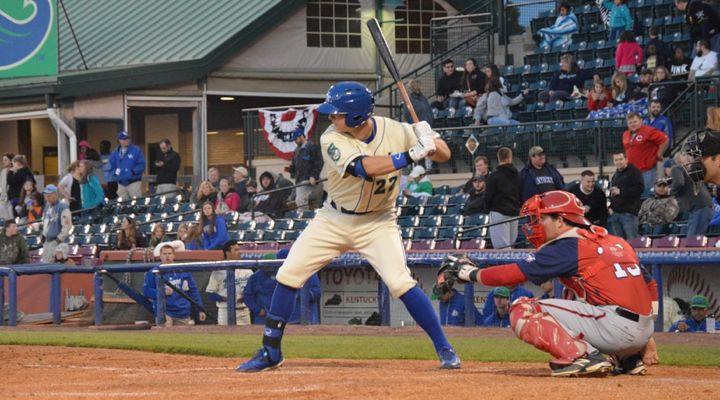
Right field for the Kansas City Royals has turned into an open audition this spring, as scheduled starter Jarrod Dyson is dealing with a strained oblique that will probably keep him sidelined until the middle of April at the earliest. About three weeks ago I discussed some of the possibilities the Royals would have in right field this season, and while Dyson and Orlando were expected to get the majority of playing time, there were also a few wild card candidates for Kansas City to keep an eye on. One of those players with an outside chance was 27 year old outfielder Jose Martinez, an outfielder who had been playing in an independent league in 2014. Martinez had a stellar 2015 season for the Royals Triple A team in Omaha, but before that he was a marginal prospect at best. So is Martinez for real? Let’s find out.

kc2

Martinez was initially ticketed for Double A Northwest Arkansas for the 2015 campaign, but once Paulo Orlando made the big league roster, Martinez was elevated to Omaha instead. Martinez took advantage of the opportunity, as he was one of the best players in the Pacific Coast League last year, leading the minors in batting and OBP, with a .384 average and an OBP of .461, while also slugging .563. While those numbers are all impressive, when you dig deeper it paints an even better picture for Martinez. Jose seemed to master the strike zone last year, slapping together a 12.1% K rate and 13.9% walk rate. While the strikeout rate is fairly close to his entire minor league career, the walk rate took a steep incline up, as his previous high was 9% in 2014, a year in which he played in 66 games in High A ball. Throw in an insane BABIP of .434 and you have a guy who spent the summer just flat out raking and terrorizing PCL pitchers. There is a prevalent thought that his season was the outlier of his career, which is true, but there are reasons to think it might not be as far fetched as first thought.

kc3

So how was this season not as flukish as it appears at first glance? For one, he has been a pretty good hitter off and on throughout his minor league career, at least when it comes to getting on base.  He hasn’t been as consistent on a year to year basis, but you can see where a guy like Martinez could be a serious prospect if he really pieced all his tools together. Second, he actually was a significant prospect at one time. Back in 2007, Martinez was the Chicago White Sox’s number 7 prospect before his age 18 season. Sometimes with age, a player picks up on parts of the game that a younger player might not be able to decipher during their younger years. There is no way to know for sure if something clicked with Martinez last year that will stick, but if he had hit earlier in his career the way he did in 2015, he would probably have already been at the least a big league backup right now.

kc4

But there even more reasons to think Martinez might still be blossoming. For one, he has a very smooth, flat, line drive swing that makes for a very consistent hitter, which Martinez was in 2015. There is also the outside chance that his power has not even fully developed, as in the last ten years players between 6’6 and 6’8(Martinez is 6’7) had a combined ISO(isolated power mark) of .223. Martinez had his highest ISO last year (.179) and also put up career best power numbers and the most extra base hits of his career as well. It’s very possible that Martinez is just now reaching his power potential, and when you add in his ability to get on base, you have a player who could contribute in the majors. 2015 also saw Martinez have one of the best hard hit rates in the entire Royals organization, a sign that he wasn’t just getting lucky hits. In fact, Martinez is the perfect hitter for what the Royals like, a contact hitter who puts the ball in play at a very high rate.

kc5

So is Martinez the real deal and someone who could see playing time for the Royals this year? I feel the Royals are taking a wait and see attitude with Martinez, wanting him to prove that his career season last year was not a fluke. ZiPS is projecting Martinez’s numbers to go down a tad but still very solid; .280/.330/.391 with a BABIP of .328.Obviously ZiPS is going off his past numbers a bit, so the numbers are bound to even out. I tend to think that while something like his BABIP might take a healthy plunge(.434 is just really insane) I can still see Martinez putting up above average numbers to prove last year wasn’t a fluke. While the chances of Martinez being a big league regular are probably a tad slim(and his age doesn’t help him in this regard), it is not inconceivable to imagine Martinez being a backup outfielder for Kansas City this year. With Dyson down for a few weeks and the uncertainty that goes along with Travis Snider and Brett Eibner, Martinez could very well slide into a big league job to start the 2015 campaign. Last year was all about the 29 year old rookie Paulo Orlando; could 2016 be all about 27 year old rookie Jose Martinez?
Locking Up the Leader: Royals, Perez Agree on Extension

kc1

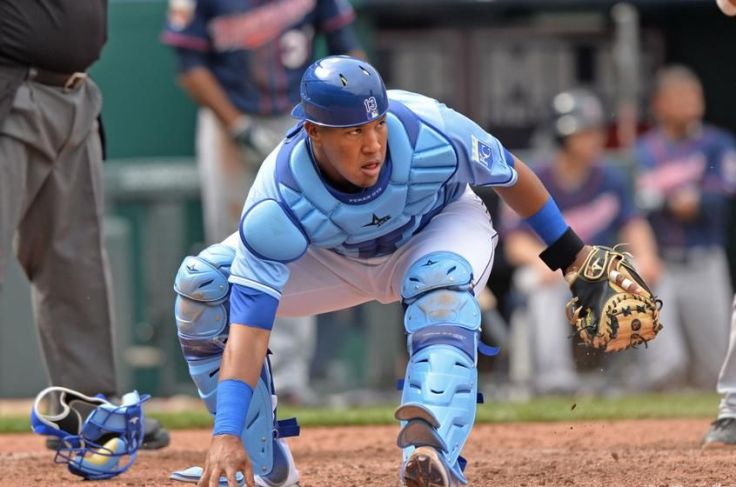
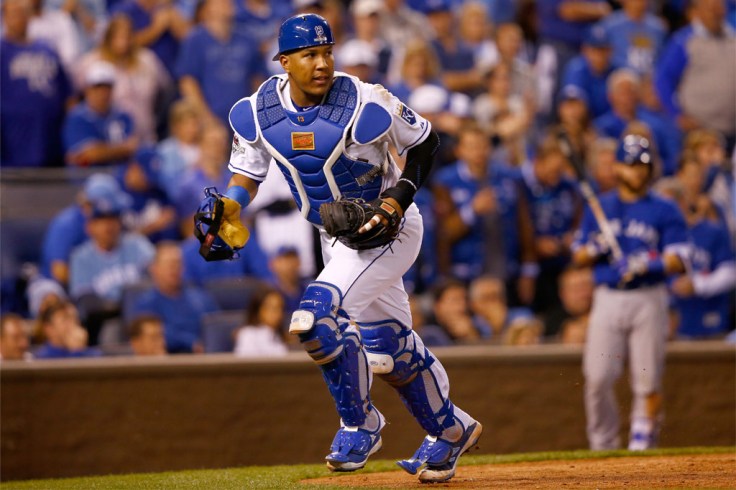
For most baseball fans, certain players stick out. They aren’t hard to find, as they stand out as having a certain ‘it’ about them and it’s fairly obvious to point out when it is right in front of your eyes. Having ‘it’ basically means a player moves like he was born to play this game, whether it be running the bases, throwing a ball or vaporizing a pitch into the upper reaches of the bleachers. Then there are those players that have the look and feel of a leader, just by how they carry themselves. It was pretty obvious from day one that Salvador Perez was one of those leaders, a catcher who was the field general in every sense of the word. Early on in his career Royals management felt the same and locked him into a very team-friendly deal that gave Salvy a commitment and made it to where all he had to worry about was his play on the diamond. It was soon evident that this deal was below market value and the deal was almost a ‘steal’ for Kansas City. The rumblings this winter were that Perez and the Royals were trying to restructure a new deal that would compensate Perez while also extending the contract further into the future. The deal was finally struck on Wednesday, as Salvy looks to now be a Royal through the 2021 season.

kc2

The new, restructured deal for Perez will start in 2017 and will keep him in Royal blue through his age 31 season:

Perez will be making a very team-friendly $2M this year, $3M in ’17, $7.5M in ’18, $10M in ’19; $13M in ’20-21. Curious about any options, since we all know Dayton Moore loves him some mutual options?
Add in a $6M bonus and the Royals showed Perez how much he is appreciated by the organization and restructured a contract that technically they didn’t have to do. This deal is a message to the nucleus of the Royals that will be eligible for free agency after the 2017 season: if you work with us and stay loyal, we will stay loyal to you. The deal makes sense for the team, as Salvy is a fan favorite, the on-field leader, gold glover and possibly even leader of the pitching staff. Perez’s true value is in his defense, as he is considered one of the top catchers in the game, a perennial All-Star who is not only an agile defender, but knows his pitching staff in and out. Add in the pop in his bat(a career high in home runs in 2015) and you have the makings of a future Royals Hall of Famer, a player who will probably receive a statue and his number retired once his career is over. If you meet a Royals fan that doesn’t love Salvy, then that person isn’t really a Royals fan. But the question has to be asked, a question I even hate mentioning because of the high status of Perez with Kansas City: Will Perez still be playing catcher by the end of this contract?

Division Series - Kansas City Royals v Los Angeles Angels of Anaheim - Game Two
(Photo by Harry How/Getty Images)

This is an honest question that needs to be asked, because Perez’s workload over the last few seasons has been, well, ridiculous. In fact, Perez has caught more innings than any other catcher in baseball over the last three seasons:

As the tweet above from Craig says, this does not even include postseason totals, or the innings Perez caught at the end of the 2014 season when he was part of an all-star team that did a tour of Japan. That is a lot of innings for any catcher, yet alone one who has had a knee surgery. Perez is easily one of the most durable catchers in baseball and that has shown by looking at the game totals for him since 2013, where he played the fewest games at 138. The bad thing is that I have been saying for years that the Royals need to give Salvy a lot more rest than they give him. I talked about it as far back as 2013 and my opinion hasn’t changed since then. Now that the Royals have made a long-term investment in Perez, they need to treat him as such. That means Perez should get a break once a week and I mean a real break, where he doesn’t come into the game once the Royals get into the later innings. Over the years we have seen many a catcher break down from their overuse behind the dish and that has also limited their productivity. In fact, we probably have already seen the beginning of this decline.

kc4

Back in 2011, everyone was surprised at how well Perez hit during his first stint in the big leagues, posting a line of .331/.361/.473 while putting up an OPS+ of 128. The thought at the time was that maybe Perez would be a better hitter than first thought. Since then he has been on a gradual decline, putting up an OPS+ the last two years of 91 and 89. His home run total reached a new high in 2015, but almost every other offensive stat saw a dip. It is very well known throughout baseball that Perez swings at almost everything, as Salvy was one of the leaders in swinging at pitches outside of the strike zone and had the lowest walk rate in the league. Is there a correlation between the amount of games played and the decline in his offensive stats? There is no way to 100% know for sure if there is, but one has to think so. Perez will probably never be a league leader in walks, but one wonders if he is able to get regular rest if that means some of his numbers will see an upward trajectory.

kc5

The other note of interest with Perez’s offense concerns him being able to stay healthy. If he isn’t able to stay healthy, the Royals at some point will have to consider moving Perez to a different position, especially if they feel that crouching behind the plate on a regular basis is hurting his health. So if Salvy moves to another position, is he going to produce enough offense to warrant not only the money he is being paid but also the playing time he will receive? This is an easy answer right now, since what he brings to the table as a catcher outweighs the lack of productivity with his bat. But once he is unable to wear the shin guards, it is highly questionable that his bat will produce enough to warrant a place in the starting lineup. It’s not fun to broach this subject, but it is something Kansas City management has to take into consideration and probably did before they signed him to this new contract. In some ways, yes, he will have earned that spot just because of what he has done the last few years for the Royals. But if his offense continues to decline at the current rate, he could be hurting the team more than helping.

kc6

Overall, this is about as positive a signing as the Royals could have, one that could benefit the team for years to come in many facets of the team. If anything, Royals management has shown a commitment to their players in a way that many organizations have ceased doing for years now. What this contract does is put Perez in the forefront of Kansas City’s plans past 2017 and into the next decade. To show this isn’t just about the money, Perez has shown himself to be a classy guy as well:

It’s kind of hard not to root for this guy. He is the real deal and probably will go down as one of the top five Royals of all-time. Yes, that is a lofty prediction but one that Perez is more than capable of upholding. More than anything, the message from this signing is that loyalty is rewarded with loyalty.

Line Up the Royals


kc1

One of the fun things about Spring Training is that anything is possible, and the opportunities are endless. In fact, every spring is spent with fans trying to predict how their favorite team will stack the lineup to start the season. In some ways it is a pointless activity but it’s always interesting to compare how you would position the starting lineup as opposed to the manager in the dugout. With that being said, here is how I would stack the starting nine for the Kansas City Royals to kick off their 2016 campaign.

kc2

Batting leadoff would be left fielder Alex Gordon. Years ago Gordon was actually the regular at the top of the order but the Royals have spent the last few years trying to utilize some of his power and put him anywhere from fourth to eighth in the order. My reasoning for having Gordon leadoff is that he is one of the few Royals to put up a good walk rate, has decent speed and has proven success in this role. I really like Gordon’s ability to get on base and feel like it is best suited for this spot in the lineup. I know it is highly unlikely this will happen, but Gordon would be my choice.

kc3

Batting in the two hole would be Lorenzo Cain. Last year Cain spent most of the year in the third spot in the order and turned in a career year that netted him a third place finish in the American League MVP vote. Now, it might seem odd to move Cain out of the third spot after the year he had, but I like having the Royals best two players hitting back to back in the order, as it allows Cain use his speed a bit more early in the game and makes it harder for pitchers to pitch around the Royals top of the order. I have no issue with Cain batting third, but I would like to see what he could do batting second.

kc4

Hitting third in my Royals batting order would be Eric Hosmer. It’s long been said that you bat your best hitter in the third spot in the order and this could be the year that Hosmer takes that leap and puts up MVP caliber numbers. Hosmer put together a solid 2015 campaign and was an RBI machine in the postseason. If Gordon and Cain got on base consistently, Hosmer would get even more RBI opportunities and give the Royals more runs on the scoreboard. Batting Hosmer third could be a win-win situation.

kc5

The “Cleanup Spot” could go to Kendrys Morales, the Royals RBI leader in 2015. The four hole has long been where you plug in your power guy and Morales is that for Kansas City. Even if we see a slight fall in extra base hits, Morales batting cleanup would give Morales even more of a chance to drive in runners than he did last year batting fifth.

kc6

In the fifth spot would be Salvador Perez. Salvy isn’t the most patient hitter in baseball, but he did put up career high home run totals in 2015 and could see better pitches hitting behind Morales. Now that Perez is signed long-term in Kansas City, its time to give the man more rest and one has to wonder if his offensive numbers would hit an upward trajectory with more time to rest his weary bones.

kc7

Despite coming off of a career season, I would bat Mike Moustakas sixth this season for the Royals. Moustakas looked like a changed man the first few months of the season, as he consistently was hitting the ball to the opposite field, forcing teams to scrap the shifts against him which were prevalent in 2014. The second half of the 2015 season saw him pull the ball at a greater rate, although still occasionally taking the ball the opposite way. So which player is Moose? I would like to say he would be more like the guy we saw in the first half of the season, but we will have to wait and see. If he continues to show that growth this season then he is more than capable of batting back near the top of the order. I would prefer to be convinced first before sliding him back.

MLB: Kansas City Royals at Chicago Cubs
(Credit: Matt Marton-USA TODAY)

The seventh, eighth and ninth spots in the order are pretty interchangeable, but I would go with Omar Infante/Christian Colon batting seventh. Infante will probably win this job and if he does he is good to bat near the bottom of the order while still occasionally driving in some runs from this spot.

kc9

Eighth would be Alcides Escobar, the man who Ned Yost will have lead-off this year. None of us can explain why it works, but batting Escobar at the top of the order, a guy who rarely walks and batted .257 last year, seemed to be a sparkplug for this Royals team during the playoffs. Honestly, Escobar just doesn’t get on base enough for my taste, which is why I would bat him near the bottom of the order. We know how this will play out, but Escobar’s bat seems to justify me batting him eighth in the Royals batting order.

MLB: Los Angeles Angels at Kansas City Royals
(Credit: Denny Medley-USA TODAY)

Batting at the bottom of the Royals lineup would be the Jarrod Dyson/Paulo Orlando platoon. I really like batting these two here for two reasons. First, neither will produce much offensively and will see the least amount of at bats in this spot. Second, if they do get on base, their speed could be utilized when the batting order flips back around to the team’s best hitters in Gordon and Cain and you could even see the hit and run used quite a bit. I actually think batting the right field duo here is the perfect spot for them.

Salvador Perez
(AP Photo/Charlie Riedel)

So how do I think the line-up will actually shake out? Knowing manager Ned Yost and what he has said so far this spring, the line-up looks to be Escobar, Moustakas, Cain, Hosmer, Morales, Gordon, Perez, Infante/Colon, Dyson/Orlando. It’s not too far off from the batting order we saw in October last year and that seemed to work out okay. How would you stack the Royals? Who knows what would actually be the most productive order for the Royals, but it sure is fun moving it around to see what comes out of it.

So About That Royals Farm System…

kc1

Last week I was posed the question of whether there was anyone in Kansas City Royals camp that could surprise the team this spring. I discussed a few non-roster invitees, but no prospects and there are a few reasons for that. For one, this team is pretty close to a set roster and will only have a few spots open for competition. The other reason is that there are very few Royals prospects on the verge of breaking into the big leagues. If you look at the top of most prospect lists for Kansas City, you will see Raul Mondesi, Kyle Zimmer and even Bubba Starling taking up space. Starling is probably (at the least) another year away, while Zimmer has to stay healthy first before he can be considered to help Kansas City this year. I do believe we will see Mondesi this year, in fact I wouldn’t be shocked if he is the starting second baseman by August. Defensively he is ready, but his offense is still a work in progress. But after these three? Well, the farm system has taken a hit the last few years, and is currently anywhere from 18 to 23 in most MLB depth lists. Is that a fair position to put the Royals farm system in?

kc2

I believe so, since the team lost a number of top prospects this past summer in the Johnny Cueto and Ben Zobrist trades. Sean Manaea  went to Oakland for Zobrist and he is now the A’s top prospect. Cody Reed was a part of the Cueto deal and he is currently number two on the Reds prospect charts. This is all without mentioning Brandon Finnegan, the former number one draft choice who was dealt with Reed to Cincinnati last summer. It sounds like a lot of talent dealt, and it was, but think of it this way; without those trades, the Royals probably aren’t world champions, so at the end of the day it was worth it. The other thing to remember is that a number of main talents are in the lower minor leagues for Kansas City, players that have been stockpiled over the last few drafts. Guys like Foster Griffin, Nolan Watson, Ashe Russell, Ryan O’Hearn and Chase Vallot are all players you should store in the back of your mind for future reference, although none will be seeing the major leagues anytime soon. The Royals front office and scouting department has done a nice job over the last few years re-stocking their minor leagues with players who will hopefully be the next wave of talent that rises through the minors together, but they won’t be part of the big picture for a few more years. So who could we see this year in Kansas City?

kc3

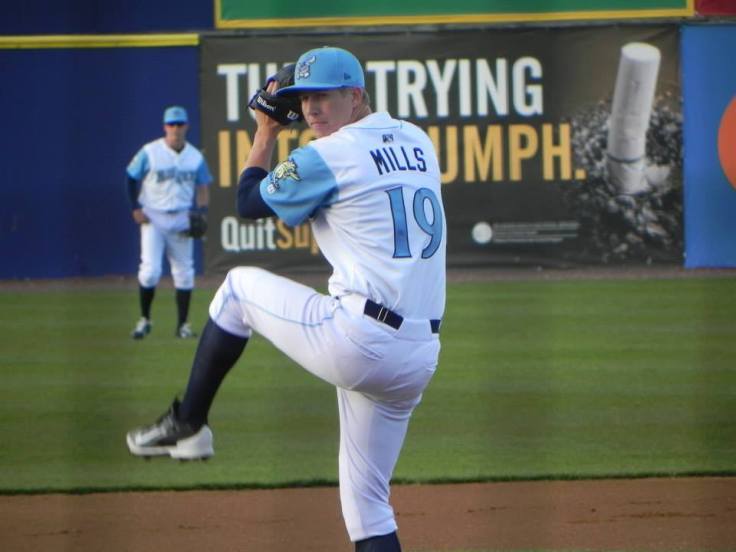
There are obvious choices, like Cheslor Cuthbert and Miguel Almonte, players we saw off and on throughout the 2015 campaign. A few other prospects worth mentioning are Matt Strahm and Alec Mills, two pitchers who have steadily risen through Kansas City’s farm system. Strahm is a lefty who could see some time out of the bullpen this year, while Mills is another power arm with a nice array of pitches in his arsenal. Mills finished the year in high A ball, striking out 111 batters while walking only 14. Either guy could be contributing for the Royals out of the bullpen by the end of the year.

kc4

So there are prospects that can contribute this season, but not many. Just looking at the surface, it appears the Royals have neglected the farm. But in reality it is a steady process that will take a few years to fully bloom. This is what happens when you win; you don’t get the higher draft picks that are on the fast track to the big leagues. Instead you accumulate arms and athletes and hope a few over-exceed expectations. The future is bright, but it gleams brighter the deeper you look.

Minor Intrigue

kc1

Remember back when the Kansas City Royals signed Ian Kennedy to fill out their rotation? Word leaked out during that time that the Royals were still on the hunt for another starter, most likely just for depth purposes. Everything stayed quiet on the Royals front, that was until Friday, a day after pitchers and catchers reported to Royals Spring Training camp:

I was instantly elated and felt this was another stellar move from GM Dayton Moore. So who is Mike Minor and how can he help the Royals moving forward? I’m glad you asked.

kc2

Minor is a former first round draft pick of the Atlanta Braves who will be entering his age 28 season for Kansas City. Minor sat out the 2015 season due to shoulder surgery, as he went in to fix the labrum  in his left shoulder back in May. Over his five year major league career, Minor has produced a slightly below league average ERA+(93) and a career FIP of 3.90 while accumulating over 652 innings. Minor doesn’t have blow you away stuff, as he uses four pitches in his arsenal (fastball around 90 mph, slider, knuckle-curve and change-up) but over his career has produced good strikeout and walk rates. There is a lot of hope within the Royals organization that the team’s medical staff will be able to help Minor, as he is about nine months removed from surgery at this point:

“We’re trusting (trainer) Nick Kenney and our medical team,” Royals general manager Dayton Moore said, “along with Mike’s work ethic and dedication to get back to perform successfully at the major leagues. (It) led us to a conclusion to give him a two-year deal.”

It is looking like we will see Minor back in the big leagues sometime around late May, early June:

“We don’t anticipate him being ready for the first six weeks to two months (of the regular season),” Moore said.

So the signing seemed to be done to have Minor help out the team later in the year, and in a lot of ways, be more helpful in 2017. If the signing seems familiar, it should.


kc3
It seems familiar cause it is very similar to the deal former teammate Kris Medlen signed with Kansas City about a year ago. Medlen was coming off of a major surgery(Tommy John) and the signing was for him to help later in the season(last year) with more emphasis on the following season. Much like Medlen, Minor could fill various roles for Kansas City, either out of the bullpen as another left-handed arm or in the rotation if needed. Overall, Minor’s role on the team in 2016 is one of doing whatever is needed, although his strength would mainly be in the rotation:

“Hopefully, we’d have him in a position to give us some depth the second half — probably before that,” Moore said. “But realistically, around that period of time.”

This also shows the team is allowing him to not rush to action and rehab at his own pace:

“We wouldn’t put limitations on him,” Moore said. “The important thing is to move at a rate that ensures his long-term health. And that’s why it was important to get him on a two-year deal; not just one year, because not always, but usually you see them better the following year.”


The contract gives Minor the luxury of knowing he is set for 2017 and anything he is able to contribute this year is purely an added bonus. This is also the kind of signing the Royals have to make.
kc4
Don’t let the world championship, nor the big contract signings of Alex Gordon and Ian Kennedy fool you; the Royals are still a small market baseball team. That means that the Royals have to look at guys coming off bad seasons and/or injuries to help fill out their team. The Royals will never be allowed to have an unlimited payroll(or at least the likelihood is very, very low) so scrounging for guys like Minor is pretty much the modus operandi for Dayton Moore and his front office staff. That being said, there is some risk involved in this signing.
kc5
The risk is quite obvious; what if Minor isn’t able to bounce back from surgery or continues to show lingering issues? That is the risk any team takes when signing a player coming back from a major injury and the Royals are just like the other 29 teams in baseball, as they know there is always that chance. The one positive aspect of this is the Royals training staff has shown a propensity the last 3-4 years of keeping players healthy and not rushing a player back out on the field before they are ready. I tend to think if the Royals really felt Minor might not be able to bounce back, they wouldn’t have signed him to a two year deal in the first place. This kind of risk will always be there, but I tend to believe if the Royals had any trepidation, we wouldn’t be discussing this signing right now.
kc6
If one would look at the Royals rotation, especially looking onward into 2017, there are more questions than answers. With that said, having Mike Minor in the fold for the foreseeable future can only be viewed as a plus for the organization. I’m not for sure we should expect much from him in 2016, in fact it could be very comparable to what Medlen contributed last year. What you can probably expect is to pencil his name into the rotation for the 2017 season. Things could still go sideways, but at this moment it looks like the Royals front office found themselves another solid arm for their starting forces. Moore has had issues developing starting pitching throughout his run in Kansas City’s front office, but finding pitching in the bargain bin has become a specialty of his.

Relying on Speed

kc1

Throughout the 2015 season, there was always speculation on who should be playing right field for the Kansas City Royals. Alex Rios was the incumbent at the position, but his lackluster play throughout the summer(plus the myriad of injuries and illnesses) made one wonder if the Royals would be better off employing a platoon in right of Jarrod Dyson and Paulo Orlando. Rios would actually put together a good September and a solid postseason for Kansas City, so this question seemed rather moot by the end of the season. But that question looks to be finally answered, as manager Ned Yost confirmed at Fanfest that the Royals would likely be employing “some sort of platoon” of Dyson and Orlando to start the 2016 season. So this begs the question: just how productive would a Dyson/Orlando platoon be?

World Series Royals Giants Baseball
(AP Photo/Eric Risberg)

Jarrod Dyson has been an intriguing player for his entire career, mostly because of his speed. Dyson has game-changing speed, the kind that any team would covet, which it appears he was this offseason:

The Royals, over the years, have done a good job of taking advantage of that speed but not misusing Dyson to where his flaws would be more prominent. Offensively, Dyson is slightly below league average throughout his career(career 83 OPS+) while stealing bases at an 86% clip(he has only been caught stealing 23 times in his career out of 169 attempts). Dyson doesn’t accumulate very many extra base hits, as he has only 61 over his 6 year career, mostly doubles and triples. His main issue has been hitting lefties, which has been a major struggle for Dyson. Over his career, Dyson has a line of .211/.288/.249 against left-handers, striking out 21% of the time against them. For the most Kansas City has sheltered him against this struggle, as he has only accumulated 243 plate appearances against lefties in his career. Defensively, Dyson is above average(which is shown by his WAR, 9.6 over his career in limited action), which is a major reason why the Royals are set to go with Dyson getting the majority of the time in right this year. His UZR is well above average, while he has racked up 43 DRS(defensive runs saved) in limited playing time over his career. Dyson doesn’t always take great routes, but he normally makes up for it with his speed. I know there was a prevalent thought by the national media in 2014 that Dyson was a better defender than Lorenzo Cain, but that couldn’t be farther from the truth. A lot of Dyson’s flaws are hid by his speed, which helps him get to balls that most players would not, while Cain actually is a more than average efficient defender. Dyson probably won’t provide much pop(and he probably should bat near the bottom of the order)but his speed and defense should make it alright for the Royals to start the year with Dyson getting more than usual playing time. I would even say Dyson could top 50 stolen bases in a year if given the time to do it. But he won’t see all the time in right field…

kc3

Paulo Orlando is entering his age 30 season, coming off a rookie campaign that saw him in the middle of a number of big Royals wins while getting a decent amount of playing time due to Rios and Alex Gordon spending time on the disabled list. Orlando became a fan favorite early on, for his great defense and propensity to hit triples. Over time, his flaws showed the more he played, so much like Dyson, Orlando platooning with Jarrod would help his productivity. Orlando had a line of .249/.269/.444 in 2015 with an OPS+ of 90 and a WAR of 1.0. Paulo has some pop in his bat and was a sprinter in Brazil before beginning his baseball career, so he is also exceptionally fast. He also became a regular defensive replacement late in the season for Rios, as he is another above average defender in the Kansas City outfield. Orlando probably wouldn’t be a good fit for the Royals as a regular, but splitting time with Dyson should help hide some of his flaws while also giving him a chance to add some production for the bottom of the order.

kc4

I know there will be a few Royals fans that will bring up minor leaguers Brett Eibner and Jose Martinez as possible players to see time in right field, but barring a major injury I can’t imagine either will see much time in Kansas City in 2016. Eibner had a good year in Omaha in 2015, putting up a line of .303/.364/.514 with 19 home runs and 81 RBI’s, pretty much a career year for him in the minors. Unfortunately, the Royals see him as a fourth outfielder type who would only really see time in the big leagues because of an injury or if he really tore it up in AAA in 2016.Martinez literally came out of nowhere in 2015 to post a .384/.461/.563 line and win the PCL batting title for Omaha. Martinez had bounced around for quite awhile with the White Sox and Braves farm systems, never getting higher than AA. Martinez is entering his age 27 season and while he did open a bunch of eyes with his batting last season, there are just as many people wondering if it was a fluke or if he is able to repeat that performance. If he shows last year wasn’t the outlier of his career, then it’s possible we could see him up with the Royals at some point. But that is a big ‘if’ coming from a guy Kansas City found in the independent leagues. There is one more possibility for time in right field this year, and that is Travis Snider. I discussed his chances earlier this month, which look very promising. I see Snider getting a decent look this spring and could even force his way onto the Kansas City bench if things go his way this spring. Snider is the most intriguing of this bunch, as he still seems to have some potential in him that could be untapped, especially if hitting coach Dale Sveum gets ahold of him and teaches him the ‘Royal Way’ of putting the ball in play.

kc5

So with all that thrown out there, here is the big question: would a Dyson/Orlando platoon produce more than last year’s right fielder Alex Rios? For this exercise, I decided to use Steamer Projections to compare the expectations from Rios for this year(if he ever signs with a team; I have literally seen nothing this winter connecting him to any team–at all) to Dyson and Orlando. Steamer has Rios with a line of .249/.287/.369 with 6 home runs and 33 RBI’s(in a projected 76 games). Dyson is set at .250/.309/.341 with 3 homers and 31 RBI’s, while Orlando is projected to hit .254/.289/.363 with 4 home runs and 23 RBI’s. Just looking at the numbers, it looks like average and on-base would be close, with the Dyson/Orlando platoon maybe accumulating a better OBP. It probably seems obvious, but Rios has the better slugging percentage, although one wonders if Dyson would get a few more extra base hits with the added playing time. The stats are eerily similar when putting them up against each other, so offensively it would seem to be fairly close to even, with Rios adding a touch more power while  the Dyson/Orlando combo would add more speed. Throw in that Jarrod and Paulo are both better defenders than Rios, and it would appear the Royals might be slightly improved this year in right with the two of them platooning. Oh, and cheaper as well, with Dyson and Orlando combined making just over $2 million this year while Rios cost the Royals $11 million in 2015. Advantage would seem to favor the 2016 Royals at this point.

kc6

But will this scenario play out all year? Probably not. As much as the Dyson/Orlando platoon in right field can suffice for Kansas City to start out the year, it would seem sensible that the team would look to improve the position before the July trade deadline. The team wouldn’t have to go out and get a top of the line right fielder, but an outfielder that could handle the job full-time while providing more offense could be found and probably not at an insane cost for the Royals. This would also open the team up to using Dyson in more pinch running situations while allowing Orlando to be a late inning defensive replacement if the new right fielder wasn’t skilled as such. As long as the Royals are contending I have to believe this is how the situation will play out and it actually is a best case scenario. The fact that the Royals are in a position where they spend a few months this summer finding out the true value of Dyson and Orlando while also knowing they can always go out and pick up another outfielder is a position that Kansas City has been fairly foreign to until the last few seasons. Dyson and Orlando are both valuable pieces of the Kansas City Royals roster, but their true value is as part-timers. I’m sure we will revisit this subject again come July but I lean toward having the same answer. The platoon will work for now, but definitely not the long-term answer for Kansas City.

The Battle of Who Could Care Less

MLB: St. Louis Cardinals at Kansas City Royals
(Credit: Peter G. Aiken-USA TODAY)

Headed into Spring Training 2016, the Kansas City Royals have very little when it comes to major concerns on their roster. There is right field (which looks like a platoon between Jarrod Dyson and Paulo Orlando), the 5th spot in the starting rotation, the backup catcher battle and a few bullpen spots. But there also is a battle at second base, where Omar Infante looks to reclaim his spot while upstart Christian Colon looks to pry playing time away from the veteran. It would appear on first look that it is Infante’s job to lose, but there is always a chance Colon could take over, especially since Infante’s numbers the last few years have been less than stellar. Word last month from the almighty GM, Dayton Moore was that Colon would get a chance to win the job away from Infante this spring. So this begs the question: who should the Royals start at second base?

kc2

Let’s start with the man we all figure will win the job, Omar Infante. Infante is getting ready for his age 34 season, year 3 of a 4 year deal with Kansas City. To say Infante has been lacking offense the last two seasons would be a bit of an understatement. Infante’s OPS+ the last two seasons has been 76 and 49(league average is 100), miles away from the 115 he produced for Detroit back in 2013. He was actually able to produce a positive WAR in 2014(0.8) but slipped to -0.8 in 2015. Pretty much every offensive statistic has suffered in his two years in Kansas City, although he did have a number of clutch hits for the team in 2014. It’s not even just the main offensive numbers; fly ball % is down, his groundball rate is up and his hard hit rate has suffered as well. None of this is too surprising, as Infante is at that age where regression starts to sit in, so a dip in the numbers shouldn’t be too shocking.

kc3

Defensively, it has been a different story, as Omar actually held his own on defense this past year. Infante was able to post a positive dWAR, a big bump in his UZR, and a slight increase in his defensive runs saved. If ever you wondered why manager Ned Yost continued to pencil Infante into the lineup everyday, looking at his defensive numbers should explain it. The real detriment to Infante the last two seasons(and why there is at least some optimism in his return) has been the litany of injuries that he has dealt with during his time in Kansas City. In just two seasons, Infante has dealt with a jaw sprain, a shoulder sprain, an oblique strain(which sidelined him at the end of 2015), and a bone spur in his right elbow that required surgery this past November. Outside of the first week of the 2014 season, I’m pretty sure we haven’t seen a completely healthy Infante during his time in Royal blue. A healthy Infante would go a long ways toward not only sewing up a starting spot but also increasing his value in any way possible.

kc4

So what about Christian Colon? Well, his numbers are a bit harder to decipher because of limited time in the majors. Offensively, he has been better than Infante the last two seasons numbers wise, but once again this is in limited action. Colon has put up an OPS+ of 139 and 91 the last two seasons, but that is in 21 and 43 games. He has compiled a positive WAR(0.7 and 0.6) and defensively has been a slightly above average fielder. I went ahead and looked at his numbers in AAA Omaha, and Colon played about how you would figure; an average hitter with little power, decent speed and a positive increase in his BB/K rate. It’s hard to really get a read on what kind of major league player Colon would be, but it would appear he is about replacement level.

kc5

If you believe Moore, this will be a serious competition between the two players.  In fact he all but said that last month when talking to MLB.com:

“We’ll just evaluate,” Moore told MLB.com. “We’re going to play the best players. Omar is a terrific second baseman. I know offensively he has not performed the way he has liked or the way we expect him to. I just know we’re going to put the best team out there each and every night, and I know Omar is capable of being that guy. But we like Christian Colon, too. But you need them all to win, as you know. It’s a team, and you count on everyone to perform. I don’t know if Omar, at this point, is going to play 162 games.”

Go ahead, look at that last sentence. Moore basically implies they aren’t for sure Infante can stay healthy the whole season. You can understand why, after the list of injuries I mentioned above, but this also makes you wonder if something else is in the mix.

kc6

There is something else in the mix, and that ‘something else’ would be hot prospect Raul Mondesi Jr. Mondesi is entering his age 20 season and finished last year in AA Northwest Arkansas in the Royals farm system.  Mondesi is still a very raw talent, but it is conceivable he could make a big jump this season. One downside is that Mondesi has only played 18 professional games at second base, although it will be interesting to see what they do with him when he starts the year in the minors. If he is playing second fairly often early on, then it is possible the Royals would be looking at him as a possible solution in the big leagues later in the summer. I don’t think we will see Mondesi in the mix to start the year, but I have a hunch we will see him before the year is up.

kc7

So what is the final verdict? Going just off of numbers, it would seem like a dead heat. Infante and Colon’s ‘Steamer Projections’ are fairly similar: Infante has a projected line of .253/.284/.352 with a wRC+(weighted runs created) of 71, while Colon’s line would be .264/.316/..352 with an 83 wRC+.  The numbers show that Colon might have a slight edge offensively, but not by much. It would seem Infante would have the edge defensively, which the Royals highly value. Infante would probably also have the edge because of his contract; it’s hard to justify benching the guy who’s making $7.8 million this year, especially since he is almost untradeable. Here is what I believe will happen: Infante will win the job out of Spring Training and will hold onto it until/if he gets hurt. Even if Infante is able to stay healthy, I really believe by August we will see Mondesi holding down the second base job. The Infante-Colon combo is not a permanent answer, especially for a team that has aspirations of making the postseason again this year. Instead it is the current answer, not the permanent one. Come August, second base could look much different for the Royals.

Projections & Predictions: The Royals Mortal Enemies

kc1

We all know the story of the Kansas City Royals and projections the last couple seasons. Before 2014 Kansas City was projected to finish 79-83 by Baseball Prospectus, in a tie for second in the American League Central with the Cleveland Indians. The Royals did ten games better, finishing 89-73, earning a Wild Card berth and ending up one game short of winning the World Series. In 2015, the Royals were projected to finish(once again by Baseball Prospectus) even worse, 72-90, the second worst projected total in the American League. The Royals would easily eclipse this projection, finishing 95-67, winning the American League Central, claiming home field advantage throughout the playoffs and eventually winning the World Series. So with pitchers and catchers reporting to Spring Training in less than two weeks, once again the Royals are once again projected to finish 79-83, this time by Fangraphs. Last year, Royals fans were in an uproar over this, feeling like the team was being overlooked and not given the respect they earned after the 2014 World Series. Even into the summer, when Kansas City steamrolled past the 72 win mark, fans would make snide remarks and mock BP, questioning the website and the way they came to their results. But the real problem isn’t Baseball Prospectus or Fangraphs; no, the real problem is that fans(and analysts alike) put too much stock in projections and predictions.

kc2

Let’s start with the PECOTA projections. I actually had no issue with the Royals being projected so low, as it made sense to me. Most of their projections are taken off of a players’ past performance and the Royals had a number of players who accumulated poor seasons in 2014. A lot of people just remember the playoffs, when Mike Moustakas and Eric Hosmer looked like beasts and the Royals looked like an unbeatable locomotive. The truth was that Moustakas had an awful 2014, Hosmer’s wasn’t great and they weren’t alone. A good chunk of the Royals lineup did not fare well, so of course the projections would be lower. Even offseason acquisition Kendrys Morales was coming off of a lackluster campaign, one in which he put up worse numbers than the man he was replacing, Billy Butler. PECOTA puts a lot of stock in past performance, so this made sense. Sam Miller of BP wrote a great article about how they came to these results, in which Miller even admits that they need to work on improving the weight of a good bullpen and excellent defense can have on a team winning. The final paragraph speaks volumes about the projections and why they aren’t perfect:

While PECOTA aspires to be perfect, what it really does is this: It projects players, individually; it converts those performances into expected runs, based on how baseball usually works; then it converts those runs into expected wins, based on how baseball usually works. At each step along the way, it gets harder to be perfect, and the Royals demonstrate that challenge well. Some players did better than we expected; some offered incomplete data on which to project them; some were added to the roster at midseason; some found the right fit. None of us is arrogant enough to think that projection systems are magic; baseball is impossible to predict with the sort of precision that avoids situations like 2015 Royals. We all know we can’€™t outrun the bear

To sum this up, the projections are based off of projected numbers put up by each player on the team. If you calculate the players who will get injured or the players who will be acquired within the season, these numbers are bound to be off. In fact, as much as I use BP quite frequently during the season(the yearly projection book is normally right beside my desk), I also know that the projections are just that, not a definite. Just look at last year’s projections: only three teams were expected to win over 90 games. Yep, three total for both leagues. Instead, seven teams finished with over 90 wins while three alone were in the National League Central. So it becomes very obvious that BP’s projections are a starting point, not a literal interpretation of how the season will actually unfold.

World Series - New York Mets v Kansas City Royals - Game One
Game One of the 2015 World Series-October 27, 2015

Predictions are different than projections in that predictions are purely one person’s opinion. Projections you can actually go back and check the numbers and see how you ended up with the finished results. It’s like when you would show your math homework; if your answer is ‘C’, all you have to do is go back and look at ‘A’ and ‘B’ to figure out how you got to your final answer. Predictions are literally just guesses. Granted, these predictions hold more weight when it is a respected baseball analyst, but at the end of the day they are still guesses. I respect the hell out of guys like Ken Rosenthal and Jayson Stark, and both of them are around the game every day and are about as knowledgeable as they come in the game. But…their predictions are still just guesses. So why are fans, most notably Royals fans, getting upset that someone essentially has a different opinion than they do?

kc4

This is where I laugh at the fan who gets visibly angry that analyst ‘x’ predicted that the Royals won’t get to the playoffs or that they won’t compete at the level they did the year before. To me, all predictions are guesses and more than anything are done for fun. Most analysts(yes, the Rosenthal’s, Stark’s and Gammon’s of the world) would even tell you their guesses are normally way off. So if we all acknowledge the fact that predictions shouldn’t be taken super serious, why do some fans get all worked up about it? The only logical answer is that they want an analyst(or you or me) to agree with them. There seems to be some underlying issue with people who view something like preseason predictions as the expected result and the end all be all of final answers. They are not. If anything, these last couple seasons have proved that with the way the Royals have gone out there and over-exceeded results. I couldn’t tell you if Kansas City used such “guesses” as bulletin board fodder or not, but I’m sure they were aware and promptly did what every other team did: go out and play the games.

MLB: JUL 22 Orioles at Royals
July 22 2013

At the end of the day, that is what it all comes down to; actually playing the games. You see, we can estimate what someone like Alex Gordon will do, and we might even be closely accurate, but the players have to go out there and actually play on the field. I am proud to say I absolutely love stats and I freely will admit to being a ‘stat nerd’, but I also realize that these are humans that go out there and play baseball. I say let all the ‘experts’ predict and project that the Royals won’t do this, or won’t do that. Let them say that they don’t hit enough home runs or make too much contact. Because if we have learned anything these last two years, it’s that this Royals team determines their own fate. The unpredictable is almost the norm for this team and that can’t be predicted. So remember that when more projections and predictions pop up soon; the numbers unfortunately can’t measure a player’s heart or will. It can’t predict a five run 8th inning or a mad dash to home with two outs. It can’t measure a team that has an out of this world defense and a cyborg for their closer. Love the numbers, but realize that anything is possible if you put your mind to it.


Your Invite is in the Mail

kc1

Spring Training is just around the corner, and there are always a few things you can count on. There is always that one player who is in “the best shape of his life”. Yep, you know the player; he’s the guy trying to bounce back from a down season and looking to put up career high numbers. Then there is the player who would conceivably be in “the worse shape of his life”. That player normally looks he spent all offseason on the couch watching Homer Simpson’s genius plan to be able to work from home by gaining as much weight as humanly possible. This role is normally reserved for Pablo Sandoval(sorry, Panda). Then there is the third type of player at Spring Training, the non-roster invitee who tries to slide into camp inconspicuously while hopefully walking away with an Opening Day spot on the 25 man roster. Most don’t, but there are always a few who make their case and wiggle their way up north. Headed into Spring Training there are a few of these players that will be in Kansas City Royals camp, looking to impress the Royals coaching staff and procuring a job. In fact, there are three in particular who will be vying for a spot that seem to have an outside chance of making the club. So who are these mystery men? Let’s start with a former New York Met looking to wear Royal blue come April.

kc2

Dillon Gee will be entering his age 30 season, coming off of an injury riddled 2015 campaign with the Mets. In fact, Gee only appeared in 8 games last year, partially due to a groin injury and partially because the Mets were loaded with a bunch of young power arms(see Syndergaard, Noah or deGrom, Jacob). Plus, Gee didn’t help his own cause by getting bombed in the few starts he was given in 2015. The positive is that Gee is a serviceable arm, one that most major league teams would use as insurance at AAA until he is needed. In other words, there is a good chance Gee will be the 2016 version of Joe Blanton, who turned in a good season for the Royals and Pirates last year, netting him a deal with the Dodgers. Gee won’t overpower you with his fastball(he averaged about 89 mph in 2015)but he knows how to get outs and if paired with the Royals defense he would probably put up some pretty solid numbers. That being said, if Gee gets 8-10 starts for the Royals, someone is either injured or something has gone horribly wrong. I like Dillon Gee as insurance at Omaha, but his chances this spring hinge on the health of the other candidates in the rotation. So unless chicken pox arises in the Royals clubhouse again, it’s a safe bet Gee will be AAA to start the year.

kc3

Peter Moylan’s chances of starting the year at Kauffman Stadium are better than Gee’s, but still a bit of an uphill battle for the 37 year old reliever. Age will be a factor for Moylan, although he has never been a guy who relied on his fastball and with his sidearm delivery his whole success is based more off of movement than velocity. Moylan was actually able to come back from a second Tommy John surgery in 2015, although the Braves initially intended him to be a coach in their low minors. Instead, the Braves stumbled and used Moylan out of the pen in September to positive results. For one, he didn’t walk anyone in the 10+ innings he threw, and was able to induce groundballs at a fairly high rate(69%), which we all know is a positive in Kansas City. He also was able to get some movement back on his sinker, which is a major plus for a guy who won’t blow pitches by batters. The Royals bullpen is loaded right now(as we all know), but there is always a chance Moylan could find his way to Kansas City. Louis Coleman was released on Wednesday, giving Moylan one less reliever to fight with for a spot in the pen. Moylan is also good friends with Royals starter Kris Medlen, as the pair were former teammates in Atlanta back in the day. I would say Moylan’s chances of making the team are slim, but did anyone predict he would have the career he has had so far? In other words, there is always a chance.

kc4

Then there is Travis Snider. Snider was signed to a minor league deal over this past weekend and is the definition of living off of potential. Snider was once a 1st round draft pick of the Blue Jays back in 2006 and ten years later the baseball world is still expecting him to prove he can be as good as once expected. Over his 8 year career, Snider has performed below league average(93 career OPS+, league average is 100) and has not hit the way scouts once expected him to. There are positives with Snider, like the fact that he is going into only his age 28 season and he isn’t too far off from his career best year in the majors(2014). Looking back at that 2014 campaign, Snider played in 140 games for the Pirates with a line of .264/.338/.438, producing an OPS+ of 117 and a WAR of 2.1. Snider fell back this past season, splitting time in Baltimore and Pittsburgh. The other positive for Snider is that the Royals are currently looking at a Jarrod Dyson/Paulo Orlando platoon in right field, so there is a lot of room for someone to step up and make Royals management take notice. The argument could even be made that if Snider showed an ability to get on base on a regular basis he would get a decent amount of playing time. The Royals at this point know what they are getting with Dyson and Orlando; Snider is the wild card that has the ability to open some eyes. There is a good chance Snider could make the opening day roster as backup outfielder and work his way to a good chunk of at bats. I don’t know if Snider will ever turn into a .300 hitter or a 20 home run guy, but a reliable bat who can get on base could work just as well when it comes to playing time.I have to say, Snider’s chances are good this spring but like most things, I am basing this off potential.

kc5

There aren’t many spots available on the Royals roster as we head into Spring Training, but just look at last year. Ryan Madson came into camp as a guy who hadn’t pitched in the majors since 2011 and ended up not only making the roster, but being a reliable cog in the pen for the entire 2015 season. A few spots are open for the taking, and any of the three names mentioned above could sneak their way onto the team. That’s the great thing about spring; hope springs eternal, even for grizzled veterans. Even if they don’t, the Royals will have depth which is always a coveted part of any winning team. These signings are proof that the Royals roster will be just as deep in 2016 as it was during their run to a world championship.

Seven Quick Questions with Andy McCullough

kc1

Earlier today I did a quick ‘Q & A’ with former Kansas City Star Royals beat writer, Andy McCullough. Andy covered the Royals during both the 2014 and 2015 seasons so he was around for their playoff runs during both years. This is just a quick few questions about his time in Kansas City and covering the team during their resurgence.

1. You went from covering the Mets & the Yankees to covering the Royals for the Kansas City Star in 2014. What was your opinion of the team(contenders, pretenders, etc.) headed into Spring Training that year & in your mind when was the point where the team seemed to shift from just playoff contenders to serious championship material?

I thought they would be a good team and compete for the division. The turning point during the postseason was after they won the Wild Card game.

2. What was it like going from big market teams like the Yankees & Mets to a small market team like the Royals? Was there a difference in how you covered the teams?

The biggest difference is the postgame interviews were shorter because you don’t have 15 people in the scrum, all asking questions. I did not cover the team any differently.

3. The Royals fanbase is quite rabid to say the least. Were you surprised at how passionate the fans were & how did you handle some of the crazier ones on Twitter?

I wasn’t surprised by the passion, but I was definitely impressed by the crowds during these past two postseasons. Great atmosphere. I muted or blocked a lot of dopes on Twitter.

4. Was there a major difference in the team when comparing Spring Training in 2014 & Spring Training this past year?

Teams sound confident, every single year, in spring training. In 2014, I suppose it appeared more like false bravado, because they hadn’t actually won anything yet. In 2015, they had some evidence to back up their confidence.

5. The two most memorable articles you wrote(in my mind) was the recap of the 2014 Wild Card game & the Lorenzo Cain piece. Did you feel it was fairly easy to find compelling stories for this team & do you think you’ll ever cover a team with as much material as the 2014-2015  Royals had? 

There was a lot of untilled ground when I took over the beat in 2014, because the team hadn’t spent much time in the national spotlight. It’s never easy to find interesting stories, but there was certainly some low-hanging fruit. I hope I’ll find a team that’s just as compelling soon enough, but I’m not sure I will.

6. Finally, looking back how do you view your time in Kansas City?

It was an OK time. Underrated city for Vietnamese food.

7. Oh, one more question for old times sake: any word on Kyle Zimmer?

I hope he starts the All-Star Game in 2017.   

I would like to thank Andy for taking the time to answer these questions. McCullough is now working for the LA Times, as he is their beat writer for the Dodgers. You can find Andy’s coverage of the Dodgers at LATimes.com and he is a great follow on Twitter. Sure, he covers the Dodgers now, but if you love baseball(and some humor), McCullough is a good follow no matter the team. Glad us Royals fans had McCullough to guide us through the last two years. He did a great job and in a lot of ways will always be connected to this team. Thanks, Andy.


Blog at WordPress.com.

Up ↑