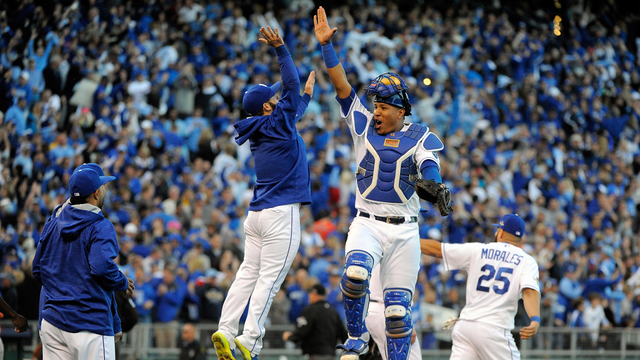
I’m going to let everyone in on a little secret that most of us longtime Kansas City Royals fans don’t tell anyone: we still sometimes expect things to go wrong. Yep, it’s not healthy and the last 15 months have helped tone down some of that thinking, but it still pops up now and then. To be honest, you can’t blame us. Before last year, the Royals hadn’t been to the playoffs since 1985 and had only one winning season between 1995-2012. Trust me, we have watched so much bad baseball in that span that it’s hard to just push it out of one’s head. So when the Royals were down 4-2 to start the 4th inning, there was a linger of doubt in my mind that they could bounce back. The rational part of my brain said “hey, it’s only two runs” but the irrational side said “please don’t let them go to Houston down two games to none and then have to face Dallas Keuchel”. Luckily, that did not happen, as the Royals pulled out a 5-4 win in Game 2 of the ALDS in dramatic fashion. But it wasn’t just that they averted defeat, oh no. No, the Royals of 2014 showed up and returned some ‘Royals Devil Magic’.
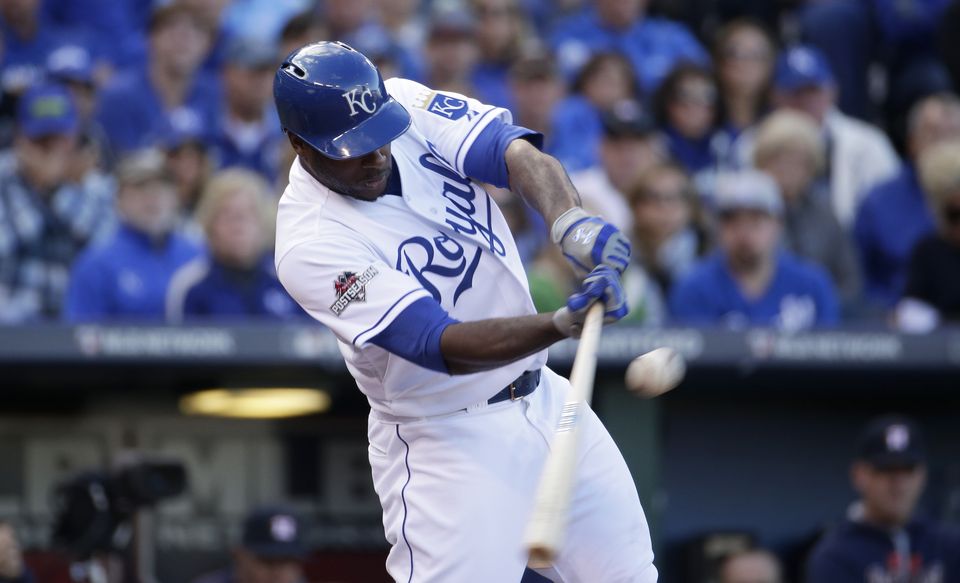
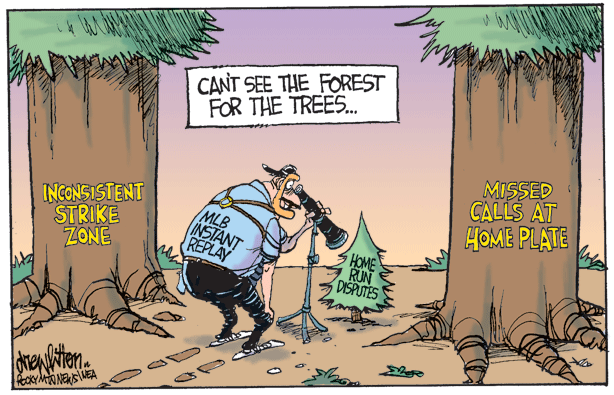
Let’s start with what I felt was a bit of a turning point. In the 5th inning it appeared the Royals changed their philosophy at the plate. Earlier in the game they appeared to be swinging at Scott Kazmir’s pitches early in the count, a strategy that had mixed results. But in the 5th it felt like a light bulb went off in their heads and they realized that home plate Umpire Angel Hernandez wasn’t calling a consistent strike zone and to play that to their advantage. So the Royals started taking more pitches, driving Kazmir’s pitch count up and forcing him to throw strikes. This would pay off in spades come the 6th inning.

Lorenzo Cain would start things off the festivities in the 6th with a 1 out double. Houston would pull Kazmir at this point and bring in lefty specialist Oliver Perez to face Eric Hosmer. The first two pitches Hosmer would flail at and it put him down 0-2 in the count. To say Hosmer did not look good on those two swings would be an understatement. Perez’s slider seemed to have Hosmer’s number, until pitch three, a pitch that Hosmer had no business actually making contact with. In fact, even Hosmer was unsure of what he hit:
What happened though was a little bloop to left center that would drive in Cain and put the Royals down by only one run, 4-3.
This hit was huge. I had even sent a text out when it happened and said that exact thing, as I felt it was a game-changer and looked to remind the Royals they were still in this ballgame. It also set up an array of events that was very reminiscent of 2014, as Kendrys Morales would hit against the Houston shift and poke the ball to right field, followed by a walk to Mike Moustakas to load the bases. Josh Fields was in the game at this point for the Astros and would walk Salvador Perez on four pitches, bringing in the tying run. Seriously, Perez not only hit a solo home run earlier in the game, but also took not only this walk, but pushed another at bat earlier to a 3-2 count before striking out. If you follow the Royals in any manner, you know that Salvy very seldom walks and most of the time is swinging early and often. I don’t know if this is a new way of thinking for him or just a rare occurrence. What I do know is the game was tied now and the Royals confidence was soaring. I want to add a personal note here: from my vantage point in the stadium, the 6th inning made everyone stop and pay attention to what was developing. By the end of the inning no one was milling around to get food or drinks. No, from what I could see everyone had stopped what they were doing and was watching the Royals comeback. There are very few times I have seen this at a ballgame but it was a great sight to see everyone glued into the action.

Moving to the 7th inning(after a great top half of the inning thrown by Kelvin Herrera) and Alcides Escobar would leadoff the inning with a triple, a ball hit over the outfielder’s heads. The Astros notoriously play shallow in the outfield and it helped Esky in this case. Another interesting tidbit from this play: both Astros outfielders on that play(Jake Marisnick and George Springer) said after the game that neither could hear the other talking to each other as they scrambled for the ball at the fence. Yes, the Kansas City crowd was that loud!
This would bring Ben Zobrist to the plate and he would plate a single to left and bring in Escobar and give the Royals the lead:
A couple of tidbits here. First, that was the first lead the Royals would take in the series. Second, this was another aggressive at bat for Kansas City and I tend to think that is what the Royals need to do the rest of the playoffs. By nature this is an aggressive team that likes to use their speed and ability to put the ball in play to mess with other team’s defenses. In fact, very little of that aggressive attack was used in September, a month where the Royals struggled. Hopefully the Royals build off of this game and start employing a more aggressive attitude.

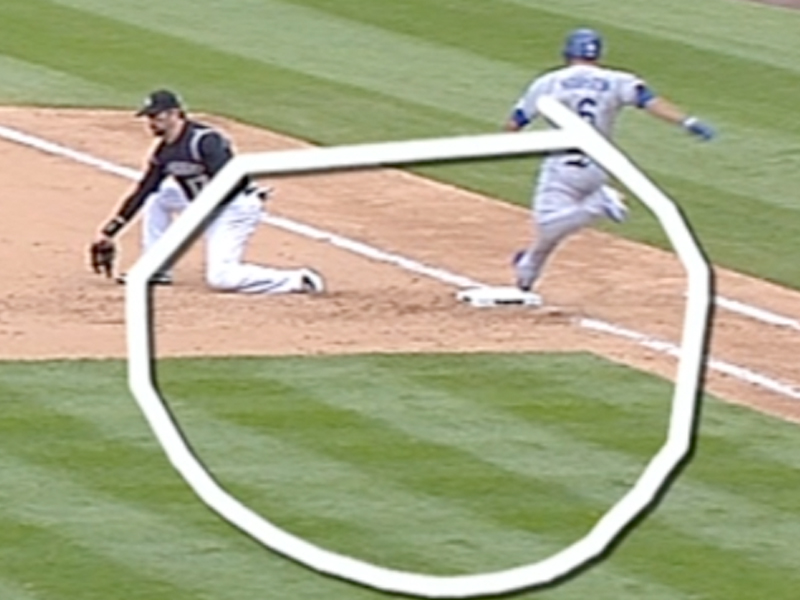
One final pivotal play. In the Top of the 9th and Wade Davis would issue a walk to pinch hitter Preston Tucker. Carlos Gomez would pinch run, and before even throwing another pitch would attempt a pick-off at first. The ump would call Gomez safe on a close throw, but the Royals would ask for a review of the play. The call would be reversed and Kansas City would go from one out and tying run on base to two outs and no one on.
A really big play for the Royals and Davis would get Jose Altuve out next to wrap up the win and the series was now tied at one game apiece headed to Houston.

So will the offense that showed up Friday afternoon stick around for the next couple games in Houston? There really is no way to tell but that game really felt like a momentum shift for this ballclub as they get set to face Keuchel in Game 3 on Sunday. The last time Kansas City faced Keuchel was in Kansas City back in July the Royals employed an all right-handed lineup against him and the Royals would win by a score of 5-1. Yes, Keuchel is going to be a tough challenge but he is not unbeatable. If the Royals can be aggressive at the plate and on the bases(and if Edinson Volquez can hold the Astros in check) then the Royals could be looking at another ‘W’ in the series. There has never been a greater time to step on the throttle and show the world what you are made of. If Kansas City plays like they did on Friday then it could be an early offseason for Houston. I might never completely rid myself of worrying about Kansas City collapsing late in the game, but I have never believed so much in a team like I have this one. The bad times might not ever completely go away, but the good times are the games I will hold onto forever.



 Bleeding Royal Blue